
Film Thickness Measurement Market Size by Film Type, Form Factor, Instrument Type, Technology, Application, Region, Industry-Wide Analysis, Competitive Landscape Assessment & Long-Term Forecast to 2032
Overview
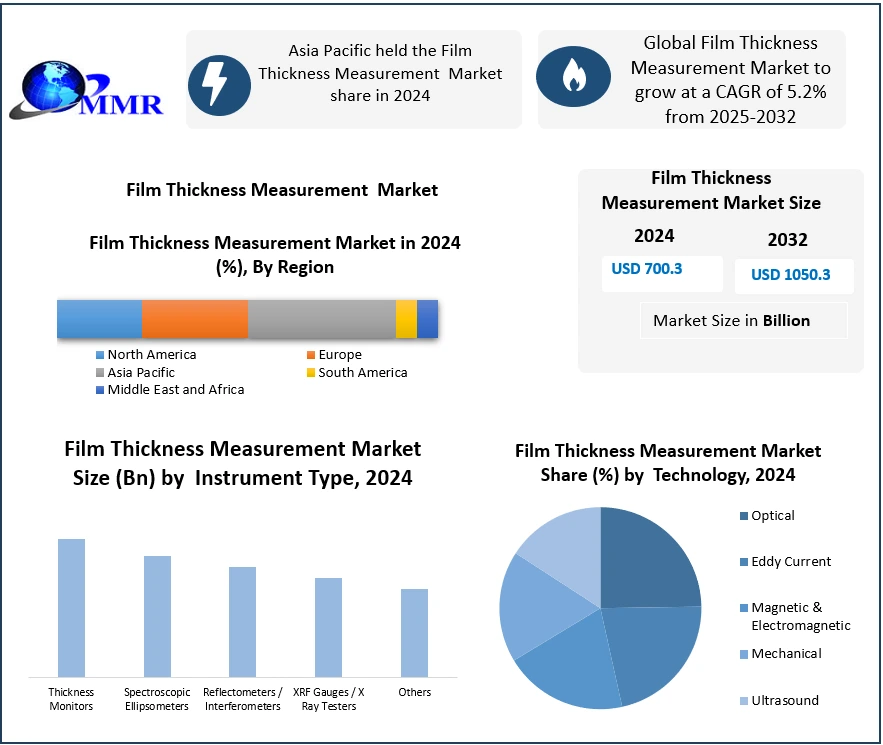
Global Film thickness Measurement Market size was valued at USD 700.3 billion in 2024, and the total revenue is expected to grow at a CAGR of 5.2% from 2025 to 2032, reaching nearly USD 1050.5 billion by 2032.
The Global Film Thickness Measurement Market Overview
Film thickness measurement refers to measuring the depth or density of a thin film material, whether it is wet or dry. Measurement methods include at least optical interferometry, ultrasonic, magnetic induction, and x-ray fluorescence. It plays a vital role in industries such as semiconductors, automotive, packaging, and medical devices. With the increasing demand for precision, real-time monitoring, and non-destructive testing, the Film Thickness Measurement Market is growing steadily with advancements in optical, ultrasonic, and eddy current measurement technologies.
 To know about the Research Methodology :- Request Free Sample Report
The demand for these systems is increasing in part due to the quality assurance and regulatory compliance requirements placed on high-precision industries that use protective films or coatings of specific thicknesses or tolerances. The report provides information related to film thickness measurement systems that includes the regional uptake, and associated trends, supply and demand for each region, with Asia-Pacific as the largest Film Thickness Measurement Market for film thickness measurement systems due to the large manufacturing and electronics base in the region. The report includes key players in the industry, which include KLA Corporation, Bruker Corporation, Otsuka Electronics and SCREEN Holdings. The report assesses end-user contribution, with electronics and semiconductor industries leading in market share due to their reliance on nanoscale film accuracy.
Global Film Thickness Measurement Market Dynamics
Film Thickness Measurement Market Driver
The rising demand for precision and quality control in high-performance industries such as semiconductors, electronics, automotive, aerospace, and medical devices drives the Film Thickness Measurement Market growth. As manufacturers continue to adopt miniaturized and advanced components, the need for accurate, reliable, and non-destructive measurement of thin films has become crucial to maintaining performance standards and regulatory compliance. The technological evolution of measurement tools, including innovations in optical interferometry, X-ray fluorescence (XRF), ellipsometry, and ultrasonic techniques, enhances measurement speed, accuracy, and automation capabilities. The report highlights that the increased integration of thin films in emerging technologies such as flexible electronics, photovoltaics (solar cells), and OLED displays is boosting the Film Thickness Measurement Market growth. The adoption of smart manufacturing and Industry 4.0 practices, which emphasize real-time process monitoring, is also expanding the deployment of advanced film thickness measurement systems across global manufacturing facilities.
Global Film Thickness Measurement Market Restraints
Precision instruments such as ellipsometers, X-ray fluorescence (XRF) analyzers, and interferometers require significant capital investment, making them less accessible for small and medium-sized enterprises (SMEs). These systems demand specialized training and technical expertise for accurate operation and data interpretation, which can lead to increased operational costs and limit widespread adoption. The sensitivity of certain technologies to environmental conditions, such as vibrations, temperature fluctuations, or surface contamination, can impact measurement accuracy, posing challenges in high-volume industrial settings. These factors combined may hinder the market's growth, especially in cost-sensitive regions or industries with limited technical infrastructure.
Global Film Thickness Measurement Challenges
The diversity of materials and multilayer film structures requires highly specialized and adaptable measurement techniques. Accurately measuring ultra-thin or complex multi-material coatingssuch as those used in semiconductors, medical implants, or advanced optics, can be difficult due to variations in transparency, reflectivity, and surface roughness. The lack of standardization across industries and regions creates inconsistencies in calibration practices and measurement benchmarks. This complicates global product development and quality assurance processes. The integration with existing production lines and automation systems complex, especially in legacy manufacturing environments where compatibility issues may arise. The limited awareness and technical know-how in emerging markets further restrict adoption, particularly among smaller enterprises lacking skilled personnel or adequate infrastructure.
Global Film Thickness Measurement Market Segment Analysis
Based on Film, the market is segmented into dry and wet. Dry films dominate the market due to their widespread use in semiconductors, packaging, optical coatings, and electronics, where precision and stability are crucial. Dry film coatings, such as protective layers, insulators, and anti-reflective coatings, require high-resolution, non-contact measurement tools. These are typically applied via vapor deposition, spraying, or lamination. In contrast, wet films such as paints, adhesives, and inks are measured during application using wet film gauges or converted into dry thickness equivalents. While essential in automotive and industrial painting, wet film measurement is more variable and requires drying correction. As industries shift toward automation and real-time QA, demand for accurate dry film measurement continues to rise.
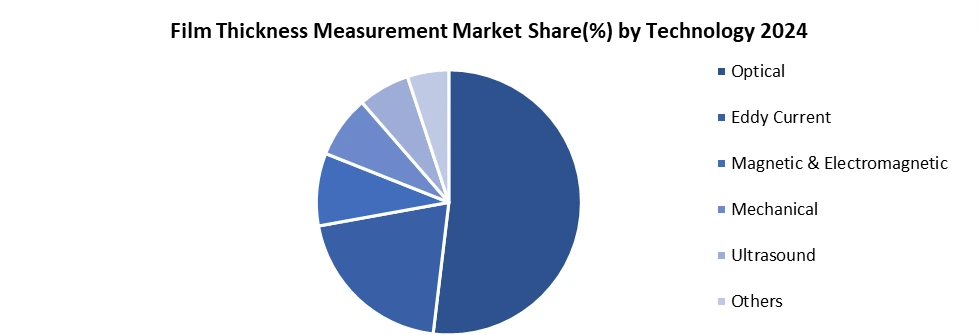
Based on Technology, the market is categorized into the Optical, Eddy Current, Magnetic & Electromagnetic, Mechanical, Ultrasound and Others. Optical methods dominate the film thickness measurement market. Techniques such as spectroscopic ellipsometry, reflectometry, and white light interferometry offer sub-nanometer precision and non-contact measurement, making them indispensable in industries like semiconductors, displays, and photovoltaics. Optical tools are ideal for analyzing transparent, multilayer, or ultra-thin films, enabling both inline and offline inspection. The eddy current and magnetic methods are best for measuring non-conductive coatings on metal substrates, such as automotive paint or plating. Ultrasound and mechanical techniques are used for thicker or layered materials but lack the resolution of optical tools.
Global Film Thickness Measurement Market Regional Insights
Asia Pacific dominated the Film Thickness Measurement Market and is expected to continue its dominance over the forecast period. The region's existing market dominance is primarily due to fast industrial development, strong growth in semiconductor production, and expanding electronics and automotive markets in China, Japan, South Korea, Taiwan, and India. Government initiatives to act as catalysts for increased investment will also continue to grow. For example, in 2015, China introduced the "Made in China 2025" plan, and in 2020, South Korea's government presented the new "K-Semiconductor Strategy." Increased industrial production and associated quality control to increasing the demand for film thickness measurement systems and their development and manufacturing technologies. Japan's Hamamatsu Photonics has reconsidered its long-standing capability boundaries due to increasing inspection demands for semiconductor production. The newly established Electric Vehicle and solar panel industry also promotes the growth of the region's measurement technologies, such as Optical Measurement, Eddy Current Measurements, and Ultrasonic Measurements, as new drivers to continuously improve precision control processes for thin film applications.
Global Film Thickness Measurement Market Competitive Landscape
Asia Pacific Film Thickness Measurement leaders including KLA Corporation and SCREEN Holdings Co., Ltd., KLA Corporation is headquartered in North America (US), however, the bulk of their business is conducted in the Asia Pacific, especially the semiconductor markets of China, Taiwan, and South Korea, which consists of the most semiconductor manufacturing. KLA Corporation is globally recognized for having leading-edge optical and metrology systems, including ellipsometry systems, which are capable of measuring to less than one nanometer. KLA prefers to be the single vendor to some of their larger semiconductor clients (e.g., TSMC and Samsung, SK Hynix). KLA invests heavily in research & development in Asia Pacific, and has several innovation hubs, as well as a significant amount of R&D to support localized product development for its customers.
SCREEN Holdings Co., Ltd. is another large contributor in this region and is headquartered in Kyoto, Japan, as well. While it has its base of operations in Japan, SCREEN Holdings Co., Ltd. is increasingly developing and expanding into China and Taiwan. The area SCREEN is focused on is optical measurement systems based on interferometry that provide high precision measurement for semiconductor, display, and other manufacturing applications.
Key Development in the Market
• June 2025 – Japan: A metrology company in Tokyo launched a next-generation non-contact optical film thickness gauge that uses AI-driven signal processing, leveraging advanced algorithms to improve accuracy for semiconductor and OLED display manufacturing.
• March 2025 – Germany, A global leading sensor manufacturer based in Germany launched a multi-layer ultrasonic film measurement system that focuses on optimizing the analysis of composite materials for aerospace and aeronautics and can be deployed for better production line assessment in real time.
• September 2024 – United States: A family-owned instrumentation company based in the United States offered a portable eddy current film thickness analyzer intended for in-field metallic coating evaluations in defense and aerospace industries to address faster and informed decisions.
• December 2024 – South Korea: One of the largest electronics corporations in South Korea, in conjunction with a local university, has designed an inline magnetic induction sensor system that incorporates IoT connectivity for real-time film thickness control of flexible electronics.
Key Trends of the Market
Improvements in In-Field Assessment Technology
Portable analysis instruments have matured into advanced eddy current film thickness analyzers that remove the variability present in using tools and equipment manufactured by different firms. In-line optical and ultrasonic measurements are similarly progressing, allowing manufacturers to monitor in real time.
Integration of Inline Measurement into Smart Manufacturing
Real-time, non-contact film thickness monitoring systems are increasingly integrated directly into production lines. Optical and ultrasonic technologies now support high-speed inline inspection, improving process automation and enabling predictive control in line with Industry 4.0 and smart factory trends.
Film Thickness Measurement Market Scope: Inquire before buying
| Global Film Thickness Measurement Market | |||
|---|---|---|---|
| Report Coverage | Details | ||
| Base Year: | 2024 | Forecast Period: | 2025-2032 |
| Historical Data: | 2019 to 2024 | Market Size in 2024: | USD 700.3 Bn. |
| Forecast Period 2025 to 2032 CAGR: | 5.2% | Market Size in 2032: | USD 1050.3 Bn. |
| Segments Covered: | by Film Type | Dry Film Wet Film |
|
| by Form Factor | Benchtop Systems Portable/Handheld Devices Others |
||
| by Instrument Type | Thickness Monitors Spectroscopic Ellipsometers Reflectometers / Interferometers XRF Gauges / X Ray Testers Others |
||
| by Technology | Optical Eddy Current Magnetic & Electromagnetic Mechanical Ultrasound Others |
||
| by Application | Aerospace & Aviation Automotive Food & Pharmaceutical Packaging Industrial & Manufacturing Medical Semiconductors Others |
||
Global Film Thickness Measurement Market, by Region
North America (United States, Canada, Mexico)
Europe (United Kingdom, France, Germany, Italy, Spain, Sweden, Russia, Rest of Europe)
Asia Pacific (China, South Korea, Japan, India, Australia, Indonesia, Malaysia, Philippines, Thailand, Vietnam, Rest of Asia Pacific)
Middle East and Africa (MEA) (South Africa, GCC, Nigeria, Rest of MEA)
South America (Brazil, Argentina, Colombia, Chile, Rest of South America)
Film Thickness Measurement Key Players
The Film Thickness Measurement Market is dominated by key players such as Elcometer, ElektroPhysik, Helmut Fischer Group, Bruker and KLA-Tencor, renowned for their progressive measurement technologies and accuracy instruments. The market is experiencing significant growth because ofgrowing demand for quality control in industries like automotive, electronics, and aerospace. Opportunities lie in increasing applications for thin film measurement in emerging technologies such as semiconductors and renewable energy. Inventions in non-destructive testing, real-time monitoring, and integration with automated systems are driving market growth, offering new avenues for development and investment in advanced measurement solutions.
North America
1. KLA Corporation – USA
2. Thermo Fisher Scientific – USA
3. Bruker Corporation – USA
4. Rudolph Technologies – USA
5. Nanometrics Incorporated – USA
6. Onto Innovation Inc– USA
7. . Nanometrics Incorporated – USA
Europe
1. OXFORD Instruments – UK
2. SCREEN Holdings Co., Ltd. (Europe Division) – Germany
3. IMS Messsysteme GmbH – Germany
4. FRT GmbH (FormFactor Inc.) – Germany
5. Polytec GmbH – Germany
6. Semilab GmbH (Germany – European branch of Semilab Hungary)
7. Micro-Epsilon Messtechnik GmbH & Co. KG (Germany)
8. Sensofar Metrology (Spain)
9. Accurion GmbH (Germany)
Asia-Pacific
1. Keyence Corporation – Japan
2. HORIBA, Ltd. – Japan
3. Tokyo Seimitsu Co., Ltd. – Japan
4. Chroma ATE Inc. – Taiwan
5. Semilab Asia Ltd. – Singapore
Frequently Asked Questions:
1. Which region has the largest share in the Global Film Thickness Measurement Market?
Ans: The Asia Pacific region held the highest share in 2024.
2. What is the growth rate of the Global Film Thickness Measurement Market?
Ans: The Global Film Thickness Measurement Market is growing at a CAGR of 5.2% during the forecast period 2025-2032.
3. What is the scope of the Global Film Thickness Measurement Market report?
Ans: Global market report helps with the PESTEL, PORTER, COVID-19 Impact analysis, Recommendations for Investors & Leaders, and market estimation of the forecast period.
4. Who are the key players in the Global Film Thickness Measurement Market?
Ans: The important key players in the Global Film Thickness Measurement Market are – KLA, Altana, Bruker, DeFelsko, Elcometer, ElektroPhysik, Fischer Technology, Hamamatsu, HORIBA, Keyence, and KLA-tencor.
5. What is the study period of this Market?
Ans: The Global Film Thickness Measurement Market is studied from 2024 to 2032.