
Extended Detection & Response Market Size – Industry Structure Evaluation, Demand Drivers Analysis, Regional Growth Analysis and Identification, Competitive Positioning Review & Global Market Size Forecast to 2030
Overview
Extended Detection & Response Market size was valued at US$ 868.19 Mn. in 2023 and the total revenue is expected to grow at 19.8% through 2024 to 2030, reaching nearly US$ 3074.77 Mn.
Extended Detection & Response Market Overview:
Global Extended detection and response (XDR) is a new concept in security technology that was created to address the demand for advanced and comprehensive detection and response. Cyber risks have increased as a result of ongoing innovations in technologies such as the Internet of Things (IoT) and the cloud, posing issues in securing important data. As a result, businesses are investing in a variety of security solutions in order to enhance their defences and limit the number of redundant attacks. XDR systems can also assist organise a large number of warnings into smaller issues based on their severity.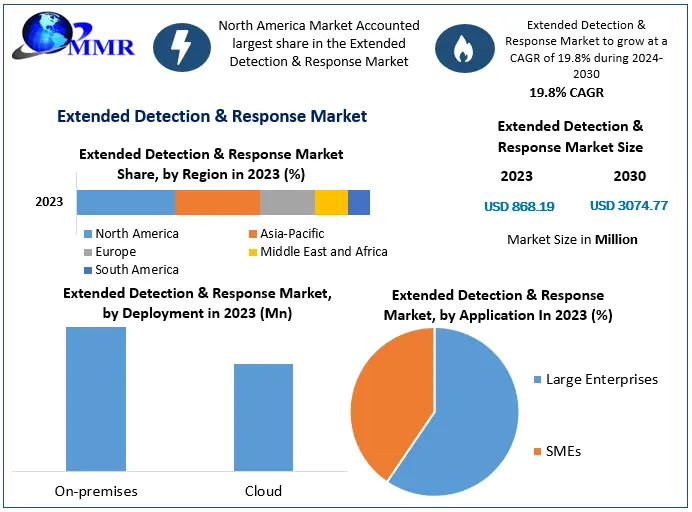 To know about the Research Methodology :- Request Free Sample Report
Extended Detection & Response Market Dynamics:
The increased integration of multiple software solutions with existing systems and the increasing complexity of managing multiple alerts in a limited context will cause security teams to lose visibility and hinder business operations. This scenario led to the emergence of XDR technology, which uses dynamic analysis and machine learning techniques to provide extended visibility, analysis, and response across networks, clouds, and endpoints.
Over the years, XDR solutions have become more and more popular in the United States. Enterprise security analysts can eliminate and locate cyber dangers based on the severity of cyber threats affecting the organization's IT infrastructure by integrating XDR technologies. Many network security providers in the United States have launched improved EDR and XDR solutions in response to the growing demand for XDR solutions. Sentinel One, a cyber-security solution provider based in the United States, for example, announced an artificial intelligence-based XDR solution in February 2022 that delivers advanced threat detection and detection of physical or virtual, internal or cloud services.
The growing demand for real-time monitoring and investigation of advanced threats forces organizations to adopt security solutions that extend threat detection capabilities from endpoints to multiple security control points, such as cloud, server, email, and network. This drives the adoption of XDR tools, which allow behavioural and telemetry analysis across multiple security layers, enabling security analysts to visualize many threats.
Increasingly complex regulatory compliance requirements, rapid migration to cloud computing, shortage of technical security personnel, and the continuous evolution of threats continue to increase the security challenges faced by enterprises. However, responding to the COVID-19 pandemic remains a major challenge for most security companies in the world in 2023. The pandemic has refocused the attention of security personnel on operating tools that do not require local area networks and cloud-delivered security tools (LAN) connectivity functions, requiring migration to cloud data centers and software-as-a-service (SaaS) applications. This encourages enterprises to adopt XDR solutions to remotely access policies and track threats in the cloud and business networks.
Architecture of Extended Detection and Response (XDR):
The XDR tool should provide the ability to centralize and normalize data in a central repository for analysis and query. As part of the recovery process, it should have associated incident response capacity to modify the state of the individual security product. Improved detection sensitivity should be possible with the XDR tool.
Benefit of Extended Detection & Response (EDR) service:
With alert and incident correlation, XDR services boost security operations productivity.
It has a built-in automation system.
It can simplify security setting and incident response, resulting in a better security result.
Extended Detection & Response Market Segment Analysis:
On the basis of component, the extended detection & response market is sub-segmented into Solutions, Services. The solution segment held the largest share of 60% in 2023. The demand for a unified solution that can give a holistic view of cyber threats across many control points, such as endpoints, networks, and servers, has aided XDR solution adoption. Furthermore, the need to lessen the difficulties associated with managing several security systems, as well as the warnings supplied by such solutions, has aided the segment growth.
The service segment is expected to grow at a CAGR of xx% during the forecast period of 2024-2030. The need for managed services is being driven by the evolving dangers of cyber threats across an organization's security parameters. Managed XDR vendors monitor enterprises' IT infrastructures in real-time, detecting and mitigating advanced issues. Furthermore, the services segment is being driven by increased demand for implementation and training services.
On the basis of deployment, the extended detection & response market is sub-segmented into On-premises, Cloud. The On-premises segment held largest share of 55% in 2023. Enterprises with the requisite IT infrastructure prefer to have XDR solutions installed on their premises since they have complete control over the solution and upgrades. On-premise extended detection and response systems are used by a variety of major organisations and businesses that deal with sensitive corporate data because they give the highest level of data protection and physical access controls.
On the basis of application, the extended detection & response market is sub-segmented into Large Enterprises, SMEs. The Large Enterprises segment held largest share of xx% in 2023. Due to the huge number of employees processing important company information and data on their workstations, large firms are more vulnerable to cyber threats. In addition, the growing trend of Bring Your Own Device (BYOD) among technology organisations is heightening the potential of cyber-attacks, fuelling demand for XDR solutions.
Extended Detection & Response Market Regional Insights:
The North America region held largest share of 50% in 2023. Because of increased investment in research and development initiatives to improve existing cyber security strategies, the United States and Canada are the region's major markets for XDR solutions. Due to increasing demand for threat detection and response solutions from nations such as the United Kingdom, Germany, and France, the European market and rising awareness of the need for protecting the enterprise cyber infrastructure is also seeing a considerable growth in demand.
The objective of the report is to present a comprehensive analysis of the global Extended Detection & Response to the stakeholders in the industry. The past and current status of the industry with the forecasted market size and trends are presented in the report with the analysis of complicated data in simple language. The report covers all the aspects of the industry with a dedicated study of key players that include market leaders, followers, and new entrants.
PORTER, PESTEL analysis with the potential impact of micro-economic factors of the market has been presented in the report. External as well as internal factors that are supposed to affect the business positively or negatively have been analyzed, which will give a clear futuristic view of the industry to the decision-makers.
The report also helps in understanding the global Extended Detection & Response dynamics, structure by analyzing the market segments and project the global Extended Detection & Response size. Clear representation of competitive analysis of key players by product, price, financial position, product portfolio, growth strategies, and regional presence in the global Extended Detection & Response make the report investor’s guide.
Global Extended Detection & Response Market Scope: Inquire before buying
| Extended Detection & Response Market | |||
|---|---|---|---|
| Report Coverage | Details | ||
| Base Year: | 2023 | Forecast Period: | 2024-2030 |
| Historical Data: | 2018 to 2023 | Market Size in 2023: | US $ 868.19 Mn. |
| Forecast Period 2024 to 2030 CAGR: | 19.8% | Market Size in 2030: | US $ 3074.77 Mn. |
| Segments Covered: | by Deployment | On-premises Cloud |
|
| by Component | Solutions Services |
||
| by Application | Large Enterprises SMEs |
||
Extended Detection & Response Market, by Region
North America (United States, Canada and Mexico)
Europe (UK, France, Germany, Italy, Spain, Sweden, Austria and Rest of Europe)
Asia Pacific (China, South Korea, Japan, India, Australia, Indonesia, Malaysia, Vietnam, Taiwan, Bangladesh, Pakistan and Rest of APAC)
Middle East and Africa (South Africa, GCC, Egypt, Nigeria and Rest)
South America (Brazil, Argetina and Rest of South America)
Extended Detection & Response Market Key Players are:
1 McAfee LLC
2 Trend Micro Incorporated.
3 Microsoft
4 Palo Alto Networks.
5 Cybereason
6 Broadcom
7 Cynet
8 Vectra AI
9 SentinelOne
10 Symantec
11 Armor Cloud Security
12 Bitdefender
13 Cisco
14 Elastic
15 Huntsman
16 CrowdStrike
17 TEHTRIS
18 Microsoft
19 Vectra AI
Frequently Asked Questions:
1. Which region has the largest share in Market?
Ans: North America region holds the highest share in 2023.
2. What is the growth rate of Market?
Ans: The Global Market is growing at a CAGR of 19.8 % during forecasting period 2024-2030.
3. What segments are covered in market?
Ans: Global Market is segmented into component, deployment, application and region.
4. What is the study period of this market?
Ans: The Global Market is studied from 2023 to 2030.