
Expression Vector Market Size by Type, End-User, Host type, Region – Segment-Level Market Assessment, Growth Opportunity Analysis, Competitive Mapping & Forecast to 2034
Overview
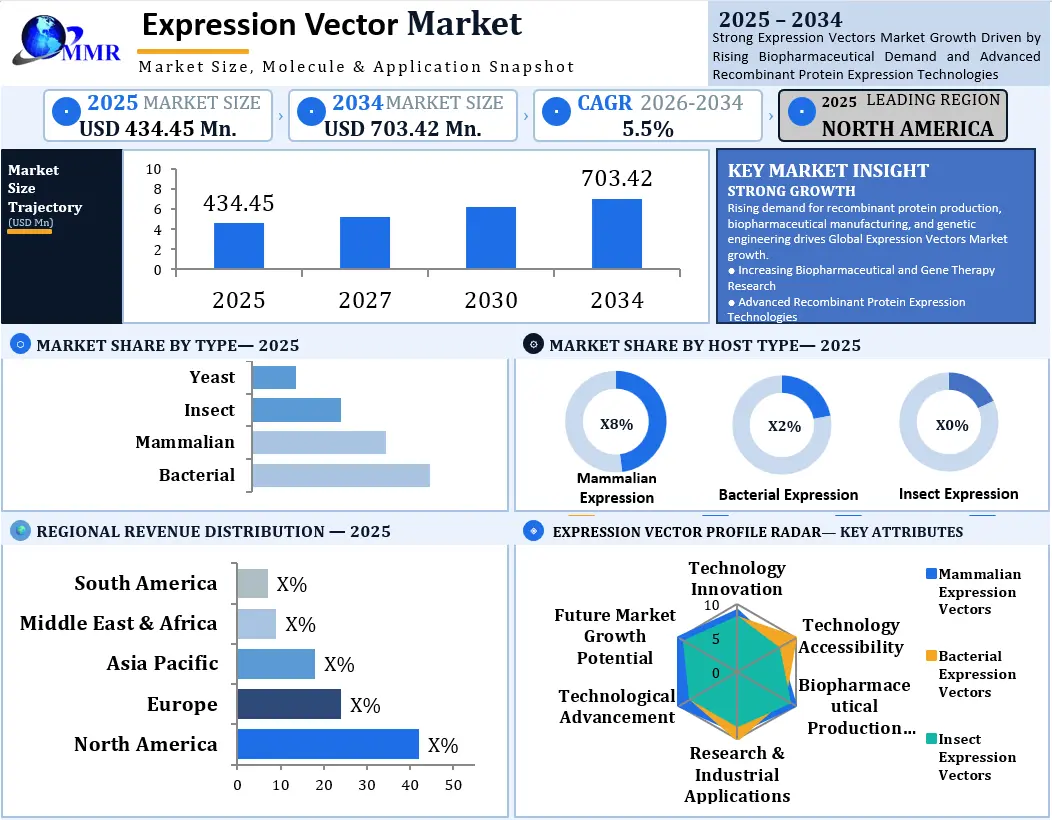
The Global Expression Vector Market was valued at USD 434.45 Million in 2025 and is projected to reach USD 703.42 Million by 2034, growing at a CAGR of 5.5% during the forecast period 2026–2034.
Expression Vector Market Overview:
The Global Expression Vectors Market includes DNA-based molecular tools that enable gene expression, recombinant protein production, and genetic engineering in host cells. Plasmid expression vectors, viral vectors, and non-viral expression systems support biopharmaceutical manufacturing, therapeutic protein development, and molecular biology research. Pharmaceutical and biotechnology companies use mammalian, bacterial, yeast, and insect expression vectors to produce monoclonal antibodies, enzymes, and recombinant proteins. Increasing demand for gene therapy research, recombinant DNA technology, and biologics manufacturing supports Expression Vectors Market growth.
The Expression Vectors Market trends reflect increasing adoption of synthetic biology, advanced plasmid engineering, and high-yield protein expression systems. Major buyers include pharmaceutical companies, biotechnology manufacturers, research institutes, CROs, and CDMOs. Growing investments in gene therapy, vaccine development, and recombinant protein manufacturing create market opportunities, while complex vector design and manufacturing costs remain key challenges. North America leads the Global Expression Vectors Market, supported by advanced biotechnology infrastructure, while Asia Pacific presents significant growth opportunities through expanding biopharmaceutical manufacturing.
The Global Expression Vectors Market competitive landscape includes Thermo Fisher Scientific, Merck KGaA, Gen Script Biotech, Takara Bio, Promega Corporation, and New England Biolabs. Thermo Fisher Scientific offers pc DNA mammalian expression vectors, while Gen Script provides custom plasmid construction and gene synthesis services. These companies focus on product innovation, expression efficiency, and biotechnology research applications. Maximize Market Research's Expression Vectors Market analysis examines market size, market share, growth drivers, segmentation by type, host type and end user, competitive landscape, regional demand, and forecasts through 2034, identifying opportunities in recombinant protein production, gene therapy research, and synthetic biology.
Expression Vector Market Size, Growth & Share Analysis
To know about the Research Methodology :- Request Free Sample Report
Global Expression Vector Market Key Highlights
• Market Size & Revenue Forecast: The Global Expression Vectors Market is valued at USD 434.45 Million in 2025 and is projected to reach USD 703.42 Million by 2034, growing at a CAGR of 5.5%.
• Strong Market Growth Drivers: Rising demand for recombinant protein production, monoclonal antibodies, gene therapy research, and biopharmaceutical manufacturing accelerates Expression Vectors Market growth.
• Key Host Type Segment: Mammalian Expression Vectors play a critical role in biologics manufacturing, supported by increasing adoption of CHO and HEK293 expression systems for therapeutic protein production.
• Leading Region & Growth Opportunities: North America leads the Expression Vectors Market, while Asia Pacific presents significant growth opportunities through expanding biotechnology investments and pharmaceutical manufacturing.
• Emerging Technologies & Market Trends: AI-assisted vector design, synthetic biology, automated plasmid construction, and high-throughput cloning create opportunities in recombinant DNA technology and custom expression vector development
Expression Vector Market Dynamics:
Rising Biopharmaceutical Production and Therapeutic Protein Development
Increasing demand for monoclonal antibodies, recombinant therapeutic proteins, vaccines, and biologics manufacturing represents a major Expression Vectors Market growth driver. Pharmaceutical and biotechnology companies use mammalian expression vectors, CHO cell expression systems, HEK293 expression platforms, and bacterial expression plasmids to produce proteins for research and biopharmaceutical development. Mammalian expression systems support complex protein folding and post-translational modifications, while bacterial systems provide efficient production of suitable recombinant proteins. Commercial vector portfolios include pcDNA3.1 mammalian expression vectors and pET-series bacterial expression plasmids, supporting different host-cell requirements. Increasing pharmaceutical R&D expenditure, biosimilar development, and demand for advanced biologics strengthen the Protein Expression Vectors Market, encouraging investments in scalable expression systems and specialized molecular biology products.
High Development Costs and Complex Vector Optimization Requirements
High development expenditure, specialized laboratory requirements, and complex vector optimization processes restrain Global Expression Vectors Market growth, particularly among smaller biotechnology companies and research institutions. Designing effective recombinant DNA expression vectors requires suitable promoters, regulatory elements, selection markers, and host-cell compatibility to achieve consistent protein expression. Commercial gene synthesis and cloning services introduce additional costs depending on gene length, sequence complexity, and plasmid preparation requirements. For example, GenScript's FLASH Gene service lists qualifying 1–800 base-pair gene synthesis and cloning packages starting at USD 89, including a 4 µg plasmid preparation. More complex constructs and specialized quality-control requirements increase project costs. These financial barriers create demand for affordable custom expression vector services, standardized plasmid products, and cost-efficient recombinant protein expression solutions.
Expanding Custom Plasmid Development and Synthetic Biology Applications
Increasing adoption of custom expression vector design, synthetic biology, and advanced gene engineering services creates significant opportunities in the Global Expression Vectors Market. Biotechnology companies and contract research organizations increasingly require customized plasmid constructs for genetic modification, protein engineering, vaccine research, and specialized therapeutic development. Growing demand for custom gene synthesis, vector cloning, codon optimization, and plasmid DNA preparation services supports specialized biotechnology service providers. For example, GenScript offers a commercial portfolio of more than 170 vector options through its FLASH Gene workflow and provides eligible gene-to-plasmid services with a four-business-day turnaround. Expanding applications in engineered enzymes, industrial biotechnology, and recombinant protein manufacturing strengthen Expression Vectors Market investment opportunities, particularly for companies offering flexible vector design, faster development cycles, and scalable molecular biology services.
Maintaining Expression Stability and Product Quality Across Host Systems
The Global Expression Vectors Market faces technical challenges involving genetic stability, inconsistent protein expression, host-cell compatibility, and reproducible manufacturing quality. Researchers must evaluate promoter efficiency, plasmid copy number, gene sequence integrity, codon usage, and host-cell responses to achieve reliable recombinant protein production. Mammalian expression systems require careful management of protein folding and cellular processing, while bacterial expression vectors face challenges associated with insoluble protein formation and limited post-translational modifications. Plasmid quality requirements also vary by application, with commercial preparation services offering specifications such as at least 80% or 90% supercoiled DNA and endotoxin control options. These requirements strengthen demand for expression vector quality-control services, plasmid sequence verification, optimized host systems, and high-purity DNA manufacturing, making product consistency an important competitive factor.
Global Expression Vectors Market Trends
Advanced Plasmid Engineering and Automated Vector Design Technologies
The Global Expression Vectors Market trends reflect growing adoption of automated plasmid construction, AI-assisted vector design, synthetic gene synthesis, high-throughput cloning, and advanced recombinant protein expression technologies. Biotechnology manufacturers increasingly integrate digital sequence design, codon optimization, automated DNA assembly, and standardized vector libraries to improve molecular biology research efficiency. Commercial service providers offer expression-ready constructs, sequence verification, and flexible plasmid preparation quantities, with selected services supporting DNA preparation from 10 µg to 2 g, depending on requirements. Advances in mammalian expression platforms, engineered bacterial strains, synthetic promoters, and modular plasmid systems expand research flexibility across pharmaceutical development and industrial biotechnology. Increasing integration of automation and computational biology strengthens the Expression Vectors Market competitive landscape, technology innovation, and future growth potential through 2034.
Expression Vector Market Segment Analysis:
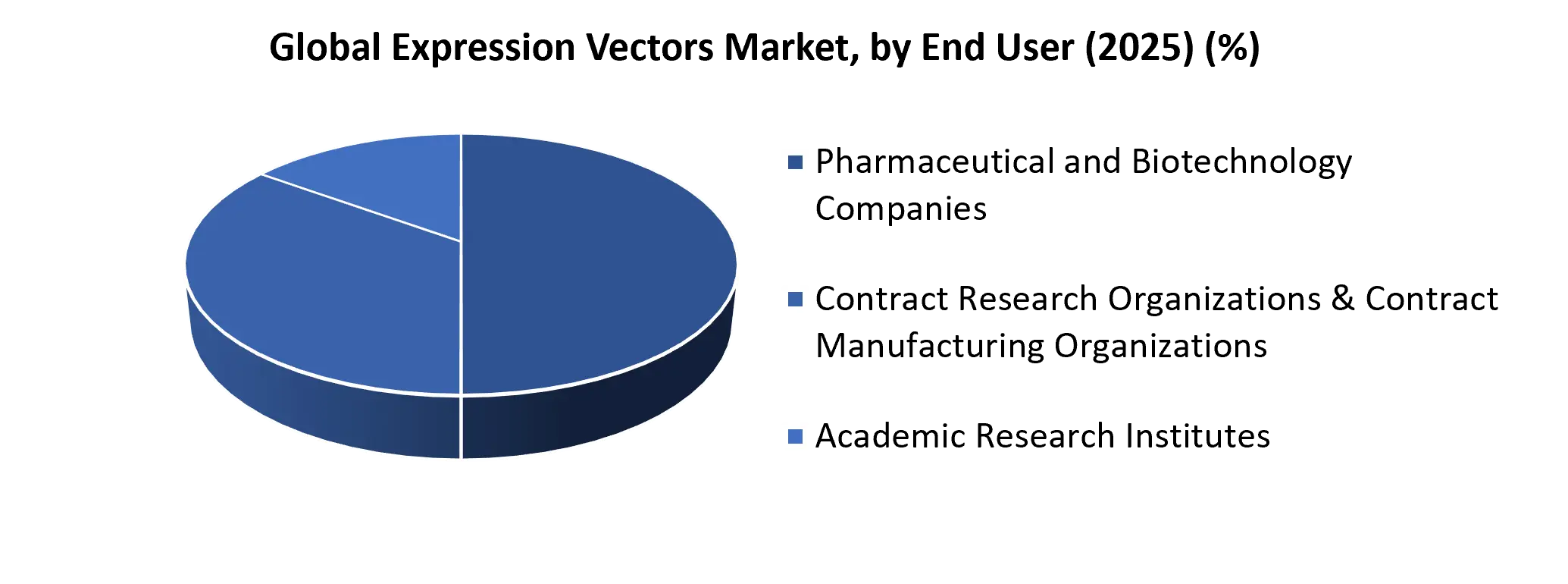
By End User, The Global Expression Vectors Market, by end user, includes Pharmaceutical and Biotechnology Companies, Contract Research Organizations (CROs) & Contract Manufacturing Organizations (CMOs), and Academic Research Institutes. Pharmaceutical and Biotechnology Companies drive significant demand through recombinant protein production, gene therapy research, monoclonal antibody development, and biologics manufacturing. CROs and CMOs support market growth through custom plasmid development, vector manufacturing, and outsourced protein expression services, while Academic Research Institutes focus on genetic engineering, molecular biology, and synthetic biology research. Increasing investments in biopharmaceutical R&D, mammalian expression vectors, recombinant DNA technology, and advanced protein expression systems strengthen Global Expression Vectors Market growth and opportunities through 2034.
 By Host Type, The Global Expression Vectors Market, by host type, includes Mammalian Expression Vectors, Bacterial Expression Vectors, Insect Expression Vectors, Yeast Expression Vectors, and Other Expression Vectors. Mammalian Expression Vectors support strong demand through monoclonal antibody production, gene therapy research, and biopharmaceutical manufacturing, while Bacterial Expression Vectors offer cost-effective recombinant protein production and high-yield protein expression. Insect Expression Vectors support vaccine development and complex protein research, whereas Yeast Expression Vectors enable industrial enzyme production and biotechnology applications. Increasing investments in recombinant DNA technology, synthetic biology, genetic engineering, and advanced protein expression systems drive Global Expression Vectors Market growth and opportunities through 2034.
Expression Vector Market Regional Insights:
The North America Expression Vectors Market holds a leading position, supported by strong pharmaceutical R&D, advanced biotechnology infrastructure, and increasing demand for recombinant protein production and gene therapy research. The United States and Canada drive adoption of mammalian expression vectors, plasmid DNA technologies, and biopharmaceutical manufacturing solutions, strengthening regional market growth.
The Europe Expression Vectors Market experiences steady growth through expanding biopharmaceutical manufacturing, genetic engineering research, and biotechnology innovation. Germany, the UK, and France support demand for protein expression vectors, recombinant DNA technologies, and monoclonal antibody production. Increasing investments in biosimilars and advanced biologics create regional market opportunities.
The Asia Pacific Expression Vectors Market presents significant growth opportunities, supported by expanding pharmaceutical manufacturing, biotechnology investments, and contract research services. China, India, Japan, and South Korea contribute to increasing demand for bacterial expression vectors, mammalian expression systems, and custom plasmid development services. Growing biologics production and synthetic biology research accelerate regional market expansion.
The Middle East & Africa Expression Vectors Market benefits from growing healthcare investments, biotechnology research initiatives, and developing biopharmaceutical infrastructure. Saudi Arabia, the UAE, and South Africa support demand for recombinant protein expression, genetic engineering technologies, and molecular biology research tools. Expanding research facilities and biotechnology partnerships create emerging market opportunities.
The South America Expression Vectors Market experiences increasing demand for biotechnology research, vaccine development, and recombinant protein manufacturing. Brazil and Argentina support adoption of plasmid expression vectors, bacterial expression systems, and genetic engineering technologies. Growing investments in academic research, agricultural biotechnology, and biologics development strengthen regional market opportunities.
Expression Vector Market Scope: Inquire before buying
| Global Expression Vector Market | |||
|---|---|---|---|
| Report Coverage | Details | ||
| Base Year: | 2023 | Forecast Period: | 2024-2030 |
| Historical Data: | 2018 to 2023 | Market Size in 2023: | USD 390.34 Mn. |
| Forecast Period 2024 to 2030 CAGR: | 5.5% | Market Size in 2030: | USD 567.83 Mn. |
| Segments Covered: | by Type | Bacterial/E.Coli Mammalian/CHO Insect/Baculovirus Yeast |
|
| by End-User | Pharmaceutical and Biotechnology Companies Contract Research Organizations (Cros) & Contract Manufacturing Organizations (Cmos) Academic Research Institutes |
||
| by Host type | Mammalian Expression Vectors Bacterial Expression Vectors Insect Expression Vectors Yeast Expression Vectors Other Expression Vectors |
||
Expression Vector Market, by Region
North America (United States, Canada and Mexico)
Europe (UK, France, Germany, Italy, Spain, Sweden, Austria and Rest of Europe)
Asia Pacific (China, South Korea, Japan, India, Australia, Indonesia, Malaysia, Vietnam, Taiwan, Bangladesh, Pakistan and Rest of APAC)
Middle East and Africa (South Africa, GCC, Egypt, Nigeria and Rest of ME&A)
South America (Brazil, Argentina Rest of South America)
Expression Vector Market, Key Players
1. Thermo Fisher Scientific Inc. (United States)
2. Merck KGaA (Germany)
3. GenScript Biotech Corporation (China)
4. Takara Bio Inc. (Japan)
5. Promega Corporation (United States)
6. Agilent Technologies, Inc. (United States)
7. Bio-Rad Laboratories, Inc. (United States)
8. QIAGEN N.V. (Netherlands)
9. New England Biolabs, Inc. (United States)
10. OriGene Technologies, Inc. (United States)
11. VectorBuilder Inc. (United States)
12. Addgene, Inc. (United States)
13. Lonza Group AG (Switzerland)
14. Sino Biological Inc. (China)
15. System Biosciences LLC (United States)
16. Oxford Biomedica plc (United Kingdom)
17. WuXi Biologics (China)
18. Creative Biogene (United States)
19. ATUM (United States)
20. Twist Bioscience Corporation (United States)
21. Synbio Technologies (United States)
22. GeneCopoeia, Inc. (United States)
23. InvivoGen (United States)
24. Applied Biological Materials Inc. (Canada)
25. BPS Bioscience, Inc. (United States)
26. Cell Biolabs, Inc. (United States)
27. AMS Biotechnology Ltd. (United Kingdom)
28. Bio-Techne Corporation (United States)
29. Charles River Laboratories International, Inc. (United States)
30. Bio Basic Inc. (Canada)
31. Eurofins Scientific SE (Luxembourg)
32. GenScript ProBio (China)
33. Creative BioMart (United States)
34. Zymo Research Corporation (United States)
35. IBA Lifesciences GmbH (Germany)
36. ProteoGenix (France)
37. Macrogen, Inc. (South Korea)
38. Azenta, Inc. (United States)
39. Telesis Bio, Inc. (United States)
40. BioCat GmbH (Germany)
41. GenScript USA Inc. (United States)
42. Integrated DNA Technologies, Inc. (United States)
43. Aldevron, LLC (United States)
44. Gene Universal Inc. (United States)
45. Biomatik Corporation (Canada)
46. Epoch Life Science, Inc. (United States)
47. Genewiz (United States)
48. GeneArt (Germany)
49. Vigene Biosciences, Inc. (United States)
50. Cell Signaling Technology, Inc. (United States)
FAQs:
1. What is the Global Expression Vectors Market size and forecasts for 2034?
The Global Expression Vectors Market size is valued at USD 434.45 Million in 2025 and is projected to reach USD 703.42 Million by 2034, growing at a CAGR of 5.5% during 2026–2034, according to the MMR report draft.
2. What are the major growth drivers of the Expression Vectors Market?
Increasing biopharmaceutical manufacturing, recombinant protein production, monoclonal antibody development, gene therapy research, and pharmaceutical R&D drives Global Expression Vectors Market growth.
3. Which host type dominates the Global Expression Vectors Market?
Mammalian Expression Vectors represent an important segment, supported by growing demand for CHO cell expression systems, HEK293 platforms, therapeutic proteins, and biologics manufacturing.
4. What are the major applications of expression vectors in biotechnology?
Major Expression Vectors Market applications include recombinant protein production, gene therapy research, vaccine development, monoclonal antibody manufacturing, synthetic biology, and genetic engineering.
5. Which region leads the Global Expression Vectors Market?
North America leads the Expression Vectors Market, supported by advanced biotechnology infrastructure and pharmaceutical R&D, while Asia Pacific presents significant growth opportunities through expanding biopharmaceutical manufacturing.
6. Who are the leading companies in the Expression Vectors Market?
Major Expression Vectors Market key players include Thermo Fisher Scientific, Merck KGaA, GenScript Biotech, Takara Bio, Promega Corporation, Agilent Technologies, QIAGEN, and New England Biolabs.
7. What are the emerging Expression Vectors Market trends and opportunities through 2034?
Key trends include AI-assisted vector design, automated plasmid construction, synthetic biology, custom gene synthesis, advanced mammalian expression systems, and high-throughput cloning technologies.