
Electric Vehicle Battery Recycling Market Size by Battery Type, Application, Region, Industry-Wide Analysis, Competitive Landscape Assessment & Long-Term Forecast to 2032
Overview
Electric Vehicle Battery Recycling Market size was valued at USD 5.91 Bn. in 2025 and the total revenue is expected to grow at 37.1 % through 2026 to 2032, Electric Vehicle Battery Recycling Market is reaching nearly USD 53.8 Bn. by 2032.
Electric Vehicle Battery Recycling Market Overview:
Automobile batteries are utilized as a backup power source. Electric vehicle batteries (EVs) are the batteries that power a battery electric vehicle's propulsion system. The batteries used in electric vehicles are usually rechargeable and have a high ampere-hour capacity. These batteries are tiny and light, which helps to reduce vehicle weight and hence improve vehicle performance. Recycling, on the other hand, is the process of transforming waste materials into new ones. The recovery of energy from waste materials is commonly mentioned in this context. Battery recycling is a type of recycling that aims to limit the number of batteries that go to waste. It contains various harmful chemicals and heavy metals and disposing of them in the same manner as typical home waste has caused water pollution issues.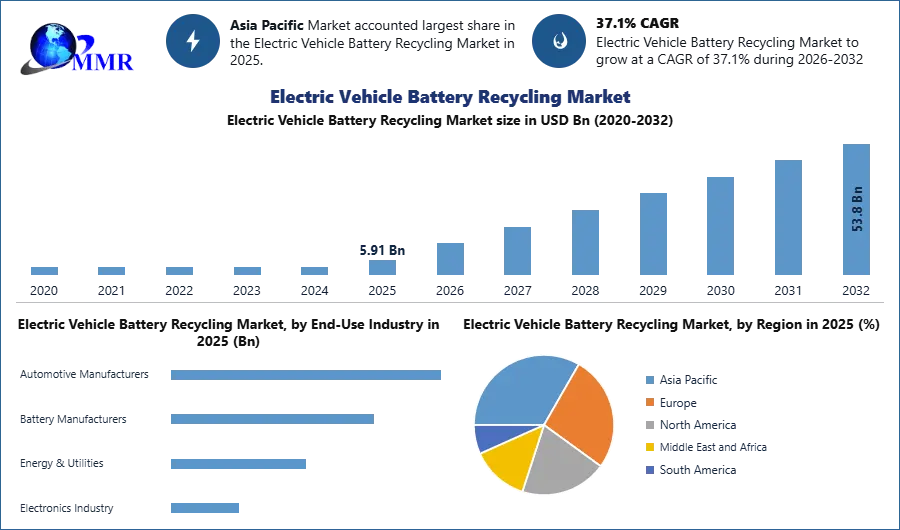 To know about the Research Methodology:- Request Free Sample Report
The reports have covered the market trends from 2020 to forecast the market through 2032. 2025 is considered a base year however 2025’s numbers are on the real output of the companies in the market.
Electric Vehicle Battery Recycling Market Dynamics:
Electric vehicle demand is on the increase – The vehicle industry is shifting to cleaner, more sustainable fuels. In the transportation system, there is a strong reliance on oil as a fuel, which is raising worries among both environmentalists and economists. Electric vehicles are becoming more popular as people become more environmentally aware. Because of the extensive use of EDVs, lithium-ion batteries are becoming more popular, which are necessary for ensuring a constant power supply. The Market for Electric Vehicles is expected to expand as a result of factors such as energy savings, pollution reduction, and customer adoption. The development of superior battery technology and reduced maintenance requirements for lithium-ion batteries has increased the number of electric vehicles.
Additionally, customer demand for electric cars (EVs) is increasing as a result of growing environmental concerns. Rising EV sales are also likely to increase the overall number of EVs at the end of their degradation period, which is expected to increase demand for the recycling of all-electric vehicle batteries. EVB recycling firms are also predicted to increase their recycling capability as the number of total batteries procured from increased sales of EVs and batteries procured through second life use sources grows. Throughout the forecast period, all of these factors are expected to promote the growth of the electric car battery recycling market.
Demand for zero-emission automobiles is increasing – Increased global concern about the harmful effects of climate change, as well as concerning levels of pollution in major cities, has created a large demand for electric vehicles. Due to the recent increase in the price of gasoline and diesel, the demand for fuel-efficient automobiles has surged. This leads to the depletion of fossil fuel reserves and an increase in firms' desire to maximize profits from these reserves. As a result of these considerations, there is a growing demand for better fuel-efficient technologies, resulting in a surge in demand for electric vehicles for travel, which drives up demand for batteries. When these batteries have reached the end of their useful life, they are recycled. The first generation of electric and hybrid vehicle batteries has reached the end of its useful life. The entire number of batteries retired from electric buses and cars is estimated to be around 55,000 units, with recycling set to begin in 2021.
EVB Recycling Plant's High Setup Costs Will Restrict Market Growth – Because of the complex processes involved in removing highly valuable elements such as batteries, as well as uncertainties about the safety, quality, and remaining lifetime of batteries sent for refurbishment, the EVB recycling plant has higher operating costs, including transaction and collection costs. These factors could stymie the large-scale development of second-life battery repurposing. Additionally, a lack of understanding about EVB recycling is expected to hinder the Electric Vehicle Battery Recycling Market's growth.
Concerns about the safety of storing and transporting spent batteries – Hazardous substances, such as acids and heavy metals like mercury and lead, can be found in spent batteries. Spent batteries retain a residual charge, creating the risk of unexpected discharge, which could cause injury or damage to property and people. Large lithium-based batteries, such as those used in automobiles, might be mistaken for lead-acid batteries if local battery manufacturers label them incorrectly. Because of these concerns, state and national governments regulate the storage and transportation of spent batteries.
Challenges of Recycling Batteries –
• Battery collection and repair – Directive 2006/66/EC mandates that at least 50% of the materials in spent batteries and accumulators be recycled in Europe. It also mandates that manufacturers collect spent batteries at their own expense before recycling them themselves or with the assistance of a specialist partner. As a result, all automobile manufacturers are responsible for recycling electric car batteries. The actual recycling procedure is then determined by the battery technology.
Disassembly is the first step in recycling a lithium-ion battery like the one that powers the Renault ZOE. A single battery is made up of hundreds of individual lithium-ion cells that are grouped into modules and then integrated into the greater total that is the battery. There are other electronic components to disassemble, such as those that govern the battery's operation and ensure its safety. The battery's total size and the number of pieces will, of course, vary depending on its capacity.
• Chemicals from lithium-ion batteries are recycled – Before being dismantled, used or broken batteries have their residual energy drained. Dedicated recycling routes are used for structural elements, polymers, metals, and soldered joints. The most important stage is to treat the lithium-ion cells, which are made up of a variety of chemical elements including lithium, as well as other metals such as cobalt, nickel, and manganese. The individual constituents of the cell must be separated before they are treated to be reused as raw materials in order to recycle the cell. The technical procedure differs depending on the company and the type of the materials used. In other circumstances, grinding everything up is the first step, followed by mechanical separation or pyrometallurgy treatment at extremely high temperatures. Hydrometallurgy is used for the final stage of separation and refining.
• Reusing raw materials as much as possible and deferring recycling as long as possible - The difficulty then becomes repurposing the recovered raw materials for the production of new electric vehicle batteries in a "short loop." In keeping with the circular economy principles, this decreases the need to extract and transport new resources. The recycling stage should be postponed as much as possible, according to this theory, by reusing batteries that no longer fulfill the criteria of powering an electric vehicle. As a result, Groupe Renault's lithium-ion batteries are given a second life as part of stationary energy battery storage systems, extending their service life as much as feasible.
Electric Vehicle Battery Recycling Market Segment Analysis:
The Electric Vehicle Battery Recycling Market is segmented into Battery Type and Application.
Based on Battery Type, the market is sub-segmented into Lithium-ion, Lead-acid, Nickel-based battery, and others. The lithium-based sub-segment is expected to increase at the fastest rate, generating US$6,099.8 million in sales by 2032, up from US$541.0 million in 2025. The lithium-based sub-segment of the global Electric Vehicle Battery Recycling Market is growing due to a number of factors, including a high power-to-weight ratio, high energy efficiency, good high-temperature performance, and low self-discharge, all which offer significant environmental benefits over other fossil fuel alternatives. Electric vehicles are expected to have an immediate impact on carbon emissions reductions as their popularity grows. Such important aspects could have a big impact on market growth during the forecast years. All of these factors contribute to the increase in demand for lithium-ion automotive batteries.
Based on Application, the market is sub-segmented into Electric cars, Electric buses, and energy storage systems. In 2025, the electric buses segment held 38.67 % of the market share, and this dominance is likely to continue over the forecast period. This is due to the increasing usage of alternative fuel technology in commercial vehicles like buses, which provide zero emissions, faster acceleration, and quieter operation. Electric buses are followed by energy storage systems and electric cars in the market. Due to the remanufacturing of lithium-ion batteries to provide a second-life with 70–80 % charging capabilities, the market for energy storage systems is predicted to develop at a CAGR of 41.45% over the forecast period.
Electric Vehicle Battery Recycling Market Regional Analysis –
The market for electric vehicle battery recycling will be led by APAC – During the forecast period, the APAC region would lead the global. Increased production and sales of electric vehicle battery cooling systems, increased investments by private and public players in India, Vietnam, Australia, Japan, and China to develop the electric vehicle battery recycling industry, increased demand for vehicle safety features, the presence of a large consumer base in China that recognizes the benefits of car battery disposal, increased vehicle population, and increased vehicle standards
Europe will have the second-largest share of the market for electric vehicle battery recycling
Over the forecast period, Europe is expected to hold the second-largest share of the global Electric Vehicle Battery Recycling Market. Regulations on vehicle emissions in France, the United Kingdom, and other EU countries, the creation of zero-emission zones, demand for electric cars, the development of battery recycling plants to manage overall demand and reduce electric car battery disposal pollution, and regulatory norms for EVs in the region that are inducing battery manufacturers to opt for recycling processes rather than dumping waste generated from batteries are all contributing to the region's regulatory norms for EVs.
The Electric Vehicle Battery Recycling Market in North America is expected to grow at a rate that is remarkable – The global Electric Vehicle Battery Recycling Market in North America is expected to grow at a moderate rate throughout the forecast period. Investments in R&D, increased government support for the development of car battery recycling and EV battery recycling factories, the need for eco-friendly vehicles, and the region's large customer base are all contributing to the global Electric Vehicle Battery Recycling Market's growth.
The objective of the report is to present a comprehensive analysis of the global Electric-vehicle Battery Recycling Market to the stakeholders in the industry. The past and current status of the industry with the forecasted market size and trends are presented in the report with the analysis of complicated data in simple language. The report covers all the aspects of the industry with a dedicated study of key players that include market leaders, followers, and new entrants.
PORTER, PESTEL analysis with the potential impact of micro-economic factors of the market have been presented in the report. External as well as internal factors that are supposed to affect the business positively or negatively have been analyzed, which will give a clear futuristic view of the industry to the decision-makers.
The report also helps in understanding the global Electric-vehicle Battery Recycling Market dynamics, structure by analyzing the market segments and projects the global Electric-vehicle Battery Recycling Market size. Clear representation of competitive analysis of key players by product, price, financial position, product portfolio, growth strategies, and regional presence in the global Electric-vehicle Battery Recycling Market make the report investor’s guide.
Electric Vehicle Battery Recycling Market Recent Industry Developments (2025–2026)
| Exact Date | Company | Development | Impact |
|---|---|---|---|
| 16 March 2026 | Maximize Market Research | Published comprehensive analysis confirming the market is projected to reach USD 4,925.91 Million by 2032. | Highlights a robust 20.9% CAGR driven by lithium-ion innovations and global expansion in the Asia-Pacific region. |
| 05 August 2025 | Glencore plc | Successfully completed the acquisition of Li-Cycle Holdings Corp. for approximately USD 40 million. | Consolidates market share and integrates advanced hydrometallurgical recovery facilities across North America and Europe. |
| 05 June 2025 | Maxvolt Energy Industries Ltd | Announced the establishment of a new state-of-the-art lithium battery recycling facility in Western Uttar Pradesh, India. | Expands infrastructure to cover 85% of India's pin codes, significantly reducing the carbon footprint of regional EV waste. |
| 14 May 2025 | Fortum Battery Recycling | Launched the "Battery Box" service in Germany and Finland to streamline logistics for lithium-ion EV battery collection. | Improves regulatory compliance and material recovery efficiency for end-of-life batteries in the European market. |
| 10 January 2025 | TNO & SusPhos | Collaborated to develop a new, economically viable recycling process specifically for Lithium Iron Phosphate (LFP) batteries. | Enables the profitable recovery of critical phosphate and lithium, targeting the fastest-growing chemistry segment in the EV market. |
Electric Vehicle Battery Recycling Market Scope: Inquire before buying
| Electric Vehicle Battery Recycling Market | |||
|---|---|---|---|
| Report Coverage | Details | ||
| Base Year: | 2025 | Forecast Period: | 2026-2032 |
| Historical Data: | 2020 to 2025 | Market Size in 2025: | 5.91 USD Bn |
| Forecast Period 2026-2032 CAGR: | 37.1% | Market Size in 2032: | 53.8 USD Bn |
| Segments Covered: | by Battery Type | Lithium-ion Lead-acid Nickel-based battery Others |
|
| by Recycling Process | Hydrometallurgical Process Pyrometallurgical Process Direct Recycling (Closed-loop) Mechanical/Physical Recycling |
||
| by Battery Chemistry | Lithium Iron Phosphate (LFP) Nickel Manganese Cobalt (NMC) Nickel Cobalt Aluminum (NCA) Lithium Titanate Oxide (LTO) Solid-State Batteries |
||
| by Application | Electric Cars Electric Buses Energy Storage Systems Others |
||
| by End-Use Industry | Automotive Manufacturers Battery Manufacturers Energy & Utilities Electronics Industry |
||
Electric Vehicle Battery Recycling Market by Region
North America (United States, Canada and Mexico)
Europe (UK, France, Germany, Italy, Spain, Sweden, Austria and Rest of Europe)
Asia Pacific (China, South Korea, Japan, India, Australia, Indonesia, Malaysia, Vietnam, Taiwan, Bangladesh, Pakistan and Rest of APAC)
Middle East and Africa (South Africa, GCC, Egypt, Nigeria and Rest of ME&A)
South America (Brazil, Argentina Rest of South America)
Electric Vehicle Battery Recycling Market Key Players
- Umicore
- Glencore plc
- Li-Cycle Holdings Corp.
- Redwood Materials, Inc.
- Ecobat, LLC
- Ganfeng Lithium Group Co., Ltd.
- American Battery Technology Company
- Fortum Battery Recycling
- Stena Recycling
- ACCUREC Recycling GmbH
- Cirba Solutions
- Neometals Ltd.
- RecycLiCo Battery Materials Inc.
- Contemporary Amperex Technology Co., Limited (CATL)
- Ascend Elements
- GEM Co., Ltd.
- Exide Industries Limited
- EnerSys
- Call2Recycle, Inc.
- Aqua Metals, Inc.
- TES-Amm
- Duesenfeld GmbH
- Raw Materials Company Inc.
- Retriev Technologies
- SITRASA