
Electric AC Motors Market Size by Type, Voltage, End-Use, Region – Segment-Level Market Assessment, Growth Opportunity Analysis, Competitive Mapping & Forecast to 2032
Overview
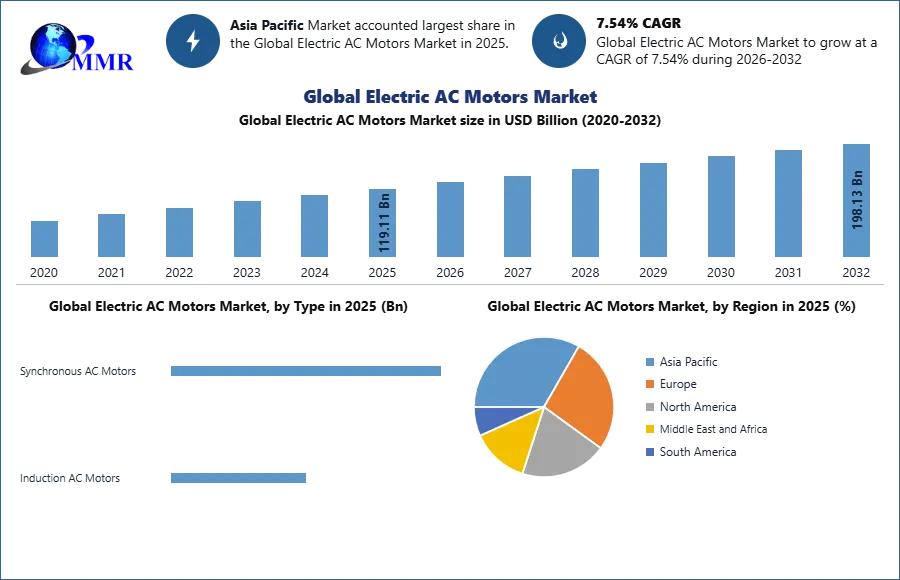
Electric AC Motors Market size was valued at USD 119.11 Bn. in 2025 and the total Global Electric AC Motors is expected to grow by 7.54% from 2026 to 2032, reaching nearly USD 198.13 Bn.
Electric AC Motors Market Overview:
Electric AC motors are devices that convert alternative current (AC) into mechanical energy, widely used in industrial, commercial, and residential applications due to their efficiency, reliability and low maintenance. Electric AC Motors market has been experiencing strong growth, expanding HVAC installations, and rapid industrial automation. The shift toward clean energy and government-backed environmental regulations is accelerating the adoption of AC motors in various fields. Key market insight highlights the dominance of induction motors due to their cost-effectiveness and scalability. Emerging industry trends, such as smart manufacturing and electric mobility, are also affecting motor design and innovation.
Asia Pacific region is expected to dominate the Electric AC Motors Market during the forecast period 2026-2032. Electric AC Motors Market key players are Siemens, ABB, Nidec Corporation, WEG and Toshiba Corporation. On September 14, 2023, Rockwell Automation, Inc. signed an agreement with Infinitum to co-develop and distribute the next-generation high-efficiency low-voltage energy and motor technology in North America. U.S. has enforced 25% tariffs on essential motor components such as rare-earth magnets, steel and semi-circulators. Additionally, 100% tariffs on Chinese electric vehicles under Section 301 have disrupted supply chains, inspiring companies to move manufacturing to Southeast Asia and Mexico. Electric AC Motors Market's end users include industrial manufacturers, HVAC system integrators, automotive OEMs, equipment manufacturers and infrastructure developers who seek efficient, reliable and energy-saving motor solutions.
Report covers the Electric AC Motors Market dynamics and structure by analyzing the market segments and projecting the Electric AC Motors Market size. It provides a clear representation of competitive analysis of key players by motor type, voltage category, end-use sector, product portfolio, strategic developments, and regional presence in the Electric AC Motors Market.
To know about the Research Methodology :- Request Free Sample Report
Global Electric AC Motors Market Dynamics:
Wide Application Scope And Operational Advantage Drive The Electric AC Motors Market
Compressors, fixed cranes, diesel-electric engines, and household appliances all utilize electric AC motors. They are appropriate for a number of applications because of their key features, including cost-effectiveness and efficient operation in severe environments. Because of their low maintenance requirements, long working life, and low power consumption, these high-efficiency items are expected to increase rapidly.
Rising Industrialization and Technological Advancements Drive the Electric AC Motors Market
Market is also growing due to the growing global demand for AC motor-driven engines. Furthermore, by 2032, factors such as rising demand for HVAC equipment and industrial machinery are expected to drive market demand. Over the last few years, AC motors have seen various technological breakthroughs, resulting in increased demand for these motors. Because of the growing number of industries in both developed and emerging countries, the market is expected to increase significantly over the forecast period. The widespread use of these items in various industrial equipment, including fixed cranes, conveyor belts, electric saws, and so on, is also driving the market.
Rising Fuel Costs and HVAC Expansion Drive the Electric AC Motors Market
In recent years, the market for electric motors has grown due to increased fuel prices and an increasing preference among customers to use cleaner energy sources. The demand is expected to be dominated by an AC motor, which is a crucial component of electric motors. Furthermore, rising environmental concerns and government measures aimed at preserving the environment remain the key drivers of market growth.
HVAC systems are widely used in a variety of settings, including commercial buildings, workplaces, and retail malls. Because of the increasing pace of urbanization and rising standard of living, HVAC systems are being installed on a massive scale. Air blowers that regulate airflow are powered by AC motors in HVAC equipment. During the forecast period, the capacity of AC types to run at multiple speeds, as well as greater dependability and operating efficiency, is expected to lead to an increase in their usage.
Electric AC Motors Market Segment Analysis:
Based on the Type, the market is segmented into Synchronous AC Motors and Induction AC Motors. Synchronous AC Motors segment is expected to hold the largest market share by 2032. In rare circumstances, synchronous motors can attain efficiencies of more than 90%, and they are generally more energy-efficient than induction motors. For power factor enhancement, a synchronous motor with no load connected to its shaft is employed. It is employed in power systems in cases where static capacitors are expensive due to their ability to behave at any electrical power factor. Synchronous motors are used in applications where the operating speed is low (about 500 rpm) but the power output is large. The size, weight, and cost of the equivalent three-phase induction motor are quite high for power requirements ranging from 35 kW to 2500 KW. As a result, these motors are preferred.
Induction AC Motors segment is expected to grow rapidly during the forecast period 2026-2032. Due to the lack of brushes, commutators, and slip rings, they require no maintenance, unlike dc and synchronous motors. Because induction motors do not contain brushes that can create sparks, they can be used in contaminated and explosive situations. In contrast to synchronous motors, three-phase induction motors have self-starting torque, therefore no starting methods are required. Single-phase induction motors, on the other hand, lack self-starting torque and must be coaxed to rotate using auxiliaries.
Based on the End-Use, the market is segmented into Industrial Machinery, Motor Vehicles, HVAC Equipment, Aerospace & Transportation, Household Appliances, and Others. The Industrial Machinery segment is expected to grow rapidly during the forecast period 2026-2032. Most industries rely on motorized automation, thus this segment offers plenty of opportunities for motor manufacturers. Pumps, boilers, compressors, and other applications utilizing electric AC motors are found in a variety of industries, including utilities, oil & gas, cement, and mining, as well as renewables, petrochemicals, chemicals, and water & wastewater treatment.
Electric AC motors power critical industrial processes like presses and rollers, as well as auxiliary systems like compressed air generation, ventilation, water pumping, and other mechanical handling and processing.
Electric AC Motors Market Regional Insights:
Asia Pacific Electric AC Motors Market was valued at USD 47.07 Bn. in 2025 and it is expected to reach USD 85.52 Bn. by 2032, at a CGAR of 7.87%. In each sector, Asia Pacific countries are shifting toward internet-based industrial activities as a result of fast industrialization. According to the GSM Association, established Asian countries such as South Korea, Japan, and Australia are progressively looking into the potential of new services and linked devices.
Region's automobile industry is rapidly booming. The Asia Pacific is the world's largest vehicle manufacturer. More than 50 million commercial cars were produced in the region. The electric AC motor market in the Asia Pacific is expected to rise as a result of these factors.
Objective of the report is to present a comprehensive analysis of the Global Electric AC Motors Market to the stakeholders in the industry. The past and current status of the industry with the forecasted market size and trends are presented in the report with the analysis of complicated data in simple language. The report covers all the aspects of the industry with a dedicated study of key players that include market leaders, followers, and new entrants.
PORTER, PESTEL analysis with the potential impact of micro-economic factors of the market has been presented in the report. External as well as internal factors that are supposed to affect the business positively or negatively have been analyzed, which will give a clear futuristic view of the industry to the decision-makers.
The reports also help in understanding the Global Electric AC Motors Market dynamic, and structure by analyzing the market segments and projecting the Global Electric AC Motors Market size. Clear representation of competitive analysis of key players by Distribution Channel, price, financial position, product portfolio, growth strategies, and regional presence in the Electric AC Motors Market make the report investor’s guide.
Electric AC Motors Market: Competitive Landscape
Electric AC Motors Market key players are Siemens, ABB, Nidec Corporation, WEG and Toshiba Corporation. These companies led due to their global scale, broad industrial applications and continuous investment in energy-efficient motor technologies. These firms are among the global leaders investing heavily in energy-efficient motor designs, IoT integration and automation systems to meet increasing demand for sustainability and performance. Also, TECO Electric & Machinery, Franklin Electric and CG Power are prominent players advancing the Electric AC Motors Market with region-specific innovations and reliable industrial applications. Siemens AG is the top company in the Electric AC Motors Market, generating €75.9 billion revenue for economic year 2024, leveraging its massive global footprint and deep investment in electrification solutions. Industry-wide adoption of electric vehicles, industrial automation and regulatory pressure on energy efficiency is reshaping the competitive landscape, with these players leading innovation and global supply.
Recent Industry Developments (2025–2026):
| Exact Date | Company | Development | Impact |
|---|---|---|---|
| 19 February 2026 | ABB Ltd. | Launched a new $2.0 billion share buyback program following record 2025 orders of $36.77 billion driven by AI data center and marine demand. | The move signals strong financial health and reinforces ABB's leadership in the high-efficiency motor segment for secular growth markets. |
| 04 February 2026 | Regal Rexnord Corporation | Reported a 53.8% increase in daily orders for Q4 2025, primarily secured through $735 million in e-Pod solution orders for data centers. | This breakthrough establishes a clear trajectory toward $1 billion in sales for their specialized automation and motion control business. |
| 08 December 2025 | Siemens AG | Board approved the sale of its Low Voltage Motors and Geared Motors business to Innomotics India for approximately INR 2,200 crore. | The divestment allows Siemens to focus on digital transformation and industrial AI while consolidating the motor business under KPS-owned Innomotics. |
| 17 March 2025 | Nidec Instruments | Launched the S-FLAG DYNAMIC MOTION™ MB Series AC Servo Motors designed for high-precision industrial robotics. | The launch enhances the company's competitive edge in factory automation by providing superior torque-to-weight ratios for robotic actuators. |
Key Trends in the Electric AC Motors Market:
• High-Efficiency Motor Adoption
Governments and industries are increasingly shifting to IE3 and IE4 electric AC motors to meet energy efficiency mandates, reduce carbon emissions, and lower operational costs across industrial and commercial sectors.
• Integration of Smart Motor Technologies
The adoption of IoT-enabled AC motors is rising, offering real-time diagnostics, condition monitoring, and predictive maintenance, enhancing reliability, minimizing downtime, and aligning with Industry 4.0 advancements globally.
• Expansion in EV and Industrial Automation
Electric vehicles and industrial automation demand compact, lightweight, and high-torque AC motors. This shift is fueling innovation in design, materials, and control technologies to meet evolving performance expectations.
Electric AC Motors Market Scope: Inquiry Before Buying
| Global Electric AC Motors Market | |||
|---|---|---|---|
| Report Coverage | Details | ||
| Base Year: | 2025 | Forecast Period: | 2026-2032 |
| Historical Data: | 2020 to 2025 | Market Size in 2025: | 119.11 USD Billion |
| Forecast Period 2026-2032 CAGR: | 7.54% | Market Size in 2032: | 198.13 USD Billion |
| Segments Covered: | by Type | Synchronous AC Motors Induction AC Motors |
|
| by Voltage | Integral HP Output Fractional HP Output |
||
| by End User | Industrial Machinery Motor Vehicles HVAC Equipment Aerospace & Transportation Household Appliances Others |
||
Electric AC Motors Market, by Region:
North America (United States, Canada and Mexico)
Europe (UK, France, Germany, Italy, Spain, Sweden, Austria, Turkey, Russia and Rest of Europe)
Asia Pacific (China, South Korea, Japan, India, Australia, Indonesia, Malaysia, Vietnam, Taiwan, Bangladesh, Pakistan and Rest of APAC)
Middle East and Africa (South Africa, GCC, Egypt, Nigeria and Rest of ME&A)
South America (Brazil, Argentina, Columbia and Rest of South America)
Key Players / Competitors Profiles Covered in Brief in Global Electric AC Motors Market Report in Strategic Perspective:
- ABB Ltd.
- Siemens AG
- Nidec Corporation
- WEG S.A.
- Regal Rexnord Corporation
- Wolong Electric Group
- Rockwell Automation Inc.
- Toshiba Corporation
- Yaskawa Electric Corporation
- Hitachi Ltd.
- Emerson Electric Co.
- Johnson Electric Holdings Limited
- Ametek Inc.
- Franklin Electric Co. Inc.
- TECO Electric & Machinery Co., Ltd.
- Brook Crompton Holdings Pte. Ltd.
- Allied Motion Technologies Inc.
- Hyosung Heavy Industries
- Robert Bosch GmbH
- Danfoss A/S
- Kirloskar Electric Company
- Mitsubishi Electric Corporation
- Sumitomo Heavy Industries Ltd.
- Schneider Electric SE
- Maxon Motor AG