
E-Invoicing Market by Component, Deployment Mode, Business Function, End-User Type, Industry Vertical, and Region – Global Market Size Estimation, Industry-Wide Analysis, Competitive Landscape Assessment & Long-Term Forecast to 2032
Overview
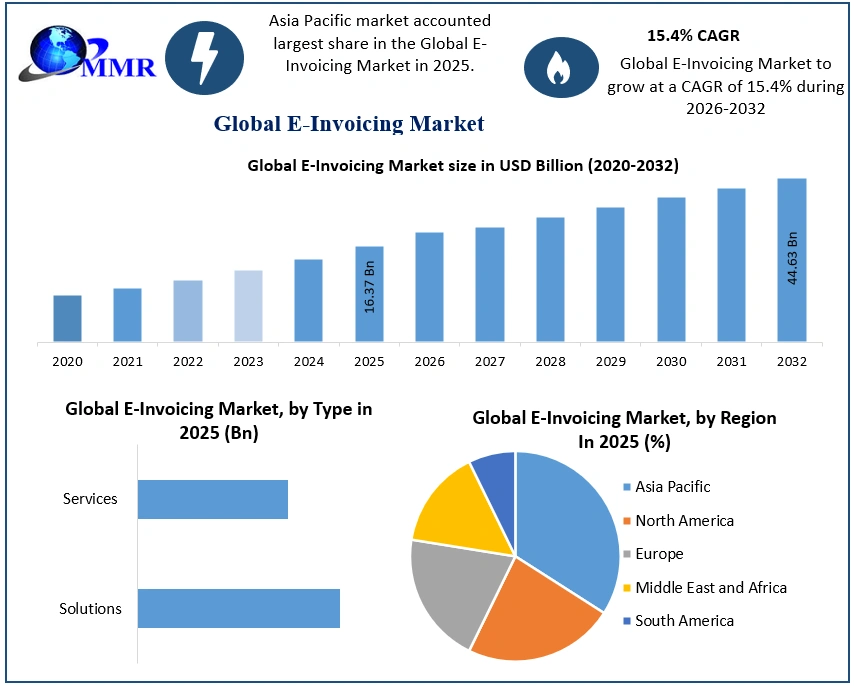
The E-Invoicing Market size was valued at USD 16.37 Billion in 2025 and the total E-Invoicing revenue is expected to grow at a CAGR of 15.4% from 2025 to 2032, reaching nearly USD 44.63 Billion by 2032.
E-Invoicing Market Overview:
E-invoicing is a digital alternative to traditional paper invoices, enabling businesses to create, send, receive, and process invoices electronically. This technology updates operations and reduces costs by automating tasks and incorporating seamlessly with accounting and financial systems. The international shift towards digitalization and automation is a significant driver, as businesses take faster and more efficient invoicing methods. Furthermore, government regulations mandating e-invoicing for tax and transparency further drive the E-Invoicing Market.

E-Invoicing Market: Recent Innovations
Recent innovations in the E-Invoicing Market highlight the growing adoption because of regulatory changes worldwide, as governments implement mandates to improve tax compliance and reduce fraud. Significant examples include the EU VAT directive and India's GST regulations. The integration of advanced technologies like artificial intelligence (AI) and blockchain is improving accuracy, security, and efficiency within the E-Invoicing Market, automating data entry, detecting fraud, and ensuring transaction integrity. The growth of cloud-based solutions has become prevalent owing to their scalability, flexibility, and cost-effectiveness, allowing businesses of all sizes to manage invoicing processes from anywhere. A substantial focus within the E-Invoicing Market is on small and medium enterprises (SMEs), with vendors offering affordable, simplified, and easy-to-implement solutions to facilitate their evolution to digital invoicing.
1. The KSA will commence the second phase of E-invoicing, known as the "Integration Phase," in January 2023. The initial "Generation Phase" began in December 2021.
2. Clear, an online taxation platform, announced its growth in the GCC region in November 2022. Clear has been operating in Saudi Arabia since 2021 and is now extending its services to the rest of the GCC region.
E-Invoicing Market Dynamics:
Growth of the E-Commerce Industry:
The significant growth of the e-commerce industry has led to a rise in online transactions, resulting in a higher volume of invoices that need to be generated, sent, received, and processed. E-invoicing provides an efficient solution to manage this increased workload. Given the diverse stakeholders included in e-commerce—sellers, buyers, and intermediaries e-invoicing platforms offer the necessary infrastructure to seamlessly handle these many parties and their invoicing needs. Additionally, the real-time nature of e-commerce transactions demands equally ready invoicing. E-invoicing systems support the instant generation and delivery of invoices, advancing customer experience and proving timely payment initiation.
To know about the Research Methodology:-Request Free Sample Report
Technological Developments in the E-Invoicing Market:
The rapid technological development and increasing emphasis on automation are fundamentally restructuring the e-invoicing market. Integration of automation technologies, such as AI and ML, is optimizing the e-invoicing process by streamlining tasks such as information extraction, data validation, and discrepancy prediction. Moreover, blockchain technology is adding prominence in the e-invoicing sector for its ability to provide secure, immutable transaction records, confirming data integrity and reducing the risk of fraud. These technological developments enhance the efficiency and accuracy of invoicing while adopting greater trust among stakeholders.
E-Invoicing Market Opportunity for New Entrance:
For new entrants in the Global E-Invoicing Market, there are various promising opportunities to explore. As governments across the world enforce stricter regulations for tax compliance and transparency, there is an expanding demand for e-invoicing solutions that adhere to these standards. New enterprises can capitalize on this need by utilizing innovative, compliant platforms that cater to diverse regulatory environments. Furthermore, the integration of cutting-edge technologies such as AI, and blockchain into e-invoicing systems presents a considerable opportunity. These technologies increase automation, accuracy, and security, and new entrants can differentiate themselves by proposing advanced, tech-driven solutions. The shift towards cloud-based services also provides a valuable opportunity for newcomers. Cloud-based e-invoicing platforms offer scalability, flexibility, and cost-efficiency, making them attractive to businesses of all sizes. Moreover, the rapid growth of the e-commerce sector has led to an increased volume of transactions and a need for efficient invoicing solutions.
Increasing into emerging E-Invoicing Markets represents another promising opportunity. Many developing regions are experiencing rapid digital transformation, and there is an extensive demand for accessible and affordable e-invoicing solutions. By affecting these regions, new entrants can tap into available markets. Furthermore, the growing need for effective cross-border transaction management and multi-currency invoicing presents an opportunity for newcomers to provides solutions that support global trade and compliance.
E-Invoicing Market Challenges:
In Global-Invoicing Market, a major challenge hampering growth is the risk of cyber-attacks and data privacy issues. E-invoicing includes handling sensitive company data, which is often stored online, both on cloud platforms or in on-premise databases, making it disposed to cyber threats. These cybersecurity and privacy concerns pose substantial challenges to the development of IT systems. As e-invoicing systems access and manage critical governmental data, they create potential vulnerabilities that unethical hackers may exploit. Mismanagement of data can raise the risk of cybercrime, possibly leading to diminished brand loyalty, costly lawsuits, and expensive insurance claims. Furthermore, technical glitches, errors, and the transfer of unsecured data within organizations further expose e-invoicing systems to cyber risks. Accordingly, addressing cybersecurity and privacy concerns remains a primary challenge for the E-Invoicing Market.
E-Invoicing Market Segment Analysis
Based on Business Function, the market is segmented into Finance & Accounting, Supply Chain Management, Human Resource Management, Sales & Marketing, and Others. Finance & accounting is expected to dominate the segment as enterprises increasingly rely on automated invoice processing, tax compliance, and real-time payment reconciliation. Supply chain management is another major adopter, driven by cross-border trade, vendor management, and procurement transparency. HR functions leverage e-invoicing for payroll and benefits administration, while sales & marketing integrate it into CRM and billing workflows. The ' Others' category includes IT operations and legal functions, where seamless invoicing ensures operational efficiency. This segmentation reflects the rising adoption of digital invoicing for efficiency, compliance, and audit readiness across enterprise functions.
Based on Industry Vertical, the market is segmented into BFSI, Retail & E-commerce, Healthcare, IT & Telecom, Energy & Utilities, Government, Transportation & Logistics, and Others. BFSI leads the adoption curve, with banks and financial institutions implementing e-invoicing to enhance transparency and meet regulatory mandates. Retail & e-commerce firms are rapidly adopting these solutions for handling large transaction volumes and ensuring real-time reconciliation. Healthcare relies on e-invoicing for vendor payments and insurance claims, while IT & telecom utilize it for subscription billing and global service contracts. Government mandates, especially in Europe and Asia, are accelerating adoption across public sector entities. Transportation & logistics players benefit from digitized invoicing for cross-border trade, reducing paperwork and fraud. Collectively, these industries highlight the diverse applicability and regulatory-driven demand for e-invoicing solutions.
E-Invoicing Market Regional Analysis:
In 2025, the Asia Pacific region led the global market with a substantial revenue share of 34.05%. China is one of the key markets for e-invoicing in APAC. Market growth in this region will be faster than the growth of the E-Invoicing Market in other regions. Government initiatives that mandate the use of e-invoicing practices in B2B and B2C services will facilitate the e-invoicing market growth in APAC over the forecast period.
In the India E-Invoicing Market, various significant developments have occurred recently. In April 2024, the Goods and Services Tax Network (GSTN) made an advisory mandating businesses with a turnover above INR 5 Crores in FY 2023-24 to generate e-invoices. Earlier, in Feb 2024, the Indian Government, in partnership with States and Union Territories, introduced a comprehensive e-invoice system. This system proposes a range of features, involving verification of enablement status, grievance resolution, IRN searches, and access to the IRP Portal and a dedicated mobile app. Furthermore, in February 2024, GSTN launched an increased e-invoice key information portal aimed at improving taxpayer services nationally. Furthermore, in June 2023, GSTN released an e-invoice QR Code Verifier app on the Google Play Store, permitting users to quickly and conveniently verify e-invoices. These innovations reflect the ongoing evolution and reinforcement of the e-invoicing framework in India.
E-Invoicing Market Scope:Inquire before buying
| Global E-Invoicing Market | |||
|---|---|---|---|
| Report Coverage | Details | ||
| Base Year: | 2025 | Forecast Period: | 2026-2032 |
| Historical Data: | 2020 to 2025 | Market Size in 2025: | USD 16.37 Bn. |
| Forecast Period 2026 to 2032 CAGR: | 15.4% | Market Size in 2032: | USD 44.63 Bn. |
| Segments Covered: | by Component | Solutions Services |
|
| by Deployment Mode | On-Premise Cloud-Based |
||
| by Business Function | Finance & Accounting Supply Chain Management Human Resource Management Sales & Marketing Others |
||
| by End-User Type | Large Enterprises Small & Medium Enterprises |
||
| by Industry Vertical | BFSI Retail & E-commerce Healthcare IT & Telecom Energy & Utilities Government Transportation & Logistics Others |
||
E-Invoicing Market, by Region
North America (United States, Canada and Mexico)
Europe (UK, France, Germany, Italy, Spain, Sweden, Austria and Rest of Europe)
Asia Pacific (China, South Korea, Japan, India, Australia, Indonesia, Malaysia, Vietnam, Taiwan, Bangladesh, Pakistan and Rest of APAC)
Middle East and Africa (South Africa, GCC, Egypt, Nigeria and Rest of ME&A)
South America (Brazil, Argentina Rest of South America)
E-Invoicing Market, Key Players:
1. Avalara - USA
2. Basware - Finland
3. Comarch SA - Poland
4. Corcentric Inc. - USA
5. Coupa Software - USA
6. DocuPhase - USA
7. Edicom - Spain
8. Esker - France
9. FreshBooks - Canada
10. IBM - USA
11. KashFlow Software Ltd - UK
12. OpenText Corporation - Canada
13. PaySimple - USA
14. Pragero - Not specified (Possibly USA-based)
15. Sage Group - UK
16. SAP - Germany
17. Seres (Docaposte) - France
18. Storecove - Netherlands
19. Tipalti Inc. - USA
20. Transcepta - USA
21. Tungsten Network - UK
22. Zycus - USA
Frequently Asked Questions:
1] Which region is expected to hold the largest market share in the global E-Invoicing Market?
Ans. The Asia Pacific region is expected to hold the largest market share in the E-Invoicing Market during the forecast period.
2] Which Product segment is expected to dominate the global E-Invoicing Market during the forecast period?
Ans. Cloud-based segment is expected to dominate the global E-Invoicing Market during the forecast period.
3] What are the major key players of the global E-Invoicing Market?
Ans. The major key players of the global E-Invoicing Market are Avalara, Basware, Comarch SA, Corcentric Inc, Coupa Software among others.
4] Which Application segment is expected to hold the largest market share in the global E-Invoicing Market?
Ans. The B2B segment is expected to dominate the global E-Invoicing Market during the forecast period.
5] Which type segment is expected to dominate the global E-Invoicing Market during the forecast period?
Ans. The Finance segment is expected to dominate the global E-Invoicing Market during the forecast period.