
Drip Irrigation Market Size by Component, Application, Crop Type and Region – Segment-Level Market Assessment, Growth Opportunity Analysis, Competitive Mapping & Forecast to 2032
Overview
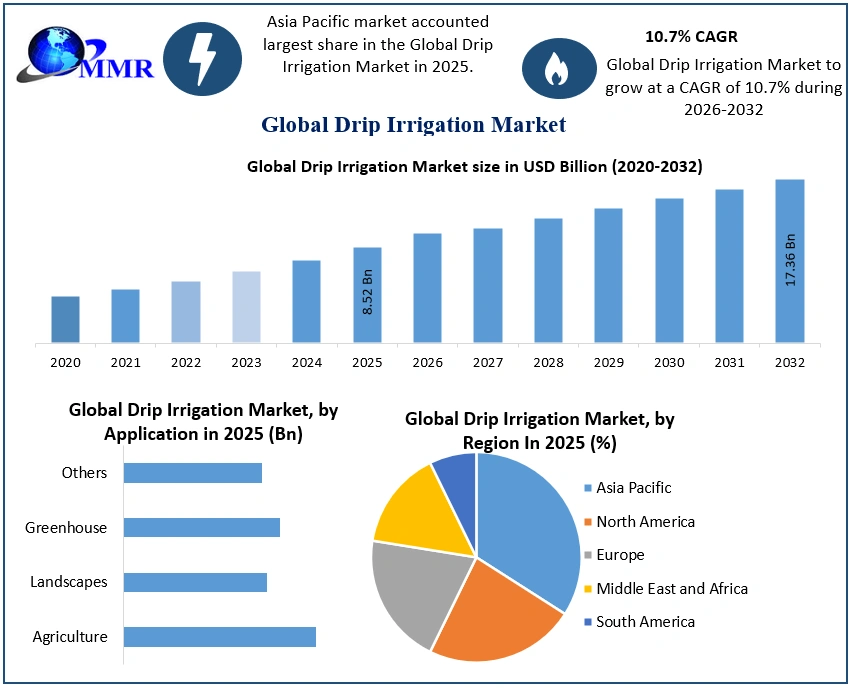
The Drip Irrigation Market size was valued at USD 8.52 Billion in 2025 and the total Drip Irrigation revenue is expected to grow at a CAGR of 10.7% from 2025 to 2032, reaching nearly USD 17.36 Billion by 2032.
The research gives a comprehensive perspective of the market by combining qualitative and quantitative data. It examines the global Drip Irrigation Market and provides forecasts for the key segments. It also includes market size and forecast estimates for five key regions: North America, Europe, Asia-Pacific (APAC), Middle East and Africa (MEA), and South America, for the years 2025 to 2032. The Drip Irrigation Market is further split into countries and markets within each location.
To know about the Research Methodology :- Request Free Sample Report
Drip Irrigation Market Dynamics
Due to their many advantages, the technologies continue to be extremely popular in farms and fields across the world. As a result, the market has been expanding at a comparable rate all over the world, and this tendency is likely to continue during the forecast period. These systems may be employed in environments with unusually shaped landscapes and surrounds, as well as places with uneven terrain or different types of soil. These techniques are more flexible, enabling farmers and gardeners to easily create a network as needed. The performance of the system is typically improved as a result. The drip irrigation market is anticipated to see growth over the expected period as a result of rising consumer awareness of these advantages and rising adoption of contemporary practices.
The global drip irrigation market is expanding as a result of the benefits that have grown in popularity among producers of field crops due to its precise application. Additionally, the market for drip irrigation is supported by higher pricing for field crops, decreased water use, and a move toward sustainable irrigation techniques. Secondly, a growing world population raises the need for food, which in turn fuels the expansion of the global drip irrigation market. The rise of the drip irrigation sector has also been spurred by government measures to provide subsidies and the rising costs of field crops.
Over the forecast period, it is expected that high expenses would somewhat impede the expansion of the global drip irrigation market's revenue. Another aspect that would have a negative effect on market revenue growth during the forecast period is the farmers in less developed nations' lack of knowledge about contemporary farming techniques.
Drip irrigation expenses and inputs in general:
With assistance from the UN Environment Programme and UNIDO, the Climate Technology Center and Network has identified and compiled the average costs of drip irrigation throughout the world. For drip irrigation on a one-hectare parcel of land, the prices given below. The main inputs are the components of the distribution network, which include the drip line, filtration and fertilising systems, and pump. Installation labour costs are also substantial. System operation and maintenance training is anticipated to last three days.
| Drip Irrigation in 1 Hectare | USD |
| Labour | 520 |
| Material | 4300 |
| Training | 180 |
| 180 | 5000 |
Commercial manufacturing options, according to BIOVISION, are, as previously said, highly expensive. Small-scale farmers can construct a drip irrigation system using locally available materials for $15 to $85 or buy one for between $15 and $85. (buckets, bamboo, or plastic pipes). Although it is often more expensive than manual irrigation, it increases yields and uses less water.
Trends in the drip irrigation market:
1. The use of vertical farming technologies is spreading:
The significance of drip irrigation in vertical farming cannot be overstated. By their very nature, all vertical farming methods need on a little amount of irrigation. In hydroponics, micro irrigation is utilised to immerse plant roots in liquid solutions containing the necessary macronutrients. Similar techniques are used in aquaponics, however instead of being manually created, nutrient-rich irrigation water is acquired from fish tanks. Last but not least, aeroponics employs the same kind of pipes as drip irrigation but sprays the nourishing liquid solution rather than dripping it.
2. Cannabis agriculture: a new development to watch for important figures:
Since it has been permitted to utilise cannabis for a variety of products over the previous five years, production has increased. Because it is a plant with a constrained growth cycle, its output lasts for around 3 to 5 months. During this phase, cannabis plants need a controlled environment as well as regular watering and fertilisation. As a result, irrigation quickly turns into a time-consuming but important task, especially in the competitive cannabis-growing market of today when resources like time and money are few. Drip irrigation is practically necessary for effectively growing cannabis. In addition to being effective, drip irrigation is an excellent way to modify a crop's essential aspects, including as pH and conductivity.
3. The significance of precision agriculture is increasing:
Precision farming combines cutting-edge technology with complex farming practises to maximise crop production, farming efficiency, and financial success. To map a crop's productivity, specialised drones, satellite imagery data, and GPS devices must be used. As a consequence, the farmer may decide whether parts of the crop need further care, such watering or fertilising. And using drip irrigation systems that have been properly planned and constructed is necessary if you want to have genuine control over the pace at which fertiliser or irrigation water is supplied. Because of this, drip irrigation is crucial in precision agriculture. It provides farmers with the precision and control they require.
Drip Irrigation Market Segmentation
The market is divided into several segments depending on the type of crop, including field crops, vegetable crops, and fruits and nuts. Throughout the projected period, the sector for fruits and nuts is anticipated to expand rapidly. The demand for fruits and nuts rises along with the deployment of drip irrigation due to expanding exports and strong profit margins. Fruit crops include bananas, grapes, citrus, pomegranate, papaya, sweet lime, mango, and watermelon benefit from drip irrigation. They boost fruit production, promote early maturation, and conserve water. Additionally, the market for vegetable crops is anticipated to see strong CAGR growth throughout the projection period. Different crops require various levels of irrigation.
Drip Irrigation Market Regional Insight
The drip irrigation market in Asia Pacific is expected to be the largest and expand at the quickest rate, with 12.6% of CAGR. Asia Pacific had the highest consumption of drip irrigation in 2025. The region is moving away from installing basic irrigation infrastructure and toward implementing precision irrigation systems as a result of technical improvements. The emphasis on agriculture has shifted away from traditional crops and toward more industrialised ones. As a result of these changes, irrigation facilities are supposed to improve their infrastructure and irrigation management. Drip irrigation is now essential since commercial crops are sensitive to the quantity of water they get.
Over the course of the forecast period, the Europe drip irrigation market is anticipated to post a strong revenue share. This is because rising industrialisation has led to a loss of arable land, which has raised demand for drip irrigation systems. Government programmes that encourage the use of drip irrigation systems on farms to boost agricultural output also contribute to the market expansion in this area.
Report Objectives:
1. Landscape analysis of the Drip Irrigation Market
2. competitive benchmarking
3. Past and current status of the industry with the forecasted market size and trends
4. Evaluation of potential key players that include market leaders, followers, and new entrants
5. Technology trends
6. The potential impact of micro-economic factors on the market
7. External and Internal factors affecting the market have been analyzed
The report also helps in understanding the Drip Irrigation Market dynamics, and structure by analyzing the market segments to project the Drip Irrigation Market size. Clear representation of competitive analysis of key players by product, price, financial position, product portfolio, growth strategies, and regional presence in the Drip Irrigation Market make the report investor’s guide.
Drip Irrigation Market Scope: Inquire before buying
| Global Drip Irrigation Market | |||
|---|---|---|---|
| Report Coverage | Details | ||
| Base Year: | 2025 | Forecast Period: | 2026-2032 |
| Historical Data: | 2020 to 2025 | Market Size in 2025: | USD 8.52 Bn. |
| Forecast Period 2026 to 2032 CAGR: | 10.7% | Market Size in 2032: | USD 17.36 Bn. |
| Segments Covered: | by Component | Valves Pressure Gauge Filters Emitters Drip Tube Others |
|
| by Application | Agriculture Landscapes Greenhouse Others |
||
| by Crop Type | Fruits and nuts Vegetable crops Field crops Others |
||
Drip Irrigation Market, by Region
North America (United States, Canada and Mexico)
Europe (UK, France, Germany, Italy, Spain, Sweden, Austria and Rest of Europe)
Asia Pacific (China, South Korea, Japan, India, Australia, Indonesia, Malaysia, Vietnam, Taiwan, Bangladesh, Pakistan and Rest of APAC)
Middle East and Africa (South Africa, GCC, Egypt, Nigeria and Rest of ME&A)
South America (Brazil, Argentina Rest of South America)
Drip Irrigation Market, Key Players
1. EPC Industries Limited
2. Driptech Incorporated
3. Microjet Irrigation Systems
4. Rain Bird Corporation
5. Rivulus Irrigation
6. Netafim limited
7. Jain Irrigation System Limited
8. The Toro Company
9. Eurodrip S.A
10. Valmont Industries
11. T-L Irrigation Company
12. Reinke Manufacturing Company, Inc.
13. ELGO Irrigation Limited
14. Hunter Industries Inc.
15. Lindsay Corporation
Frequently Asked Questions
1. What was the Global Drip Irrigation Market size in 2025?
Ans: The Global Drip Irrigation Market size was USD 8.52 Billion in 2025.
2. What are the key driving factors for the growth of the Drip Irrigation Market?
Ans- The drip irrigation market is anticipated to see growth over the expected period as a result of rising consumer awareness of these advantages and rising adoption of contemporary practices.
3. Which Region accounted for the largest Drip Irrigation Market share?
Ans- The drip irrigation market in Asia Pacific is expected to be the largest and expand at the quickest rate, with 12.6% of CAGR.
4. What makes Europe a Lucrative Market for Drip Irrigation Market?
Ans- Government programmes that encourage the use of drip irrigation systems on farms to boost agricultural output also contribute to the market expansion in this area.
5. What are the top players operating in the Drip Irrigation Market?
Ans- EPC Industries Limited, Driptech Incorporated, Microjet Irrigation Systems, Rain Bird Corporation, and Rivulus Irrigation.