
Dill Pickles Market Size – Industry Structure Evaluation, Demand Drivers Analysis, Regional Growth Analysis and Identification, Competitive Positioning Review & Global Market Size Forecast to 2032
Overview
Global Dill Pickles Market size was valued at USD 13.69 Bn. in 2025, and the total Dill Pickles Market revenue is expected to grow by 4.6% from 2026 to 2032, reaching nearly USD 17.68 Bn.
Dill Pickles Market Overview:
Dill pickles are cucumbers preserved in a vinegar or brine solution, flavoured predominantly with dill weed and other spices, for a distinct, tangy taste.
The market study elaborates that dill pickles occupy a significant share of the global pickles market due to their high consumption in fast foods, sandwiches, burgers, and as a standalone snack. According to the report, the market is well-supported by an abundant supply of cucumbers and efficient preservation technologies, ensuring steady availability throughout the year despite seasonal harvesting challenges.
North America dominated the global Dill Pickles Market in 2025, with the United States leading due to strong demand from both households and the foodservice industry, while Europe followed closely, driven by traditional pickle culture. Key players identified in the report include Mt. Olive Pickle Company, Kraft Heinz (Vlasic and Claussen), Gedney Foods, Kühne GmbH, and Orkla ASA, all of whom are focusing on product innovation, organic options, and convenient packaging.
The Dill Pickles Market Report details end-user contribution, indicating that retail consumers form the largest segment, followed by restaurants and quick-service outlets. The study also explores evolving trends such as low-sodium variants and probiotic-rich dill pickles, offering insights into the factors shaping demand and competitive dynamics from 2025-2032.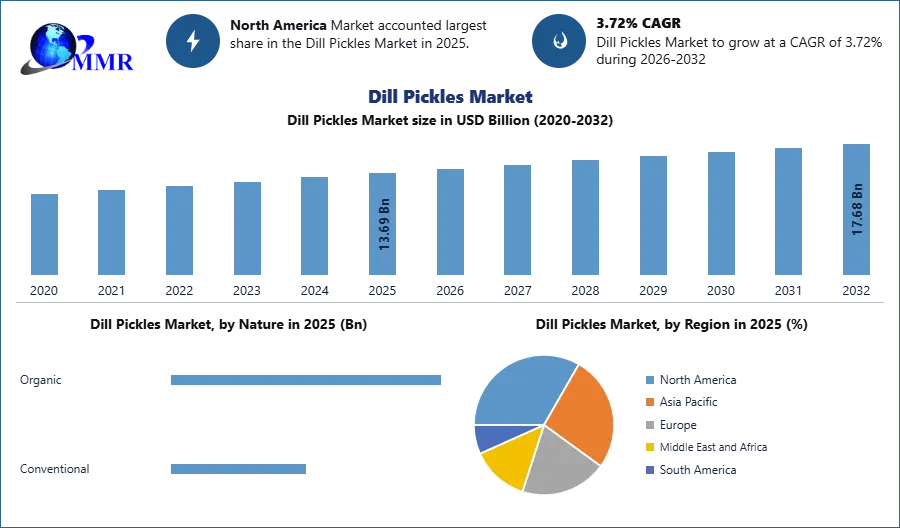 To know about the Research Methodology :- Request Free Sample Report
2025 is considered a base year to forecast the market from 2026 to 2032. 2025’s market size is estimated based on real numbers and outputs of the key players and major players across the globe. The past five years' trends are considered while forecasting the market through 2032. 2020 is a year of exception and is analyzed especially with the impact of lockdown by region.
Dill Pickles Market Dynamics
Probiotic Demand and Fast-Food Industry Expansion Dill Pickles Market Growth
The Dill Pickles market is expected to witness robust growth by 2032, driven primarily by increasing consumer preference for tangy, fermented, and probiotic-rich foods that support gut health. Growing demand for convenient, ready-to-eat snacks, coupled with the rising popularity of sandwiches, burgers, and fast-food chains that use dill pickles as a key ingredient, significantly boosts consumption. Additionally, the surge in product innovation, such as new flavor infusions and organic, low-sodium variants, attracts health-conscious buyers. Expanding retail distribution through supermarkets, convenience stores, and online channels further propels market expansion.
Premiumization and Globalization to Create Dill Pickles Market Opportunity
Ample opportunities exist for manufacturers in the Dill Pickles market to capitalize on evolving consumer trends by launching premium and organic product lines, experimenting with unique flavors like spicy or sweet dill, and offering smaller, single-serve packaging targeting on-the-go snacking. The growing popularity of plant-based and clean-label diets opens doors for brands to highlight natural fermentation processes and probiotic benefits. Emerging markets in Asia-Pacific and Latin America, where Western cuisines are increasingly embraced, present untapped potential for global brands to expand their footprint and diversify revenue streams by 2032.
Raw Material Volatility and Rising Competition to Create the Dill Pickles Market Challenges
Despite favorable growth prospects, the Dill Pickles market faces notable challenges by 2025, including fluctuating raw material prices, particularly cucumbers and spices, which impact production costs. Supply chain disruptions, due to weather variability affecting cucumber yields, pose an ongoing risk to consistent product availability. In addition, maintaining flavor consistency and shelf stability without artificial preservatives requires careful formulation and quality control. Intense competition from local and artisanal pickle makers further pressures established brands to differentiate through branding and innovation.
Health Concerns and Regulatory Pressures to Restrain the Dill Pickles Market
Key restraints for the Dill Pickles market include rising health concerns over high sodium content, which deters a section of health-focused consumers. Strict food safety and labeling regulations, especially in North America and Europe, can increase compliance costs for manufacturers. Moreover, shifting consumer preference towards fresh or homemade pickling alternatives may limit growth in certain mature markets. Economic fluctuations and changing import/export tariffs also create uncertainties that can impact pricing strategies and profitability for global players by 2032.
Dill Pickles Market Segment Analysis:
Based on Nature, the Market is segmented into Organic and Processed. The processed segment dominated the Dill Pickles Market in 2025. The pickling technique uses acetic acid from vinegar rather than lactic acid from fermentation, quick-process pickles fluctuate from enflamed pickles. Quick-process pickles are ideal for entities that formulate pickles in a few days. In the U.S population, processed pickle has an extensive appeal and are chosen by a ratio of more than two to one compared to any other type of pickle. Bread & Butter is a detached second (21%), even with the statistic that only 12 % of millennials select it as their preference.
Based on Product Type, the market is segmented into Kosher, Polish, Genuine, Baby, and Others. The Kosher segment held the largest share of the Dill Pickles Market, accounting for 37% in 2025. Kosher pickles are made with brine and garlic, and typically use coarse-grained salt for preserving meats and vegetables. The cultural traditions of the Jewish community are expected to drive the growth of the Kosher pickle segment. However, the Polish pickle segment is projected to grow steadily during the forecast period. Polish pickles are made using kosher salt, water, dill, and cucumbers. In the preservation process, Polish pickles generally contain more fresh dill compared to Kosher pickles. Additionally, spices such as black pepper, red pepper, and mustard seeds are frequently used in Polish pickles in recent times.
Dill Pickles Market Regional Insights:
The North American region is expected to dominate the market through the forecast period (2026-2032). The rising demand for Dill Pickles and the wide usage of the product in fermented food products are creating profitable growth in this region. Michigan produced 37.3 % of all pickles produced in the United States in 2025. Pickling cucumbers were grown on 35,000 acres in this region in 2025. Five states account for 75% of all pickles such as Michigan, Florida, Wisconsin, Ohio, and Texas.
However, the European region is expected to grow at a CAGR of xx% during the forecast period. The Pickles Market in this region has grown up because of the nutritious benefits of vigorous and low-fat foodstuffs, as well as a cumulative taste for pickles in cookery. Pickle sales have poured in this region due to an upsurge in healthy food consumption and the nourishing doses of agitated pickles. Ingesting pickles is focused on the European region, accounting for 72% of total consumption.
The objective of the report is to present a comprehensive analysis of the global Dill Pickles Market to the stakeholders in the industry. The past and status of the industry, with the forecasted market size and trends, are presented in the report, with the analysis of complicated data in simple language. The report covers all the aspects of the industry with a dedicated study of key players that include market leaders, followers, and new entrants.
PORTER, PESTEL analysis with the potential impact of micro-economic factors of the market has been presented in the report. External as well as internal factors that are supposed to affect the business positively or negatively have been analyzed, which will give a clear futuristic view of the industry to the decision-makers.
The reports also help in understanding the Dill Pickles Market dynamics, structure by analyzing the market segments and projecting the Dill Pickles Market size. Clear representation of competitive analysis of key players by Technology, price, financial position, product portfolio, growth strategies, and regional presence in the Dill Pickles Market makes the report an investor’s guide.
Competitive Landscape of Dill Pickles Market:
The dill pickles market is highly competitive, featuring a mix of global giants, regional leaders, and niche artisanal brands. Major players like Vlasic (Conagra Brands), Kraft Heinz, and Mt. Olive Pickle Company dominate supermarket shelves with classic and flavored dill pickles, while expanding low-sodium and organic offerings to meet health-conscious demand. Alongside them, premium brands such as Bubbies, Grillo’s Pickles, and McClure’s carve out market share through clean-label, naturally fermented products and unique flavor innovations. Private labels from retailers like Aldi and Trader Joe’s intensify price competition by offering affordable alternatives.
The competitive landscape is further shaped by emerging start-ups and local producers who emphasize sustainability, small-batch production, and direct-to-consumer sales through online channels and subscription boxes. Overall, the market is witnessing steady growth driven by rising consumer preference for healthier, probiotic-rich snacks, creative flavor profiles, and eco-friendly packaging, compelling both large and small players to continuously innovate and differentiate their products.
Key Trends shaping the dill pickle market
1. Health-focused, clean-label & probiotic products – Increasing consumer demand for better-for-you foods is driving pickle brands to offer low-sodium, preservative-free options and fermented (naturally cultured) varieties rich in live probiotics. Fermented pickles are seen not only as flavorful but also beneficial for gut health, prompting both large and artisanal producers to reformulate recipes and highlight clean-label credentials.
2. Flavor innovation & snack crossover expansion – Bold new taste combinations—from spicy jalapeño, kimchi-style, and exotic fruit pickles to pickle-flavored snacks like chips, popcorn, pistachios, ramen, and even chickpea puffs—are proliferating across retail and foodservice. This reflects a broader trend of snack-flavored experiences, fueled heavily by Gen Z and Millennial interest, social media virality, and global flavor fusion.
Recent Industry Developments
| Exact Date | Company | Development | Impact |
|---|---|---|---|
| 14 March 2026 | Patriot Pickle | Completed the phase-two expansion of its Garland, Texas production facility, doubling the capacity for refrigerated kosher dill spears. | The expansion significantly strengthens regional supply chain resilience for the southern US foodservice and private-label sectors. |
| 28 January 2026 | The Kraft Heinz Company | Executed a strategic corporate restructuring of its condiments division to accelerate the innovation of clean-label and low-sodium dill products. | This shift is expected to shorten R&D cycles for health-aligned pickles, targeting the growing probiotic snack market. |
| 12 November 2025 | Vlasic (Conagra Brands) | Launched a new "Snack-to-Go" line featuring single-serve pouches of extreme-crunch dill chips designed for convenience retail. | The move directly addresses the on-the-go snacking trend, diversifying the brand beyond traditional jarred household consumption. |
| 15 September 2025 | Mt. Olive Pickle Company | Announced a multi-year technology partnership to implement AI-driven automated brining systems across its North Carolina facilities. | Automated precision in fermentation is projected to increase product consistency and reduce batch-to-batch flavor variance by 15%. |
| 22 June 2025 | Grillo’s Pickles | Secured a nationwide distribution agreement with a major big-box retailer to stock its non-pasteurized organic dill varieties. | The deal marks a major competitive threat to shelf-stable brands by bringing premium refrigerated pickles to mainstream consumers. |
Dill Pickles Market Scope: Inquiry Before Buying
| Dill Pickles Market | |||
|---|---|---|---|
| Report Coverage | Details | ||
| Base Year: | 2025 | Forecast Period: | 2026-2032 |
| Historical Data: | 2020 to 2025 | Market Size in 2025: | 13.69 USD Billion |
| Forecast Period 2026-2032 CAGR: | 3.72% | Market Size in 2032: | 17.68 USD Billion |
| Segments Covered: | by Nature | Organic Conventional |
|
| by Product Type | Whole Pickles Sliced Pickles Spears Chips Others |
||
| by Distribution Channel | Supermarkets & Hypermarkets Convenience Stores Online Retail Specialty Stores |
||
Dill Pickles Market, by Region
North America (United States, Canada and Mexico)
Europe (United Kingdom, France, Germany, Italy, Spain, Sweden, Russia, Rest of Europe)
Asia Pacific (China, Japan, South Korea, India, Australia, Malaysia, Thailand, Vietnam, Indonesia, Philippines, Rest of APAC)
Middle East and Africa (South Africa, GCC, Nigeria, Egypt, Turkey, Rest of MEA)
South America (Brazil, Argentina, Colombia, Chile, Peru, Rest of South America)
Key Players / Competitors Profiles Covered in Brief in Global Dill Pickles Market Report in Strategic Perspective:
- Mt. Olive Pickle Company
- Conagra Brands
- The Kraft Heinz Company
- ADF Foods
- Del Monte Foods
- B&G Foods
- Orkla ASA
- Patriot Pickle
- Bay Valley Foods
- Gedney Foods Company
- Hausbeck Pickle Company
- Freestone Pickle Company
- Dillman Farm
- Nilon's Enterprises
- M.A. Gedney
- American Garden
- Annie's Homegrown
- Saks Pickles
- Hermann Pickle
- Grillo’s Pickles
- Clemson’s Best
- McClure's Pickles
- Glaser's
- The Real Dill
- Farmhouse Culture