
Digital Light Processing Chipset Market – Global Market Size, Strategic Growth Drivers, Risk Assessment Framework, Regulatory Landscape Review, Competitive Intensity Mapping & Long-Term Industry Outlook to 2034
Overview
The Global Digital Light Processing Chipset Market size was valued at USD 6.26 Billion in 2025 and the total Digital Light Processing Chipset Market revenue is expected to grow at a CAGR of 7.1% from 2026 to 2034, reaching nearly USD 11.61 Billion.
Digital Light Processing Chipset Market Overview
The Digital Light Processing (DLP) Chipset Market is currently experiencing robust growth driven by several key factors. DLP technology, widely used in applications such as projectors, 3D printing, and automotive head-up displays, is gaining momentum due to its superior image quality, energy efficiency, and reliability. The market has witnessed an upsurge in demand, primarily attributed to the burgeoning entertainment industry, increased adoption of high-quality projectors in corporate and educational sectors, and the integration of DLP chipsets in emerging technologies like augmented reality (AR) and virtual reality (VR). Furthermore, the pandemic-induced shift towards remote work and virtual communication has further fuelled the demand for DLP-based video conferencing and home entertainment solutions.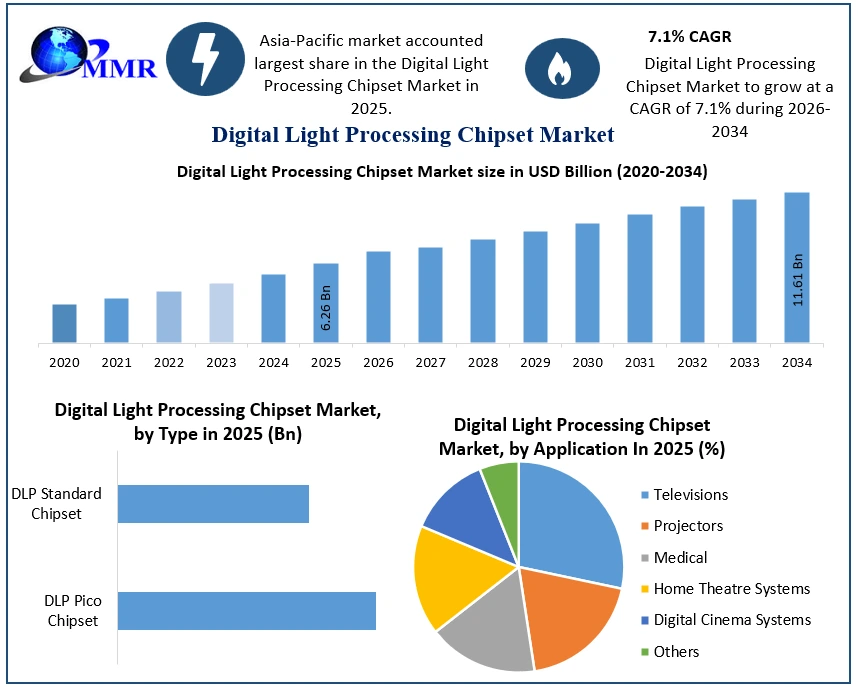
To know about the Research Methodology :- Request Free Sample Report
Prominent players in the Digital Light Processing Chipset market, including Texas Instruments, are actively investing in research and development to enhance the performance and efficiency of DLP chipsets. Recent developments in the industry include advancements in micro-mirror technology, enabling higher resolution and brightness in DLP projectors, as well as the miniaturization of chipsets for compact consumer electronics like smartphones and wearable devices. With the continued expansion of its application spectrum, the DLP Chipset Market is poised for growth in the forecast period.
The Digital Light Processing Chipset Market Dynamics
Powering Entertainment, Education, Automotive, Healthcare in DLP Chipsets Fuels Market Growth
The Digital Light Processing (DLP) Chipset Market is being propelled by a multitude of growth drivers. The expansion of the entertainment industry, encompassing cinema, gaming, and live events, has led to increased demand for DLP chipsets. These chipsets have become integral in delivering immersive visual experiences in cinemas and gaming, with companies like Barco utilizing them to enhance audience engagement. In the education sector, DLP technology is gaining prominence, as it enhances interactive learning experiences.
Notably, companies like BenQ offer DLP-based projectors with interactive features, facilitating effective teaching methods. Simultaneously, the corporate sector relies on DLP projectors for presentations and conferences, with leading manufacturers such as Epson catering to their needs through advanced connectivity options. DLP chipsets are also making significant strides in the automotive industry, where they are pivotal in advanced head-up displays (HUDs). Automakers like Texas Instruments collaborate to develop HUDs that project essential information onto windshields, increasing driver safety.
In the healthcare sector, DLP technology finds applications in medical imaging equipment, offering accurate diagnoses. Companies like Philips Healthcare incorporate DLP chipsets into their medical displays, improving visualization. Moreover, DLP technology plays a crucial role in high-resolution 3D printing, with manufacturers like Formlabs employing it for precise and detailed printing. The market is further bolstered by the growth of augmented and virtual reality applications, exemplified by DLP-based VR headsets like Oculus Rift. DLP chipsets are also increasingly integrated into compact consumer electronics, such as Pico projectors in devices like Sony, and large venue projectors used in sports arenas and auditoriums, with companies like Optoma offering high-brightness and high-resolution solutions. Lastly, DLP's energy efficiency aligns with sustainability trends, with reduced power consumption in DLP projectors, as seen in offerings from companies like Casio, catering to eco-conscious consumers and fostering growth in the green technology sector.
For Instance, in February 2022, the Einstein Pro XL represents a DLP-based polymer printing system equipped with a 4K ultra-high-definition projector, ensuring precise printing capabilities with a resolution of 45 microns in both X and Y dimensions. This high-speed printer incorporates exclusive Hyperprint technology, which significantly accelerates printing by strategically applying heat and utilizing a closed-loop sensing system, among other improvements. With a price tag of USD 39,999 and no requirement for a long-term lease commitment, the Einstein Pro XL is an attractive option. It complements the existing entry-level Einstein desktop printer introduced in 2022, forming a comprehensive range of printing solutions tailored to the needs of dental and medical professionals. All these factors are estimated to accelerate the Digital Light Processing Chipset market growth rate in the next few years.

High Manufacturing Costs and Periodic Maintenance Restrain the DLP Chipsets Market Growth Trend
The Digital Light Processing Chipset Market, while experiencing growth, faces a set of substantial restraints and challenges. One of the primary barriers is the violent competition posed by emerging display technologies like OLED and MicroLED, which offer superior contrast ratios and energy efficiency, diverting attention from DLP solutions. Moreover, the manufacturing of DLP chipsets involves intricate processes, resulting in relatively high production costs, and limiting their affordability and accessibility. Despite ongoing efforts, DLP-based projectors still encounter size and portability constraints, hindering their integration into compact devices like smartphones. Additionally, the need for periodic maintenance, including lamp replacements, is a drawback in sectors demanding uninterrupted operation, such as healthcare and education. DLP projectors have made strides in resolution but may still fall short in applications requiring exceptionally high-definition visuals. Market saturation poses challenges in segments like home entertainment projectors.
Furthermore, the complexity of alignment and calibration required by DLP systems deter potential users, favoring more user-friendly alternatives. In terms of power consumption, despite improvements, some DLP projectors remain less energy-efficient than competitors. Environmental concerns have also arisen, with shifting preferences towards greener technologies, given the use of lamps and potential mercury content in some DLP lamps. Navigating intellectual property and licensing issues, as seen with Texas Instruments' agreements, leads to legal disputes and increased costs for companies utilizing DLP technology in their products. These challenges collectively influence the trajectory of the Digital Light Processing Chipset Market Demand.
The intersection of 3D printing and the Digital Light Processing Chipset Market presents a dynamic landscape ripe with potential. DLP technology's precision and speed have made it an ideal candidate for 3D printing applications. By using DLP-based resin printers, manufacturers rapidly prototype intricate designs and produce complex objects with remarkable detail. One of the key advantages of DLP technology in 3D printing is its ability to cure entire layers of resin simultaneously, resulting in faster printing times compared to traditional layer-by-layer methods. This efficiency is particularly valuable in industries like healthcare and aerospace, where rapid prototyping and the production of customized, high-precision components are critical.

Broadening Prospects for 4K and 8K Displays Propel the DLP Chipset Market Demand
The DLP (Digital Light Processing) chipset market is primed for substantial growth across multiple sectors due to various opportunities. The increasing demand for 4K and 8K displays in consumer electronics has created a need for DLP chipsets to power high-resolution projectors and televisions. For instance, Texas Instruments' DLP technology is integrated into projectors like the BenQ HT3550, providing stunning 4K visuals for home entertainment. In the automotive industry, DLP chipsets are driving the growth of Head-Up Displays (HUDs), with companies like Continental using them to create augmented reality HUDs that enhance driver safety.
Additionally, DLP chipsets are well-suited for Augmented Reality (AR) and Mixed Reality (MR) applications, exemplified by Microsoft's HoloLens 2, which leverages DLP technology to deliver a seamless mixed reality experience. The expansion of AR and MR beyond gaming into healthcare and education bodes well for DLP chipsets. Furthermore, DLP-based 3D printing is gaining momentum for its speed and precision, as seen with companies like Carbon, which utilizes DLP technology for rapid prototyping and complex object manufacturing. In the medical field, DLP chipsets find application in digital X-ray systems, such as GE Healthcare's Revolution ACTs CT scanner, offering high-quality images with reduced radiation exposure.
Industrial and consumer projectors, as well as smart home devices, increasingly rely on DLP technology. This includes interactive whiteboards in education technology (EdTech) and smart mirrors with real-time updates in the smart home market. As remote work and home entertainment trends continue, DLP chipsets stand to grow in these segments. Gaming consoles like the Xbox Series X employ DLP-based digital projectors to deliver immersive gaming experiences, reflecting the potential for DLP chipsets in gaming peripherals and displays.
Finally, the miniaturization capabilities of DLP technology position it well for wearables, such as smart glasses exemplified by devices like the Vuzix Blade and North Focals. These wearables offer applications in enterprise and consumer markets, contributing to the development of the DLP chipset market. In summary, DLP chipsets are set to capitalize on a diverse range of growth opportunities across industries driven by their ability to deliver high-quality visuals and innovative applications. These initiatives are predicted to boost the digital light processing chipset market size during the analysis timeframe.

Digital Light Processing Chipset Market Segment Analysis:
Based on Chip Model, the market has been divided into 1-chip DLP and 3-chip DLP. Among these, the 1-chip DLP sub-segment is projected to generate the maximum revenue. The 1-chip sub-segment witnessed the highest market share in the global digital light processing chipset market analysis in 2023. The 1-chip DLP (Digital Light Processing) segment within the DLP Chipset Market represents a significant category with distinct application and adoption characteristics. This segment is known for its compact design and versatility. In the realm of consumer electronics, 1-chip DLP technology is frequently employed in compact projectors and pico projectors. These portable devices have gained popularity for on-the-go entertainment and business presentations due to their small form factor and impressive image quality.
Furthermore, the automotive sector is adopting 1-chip DLP for smaller Head-Up Displays (HUDs) and augmented reality features, especially in vehicles with limited dashboard space. The technology's potential is also evident in the realm of education technology (EdTech) where interactive whiteboards and portable projectors are becoming prevalent tools for dynamic learning experiences. The 1-chip DLP technology's adaptability extends to smart home devices, including compact smart projectors and miniaturized displays. Its applications in gaming peripherals and wearables are also noteworthy, as it offers a balance between performance and size. In summary, the 1-chip DLP segment provides compact, versatile solutions for a range of applications, making it a key player in the broader DLP Chipset Market. These factors are anticipated to boost Digital Light Processing Chipset market growth in the upcoming years.
Digital Light Processing Chipset Market Regional Insights
The Asia Pacific region dominated the digital light processing chipset market trend in the year 2025 and is expected to continue its dominance during the forecast period. The Asia-Pacific digital light processing chipset market is poised for substantial growth in the foreseeable future, driven by the increasing digitalization within the education sector and the burgeoning entertainment industry in countries like India, China, and Japan. Furthermore, this region is home to leading market players, including Sharp Corporation, BenQ Corporation, Vivitek, Panasonic Corporation, LG Electronics, and others.
The rise of smart classrooms and a heightened focus on enhancing the education system are key growth factors in this region. For instance, Pakistan's government has been actively investing in educational infrastructure and higher education through initiatives like the 'Smart Classroom' project under the China-Pakistan Economic Corridor (CPEC). Similarly, the Indian government is shifting from traditional classrooms to smart ones, with plans to digitize thousands of classrooms in government schools in states like Telangana, Ajmer, and Uttarakhand. Uttarakhand, for instance, aims to implement smart classrooms in over 11,000 schools across the state. Additionally, Huawei Technologies Co. Ltd, a Chinese DLP chipset provider, introduced a smart classroom 2.0 solution in January 2023, integrating intelligent edge devices and Wi-Fi 7 to facilitate innovative teaching practices through cloud-edge interaction. These proactive endeavors to advance smart classrooms are expected to drive the demand for the DLP chipset market in the coming years.
Digital Light Processing Chipset Market Recent industry Development
| Date | Company | Development | Impact |
|---|---|---|---|
| 15 Apr 2026 | Optoma | The company launched the HCPro-5400, a professional home cinema triple RGB laser projector powered by advanced 4K UHD DLP technology. | This integration delivers up to 5,000 lumens of brightness, expanding choices for premium, high-fidelity consumer displays without sacrificing color vibrancy. |
| 03 Feb 2026 | Panasonic | The enterprise debuted the PT-HTQ20, a groundbreaking 20,000-lumen 4K RGB laser projector built around a single-chip DLP architecture. | This marks the company's first single-chip DLP implementation to fully support the Rec. 2020 color gamut for highly immersive projection environments. |
| 20 Jan 2026 | Christie Digital Systems | The organization introduced its Korus Series display line utilizing an advanced 0.8-inch High Efficiency Projection (HEP) Digital Micromirror Device (DMD) chipset. | The specialized chipset enables the projector to generate 14,250 lumens of brightness while maintaining a highly compact 38-pound lightweight chassis. |
| 22 Dec 2025 | Hisense | The brand unveiled the XR10 laser projection system designed to enhance premium theater-scale home cinema applications. | By leveraging dedicated DLP visual controllers, the platform delivers high structural design flexibility and premium edge-to-edge image fidelity. |
| 09 Sep 2025 | Texas Instruments | The chipmaker published formal technical documentation releasing specifications for its new DLP650TE 0.65-inch 4K UHD DMD chipset family. | The release accelerates commercial product cycles by standardizing a high-speed serial interface (HSSI) supporting 4K UHD at 60Hz and Full HD at 240Hz display profiles. |
Competitive Landscape
The competitive landscape of the Digital Light Processing Chipset Market is marked by several key players offering diverse products and engaging in various competitive scenarios. Companies like Optoma, BenQ, Acer, and ViewSonic, hailing from Taiwan, compete by continuously launching new DLP-powered projectors and displays, catering to the growing demand for high-quality visuals in the consumer electronics segment. International players like BARCO, Sharp, NEC, Panasonic, Mitsubishi Electric, LG, Canon, and JVC from Belgium, Japan, South Korea, and Canada are actively involved in mergers and acquisitions to expand their DLP chipset technology portfolio, enhancing their presence in multiple sectors such as automotive, healthcare, and entertainment.
For instance, in January 2023, Optoma introduced its latest projector, the GT2160HDR, targeting gaming and home cinema enthusiasts. This cutting-edge short-throw projector is powered by a 4K UHD DLP chipset, ensuring exceptional visual quality. It boasts advanced features like HDR tone and hue mapping technology, along with a rapid-switching display capability. Notably, the GT2160HDR offers the convenience of automatic HDR display mode switching, enhancing the overall viewing experience for users.
Digital Light Processing Chipset Market Scope: Inquiry Before Buying
| Global Digital Light Processing Chipset Market | |||
|---|---|---|---|
| Report Coverage | Details | ||
| Base Year: | 2025 | Forecast Period: | 2026-2034 |
| Historical Data: | 2020 to 2025 | Market Size in 2025: | US $ 6.26 Bn. |
| Forecast Period 2026 to 2034 CAGR: | 7.1% | Market Size in 2034: | US $ 11.61 Bn. |
| Segments Covered: | by Type | DLP Pico Chipset DLP Standard Chipset |
|
| by Chip Model | 1-chip DLP 3-chip DLP |
||
| by Light Source | Lamp LED Laser |
||
| by Application | Televisions Projectors Medical Home Theatre Systems Digital Cinema Systems Others |
||
Digital Light Processing Chipset Market, Region
North America (United States, Canada, and Mexico)
Europe (UK, France, Germany, Italy, Spain, Sweden, Austria and Rest of Europe)
Asia Pacific (China, South Korea, Japan, India, Australia, Indonesia, Malaysia, Vietnam, Taiwan, Bangladesh, Pakistan and Rest of APAC)
Middle East and Africa (South Africa, GCC, Egypt, Nigeria and Rest of ME&A)
South America (Brazil, Argentina Rest of South America)
Digital Light Processing Chipset Key Players
1. Optoma (Taiwan)
2. BenQ (Taiwan)
3. BARCO(Belgium)
4. Acer (Taiwan)
5. ViewSonic (United States)
6. XMIGI (China)
7. Delta Electronics (Taiwan)
8. Panasonic (Japan)
9. INFocus (United States)
10. JVC (Japan)
11. Appotronics Corporation (China)
12. Honghe Tech (China)
13. Mitsubishi Electric (Japan)
14. LG (South Korea)
15. Canon (Japan)
16. Christie (Canada)
17. Digital Projection (United Kingdom)
18. Dell (United States)
19. ACTO (Taiwan)
20. ASUS (Taiwan)
21. Eiki Industrial (Japan)
22. Boxlight (United States)
FAQs:
1. What are the growth drivers for the Digital Light Processing Chipset Market?
Ans. The growth drivers for the Digital Light Processing (DLP) chipset market include increasing demand for high-quality image projection in various applications, the adoption of DLP technology in consumer electronics and automotive displays, and advancements in DLP technology offering improved performance and energy efficiency.
2. What is the major Opportunity for the Digital Light Processing Chipset Market growth?
Ans. A major opportunity for the growth of the Digital Light Processing (DLP) chipset market lies in its expanding applications in emerging technologies such as augmented reality (AR), virtual reality (VR), and 3D printing, where DLP technology offer precise and efficient light modulation solutions. Additionally, the increasing adoption of DLP in healthcare for diagnostic and therapeutic purposes presents another significant growth opportunity.
3. Which Region is expected to lead the global Digital Light Processing Chipset Market during the forecast period?
Ans. Asia Pacific is expected to lead the Digital Light Processing Chipset Market during the forecast period.
4. What is the projected market size and growth rate of the Digital Light Processing Chipset Market?
Ans. The Digital Light Processing Chipset Market size was valued at USD 6.26 Billion in 2025 and the total Digital Light Processing Chipset Market revenue is expected to grow at a CAGR of 7.1% from 2025 to 2034, reaching nearly USD 11.61 Billion.
5. What segments are covered in the Digital Light Processing Chipset Market report?
Ans. The segments covered in the Digital Light Processing Chipset Market report are Type, Chipset Model, Light Source, Application, and Region.