Desiccant Wheel Market- Industry Structure Evaluation, Demand Drivers Analysis, Regional Growth Analysis and Identification, Competitive Positioning Review & Global Market Size Forecast to 2034

5.83%
CAGR (2026-2034)
229.28 USD Mn.
Forecast Market Size
324
Report Pages
135
Market Tables

Overview

The Desiccant Wheel Market size was valued at USD 229.28 Million in 2025 and the total Desiccant Wheel revenue is expected to grow at a CAGR of 5.83% from 2026 to 2034, reaching nearly USD 381.80 Million by 2034.

Global Desiccant Wheel Market Overview:

Since the past few decades, overall humidity content of the atmosphere has drastically changed owing to the rising carbon percent and increased atmospheric temperature. There are several industries such as, chemicals, pharmaceuticals, food, and beverages demand for highly controlled atmospheric conditions in their production area. As various products manufactured in these verticals are hygroscopic in nature and can easily absorb the moisture from the atmosphere. This increased level moisture or humidity might impact adversely the production process or the manufactured product. To avoid this crisis industries use methods of dehumidification in close vicinity. One of the most effective and economical methods is the use of desiccant wheels to control humidity level for aforementioned industries.The report study has analyzed revenue impact of covid-19 pandemic on the sales revenue of market leaders, market followers and disrupters in the report and same is reflected in our analysis.

Desiccant Wheel Market Growth and Share Analysis
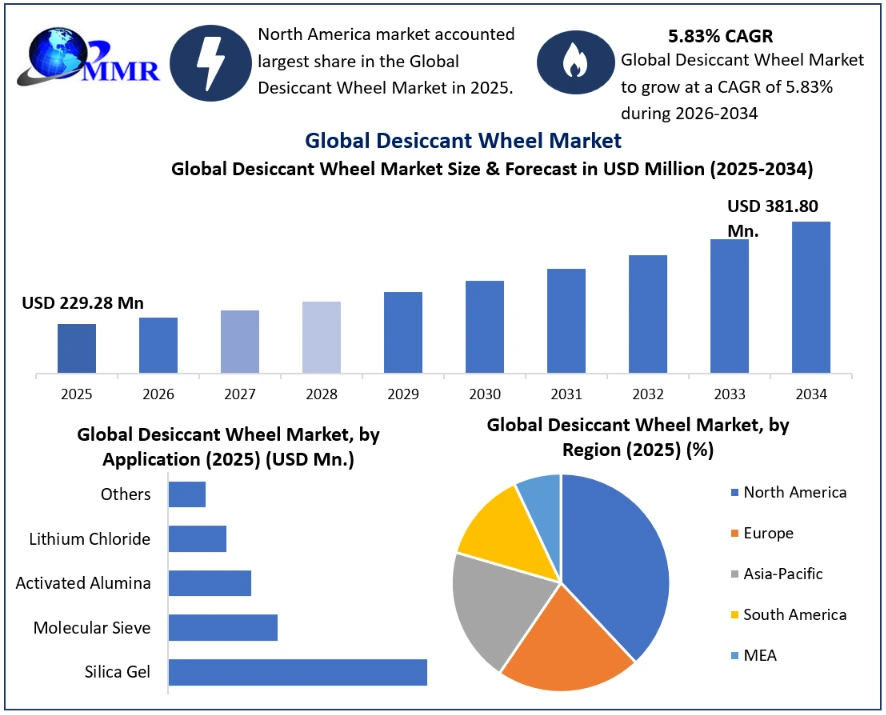
Desiccant Wheel Market Growth

To know about the Research Methodology :- Request Free Sample Report

In recent times, government and legal authorities have laid rigorous regulations on the industries such as food and beverages, pharmaceutical, chemical, electronics and others. All the mentioned industries are experiencing promising growth over the years and in order to achieve the permitted humidity level, these industries broadly use desiccant wheels for moisture control. In addition, desiccant wheels propose numerous advantages over conventional dehumidification methods including thermal wheels and compressor driven dehumidifiers. Moreover, desiccant wheel allows facility of reuse after the removal of moisture from the desiccant. This feature helps in minimizing the overall operating cost and makes this method cost effective for number of industries. Therefore, desiccant wheel market is estimated to grow at a speedy rate in forecasted years along with the industries where it is mostly use.

Global Desiccant Wheel Market Dynamics:

The growing worldwide need of extracting moisture in short time spans is boosting the Desiccant Wheel Market as desiccant dehumidifiers have proven their ability to be much more effective and faster than compressor-based dehumidifiers. Furthermore, rising electricity costs and portability of desiccant dehumidifiers are likely to boom the popularity of desiccant wheels on a global front.

The key driver responsible for the growth of the global desiccant wheel market is the prompt growth rate in infrastructure demonstrated by a large number of industry verticals around the world. Several companies in the sector of electronics, pharmaceuticals, chemicals, food & beverages and others are exclusively presenting a massive growth in their demand and development of infrastructure. The growth of these industries resulted in high demand for desiccant wheels in the forecasted duration. Furthermore, desiccant wheels can soak up atmospheric moisture in much less time spans, which has accelerated the Global Desiccant Wheel Market.

Global Desiccant Wheel Market Regional Analysis:

As of 2025, North America with the size US$ xx Bn has become the most dominant region in the global Desiccant Wheel Market. While Europe stands as the second most contributing region with market share xx% Bn. The market in North America is likely to grow at the highest CAGR xx% during the forecast period. Factors accelerating to the growth of this market include the highest use of Desiccant Wheel in chemical and pharmaceutical industries in this region. Asia Pacific countries such as China & Japan are the major contributor in Electronic world. The governments of these countries deployed stringent regulations and passed legislations, which are completely driving the overall demand of Desiccant Wheel in Asia Pacific. With regards to Asia Pacific, India is a hub for several small & medium enterprises. Among large of them require Desiccant Wheel in their manufacturing plant. Thus, Asia Pacific is expected to witness the rapid growth of CAGR xx% during forecasted period. Similarly, the report covers the detail analysis of all the regions such as, Latin America and Middle East & Africa. Their growth rate and the reason for growth along with the expected value to be reached by end of the 2030 are mentioned in the final report.

Global Desiccant Wheel Market Segmentation Analysis:

The report provides study of global desiccant wheel market on the basis of desiccant type, application, and region. The desiccant wheel is segmented into the silica gel, molecular sieve, and activated alumina according to the desiccant type. Among all, silica gel desiccant wheel segment led the market in 2025, contributing more than 65% of the total market share of the global desiccant wheel market. Silica gel wheels are tremendously popular for their superior capacity of soaking moisture along with the non-flammable nature, and much longer life-span than other wheel types. Also, silica gel desiccant wheels are supposed to be safe for food and beverage production environments by a number of top regulatory authorities, making it an essential factor for many companies from this industry. Hence, this segment is likely to witness an exponential growth of CAGR xx % in forecasted duration.

Depending on application, the desiccant wheel market is further classified as chemical, pharmaceutical, electronics, food & beverage industries, warehousing and among others. As of 2019, owing to the fastest growth in infrastructure of pharmaceutical sector, the demand for a desiccant wheel in this industry dominated the overall market with revenue generation of USD xx Mn. Along with the pharmaceutical companies, chemicals manufacturers are also make use of desiccant wheels at large scale to control the humidity levels within the production plant to maintain the finest environment. With regards to pharmaceutical this applies to several tablet manufacturers as tablet surfaces are meant to be extremely hygroscopic as well as various chemical manufacturers where surface or area need not to be humid.

Objective of the Global Desiccant Wheel Market:

The objective of the report is to present a comprehensive analysis of the Global Desiccant Wheel Market including all the stakeholders of the industry. The past and current status of the industry with forecasted market size and trends are presented in the report with the analysis of complicated data in simple language.

The report covers all the aspects of the industry with a dedicated study of key players that includes market leaders, followers and new entrants. PORTER, SVOR, PESTEL analysis with the potential impact of micro-economic factors of the market have been presented in the report. External as well as internal factors that are supposed to affect the business positively or negatively have been analyzed, which will give a clear futuristic view of the industry to the decision-makers.

The report also helps in understanding Global Market dynamics, structure by analyzing the market segments and projects the Global Market size. Clear representation of competitive analysis of key players by Application, price, financial position, Product portfolio, growth strategies, and regional presence in the Global Market make the report investor’s guide.

Global Desiccant Wheel Market Recent Developments:

Date Company Development Impact
15 November 2025 Bry-Air (Asia) Pvt. Ltd. Bry-Air launched its P80x pharmaceutical desiccant dehumidifier incorporating the MIRACLE Next-Gen Rotor powered by Metal-Organic Framework (MOF) desiccant media. The innovation enables lower regeneration temperatures of 60–80°C compared to conventional 120–140°C systems, delivering over 25% higher performance and up to 50% energy savings.
18 March 2026 Munters Group AB Munters released its MX3 and MX3 PLUS desiccant dehumidifier series featuring advanced desiccant rotors and configurable heat recovery systems for sub-10% RH environments. The series reduces total system energy consumption by 15–20% while providing real-time remote monitoring for pharmaceutical and battery manufacturing plants.
14 May 2026 Seibu Giken Co., Ltd. Seibu Giken reported Q1 2026 growth driven by expanded sales of its honeycomb desiccant rotors and ultra-low dew point systems across Asian battery and semiconductor markets. The company achieved net quarterly sales of ¥9.6 billion, scaling manufacturing capacity for high-precision desiccant wheels used in critical dry room applications.
10 July 2026 CAREL Industries S.p.A. CAREL Industries signed a definitive agreement to acquire 100% of Cotes A/S, a specialist manufacturer of industrial desiccant dehumidifiers and adsorption rotors. The $64 million transaction expands CAREL’s product footprint in energy-efficient desiccant wheels for offshore wind, lithium battery production, and pharmaceutical plants.
15 September 2026 Seibu Giken DST AB Seibu Giken DST convened its 2026 European Summit in Sweden to rollout upgraded industrial desiccant rotors and dry room systems for European HVAC partners. The initiative expands regional technical support and supply chains for customized desiccant wheel configurations in commercial cleanroom facilities.

Scope of the Global Desiccant Wheel Market Report: Inquire before buying

Global Desiccant Wheel Market
Report Coverage Details
Base Year: 2025 Forecast Period: 2026-2034
Historical Data: 2020 to 2025 Market Size in 2025: USD 229.28 Mn.
Forecast Period 2026 to 2034 CAGR: 5.83% Market Size in 2034: USD 381.80 Mn.
Segments Covered: by Desiccant Type Silica Gel
Molecular Sieve
Activated Alumina
Lithium Chloride
Others
by System Configuration Standalone Desiccant Wheel Systems
Hybrid Desiccant Systems
by Installation Type Retrofit
New Installation
by Application HVAC & Air Conditioning
Industrial Dehumidification
Process Air Drying
Moisture-Sensitive Material Protection
Energy Recovery / Preconditioning
Others
Mining Equipment
Agricultural Machinery
by End User Commercial Buildings
Industrial Facilities
Residential Buildings
Data Centers
Institutional Facilities
Others

Desiccant Wheel Market, by Region

North America (United States, Canada and Mexico)
Europe (UK, France, Germany, Italy, Spain, Sweden, Austria and Rest of Europe)
Asia Pacific (China, South Korea, Japan, India, Australia, Indonesia, Malaysia, Vietnam, Taiwan, Bangladesh, Pakistan and Rest of APAC)
Middle East and Africa (South Africa, GCC, Egypt, Nigeria and Rest of ME&A)
South America (Brazil, Argentina Rest of South America)

Key players operating in the Global Desiccant Wheel Market

North America
1. NovelAire Technologies, LLC
2. Rotor Source, Inc.
3. Xetex, Inc.
4. Dedert Corporation
5. RenewAire, LLC (Rheem Manufacturing Company)
6. Greenheck Fan Corporation
7. Airxchange, Inc.
8. Trane Technologies plc
9. SEMCO LLC (FläktGroup Holding GmbH)
10. Climate by Design International, LLC (Nortek Air Solutions, LLC)
Others

Europe
1. Munters Group AB
2. Proflute AB
3. Klingenburg GmbH
4. Konvekta AG
5. FläktGroup Holding GmbH
6. Menerga GmbH
7. Systemair AB
8. Zehnder Group AG
9. DencoHappel GmbH
10. Robatherm GmbH & Co. KG
11. Swegon AB
12. Wolf GmbH
Others

Asia Pacific
1. Seibu Giken Co., Ltd.
2. Bry-Air, Inc. / Bry-Air Asia (Pahwa Group)
3. Desiccant Rotors International Pvt. Ltd. (DRI) (Pahwa Group)
4. Thermotech Enterprises
5. Drytech Industries
6. Zenco Industries (Zencoindia)
7. DryCare Technology
8. Fantech Pty Ltd (Systemair AB)
Others

Frequently Asked Questions:

1. Which region has the largest share in Global Desiccant Wheel Market?
Ans: North America region held the highest share in 2025.

2. What is the growth rate of Global Desiccant Wheel Market?
Ans: The Global Desiccant Wheel Market is growing at a CAGR of 5.83% during forecasting period 2026-2034.

3. What is scope of the Global Desiccant Wheel Market report?
Ans: Global Desiccant Wheel Market report helps with the PESTEL, PORTER, COVID-19 Impact analysis, Recommendations for Investors & Leaders, and market estimation of the forecast period.

4. Who are the key players in Global Desiccant Wheel Market?
Ans: The important key players in the Global Desiccant Wheel Market are – Desiccant Technologies Group,, Innovative Air Technologies,, Polygon AB,, NovelAire Technologies,, Munters,, Desiccant Rotors International Pvt. Ltd.,, Trane Inc.,, Proflute AB,, Seibu Giken DST AB,, Airxchange Inc.,, Fläkt Woods Group, Trane Inc., Greenheck Fan Corporation, Rotor Source, Inc., DRI Inc., Novelion Therapeutics, Inc.

5. What is the study period of this Market?
Ans: The Global Desiccant Wheel Market is studied from 2020 to 2034.

Table of Contents

1.SECTION A – GLOBAL DESICCANT WHEEL MARKET INTRODUCTION 1.1 Executive Market Landscape and Industry Overview 1.1.1 Global Desiccant Wheel Market Size (Value USD Million & Volume in 000' Units), 2025–2034 1.1.2 Historical Market Size Trends and Growth Momentum Analysis Across Desiccant Wheel Industry 1.1.3 Forecast Revenue Projections with Underlying Market Growth Driving Factors 1.1.4 Demand-Supply Balance and Its Influence on Market Expansion Potential 1.1.5 Impact of Macroeconomic Indicators on Desiccant Wheel Market Growth Trajectory 1.1.6 Global HVAC, Ventilation and Air Treatment Industry Trends Influencing Desiccant Wheel Demand 1.1.7 Long-Term Market Outlook Highlighting Structural Growth Opportunities Through 2034 1.1.8 CAGR Analysis of Global Desiccant Wheel Market (2025–2034) 1.2 Desiccant Wheel Market Dynamics 1.2.1 Desiccant Wheel Market Trends 1.2.2 Desiccant Wheel Market Dynamics 1.2.3 Drivers 1.2.4 Restraints 1.2.5 Opportunities 1.2.6 Challenges 1.2.7 PORTER’s Five Forces Analysis 1.2.8 PESTLE Analysis 1.3 Pricing Structure and Value Chain Profitability Assessment 1.3.1 Comprehensive Breakdown of Desiccant Wheel Cost Structure Across the Value Chain 1.3.2 Margin Distribution Analysis Among Desiccant Wheel Manufacturers, HVAC OEMs, System Integrators, Distributors and Installation Contractors 1.3.3 Impact of Desiccant Material, Wheel Size and Configuration on Product Pricing 1.3.4 Pricing Comparison Across Standard, High-Capacity and Customized Desiccant Wheel Systems 1.3.5 Impact of Raw Material and Manufacturing Cost Fluctuations on Pricing Strategies 1.3.6 Role of Performance Efficiency, Moisture Removal Capacity and Regeneration Requirements in Product Pricing 1.4 Desiccant Material Procurement and Supply Dynamics 1.4.1 Desiccant Material Sourcing Models and Supplier Dependency Assessment 1.4.2 Silica Gel Supply and Procurement Dynamics 1.4.3 Molecular Sieve and Zeolite Material Supply Trends 1.4.4 Lithium Chloride and Other Desiccant Material Availability 1.4.5 Impact of Raw Material Price Fluctuations on Desiccant Wheel Manufacturing Costs 1.4.6 Material Quality Influence on Moisture Adsorption and Desorption Performance 1.4.7 Supplier Qualification and Material Consistency Requirements 1.5 Chemistry, Adsorption Science and Desiccant Material Evolution 1.5.1 Evolution of Adsorption-Based Dehumidification Chemistry 1.5.2 Role of Surface Chemistry in Moisture Adsorption and Desorption 1.5.3 Development of High-Performance Desiccant Materials 1.5.4 Silica Gel Chemistry and Moisture Adsorption Characteristics 1.5.5 Molecular Sieve and Zeolite Chemistry in Desiccant Wheel Applications 1.5.6 Lithium Chloride and Salt-Based Desiccant Technologies 1.5.7 Surface Modification and Functionalization of Desiccant Materials 1.5.8 Impact of Pore Structure and Surface Area on Adsorption Performance 1.5.9 Chemical Stability and Regeneration Characteristics of Desiccant Materials 1.5.10 Development of Next-Generation Adsorbent Materials 1.6 Desiccant Chemistry Innovation and Material Performance Development 1.6.1 Development of Advanced Adsorbent Materials 1.6.2 Surface Chemistry Modification for Enhanced Moisture Adsorption 1.6.3 High-Surface-Area Desiccant Material Development 1.6.4 Development of Low-Regeneration-Temperature Adsorbents 1.6.5 Composite and Hybrid Desiccant Material Technologies 1.6.6 Nanostructured Adsorbent Development 1.6.7 Advanced Desiccant Coating and Impregnation Technologies 1.6.8 Chemical Stability and Long-Term Adsorption Performance 1.6.9 Regeneration Efficiency and Adsorption-Desorption Cycle Optimization 1.6.10 Development of Customized Desiccant Materials for Specific Applications 1.7 Desiccant Material Chemistry, Sustainability and Environmental 1.7.1 Development of Environmentally Friendly Desiccant Materials 1.7.2 Reduction of Energy Consumption Through Advanced Adsorption Chemistry 1.7.3 Low-Temperature Regeneration Chemistry 1.7.4 Development of Non-Toxic and Safer Desiccant Materials 1.7.5 Bio-Based and Naturally Derived Adsorbent Materials 1.7.6 Reduction of Chemical Waste During Desiccant Material Manufacturing 1.7.7 Recycling and Regeneration of Desiccant Materials 1.7.8 Life-Cycle Environmental Assessment of Desiccant Materials 1.8 HVAC Integration and Air Handling System Dynamics 1.8.1 Integration of Desiccant Wheels Into Air Handling Units 1.8.2 Integration With Dedicated Outdoor Air Systems 1.8.3 Desiccant Wheel Integration With Cooling Coils 1.8.4 Desiccant Wheel Integration With Heat Recovery Systems 1.8.5 Hybrid Desiccant and Vapor-Compression HVAC Systems 1.8.6 Desiccant Wheel Integration With Evaporative Cooling 1.8.7 Airflow Configuration and System Design Considerations 1.8.8 Process Air and Regeneration Air Management 1.9 Digital Transformation and Smart HVAC Control Strategies 1.9.1 Digital Monitoring of Desiccant Wheel Performance 1.9.2 Sensors and Real-Time Humidity Monitoring Systems 1.9.3 Automated Regeneration Temperature and Airflow Control 1.9.4 AI and Predictive Analytics for Desiccant Wheel Optimization 1.9.5 Smart Building Management System Integration 1.9.6 IoT-Enabled HVAC Performance Monitoring 1.9.7 Predictive Maintenance and Wheel Performance Diagnostics 1.10 Sustainability and Green Building Trends 1.10.1 Rising Demand for Low-Carbon HVAC and Ventilation Technologies 1.10.2 Role of Desiccant Wheels in Green Building Design 1.10.3 Integration With Net-Zero and Low-Energy Buildings 1.10.4 Sustainable Desiccant Materials and Environmentally Friendly Coatings 1.10.5 Energy Consumption Reduction Across HVAC Operations 1.10.6 Circular Economy Opportunities for Desiccant Wheel Components 1.10.7 Wheel Core Refurbishment and Replacement Practices 1.11.1 Adsorption, Desorption and Chemical Performance 1.11.1.1 Moisture Adsorption Capacity Across Major Desiccant Materials 1.11.1.2 Adsorption Isotherm and Equilibrium Characteristics 1.11.1.3 Desorption and Regeneration Behavior 1.11.1.4 Influence of Temperature on Adsorption Performance 1.11.1.5 Influence of Relative Humidity on Adsorption Capacity 1.11.1.6 Mass Transfer Characteristics Across Desiccant Materials 1.11.1.7 Adsorption Kinetics and Moisture Transfer Efficiency 1.11.1.8 Chemical Stability Across Repeated Adsorption-Desorption Cycles 1.11.1.9 Thermal Stability of Desiccant Materials 1.11.1.10 Long-Term Performance Degradation and Material Aging 1.11.2 Import-Export Trade Analysis (2025) 1.11.2.1 Global Trade Flow Trends Impacting Desiccant Wheel Market Development 1.11.2.2 Import-Export Patterns Influencing Product Pricing and Availability 1.11.2.3 Supply Chain Disruptions Affecting Desiccant Wheel Manufacturing and Distribution 1.11.2.4 Geopolitical Factors Impacting Desiccant Material and HVAC Equipment Trade Routes 1.11.2.5 Tariff and Regulatory Barriers Affecting Cross-Border Trade 1.11.2.6 Regional Trade Dependency and Supplier Concentration Analysis 1.11.2.7 Post-Pandemic Supply Chain Resilience and Adaptation Strategies 1.11.3 Manufacturing Technologies and Process Optimization 1.11.3.1 Automation in Desiccant Wheel Manufacturing Processes 1.11.3.2 Advanced Honeycomb Matrix Manufacturing Technologies 1.11.3.3 Desiccant Coating and Impregnation Technologies 1.11.3.4 Precision Wheel Assembly and Balancing Technologies 1.11.3.5 Automated Adhesive Application and Component Assembly 1.11.3.6 Digital Quality Monitoring and Inspection Systems 1.11.3.7 Artificial Intelligence in Manufacturing Process Optimization 1.11.3.8 Energy-Efficient Manufacturing Technologies 1.11.3.9 Industry 1.4.0 Implementation Across Desiccant Wheel Production Facilities 1.11.4 Chemical Applications and Desiccant Material End-Use Analysis 1.11.4.1 Chemical Processing Industry Dehumidification Applications 1.11.4.2 Petrochemical Processing Moisture Control Applications 1.11.4.3 Natural Gas Processing Dehumidification Applications 1.11.4.4 Pharmaceutical Manufacturing Moisture Control Applications 1.11.4.5 Food Processing Humidity Management Applications 1.11.4.6 Electronics Manufacturing Moisture Control Applications 1.11.4.7 Semiconductor Manufacturing Dry Air Applications 1.11.4.8 Battery Manufacturing Moisture Control Applications 1.11.4.9 Laboratory Research Facility Dehumidification Applications 1.11.4.10 Other Chemical Industry Dehumidification Applications 1.11.5 Regulatory Framework and Compliance Analysis 1.11.5.1 Global HVAC and Ventilation Regulations Governing Desiccant Wheel Systems 1.11.5.2 Indoor Air Quality Standards Affecting Ventilation System Design 1.11.5.3 Building Energy Codes Influencing Desiccant Wheel Adoption 1.11.5.4 Environmental Regulations Supporting Energy-Efficient Dehumidification 1.11.5.5 Product Safety and Electrical Compliance Requirements 1.11.5.6 Material and Chemical Compliance Requirements 1.11.5.7 Testing and Performance Certification Standards 1.11.6 Retrofit, Replacement and Aftermarket Dynamics 1.11.6.1 Growing Replacement Demand From Existing HVAC Installations 1.11.6.2 Desiccant Wheel Replacement Cycle and Maintenance Requirements 1.11.6.3 Retrofit Opportunities Across Commercial HVAC Systems 1.11.6.4 Upgrading Conventional HVAC Systems With Desiccant Dehumidification 1.11.6.5 Wheel Core Replacement and Refurbishment Market 1.11.6.6 Aftermarket Service and Maintenance Requirements 1.11.6.7 Spare Parts and Component Replacement Demand 1.11.7 Emerging Building Designs and Ventilation Requirements 1.11.7.1 Growth of High-Performance and Energy-Efficient Buildings 1.11.7.2 Increasing Adoption of Green and Net-Zero Buildings 1.11.7.3 Smart Building Development and Intelligent Ventilation Systems 1.11.7.4 Growth of High-Density Commercial Buildings 1.11.7.5 Expansion of Healthcare and Pharmaceutical Infrastructure 1.11.7.6 Increasing Data Center Construction and Humidity Management Requirements 1.11.7.7 Urbanization and Rising Indoor Air Quality Requirements 1.11.7.8 Demand for Advanced Ventilation in Hot and Humid Regions 1.11.8 Private Label, OEM and System Integrator Expansion Analysis 1.11.8.1 OEM-Based Desiccant Wheel Supply Models 1.11.8.2 Private-Label and Customized Desiccant Wheel Solutions 1.11.8.3 HVAC System Integrator Influence on Product Selection 1.11.8.4 Strategic Partnerships Between Wheel Manufacturers and HVAC OEMs 1.11.8.5 Distributor and Contractor Network Expansion 1.11.8.6 Customized Wheel Design for Specific Air Handling Requirements 1.11.9 Investment Trends and Capital Allocation Analysis 1.11.9.1 Investment Trends Across Desiccant Material Manufacturers 1.11.9.2 Capital Expenditure in Production Capacity Expansion 1.11.9.3 R&D Investment in Adsorption Material Technologies 1.11.9.4 Investment in Advanced Desiccant Chemistry Development 1.11.9.5 Strategic Investment in Chemical Processing Applications 1.11.9.6 Mergers and Acquisitions Across Desiccant Industry 1.12 Desiccant Wheel Market: Market Size and Forecast by Segmentation (by Value USD Million & Volume in 000' Units) (2025–2034) 1.12.1 Desiccant Wheel Market Size and Forecast, By Desiccant Type 1.12.1.1 Silica Gel 1.12.1.2 Molecular Sieve 1.12.1.3 Activated Alumina 1.12.1.4 Lithium Chloride 1.12.1.5 Others 1.12.2 Desiccant Wheel Market Size and Forecast, By System Configuration 1.12.2.1 Standalone Desiccant Wheel Systems 1.12.2.2 Hybrid Desiccant Systems 1.12.3 Desiccant Wheel Market Size and Forecast, By Installation Type 1.12.3.1 Retrofit 1.12.3.2 New Installation 1.12.4 Desiccant Wheel Market Size and Forecast, By Application 1.12.4.1 HVAC & Air Conditioning 1.12.4.2 Industrial Dehumidification 1.12.4.3 Process Air Drying 1.12.4.4 Moisture-Sensitive Material Protection 1.12.4.5 Energy Recovery / Preconditioning 1.12.4.6 Others 1.12.5 Desiccant Wheel Market Size and Forecast, By End Users 1.12.5.1 Commercial Buildings 1.12.5.2 Industrial Facilities 1.12.5.3 Residential Buildings 1.12.5.4 Data Centers 1.12.5.5 Institutional Facilities 1.12.5.6 Others 1.12.6 Desiccant Wheel Market Size and Forecast, By Region 1.12.6.1 North America 1.12.6.1.1 United States 1.12.6.1.2 Canada 1.12.6.1.3 Mexico 1.12.6.2 Europe 1.12.6.2.1 United Kingdom 1.12.6.2.2 France 1.12.6.2.3 Germany 1.12.6.2.4 Italy 1.12.6.2.5 Switzerland 1.12.6.2.6 Spain 1.12.6.2.7 Sweden 1.12.6.2.8 Russia 1.12.6.2.9 Rest of Europe 1.12.6.3 Asia Pacific 1.12.6.3.1 China 1.12.6.3.2 South Korea 1.12.6.3.3 Japan 1.12.6.3.4 India 1.12.6.3.5 Australia 1.12.6.3.6 Indonesia 1.12.6.3.7 Philippines 1.12.6.3.8 Malaysia 1.12.6.3.9 Vietnam 1.12.6.3.10 Thailand 1.12.6.3.11 Rest of Asia Pacific 1.12.6.4 Middle East And Africa 1.12.6.4.1 South Africa 1.12.6.4.2 Turkey 1.12.6.4.3 Saudi Arabia 1.12.6.4.4 UAE 1.12.6.4.5 Qatar 1.12.6.4.6 Egypt 1.12.6.4.7 Nigeria 1.12.6.4.8 Rest of ME&A 1.12.6.5 South America 1.12.6.5.1 Brazil 1.12.6.5.2 Argentina 1.12.6.5.3 Chile 1.12.6.5.4 Colombia 1.12.6.5.5 Rest Of South America 2. SECTION B – COMPETITIVE INTELLIGENCE & INDUSTRIAL ECOSYSTEM 2.1 Competitive Landscape 2.1.1 MMR Competition Matrix 2.1.2 Competitive Positioning of Leading Key Players [Revenue and Market Share(%)] 2.1.3 Key Players Benchmarking 2.1.3.1 Company Name 2.1.3.2 Headquarter 2.1.3.3 Product Portfolio 2.1.3.4 Product Quality & Reliability 2.1.3.5 Technology Innovation & Differentiation 2.1.3.6 Manufacturing Capacity 2.1.3.7 Distribution Network 2.1.3.8 End-Use Industry Coverage 2.1.3.9 Revenue (2025) 2.1.3.10 R&D Investment (%) 2.1.3.11 Profit Margin (%) 2.1.3.12 Growth Rate (Y-o-Y %) 2.1.3.13 Geographic Presence 2.1.4 Market Structure 2.1.4.1 Market Leaders 2.1.4.2 Market Followers 2.1.4.3 Emerging Players 2.1.5 Growth Rate/Y-o-Y (%) of Companies 2.1.6 Profit Margin (%) of Companies 2.1.7 R&D Investments (%) of Companies 2.1.8 Mergers and Acquisitions Details 2.1.9 Recent Key Developments 2.2 Desiccant Wheel Competitive Landscape and Industry Structure 2.2.1 Market Concentration Levels and Competitive Intensity Across Desiccant Wheel Industry 2.2.2 Competitive Positioning Strategies Among Leading Global Manufacturers 2.2.3 Entry Barriers and Challenges for New Participants 2.2.4 Importance of Technology and Application Expertise in Competitive Positioning 2.2.5 OEM and HVAC System Integrator Relationships 2.2.6 Market Share Distribution Patterns Among Established and Emerging Players 2.2.7 Competitive Benchmarking Based on Product Efficiency, Pricing, Reliability and Innovation 2.3 Company Market Share and Positioning Analysis (2024–2025) 2.3.1 Revenue-Based Market Share Comparison Across Leading Desiccant Wheel Companies 2.3.2 Technology Positioning Across Standard and Advanced Wheel Configurations 2.3.3 Growth Performance Analysis of Emerging Market Players 2.3.4 Competitive Pricing Benchmarking Across Major Industry Participants 2.3.5 Impact of HVAC OEM Relationships on Market Share Expansion 2.3.6 Product Differentiation Through Efficiency, Pressure Drop and Regeneration Performance 2.3.7 Ventilation Application Positioning Across Key Companies 2.4 Strategic Initiatives and Expansion Strategy Analysis 2.4.1 Mergers and Acquisitions Shaping Competitive Landscape 2.4.2 Manufacturing Capacity Expansion Strategies 2.4.3 Global Market Entry and Expansion Strategies 2.4.4 Strategic Partnerships With HVAC OEMs and System Integrators 2.4.5 Expansion of Distribution and Contractor Networks 2.4.6 Investment in Low-Temperature Regeneration Technologies 2.4.7 Expansion Into Ventilation and Energy-Efficient HVAC Applications 2.4.8 Diversification Across Air Treatment Technologies 2.5 Product Portfolio and Innovation Benchmarking Analysis 2.5.1 Comparative Analysis of Desiccant Wheel Product Portfolios 2.5.2 Silica Gel, Molecular Sieve and Other Desiccant Technology Benchmarking 2.5.3 Wheel Configuration and Performance Benchmarking 2.5.4 Moisture Removal Capacity Comparison 2.5.5 Pressure Drop and Airflow Performance Benchmarking 2.5.6 Regeneration Temperature Benchmarking 2.5.7 Energy Efficiency and Heat Recovery Capability Comparison 2.5.8 Ventilation and HVAC Application Coverage 2.5.9 Product Customization and Retrofit Capability Benchmarking 2.6 Financial Performance and Profitability Benchmarking 2.6.1 Revenue Growth Trends Across Leading Market Participants 2.6.2 Profit Margin Analysis and Cost Structure Comparison 2.6.3 Investment Trends in Research and Development Activities 2.6.4 Financial Resilience During HVAC and Construction Industry Disruptions 2.6.5 Impact of Premium Technology on Revenue and Profitability 2.6.6 Aftermarket and Replacement Revenue Opportunities 2.6.7 Operational Efficiency Strategies Supporting Cost Optimization 2.6.8 Research and Development Investment Trends Across Leading Companies 2.7 Branding Strategies and Customer Engagement Analysis 2.7.1 Brand Identity Development Strategies Across Leading Desiccant Wheel Manufacturers 2.7.2 Technology-Based Product Positioning Strategies 2.7.3 Customer Engagement Models Driving Long-Term HVAC Relationships 2.7.4 Technical Consultation and Application Engineering Strategies 2.7.5 HVAC Contractor and System Integrator Engagement 2.7.6 Digital Marketing Initiatives Supporting Customer Awareness 2.7.7 Technical Content and Application-Based Marketing 2.7.8 Customer Service and Aftermarket Support Strategies 2.8 Company Profile: 30+ Key Players 2.8.1 Detailed Profile Considering the Parameters 2.8.1.1 Overview 2.8.1.2 Business Portfolio 2.8.1.3 Financial Overview 2.8.1.4 SWOT Analysis 2.8.1.5 Strategic Analysis 2.8.1.6 Recent Developments 2.8.2 North America 2.8.2.1 NovelAire Technologies, LLC 2.8.2.2 Rotor Source, Inc. 2.8.2.3 Xetex, Inc. 2.8.2.4 Dedert Corporation 2.8.2.5 RenewAire, LLC (Rheem Manufacturing Company) 2.8.2.6 Greenheck Fan Corporation 2.8.2.7 Airxchange, Inc. 2.8.2.8 Trane Technologies plc 2.8.2.9 SEMCO LLC (FläktGroup Holding GmbH) 2.8.2.10 Climate by Design International, LLC (Nortek Air Solutions, LLC) 2.8.2.11 Others 2.8.3 Europe 2.8.3.1 Munters Group AB 2.8.3.2 Proflute AB 2.8.3.3 Klingenburg GmbH 2.8.3.4 Konvekta AG 2.8.3.5 FläktGroup Holding GmbH 2.8.3.6 Menerga GmbH 2.8.3.7 Systemair AB 2.8.3.8 Zehnder Group AG 2.8.3.9 DencoHappel GmbH 2.8.3.10 Robatherm GmbH & Co. KG 2.8.3.11 Swegon AB 2.8.3.12 Wolf GmbH 2.8.3.13 Others 2.8.4 Asia Pacific 2.8.4.1 Seibu Giken Co., Ltd. 2.8.4.2 Bry-Air, Inc. / Bry-Air Asia (Pahwa Group) 2.8.4.3 Desiccant Rotors International Pvt. Ltd. (DRI) (Pahwa Group) 2.8.4.4 Thermotech Enterprises 2.8.4.5 Drytech Industries 2.8.4.6 Zenco Industries (Zencoindia) 2.8.4.7 DryCare Technology 2.8.4.8 Fantech Pty Ltd (Systemair AB) 2.8.4.9 Others 3. SECTION C – KEY INSIGHTS, STRATEGIC OUTLOOK & METHODOLOGICAL FRAMEWORK 3.1 Key Findings 3.2 Strategic Moves & Industry Outlook 3.3 Research Methodology

Custom Market Research Services

We Will Customise The Research For You, In Case The Report Listed Above Does Not Meet With Your Requirements