
Global Data Fabric Market - Industry Structure Evaluation, Demand Drivers Analysis, Regional Growth Analysis and Identification, Competitive Positioning / Landscape Review & Global Market Size Forecast to 2032
Overview
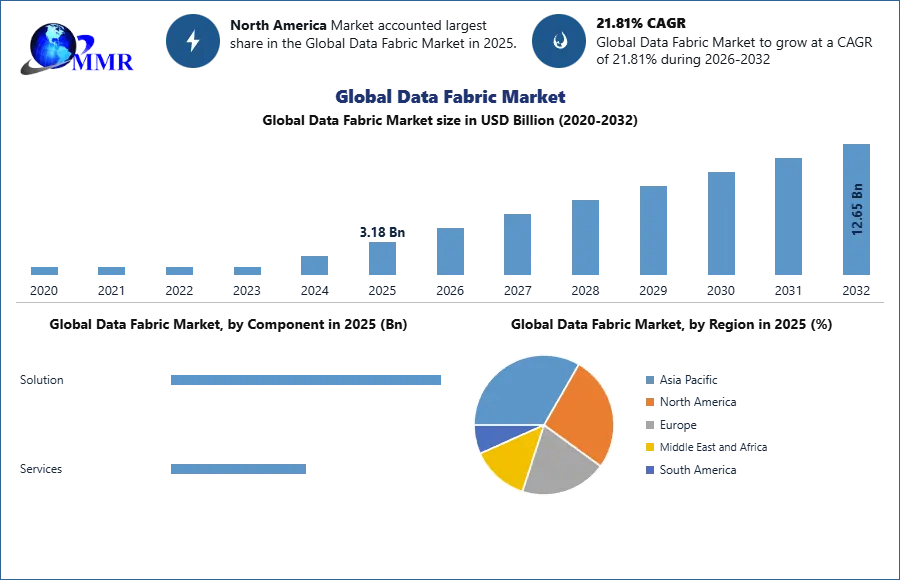
Data Fabric Market was valued at US$ 3.18 Bn. in 2025. Global Data Fabric Market size is estimated to grow at a CAGR of 21.81% over the forecast period.
Data Fabric Market Overview:
Global Data Fabric Market size is expected to reach USD 12.65 Bn by 2032 . The growing demand for real-time analytics and edge computing is driving enterprises to adopt data fabric solutions in the Data Fabric Market, enabling instant data processing and analysis. These technologies help businesses make quicker, data-driven decisions in sectors such as healthcare, manufacturing, and logistics. Data fabric architectures process data closer to the source, reducing latency and enhancing response times. This capability is vital for mission-critical applications requiring immediate insights, making real-time analytics within data fabrics a key factor in improving operational efficiency and maintaining competitiveness.
 To know about the Research Methodology :- Request Free Sample Report
Data Fabric Market Dynamics:
Private and public investments have surged up to millions of dollars in big data analytics applications. The rapid growth in data volume and complexity due to the use of mobile data and cloud computing and the use of more advanced technologies, including artificial intelligence (AI) and the internet of things (IoT), drive the need for big data analytics technologies. This technology has a great deal of potential to transform the way businesses operate. Large structured and unstructured data sets can be effectively analyzed by using big data platforms. The banking and finance industry is one of the leading industries that invest heavily in big data and analytics. North America and Europe are two of the most active markets for these technologies. These regions are also implementing several programs to implement big data in numerous industries.
One of the major drivers of the data fabric market is big data analytics technology, which helps gain actionable insights from structured and unstructured data, including web and social media data. Big data analysis provides businesses with crucial insight for improving customer retention, new market discovery, enhancing customer service, retaining employees, and increasing customer loyalty. Consequently, growing consumer demand for real-time analytics contributes to the growth of the data fabric market.
There are some factors hindering market revenue growth, including a lack of awareness about data fabric and a shortage of skilled professionals. Moreover, lack of investment in newer technologies and integration concerns with legacy systems are some of the factors expected to restrain market revenue growth within the forecast period. Today, businesses must learn more about how they can store and analyze real-time, critical data coming from a range of business events to achieve a sustainable impact from the adoption of data fabrics.
Technology advancements contribute significantly to increasing the adoption trend by companies and customers. Leading analytics technology vendors are now concentrating on developing a complete cloud-based suite that will be able to evaluate and enhance their digital assets. Using this model, organizations can save time and money for onsite deployment and management of software solutions. According to a report published by Hosting Tribunal in January 2022, 50% of enterprises spend more than USD 1.2 million on cloud services annually, and 94% use a cloud service already. Hence, the growing use of cloud technologies across vertical industries will create immense opportunities for data fabric vendors.
Data Fabric Market Trends:
As the market trends toward reducing inconsistencies and improving data quality, the ability of data fabric solutions to enable self-service data consumption while also being able to incorporate controls and automate the integration process is a key contributing factor to market growth; companies have begun customizing data to gain deeper insights, which aids in minimizing inconsistencies and improving data quality.
Data Fabric Market Segment Analysis:
Based on Deployment, the Data Fabric Market is segmented into On-premises and On-cloud. On-premises is expected to have the largest market share through the forecast period. Many industries that are sensitive to data losses, privacy breaches, and security breaches prefer on-premises deployments of data management solutions, which is why on-premises deployments are adopted more frequently.
Based on Organization Size, the Data Fabric Market is segmented into Large and SMEs. The market share for large enterprises is higher, and the market for small and medium-sized businesses is expected to register a higher CAGR during the forecast period. Business continuity is a greater concern for SMEs, and Data Fabric solutions can make them more productive, efficient, and marketable, as well as improve other aspects of their operations.
Based on Application, the Data Fabric Market is segmented into Customer Experience Management, Fraud Detection Management, Business Process Management, Asset Management, and Others. Business Process Management held the highest market share in 2024, and it will boost the market growth during the forecast period. Businesses using BPM can align their business processes with customer needs, monitor and measure company resources, reduce costs, and minimize errors and risks. BPM can be used to create greater efficiency and productivity, reduce costs, and minimize errors.
Based on Type, the Data Fabric Market is segmented into In-Memory Data Fabric and Disk-based Data Fabric. The Disk-based Data Fabric had the highest market share in 2025. A disk-based data fabric offers many features such as controlled, governed, and secured data. A data warehouse also allows users to access data whenever they need it for their applications, as well as migrate data and applications so that the cost of ownership and data compliance is reduced.
Regional Insights:
The North America region held the largest market share accounting for 46.1% in 2025. As mobile broadband and big data analytics grow, data center infrastructure solutions in North America have seen remarkable growth. Cloud computing, mobile broadband, and big data analytics are among the driving forces behind the growth in data centers. Data centers have increased in number due to the installation of multi-core processors, which run multiple applications on a single processor, and the need for high-speed data transfer systems, which leads to increased demand for high-bandwidth networking fabrics in this region.
The Asia Pacific region is expected to witness significant growth during the forecast period. Data fabric was adopted in APAC by the major technology-driven countries in China, Japan, India, and South Korea, which are the primary drivers of investment and revenue in the region.
The objective of the report is to present a comprehensive analysis of the global Data Fabric Market to the stakeholders in the industry. The past and current status of the industry with the forecasted market size and trends are presented in the report with the analysis of complicated data in simple language. The report covers all the aspects of the industry with a dedicated study of key players that include market leaders, followers, and new entrants.
PORTER, PESTEL analysis with the potential impact of micro-economic factors of the market have been presented in the report. External as well as internal factors that are supposed to affect the business positively or negatively have been analyzed, which will give a clear, futuristic view of the industry to the decision-makers.
The reports also help in understanding the Data Fabric Market dynamic and structure by analyzing the market segments and projecting the Data Fabric Market size. Clear representation of competitive analysis of key players by Design, price, financial position, product portfolio, growth strategies, and regional presence in the Data Fabric Market make the report investor’s guide.
Data Fabric Market Scope: Inquiry Before Buying
| Global Data Fabric Market | |||
|---|---|---|---|
| Report Coverage | Details | ||
| Base Year: | 2025 | Forecast Period: | 2026-2032 |
| Historical Data: | 2020 to 2025 | Market Size in 2025: | 3.18 USD Billion |
| Forecast Period 2026-2032 CAGR: | 21.81% | Market Size in 2032: | 12.65 USD Billion |
| Segments Covered: | by Component | Solution Services |
|
| by Type | In-Memory Data Fabric Disk-based Data Fabric |
||
| by Deployment | On-premises 0n-cloud |
||
| by Organization Size | Large SME |
||
| by Application | Customer Experience Management Fraud Detection Management Business Process Management Asset Management Others |
||
| by End-user | IT & Telecom Manufacturing BFSI Healthcare Others |
||
Data Fabric Market by Region:
North America (United States, Canada and Mexico)
Europe (UK, France, Germany, Italy, Spain, Sweden, Austria and Rest of Europe)
Asia Pacific (China, South Korea, Japan, India, Australia, Indonesia, Malaysia, Vietnam, Taiwan, Bangladesh, Pakistan and Rest of APAC)
Middle East and Africa (South Africa, GCC, Egypt, Nigeria and Rest of ME&A)
South America (razil, Argentina Rest of South America)
Key Players:
1. IBM Corporation
2. Oracle Corporation
3. SAP SE
4. Informatica Inc.
5. Talend Inc.
6. Cloudera, Inc.
7. TIBCO Software Inc.
8. Amazon Web Services, Inc.
9. data.world, Inc.
10. Denodo Technologies Inc.
11. Hewlett Packard Enterprise (HPE)
12. Dell Technologies
13. NetApp, Inc.
14. Teradata
15. Splunk
16. K2View
17. Cinchy
18. Precisely (formerly Syncsort)
19. IDERA
20. Intenda
21. Nexla
22. Starburst Data
23. CluedIn
24. Iguazio
25. Global IDs
26. Software AG
27. Radiant Logic
28. Hexstream
29. Qomplx
30. Intellidata