
Data Broker Market - Industry Structure Evaluation, Demand Drivers Analysis, Regional Growth Analysis and Identification, Competitive Positioning Review & Global Market Size Forecast to 2032
Overview
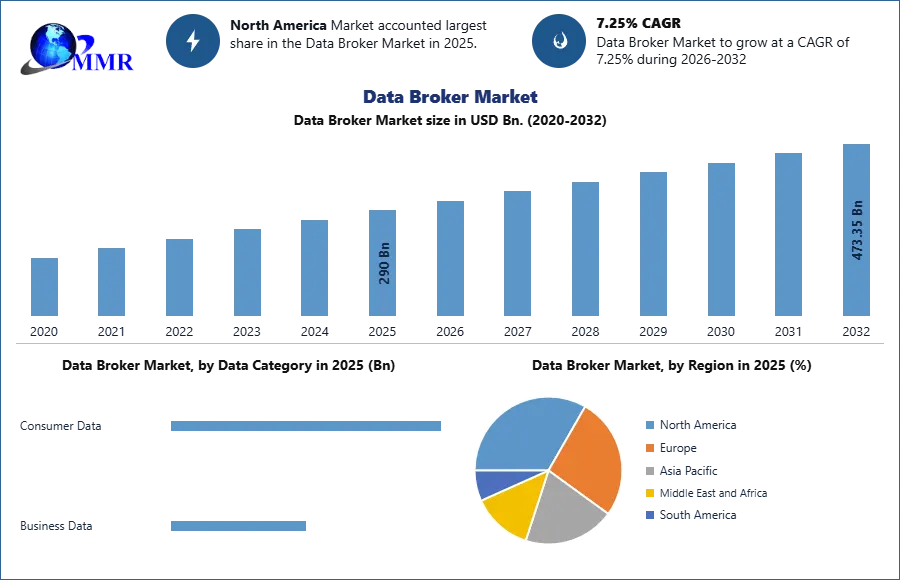
Global Data Broker Market size was valued at USD 290 Bn in 2025 and is expected to reach USD 473.35 Bn by 2032, at a CAGR of 7.25%
Data Broker Market Overview:
Data broker market includes organizations, also known as information product companies, that profit by collecting personal information, analysing it, and licensing it out to other companies for targets like marketing. Data brokers play a substantial role in the data markets and, more broadly, in surveillance capitalism. Their increasingly advanced techniques enable pervasive datafication, national security, posing serious threats to privacy, and the trust needed for data markets to function properly.
The data broker market is highly fragmented. Reports study estimate there may be up to 5,000 data brokers globally, along with approximately 10 million open datasets published by government agencies and non-governmental organizations (NGOs). In most countries, data broker market is largely unregulated and heterogeneous, consisting of many small, narrowly segmented submarkets.

Data Broker Market Dynamics:
The MMR report presents a complete overview by providing detailed information about the current Data Broker market trends, existing drivers, growth opportunities and potentials, and emerging challenges. The spring market report has up-to-date insights about market dynamics and market scenarios that can shape the overall data broker market growth and output during the forecast period, 2026 to 2032.
Data Broker Market Drivers –
The increasing demand for big data analytics is expected to significantly boom the data broker market. Big data analytics permits businesses to analyse large volumes of data and derive valuable insights, developing strategic decision-making and operational efficiency. This growing demand has propelled the growth of the Data Broker Market. Furthermore, the increasing need for data protection and privacy regulations is expected to drive the data broker market globally. Businesses handle vast amounts of sensitive data, making data protection a top priority. Data brokers play a crucial role in this view by providing services that ensure data is managed, stored, and used in compliance with various regional and global data protection regulations.
The report has given historical market size at actuals from 2020 to 2025. The estimated year is 2026 and the market is forecasted through 2032.
To know about the Research Methodology :- Request Free Sample Report
Data Broker Market Restraints –
Rising data privacy concerns hamper the data broker market. The growth in data breaches and cyber-attacks has heightened caution among both consumers and businesses regarding data sharing and handling. This increased wariness has resulted in a reduced tendency to interact with data brokers, subsequently posing a constraint on the data broker market's growth.
Regulatory challenges also restrain the data broker market globally. The introduction of stringent data protection laws, such as the General Data Protection Regulation (GDPR) in Europe and the California Consumer Privacy Act (CCPA) in the U.S., has increased the compliance burden on data brokers. This has resulted in higher operational costs and potential legal risks, thereby hindering data broker market growth. The issue of data accuracy further hinders the data broker market. The value of services provided by data brokers heavily relies on the accuracy and relevance of the data. However, ensuring the accuracy of large volumes of data is a challenging task. Any inaccuracies in the data lead to incorrect insights and decisions, which negatively impact the reputation and credibility of data brokers.
Data Broker Market Opportunities –
The growing demand for predictive analytics is projected to create lucrative opportunities for the data broker market. Businesses are increasingly seeking to forecast future trends and consumer behaviours to stay ahead of the competition. Data brokers, with their sizable data resources and analytical capabilities, are well-positioned to meet this demand.
Furthermore, the growing need for data monetization is expected to create immense opportunities for the data broker market. Businesses recognize the value of their data and are looking for ways to monetise it. Data brokers offer the necessary tools and expertise to help businesses achieve this goal. Likewise, the growing adoption of AI and machine learning technologies presents significant opportunities for the data broker market globally. These technologies enable efficient and accurate data analysis, developing the value of the services provided by data brokers.
Data Broker Market Trends–
1. In today's digital age, data is the new currency, driving decisions, strategies, and innovations across industries. At the heart of this data-driven revolution lies the data broker market, where entities collect, analyze, and sell vast amounts of data to businesses, marketers, and other organizations seeking valuable insights.
2. A key trend shaping this dynamic landscape is the rise of big data analytics. As businesses strive to gain a competitive edge, the demand for comprehensive and actionable data has skyrocketed, with data brokers harnessing big data analytics to collect data from various sources, including social media, online transactions, and consumer behavior. They apply sophisticated analytics to extract valuable insights, ensuring that businesses have access to rich, multi-dimensional data sets that drive informed decision-making. Simultaneously, there is a growing focus on data privacy and compliance. In an era of heightened data privacy concerns, data brokers are emphasizing compliance with stringent regulations such as GDPR and CCPA, investing in robust data protection measures, transparency practices, and consent management systems to build trust with consumers.
3. The integration of artificial intelligence (AI) and machine learning (ML) technologies is revolutionizing the data broker market. AI-driven algorithms can analyze vast datasets at lightning speed, uncovering patterns and trends that human analysts might miss. Data brokers are leveraging AI and ML to enhance data processing efficiency, improve predictive analytics, and deliver more accurate insights to their clients.
Data Broker Market Segment Analysis–
Based on End User, the BFSI segment held the largest market share of the Data Broker market in 2025 and is expected to grow rapidly during the forecast period. The financial services sector relies on innovation to conduct its operations more today than ever before. The commercial reasons driving banks to seek big data technology to meet the workloads listed would come as no surprise to anyone familiar with the banking industry's recent focus. To acquire a clearer picture of a person's finances, data brokers can combine information such as purchase history, loan history, and credit score.
Banks, credit card companies, and landlords may find this information useful. They may use this information to decide whether they want to deal with someone and what the optimum interest rates would be based on the risks involved. These data brokers get information on specific individuals from a variety of public records. Brokers may use this information to develop a thorough profile of a person, including their entire name, age, education, career history, and even special hobbies. Due to the benefits of the Data Brokers, the segment growth is increasing. Additionally, banks and lending institutions utilize data brokering tailor loan offers to individual prospects. After that, a data broker would gather financial data and information, such as online purchase history, from which corporations could identify the individual's financial status and anticipate purchasing intent. This would inform the bank about the magnitude of loan that might be risked with that person, as well as the interest rate that should be set. As a result, the category is growing.
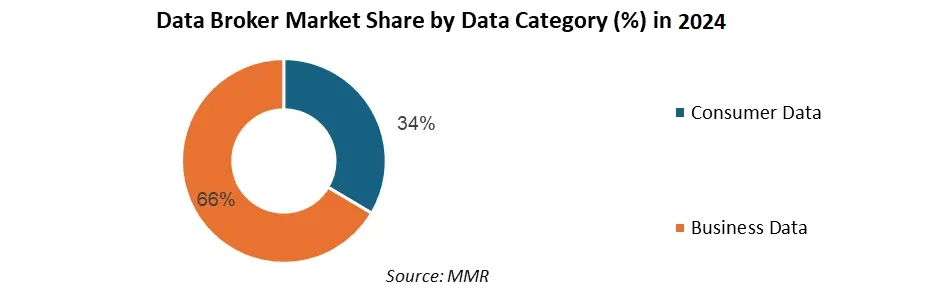
By Data Type, The Structured Data segment held the largest market share of about 58.5% for the data broker market in 2025 and is expected to grow rapidly during the forecast period. Structured data, which is most derived from text files, is information that can be readily arranged and processed using data mining and/or management tools. Most businesses are familiar with structured data since it now constitutes the majority, if not all, of their available information and hence it is driving the segment growth during the forecast period. Consider structured data to be the digital counterpart of a well-organized file cabinet, with each record labelled, arranged, and optimized for retrieval.
Data Broker Market Regional Analysis–
In 2025, North America held the dominant share of nearly 34.68% in global data broker market. This dominance is driven by increased demand for diverse data-based information across various sectors, including customer insights, technical data related to weather and natural events, organizational data, pharmacological research, and real estate information. These factors collectively contribute to the market's growth trajectory.
Data broker market is witnessing heightened demand for unstructured and custom structured data, fuelled by the lack of standardization in IT systems and the growing adoption of big data technologies across industries. This trend enhances the availability of raw, unstructured, and non-standardized data, further driving data broker market growth.
In Europe, the data broker market holds the second-largest market share in 2025. Within the manufacturing sector, data brokers are focal in compiling comprehensive reports on business performance, customer insights, and market intelligence. Particularly, the European Union's industrial production has shown significant growth, with a notable increase in industrial output and sold production values. This data-driven approach aids in informed decision-making, facilitating enhanced production planning and forecasting. Germany leads as the largest market in the European data broker market, while the UK emerges as the fastest-growing data broker market in the region.
Data Broker Market Competitive Analysis:
In the Data Broker market, industry participants are strategically emphasizing collaborations and joint ventures as part of their initiatives to broaden their product offerings, acquire fresh customer bases, and extend their presence into new geographical territories. Such as, In March 2023, the Consumer Financial Protection Bureau (CFPB) initiated an inquiry into the business practices of data brokers who track and collect personal information about individuals. The CFPB aims to comprehensively understand the operations and impacts of these practices on consumers' daily lives.
In February 2023, CoreLogic, a prominent global provider of property information, analytics, and data-enabled solutions, acquired Roostify, a leading digital mortgage technology provider. This acquisition aims to integrate Roostify’s digital mortgage technology platform with CoreLogic’s robust data, analytics, and workflow solutions. By doing so, clients will gain critical insights into borrowers and properties early in the loan process, resulting in significant time and cost savings.
Recent Industry Developments (2025–2026) :
| Exact Date | Company | Development | Impact |
|---|---|---|---|
| 15 September 2025 | Acxiom | Formed a strategic partnership with European Telecommunications providers to build a GDPR-compliant data pool for targeted advertising. | This collaboration strengthens the competitive position of brokers in high-regulation zones by ensuring legal data sourcing. |
| 22 June 2025 | IBM | Launched new watsonx data management tools designed specifically for data brokers to process unstructured location and health signals. | The launch accelerates the commercial viability of complex datasets that were previously too costly to analyze. |
| 14 June 2025 | CFPB | The U.S. Consumer Financial Protection Bureau announced strict oversight measures targeting brokers selling location and health-related data. | Increased regulation forces brokers to adopt consent-based architectures, potentially reducing the volume of available third-party data. |
| 18 April 2025 | Experian | Expanded its cloud-native delivery systems and structured data APIs to enable real-time consumer insight integration. | This development enhances market agility by allowing clients to integrate brokered data directly into live marketing platforms. |
Data Broker Market Report Scope:
The Data Broker Market research report covers product classification, product application, development trend, product technology, competitive landscape, industrial chain structure, industry overview, national policy and planning analysis of the industry, and the most recent dynamic analysis, among other things. The report discusses the global Market’s drivers, opportunities, and limitations. It discusses the influence of various drivers, trends, and restraints on Market demand during the forecast period. The research also outlines market potential on a global scale.
The research includes the production time, base distribution, technical characteristics, research and development trends, technology sources, and raw material sources of main Market firms in terms of production bases and technologies. The more precise study also contains the primary market and consumer application sectors, significant regions and consumption, major producers, distributors, raw material suppliers, equipment providers, and their contact information, as well as an industry chain relationship analysis. This report's study also contains product specifications, manufacturing processes, cost structure, and data information organised by Data Category, Data Type, End User and Region.
Data Broker Market Scope: Inquire before buying
| Data Broker Market | |||
|---|---|---|---|
| Report Coverage | Details | ||
| Base Year: | 2025 | Forecast Period: | 2026-2032 |
| Historical Data: | 2020 to 2025 | Market Size in 2025: | 290 USD Bn. |
| Forecast Period 2026-2032 CAGR: | 7.25% | Market Size in 2032: | 473.35 USD Bn. |
| Segments Covered: | by Data Category | Consumer Data Business Data |
|
| by Data Type | Unstructured Data Structured Data Custom Structure Data |
||
| by End User | BFSI Retail and FMCG Manufacturing Media Government Sector |
||
Data Broker Market, by Region:
North America (United States, Canada and Mexico)
Europe (UK, France, Germany, Italy, Spain, Sweden, Austria, Turkey, Russia and Rest of Europe)
Asia Pacific (China, India, Japan, South Korea, Australia, ASEAN and Rest of APAC)
Middle East and Africa (South Africa, GCC, Egypt, Nigeria and Rest of ME&A)
South America (Brazil, Argentina, Columbia and Rest of South America)
Key Players / Competitors Profiles Covered in Brief in Global Data Broker Market Report in Strategic Perspective:
- Acxiom
- Experian
- Equifax
- CoreLogic
- TransUnion
- Oracle
- LifeLock (NortonLifeLock)
- H.I.G. Capital
- NielsenIQ
- LiveRamp Holdings
- Dun & Bradstreet
- Thomson Reuters Corporation
- Epsilon Data Management
- LexisNexis Risk Solutions
- IBM
- Bloomberg Finance L.P.
- Wolters Kluwer
- Fair Isaac and Company (FICO)
- Data Axle
- FullContact
- Informatica
- Lotame Solutions
- TowerData
- Zeta Global
- Meltwater