Connected Rail Market – Industry Structure Evaluation, Demand Drivers Analysis, Regional Growth Analysis and Identification, Competitive Positioning Review & Global Market Size Forecast to 2032

5.81%
CAGR (2026-2032)
105.25 USD Bn.
Market Size
301
Report Pages
143
Market Tables

Overview

The Global Connected Rail Market size was valued at USD 105.25 Bn. in 2025, and is expected to grow by 5.81% from 2025 to 2032, reaching nearly USD 156.28 Bn. in 2032
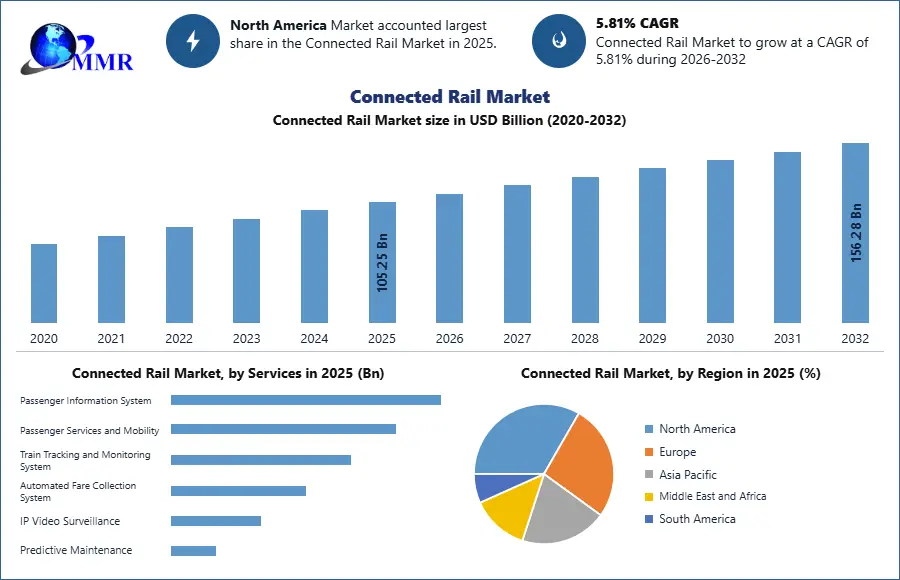
 

Connected Rail Market Growth Analysis

To know about the Research Methodology:-Request Free Sample Report

Connected Rail Market Overview

The Connected Rail Market represents the ecosystem of digital, communication, control, monitoring, analytics, and passenger-facing technologies deployed across railway infrastructure, rolling stock, stations, and network operations. It covers real-time passenger information, train tracking and monitoring, automated fare collection, predictive maintenance, IP video surveillance, and digital signalling platforms such as Positive Train Control, CBTC, and ATC. As rail systems become more data-centric, connected rail has shifted from a support function to a strategic operating model for safety, punctuality, capacity utilization, and lifecycle cost optimization.

The strongest growth factors have been rising urbanization, the need for higher-capacity public transport, and the modernization of aging rail infrastructure. Transit agencies and national rail operators have been investing in intelligent transport systems to improve service reliability, reduce manual interventions, and manage increasing passenger volumes with greater operational precision. At the same time, digital rail technologies have gained policy relevance because governments increasingly view rail as a lower-emission transport mode that supports decarbonization goals and more efficient mobility planning. Rail carries only a modest share of transport emissions relative to its passenger and freight role, reinforcing investment interest in digitally enabled rail expansion.

Technological development has accelerated the market’s transformation. CBTC and ETCS-based signalling, cloud-enabled control architectures, AI-assisted inspection, digital twins, and asset condition monitoring are now moving from pilot scale to mainstream deployment. Operators are also prioritizing integrated control centers, onboard connectivity, and real-time data exchange between train, trackside, and central systems. The demand outlook remains favorable because rail agencies are under pressure to increase throughput, improve passenger communication, and extend asset life without proportionately increasing maintenance costs. As a result, the Connected Rail Market is expected to remain a key beneficiary of smart mobility investment, rail automation, and sustainability-led infrastructure spending.

Connected Rail Market Growth Catalysts

Urban Mobility Modernization and Capacity Expansion
The Connected Rail Market has been driven by the need to modernize urban and suburban rail systems facing crowding, punctuality pressures, and rising service expectations. Connected control and monitoring platforms have helped operators run more trains at tighter intervals, improve service regularity, and optimize traffic flow. In metro environments, CBTC has become especially important because it improves reliability and increases capacity through more precise train separation and real-time control.

Safety Regulation and Digital Signalling Investment
The Connected Rail Market has also benefited from regulatory support for safer train operations. In the United States, FRA-mandated PTC deployment created a strong installed base for digital safety systems, while in Europe ERTMS has supported interoperability, safety, and infrastructure capacity improvements. These frameworks have accelerated adoption of advanced signalling, communication, and control technologies across both passenger and freight corridors.

Predictive Maintenance and Lifecycle Efficiency
Rail operators increasingly prefer predictive maintenance because it reduces unplanned downtime, improves asset availability, and lowers whole-life maintenance cost. Connected inspection systems, remote diagnostics, and AI-enabled analytics allow rolling stock and infrastructure faults to be identified earlier. This has made digital maintenance one of the highest-return use cases in the Connected Rail Market.

Connected Rail Market Limitations

High Integration Cost Across Legacy Networks
The Connected Rail Market still faces a major limitation in the cost and complexity of integrating modern digital systems into legacy networks. Many operators must retrofit aging signalling, onboard equipment, control rooms, and station systems in phases, which stretches budgets and extends deployment timelines. Large modernization programs often require years of staged execution.

Cybersecurity and Interoperability Constraints
The Connected Rail Market also faces technical barriers around interoperability and cyber-resilience. As rail networks become more software-defined and more connected to cloud, communications, and centralized monitoring systems, safety assurance and system compatibility become more demanding. Standards-based integration helps, but multi-vendor rail environments still create operational friction.

Connected Rail Market Future Growth Potential

Cloud-Based Rail Control and Digital Twins
A major opportunity in the Connected Rail Market lies in cloud-enabled signalling, digital twins, and network-wide simulation. Vendors are increasingly commercializing architectures that combine real-time control data with analytics, optimization, and remote lifecycle management. This opens the door to more scalable deployments and faster software-led upgrades.

Electrified Rail and Sustainable Mobility Corridors
The Connected Rail Market is well positioned to benefit from the expansion of electrified rail corridors. Rail is already among the most electrified transport modes, and digital rail technologies strengthen the business case further by improving asset utilization, energy efficiency, and operational reliability. This combination of electrification and digitalization will remain a strong investment theme.

Passenger Experience Platforms
Passenger-facing connectivity remains an important emerging opportunity. Real-time journey information, dynamic service alerts, digital ticketing, and onboard information systems directly affect perceived service quality. Agencies that improve the passenger interface can support ridership recovery and better network utilization.

Connected Rail Market Operational & Strategic Barriers

The Connected Rail Market remains exposed to long procurement cycles and fragmented ownership structures. Rail projects often depend on public funding, multi-agency approvals, and staged implementation, which slows revenue realization and complicates project sequencing.

The Connected Rail Market also faces adoption barriers tied to workforce capability and operational change management. Moving from conventional signalling and reactive maintenance to highly digital operations requires retraining, revised operating rules, and sustained systems integration support.

Connected Rail Market Trends

CBTC and Automated Train Operation Becoming Core Urban Rail Infrastructure
The market trend with the strongest momentum is the shift toward CBTC and higher-grade train automation in metro systems. Transit agencies increasingly view these systems as foundational for capacity growth, reliability improvement, and service digitization.

AI-Enabled Inspection and Predictive Maintenance Platforms
Another major trend is the deployment of machine vision, thermal sensing, acoustic monitoring, and AI analytics for rolling stock inspection and infrastructure maintenance. This trend is moving connected rail from simple monitoring toward automated decision support.

Integrated Passenger Information and Operations Visibility
Real-time arrival data, disruption alerts, onboard information, and control-center integration are becoming standard expectations rather than optional upgrades. Agencies increasingly link passenger communication with core traffic management systems.

Connected Rail Market Segments Analysis

Connected Rail Market Segmentation, by Services

In 2025, the Passenger Information System segment was the largest in the Connected Rail Market because rail operators increasingly prioritized real-time service visibility, disruption communication, platform displays, onboard announcements, and app-based passenger information. The segment had broad adoption across metro, commuter, and intercity networks because it directly influenced customer experience and service trust. It also benefited from easier retrofit economics compared with full signalling replacement, which allowed agencies to scale deployments faster. CBTC rollouts and digital control upgrades further reinforced this segment because better train location data improves arrival predictions and service alerts. Passenger information systems also supported accessibility communication, multimodal coordination, and network resilience during service disruptions. Their 2025 dominance reflected strong demand, broad use cases, and direct value creation at both operational and consumer levels.

Connected Rail Market Segmentation, by Rolling Stock

In 2025, the Electric Locomotive segment dominated the Connected Rail Market by rolling stock because electrified rail systems attracted greater policy support, higher digital investment intensity, and stronger alignment with sustainable mobility goals. Electric rail networks were more likely to deploy advanced signalling, diagnostics, traffic management, and energy optimization systems. Rail is already one of the most electrified transport modes globally, and in Europe a large share of traffic runs on electrified lines, creating a stronger installed base for connected technologies. Electric locomotives also supported better integration with modern control and monitoring architectures, especially on high-utilization passenger and mixed-traffic routes. Their leading position reflected industrial growth in electrified corridors, technology readiness, and infrastructure compatibility with connected rail systems.

Connected Rail Market Segmentation, by Safety & Signalling System

In 2025, the Communication Based Train Control segment led the Connected Rail Market by safety and signalling system, particularly in urban rail and metro networks. CBTC had become widely accepted because it improves reliability, supports closer train spacing, increases infrastructure capacity, and strengthens real-time system awareness. It also improves the accuracy of live arrival information and enables the automation pathway from assisted operation to driverless service. While Positive Train Control remained essential in North America and ATC continued to support many legacy systems, CBTC gained the strongest commercial momentum where operators wanted more throughput, higher service frequency, and integrated digital control. Its leadership in 2025 reflected adoption depth in metros, software-rich architecture, and strong fit with the broader smart rail transformation agenda.

Connected Rail Market Regional Analysis

In 2025, North America was the leading region in the Connected Rail Market, supported by advanced rail infrastructure, strong digital signalling adoption, and a mature regulatory environment for connected safety systems. The region benefited from PTC implementation across mandated main lines, which created a substantial installed base for digital train control and interoperability. Technology leadership was reinforced by continued CBTC deployment in major urban transit systems, where agencies used connected train control to improve reliability, real-time passenger information, and network capacity. Infrastructure strength also remained a differentiator: North America combined large freight rail networks, high-value commuter corridors, and significant public transit modernization budgets. Market data for 2025 indicated North America held the largest regional share, and that position was consistent with the region’s regulatory experience, industrial scale, and long-running investment in intelligent transportation systems.

Connected Rail Market Key Development

February 2025: Hitachi Rail signed a contract with the San Francisco Municipal Transportation Agency to modernize Muni using SelTrac CBTC across the roughly 71-mile, 33-station network. The project covers both subway and surface operations, which is strategically important because connected rail value rises when one control logic governs mixed operational environments instead of isolated route sections. Hitachi said around 160 million passenger journeys annually would benefit from the upgrade, and the agreement also included a 10-year service support package with an option for 10 more years. From a market perspective, this development signaled continued demand for end-to-end signalling modernization, long-duration lifecycle services, and software-intensive urban rail control. It also reinforced the commercial appeal of integrated train tracking, centralized traffic management, and future-ready passenger information systems. For the Connected Rail Market, the project exemplified how operators are moving beyond isolated signalling refreshes toward network-wide digital operating platforms.

February 2025: Alstom and Deutsche Bahn signed a long-term framework agreement worth more than EUR 600 million for the modernization and digitalization of the German rail network. The agreement included at least 1,890 interlocking units, multiple call-offs between 2025 and 2028, and implementation through 2032, with scope covering digital interlocking plus train control and safety technology in the ETCS standard. This was important for the Connected Rail Market because it demonstrated that digital rail spending is shifting toward multi-year, programmatic deployment rather than isolated project procurement. It also highlighted growing demand for interoperable signalling architectures that can support capacity growth, lower maintenance complexity, and improve execution certainty for network operators. Strategically, the deal underscored Europe’s role in large-scale rail digitalization, where interoperability, resilience, and long-horizon infrastructure planning are accelerating adoption of connected signalling ecosystems across both core and secondary lines.

August 2025: Siemens Mobility won the contract to fully automate Paris Metro Line 13 using its CBTC GoA4 technology, with scope including a new operations control center and equipment for 66 trains. Siemens said the project would enable fully automated, driverless service, increase transport capacity, improve reliability, optimize energy consumption, and provide real-time passenger information onboard trains. The line carries more than 550,000 passengers daily, making the project commercially significant for the Connected Rail Market because it links signalling, control-center modernization, onboard systems, and passenger experience into one transformation program. Beyond the metro itself, the contract reinforced a broader market pattern: rail agencies increasingly view connected automation not only as a safety upgrade, but as a capacity, decarbonization, and rider-experience investment. This kind of project also strengthens recurring revenue potential through long-term maintenance, software support, and lifecycle performance optimization.

The scope of the Global Connected Rail Market:  Inquire before buying

Connected Rail Market
Report Coverage Details
Base Year: 2025 Forecast Period: 2026-2032
Historical Data: 2020 to 2025 Market Size in 2025: USD 105.25 Billion
Forecast Period 2026-2032 CAGR: 5.81% Market Size in 2032: USD 156.28 Billion
Segments Covered: by Services Passenger Information System
Passenger Services and Mobility
Train Tracking and Monitoring System
Automated Fare Collection System
IP Video Surveillance
Predictive Maintenance
By Rolling Stock Electric Locomotive
Diesel Locomotive
DMU (Diesel Multiple Unit)
by Safety & Signalling System Positive Train Control (PTC)
Communication/Computer-Based Train Control (CBTC)
Automated/Integrated Train Control (ATC)


Global Connected Rail Market, by Region

North America (United States, Canada, and Mexico)
Europe (UK, France, Germany, Italy, Spain, Sweden, Austria, and the Rest of Europe)
Asia Pacific (China, South Korea, Japan, India, Australia, ASEAN, Indonesia, Philippines, Malaysia, Vietnam, Thailand, ASEAN, Rest of Asia Pacific)
Middle East & Africa (South Africa, GCC, Nigeria, Rest of ME&A)
South America (Brazil, Argentina, Rest of South America)

Global Connected Rail Market, Key Players

  1. Siemens Mobility
  2. Alstom
  3. Hitachi Rail
  4. Thales
  5. Wabtec Corporation
  6. Nokia
  7. Cisco Systems
  8. Huawei
  9. IBM
  10. Indra Sistemas
  11. Mitsubishi Electric
  12. ABB
  13. CAF Signalling
  14. EKE-Electronics
  15. Trimble
  16. Frequentis
  17. Advantech
  18. Toshiba Infrastructure Systems & Solutions
  19. Fujitsu
  20. Nokia Solutions and Networks
  21. Knorr-Bremse
  22. Belden
  23. Kontron Transportation
  24. Duagon
  25. Televic Rail

Table of Contents

1. Connected Rail Market Introduction
1.1. Study Assumption and Market Definition
1.2. Scope of the Study
1.3. Executive Summary
2. Global Connected Rail Market: Competitive Landscape
2.1. MMR Competition Matrix
2.2. Competitive Landscape
2.3. Key Players Benchmarking
2.3.1. Company Name
2.3.2. Business Segment
2.3.3. End-user Segment
2.3.4. Revenue (2025)
2.3.5. Company Locations
2.4. Leading Connected Rail Market Companies, by market capitalization
2.5. Market Structure
2.5.1. Market Leaders
2.5.2. Market Followers
2.5.3. Emerging Players
2.6. Mergers and Acquisitions Details
3. Connected Rail Market: Dynamics
3.1. Connected Rail Market Trends by Region
3.1.1. North America Connected Rail Market Trends
3.1.2. Europe Connected Rail Market Trends
3.1.3. Asia Pacific Connected Rail Market Trends
3.1.4. Middle East and Africa Connected Rail Market Trends
3.1.5. South America Connected Rail Market Trends
3.2. Connected Rail Market Dynamics by Region
3.2.1. North America
3.2.1.1. North America Connected Rail Market Drivers
3.2.1.2. North America Connected Rail Market Restraints
3.2.1.3. North America Connected Rail Market Opportunities
3.2.1.4. North America Connected Rail Market Challenges
3.2.2. Europe
3.2.2.1. Europe Connected Rail Market Drivers
3.2.2.2. Europe Connected Rail Market Restraints
3.2.2.3. Europe Connected Rail Market Opportunities
3.2.2.4. Europe Connected Rail Market Challenges
3.2.3. Asia Pacific
3.2.3.1. Asia Pacific Connected Rail Market Drivers
3.2.3.2. Asia Pacific Connected Rail Market Restraints
3.2.3.3. Asia Pacific Connected Rail Market Opportunities
3.2.3.4. Asia Pacific Connected Rail Market Challenges
3.2.4. Middle East and Africa
3.2.4.1. Middle East and Africa Connected Rail Market Drivers
3.2.4.2. Middle East and Africa Connected Rail Market Restraints
3.2.4.3. Middle East and Africa Connected Rail Market Opportunities
3.2.4.4. Middle East and Africa Connected Rail Market Challenges
3.2.5. South America
3.2.5.1. South America Connected Rail Market Drivers
3.2.5.2. South America Connected Rail Market Restraints
3.2.5.3. South America Connected Rail Market Opportunities
3.2.5.4. South America Connected Rail Market Challenges
3.3. PORTER's Five Forces Analysis
3.4. PESTLE Analysis
3.5. Technology Roadmap
3.6. Regulatory Landscape by Region
3.6.1. North America
3.6.2. Europe
3.6.3. Asia Pacific
3.6.4. Middle East and Africa
3.6.5. South America
3.7. Key Opinion Leader Analysis For Connected Rail Industry
3.8. Analysis of Government Schemes and Initiatives For Connected Rail Industry
3.9. Connected Rail Market Trade Analysis
3.10. The Global Pandemic Impact on Connected Rail Market
4. Connected Rail Market: Global Market Size and Forecast by Segmentation (in USD Billion) 2025-2032
4.1. Connected Rail Market Size and Forecast, by Services (2025-2032)
4.1.1. Passenger Information System
4.1.2. Passenger Services and Mobility
4.1.3. Train Tracking and Monitoring System
4.1.4. Automated Fare Collection System
4.1.5. IP Video Surveillance
4.1.6. Predictive Maintenance
4.2. Connected Rail Market Size and Forecast, by By Rolling Stock (2025-2032)
4.2.1. Electric Locomotive
4.2.2. Diesel Locomotive
4.2.3. DMU (Diesel Multiple Unit)
4.3. Connected Rail Market Size and Forecast, by Safety & Signalling System (2025-2032)
4.3.1. Positive Train Control (PTC)
4.3.2. Communication/Computer-Based Train Control (CBTC)
4.3.3. Automated/Integrated Train Control (ATC)
4.4. Connected Rail Market Size and Forecast, by Region (2025-2032)
4.4.1. North America
4.4.2. Europe
4.4.3. Asia Pacific
4.4.4. Middle East and Africa
4.4.5. South America
5. North America Connected Rail Market Size and Forecast by Segmentation (in USD Billion) 2025-2032
5.1. North America Connected Rail Market Size and Forecast, by Services (2025-2032)
5.1.1. Passenger Information System
5.1.2. Passenger Services and Mobility
5.1.3. Train Tracking and Monitoring System
5.1.4. Automated Fare Collection System
5.1.5. IP Video Surveillance
5.1.6. Predictive Maintenance
5.2. North America Connected Rail Market Size and Forecast, by By Rolling Stock (2025-2032)
5.2.1. Electric Locomotive
5.2.2. Diesel Locomotive
5.2.3. DMU (Diesel Multiple Unit)
5.3. North America Connected Rail Market Size and Forecast, by Safety & Signalling System (2025-2032)
5.3.1. Positive Train Control (PTC)
5.3.2. Communication/Computer-Based Train Control (CBTC)
5.3.3. Automated/Integrated Train Control (ATC)
5.4. North America Connected Rail Market Size and Forecast, by Country (2025-2032)
5.4.1. United States
5.4.1.1. United States Connected Rail Market Size and Forecast, by Services (2025-2032)
5.4.1.1.1. Passenger Information System
5.4.1.1.2. Passenger Services and Mobility
5.4.1.1.3. Train Tracking and Monitoring System
5.4.1.1.4. Automated Fare Collection System
5.4.1.1.5. IP Video Surveillance
5.4.1.1.6. Predictive Maintenance
5.4.1.2. United States Connected Rail Market Size and Forecast, by By Rolling Stock (2025-2032)
5.4.1.2.1. Electric Locomotive
5.4.1.2.2. Diesel Locomotive
5.4.1.2.3. DMU (Diesel Multiple Unit)
5.4.1.3. United States Connected Rail Market Size and Forecast, by Safety & Signalling System (2025-2032)
5.4.1.3.1. Positive Train Control (PTC)
5.4.1.3.2. Communication/Computer-Based Train Control (CBTC)
5.4.1.3.3. Automated/Integrated Train Control (ATC)
5.4.2. Canada
5.4.2.1. Canada Connected Rail Market Size and Forecast, by Services (2025-2032)
5.4.2.1.1. Passenger Information System
5.4.2.1.2. Passenger Services and Mobility
5.4.2.1.3. Train Tracking and Monitoring System
5.4.2.1.4. Automated Fare Collection System
5.4.2.1.5. IP Video Surveillance
5.4.2.1.6. Predictive Maintenance
5.4.2.2. Canada Connected Rail Market Size and Forecast, by By Rolling Stock (2025-2032)
5.4.2.2.1. Electric Locomotive
5.4.2.2.2. Diesel Locomotive
5.4.2.2.3. DMU (Diesel Multiple Unit)
5.4.2.3. Canada Connected Rail Market Size and Forecast, by Safety & Signalling System (2025-2032)
5.4.2.3.1. Positive Train Control (PTC)
5.4.2.3.2. Communication/Computer-Based Train Control (CBTC)
5.4.2.3.3. Automated/Integrated Train Control (ATC)
5.4.3. Mexico
5.4.3.1. Mexico Connected Rail Market Size and Forecast, by Services (2025-2032)
5.4.3.1.1. Passenger Information System
5.4.3.1.2. Passenger Services and Mobility
5.4.3.1.3. Train Tracking and Monitoring System
5.4.3.1.4. Automated Fare Collection System
5.4.3.1.5. IP Video Surveillance
5.4.3.1.6. Predictive Maintenance
5.4.3.2. Mexico Connected Rail Market Size and Forecast, by By Rolling Stock (2025-2032)
5.4.3.2.1. Electric Locomotive
5.4.3.2.2. Diesel Locomotive
5.4.3.2.3. DMU (Diesel Multiple Unit)
5.4.3.3. Mexico Connected Rail Market Size and Forecast, by Safety & Signalling System (2025-2032)
5.4.3.3.1. Positive Train Control (PTC)
5.4.3.3.2. Communication/Computer-Based Train Control (CBTC)
5.4.3.3.3. Automated/Integrated Train Control (ATC)
6. Europe Connected Rail Market Size and Forecast by Segmentation (in USD Billion) 2025-2032
6.1. Europe Connected Rail Market Size and Forecast, by Services (2025-2032)
6.2. Europe Connected Rail Market Size and Forecast, by By Rolling Stock (2025-2032)
6.3. Europe Connected Rail Market Size and Forecast, by Safety & Signalling System (2025-2032)
6.4. Europe Connected Rail Market Size and Forecast, by Country (2025-2032)
6.4.1. United Kingdom
6.4.1.1. United Kingdom Connected Rail Market Size and Forecast, by Services (2025-2032)
6.4.1.2. United Kingdom Connected Rail Market Size and Forecast, by By Rolling Stock (2025-2032)
6.4.1.3. United Kingdom Connected Rail Market Size and Forecast, by Safety & Signalling System (2025-2032)
6.4.2. France
6.4.2.1. France Connected Rail Market Size and Forecast, by Services (2025-2032)
6.4.2.2. France Connected Rail Market Size and Forecast, by By Rolling Stock (2025-2032)
6.4.2.3. France Connected Rail Market Size and Forecast, by Safety & Signalling System (2025-2032)
6.4.3. Germany
6.4.3.1. Germany Connected Rail Market Size and Forecast, by Services (2025-2032)
6.4.3.2. Germany Connected Rail Market Size and Forecast, by By Rolling Stock (2025-2032)
6.4.3.3. Germany Connected Rail Market Size and Forecast, by Safety & Signalling System (2025-2032)
6.4.4. Italy
6.4.4.1. Italy Connected Rail Market Size and Forecast, by Services (2025-2032)
6.4.4.2. Italy Connected Rail Market Size and Forecast, by By Rolling Stock (2025-2032)
6.4.4.3. Italy Connected Rail Market Size and Forecast, by Safety & Signalling System (2025-2032)
6.4.5. Spain
6.4.5.1. Spain Connected Rail Market Size and Forecast, by Services (2025-2032)
6.4.5.2. Spain Connected Rail Market Size and Forecast, by By Rolling Stock (2025-2032)
6.4.5.3. Spain Connected Rail Market Size and Forecast, by Safety & Signalling System (2025-2032)
6.4.6. Sweden
6.4.6.1. Sweden Connected Rail Market Size and Forecast, by Services (2025-2032)
6.4.6.2. Sweden Connected Rail Market Size and Forecast, by By Rolling Stock (2025-2032)
6.4.6.3. Sweden Connected Rail Market Size and Forecast, by Safety & Signalling System (2025-2032)
6.4.7. Austria
6.4.7.1. Austria Connected Rail Market Size and Forecast, by Services (2025-2032)
6.4.7.2. Austria Connected Rail Market Size and Forecast, by By Rolling Stock (2025-2032)
6.4.7.3. Austria Connected Rail Market Size and Forecast, by Safety & Signalling System (2025-2032)
6.4.8. Rest of Europe
6.4.8.1. Rest of Europe Connected Rail Market Size and Forecast, by Services (2025-2032)
6.4.8.2. Rest of Europe Connected Rail Market Size and Forecast, by By Rolling Stock (2025-2032)
6.4.8.3. Rest of Europe Connected Rail Market Size and Forecast, by Safety & Signalling System (2025-2032)
7. Asia Pacific Connected Rail Market Size and Forecast by Segmentation (in USD Billion) 2025-2032
7.1. Asia Pacific Connected Rail Market Size and Forecast, by Services (2025-2032)
7.2. Asia Pacific Connected Rail Market Size and Forecast, by By Rolling Stock (2025-2032)
7.3. Asia Pacific Connected Rail Market Size and Forecast, by Safety & Signalling System (2025-2032)
7.4. Asia Pacific Connected Rail Market Size and Forecast, by Country (2025-2032)
7.4.1. China
7.4.1.1. China Connected Rail Market Size and Forecast, by Services (2025-2032)
7.4.1.2. China Connected Rail Market Size and Forecast, by By Rolling Stock (2025-2032)
7.4.1.3. China Connected Rail Market Size and Forecast, by Safety & Signalling System (2025-2032)
7.4.2. S Korea
7.4.2.1. S Korea Connected Rail Market Size and Forecast, by Services (2025-2032)
7.4.2.2. S Korea Connected Rail Market Size and Forecast, by By Rolling Stock (2025-2032)
7.4.2.3. S Korea Connected Rail Market Size and Forecast, by Safety & Signalling System (2025-2032)
7.4.3. Japan
7.4.3.1. Japan Connected Rail Market Size and Forecast, by Services (2025-2032)
7.4.3.2. Japan Connected Rail Market Size and Forecast, by By Rolling Stock (2025-2032)
7.4.3.3. Japan Connected Rail Market Size and Forecast, by Safety & Signalling System (2025-2032)
7.4.4. India
7.4.4.1. India Connected Rail Market Size and Forecast, by Services (2025-2032)
7.4.4.2. India Connected Rail Market Size and Forecast, by By Rolling Stock (2025-2032)
7.4.4.3. India Connected Rail Market Size and Forecast, by Safety & Signalling System (2025-2032)
7.4.5. Australia
7.4.5.1. Australia Connected Rail Market Size and Forecast, by Services (2025-2032)
7.4.5.2. Australia Connected Rail Market Size and Forecast, by By Rolling Stock (2025-2032)
7.4.5.3. Australia Connected Rail Market Size and Forecast, by Safety & Signalling System (2025-2032)
7.4.6. Indonesia
7.4.6.1. Indonesia Connected Rail Market Size and Forecast, by Services (2025-2032)
7.4.6.2. Indonesia Connected Rail Market Size and Forecast, by By Rolling Stock (2025-2032)
7.4.6.3. Indonesia Connected Rail Market Size and Forecast, by Safety & Signalling System (2025-2032)
7.4.7. Malaysia
7.4.7.1. Malaysia Connected Rail Market Size and Forecast, by Services (2025-2032)
7.4.7.2. Malaysia Connected Rail Market Size and Forecast, by By Rolling Stock (2025-2032)
7.4.7.3. Malaysia Connected Rail Market Size and Forecast, by Safety & Signalling System (2025-2032)
7.4.8. Vietnam
7.4.8.1. Vietnam Connected Rail Market Size and Forecast, by Services (2025-2032)
7.4.8.2. Vietnam Connected Rail Market Size and Forecast, by By Rolling Stock (2025-2032)
7.4.8.3. Vietnam Connected Rail Market Size and Forecast, by Safety & Signalling System (2025-2032)
7.4.9. Taiwan
7.4.9.1. Taiwan Connected Rail Market Size and Forecast, by Services (2025-2032)
7.4.9.2. Taiwan Connected Rail Market Size and Forecast, by By Rolling Stock (2025-2032)
7.4.9.3. Taiwan Connected Rail Market Size and Forecast, by Safety & Signalling System (2025-2032)
7.4.10. Rest of Asia Pacific
7.4.10.1. Rest of Asia Pacific Connected Rail Market Size and Forecast, by Services (2025-2032)
7.4.10.2. Rest of Asia Pacific Connected Rail Market Size and Forecast, by By Rolling Stock (2025-2032)
7.4.10.3. Rest of Asia Pacific Connected Rail Market Size and Forecast, by Safety & Signalling System (2025-2032)
8. Middle East and Africa Connected Rail Market Size and Forecast by Segmentation (in USD Billion) 2025-2032
8.1. Middle East and Africa Connected Rail Market Size and Forecast, by Services (2025-2032)
8.2. Middle East and Africa Connected Rail Market Size and Forecast, by By Rolling Stock (2025-2032)
8.3. Middle East and Africa Connected Rail Market Size and Forecast, by Safety & Signalling System (2025-2032)
8.4. Middle East and Africa Connected Rail Market Size and Forecast, by Country (2025-2032)
8.4.1. South Africa
8.4.1.1. South Africa Connected Rail Market Size and Forecast, by Services (2025-2032)
8.4.1.2. South Africa Connected Rail Market Size and Forecast, by By Rolling Stock (2025-2032)
8.4.1.3. South Africa Connected Rail Market Size and Forecast, by Safety & Signalling System (2025-2032)
8.4.2. GCC
8.4.2.1. GCC Connected Rail Market Size and Forecast, by Services (2025-2032)
8.4.2.2. GCC Connected Rail Market Size and Forecast, by By Rolling Stock (2025-2032)
8.4.2.3. GCC Connected Rail Market Size and Forecast, by Safety & Signalling System (2025-2032)
8.4.3. Nigeria
8.4.3.1. Nigeria Connected Rail Market Size and Forecast, by Services (2025-2032)
8.4.3.2. Nigeria Connected Rail Market Size and Forecast, by By Rolling Stock (2025-2032)
8.4.3.3. Nigeria Connected Rail Market Size and Forecast, by Safety & Signalling System (2025-2032)
8.4.4. Rest of ME&A
8.4.4.1. Rest of ME&A Connected Rail Market Size and Forecast, by Services (2025-2032)
8.4.4.2. Rest of ME&A Connected Rail Market Size and Forecast, by By Rolling Stock (2025-2032)
8.4.4.3. Rest of ME&A Connected Rail Market Size and Forecast, by Safety & Signalling System (2025-2032)
9. South America Connected Rail Market Size and Forecast by Segmentation (in USD Billion) 2025-2032
9.1. South America Connected Rail Market Size and Forecast, by Services (2025-2032)
9.2. South America Connected Rail Market Size and Forecast, by By Rolling Stock (2025-2032)
9.3. South America Connected Rail Market Size and Forecast, by Safety & Signalling System (2025-2032)
9.4. South America Connected Rail Market Size and Forecast, by Country (2025-2032)
9.4.1. Brazil
9.4.1.1. Brazil Connected Rail Market Size and Forecast, by Services (2025-2032)
9.4.1.2. Brazil Connected Rail Market Size and Forecast, by By Rolling Stock (2025-2032)
9.4.1.3. Brazil Connected Rail Market Size and Forecast, by Safety & Signalling System (2025-2032)
9.4.2. Argentina
9.4.2.1. Argentina Connected Rail Market Size and Forecast, by Services (2025-2032)
9.4.2.2. Argentina Connected Rail Market Size and Forecast, by By Rolling Stock (2025-2032)
9.4.2.3. Argentina Connected Rail Market Size and Forecast, by Safety & Signalling System (2025-2032)
9.4.3. Rest Of South America
9.4.3.1. Rest Of South America Connected Rail Market Size and Forecast, by Services (2025-2032)
9.4.3.2. Rest Of South America Connected Rail Market Size and Forecast, by By Rolling Stock (2025-2032)
9.4.3.3. Rest Of South America Connected Rail Market Size and Forecast, by Safety & Signalling System (2025-2032)
10. Company Profile: Key Players
10.1. Siemens Mobility
10.1.1. Company Overview
10.1.2. Business Portfolio
10.1.3. Financial Overview
10.1.4. SWOT Analysis
10.1.5. Strategic Analysis
10.1.6. Scale of Operation (small, medium, and large)
10.1.7. Details on Partnership
10.1.8. Regulatory Accreditations and Certifications Received by Them
10.1.9. Awards Received by the Firm
10.1.10. Recent Developments
10.2. Alstom
10.3. Hitachi Rail
10.4. Thales
10.5. Wabtec Corporation
10.6. Nokia
10.7. Cisco Systems
10.8. Huawei
10.9. IBM
10.10. Indra Sistemas
10.11. Mitsubishi Electric
10.12. ABB
10.13. CAF Signalling
10.14. EKE-Electronics
10.15. Trimble
10.16. Frequentis
10.17. Advantech
10.18. Toshiba Infrastructure Systems & Solutions
10.19. Fujitsu
10.20. Nokia Solutions and Networks
10.21. Knorr-Bremse
10.22. Belden
10.23. Kontron Transportation
10.24. Duagon
10.25. Televic Rail
11. Key Findings
12. Industry Recommendations
13. Connected Rail Market: Research Methodology
14. Terms and Glossary

Custom Market Research Services

We Will Customise The Research For You, In Case The Report Listed Above Does Not Meet With Your Requirements