Concrete Admixture Market Size by Type, Application, Construction, Region – Segment-Level Market Assessment, Growth Opportunity Analysis, Competitive Mapping & Forecast to 2032

6.66%
CAGR (2026-2032)
17.29 USD Bn.
Market Size
310
Report Pages
139
Market Tables

Overview

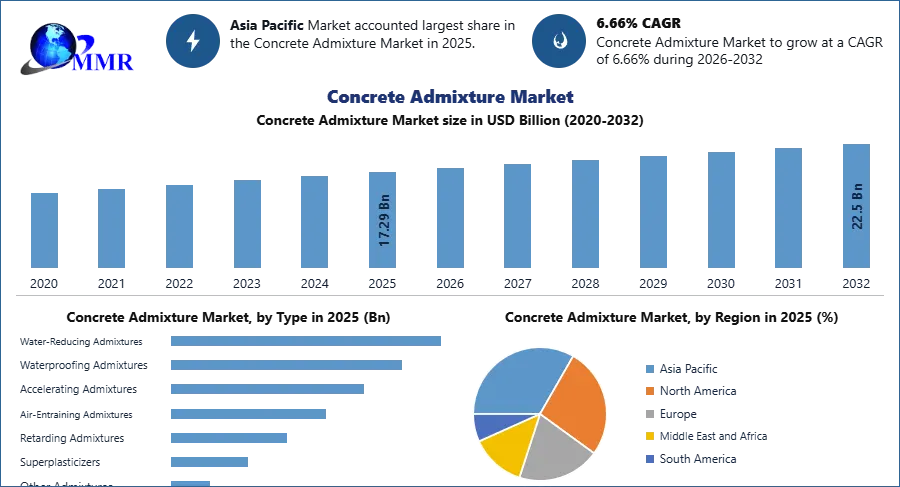
Concrete Admixture market was valued at USD 17.29 Bn. in 2025. Global Concrete Admixture Market size is estimated to grow at a CAGR of 6.66 % over the forecast period.

Concrete Admixture Market Overview:

Global Concrete admixtures are substances that are added to fresh or hardened concrete during mixing to improve certain qualities, such as workability, durability, or early and final strength. The Concrete admixtures are used to enhance concrete's performance in a range of situations. This Concrete admixtures save building costs, alter the properties of hardened concrete, maintain concrete quality throughout mixing, shipping, placing, and curing, and handle several emergencies that may arise during concrete operations.
Concrete Admixture Market

To know about the Research Methodology :- Request Free Sample Report

The report explores the Concrete Admixture Market's segments (Type, Application). Data has been provided by market participants, and regions (North America, Asia Pacific, Europe, Middle East & Africa, and South America). The MMR market report provides a thorough analysis of the rapid advances that are currently taking place across all industry sectors. Facts and figures, illustrations, and presentations are used to provide key data analysis for the historical period from 2020 to 2025. The report investigates the Concrete Admixture Market’s drivers, limitations, prospects, and barriers. This MMR report includes investor recommendations based on a thorough examination of the Concrete Admixture Market's contemporary competitive scenario.

Concrete Admixture Market Dynamics:

Rapid urbanization is the key factor to grow the market

Governments are investing more in the creation of public infrastructure to fulfil the demands of the expanding population for residential, commercial, and industrial construction. This is likely to cause fast urbanization. This is anticipated to drive the need for concrete admixtures such air-entraining and retarding admixtures throughout the forecast period. Furthermore, it is anticipated that the increased attention of global leaders to the development of smart cities, particularly in emerging nations, will fuel market expansion. Additionally, it is anticipated that the industry would rise during the projected period as a result of increasing research and development by the major market players to create high-quality concrete admixtures. The demand in the construction industry will continue to be driven by the requirement for large-scale projects including energy, road, rail, water, and other infrastructure, which will further fuel the expanding market for concrete admixtures.

Concrete framework

Formwork is often left in place until the concrete has sufficiently dried to be removed. It typically takes between 24 and 48 hours to remove the form from walls, columns, and other structures when using regular concrete. Similar to how different construction structures require varied amounts of time. Contrarily, the addition of concrete admixtures to cement or new concrete improves several characteristics, including workability, durability, and early and final strengths. This ultimately reduces the amount of time it takes for concrete to set, saving the builder both money and time. Therefore, the market for concrete admixtures is anticipated to grow in the approaching years due to the growing use of concrete admixtures in significant construction projects, particularly for bridges, tunnels, and other structures.

Reduce the cost Expenditure

Concrete admixtures are additives, either natural or synthetic, that are incorporated into the concrete mix during or before it is finished to greatly improve attributes including durability, corrosion resistance, workability, finish quality, and compressive strength. These additives reduce the curing of hardened concrete and enhance the quality of the concrete during the stages of transport, mixing, and placement. The innovation also makes it easier to cut building costs.

As the sustainability trend grows, it is anticipated that the rising cost of the basic and intermediate chemicals used in the formulation of concrete admixtures would prove to be a significant barrier to the market's expansion. The growing desire to use fewer dangerous chemicals is predicted to have a negative impact on Concrete Admixture sales.

Huge government investments in airport expansion are opportunities to boost the growth of concrete admixtures, and the developing tourism sector in the concrete admixture business has increased demand for the building of new hotels, which in turn has increased demand for the concrete admixture industry. In the forecast period, the widespread availability of technologically improved infrastructure will generate further chances for the concrete admixtures market.

A solidified concrete mixture contracts as a result of capillary water loss, which is known as drying shrinkage. The tensile stress may rise as a result, eventually leading to breaking, internal warping, and outward deflection. The degree of shrinkage during drying depends on several variables, including the member size, the moisture content during curing, the characteristics of the components, and their proportions. However, the water in the cement paste and the evaporation of capillary water are mostly to blame for its occurrence. Concrete drying shrinkage can sometimes be influenced both directly and indirectly by the quantities of water and admixtures used during mixing. Therefore, drying shrinkage may cause worry for the development of concrete admixtures shortly.

COVID-19 Impact on Concrete Admixture Market:

The real-estate industry has faced a huge negative impact due to covid-19. As a result Concrete Admixture market also faced backlashes because these two are complementary to each other. Manufacturers, vendors, distributors, and consumers are among the groups of stakeholders calling for action as a result of the global COVID-19 situation. The profitability of concrete admixtures makers and vendors has been under strain due to a decline in business for at least five months in 2020 and weaker demand from a few key areas. The detrimental effects of COVID-19 on concrete admixtures will, however, be made up for in the medium to long term.

Additionally, the epidemic drove builders and contractors to postpone or cancel several construction projects, causing millions and billions of dollars in losses. Infrastructure projects worth more than $9.6 billion, as per American Road & Transportation Builders Association (ARTBA), have been either postponed or cancelled in the current economic climate.

Concrete Admixture Market Segment Analysis:

Based on Type, Water reducing segment is dominating the market with the highest CAGR during the forecast period. In hot weather, water-reducing admixtures are very useful since they reduce the amount of water required to mix your concrete to a pourable consistency. Concrete can become too weak if too much water is added to keep it pourable when heat causes it to set up too soon. The strength of your concrete will increase with the amount of water in the mix. One of the best forms of concrete admixtures when you need more strength and durability is a water-reducer. Water-reducing admixtures, for instance, are frequently used in the formulation of concrete for foundations.


Based on the Application, Residential segment is dominating the market with highest CAGR during the forecast period. Due to growing urbanisation and increased housing demand globally, the residential application segment is anticipated to have substantial expansion across a number of geographic areas. India, China, and the United States are anticipated to be the segment's top three markets. The non-residential and commercial segments are anticipated to increase at the quickest rates because to increasing industrialization on a global scale.

Concrete Admixture Market Regional Insights:

The Asia-Pacific region dominated the market with highest share in 2025. The Asia-Pacific region is expected to witness significant growth at a CAGR of 9.9% through the forecast period.

The most important factors driving demand in the Asia Pacific region's global market for concrete admixtures are the region's rapid infrastructure development and the expanding need for cheap housing options brought on by the region's steadily growing population. According to the research report, the Asia Pacific region's share of the global market for concrete admixtures will increase exponentially over the forecast years due to a number of factors, including the region's growing urbanization rate, rising household income levels, and expanding population.

The two largest Asia-Pacific nations that are monopolising the market for concrete admixtures are Japan and South Korea. Japan has a sizable, technologically advanced construction market and is a vital place for advanced infrastructure properties, which is why firms that make concrete admixtures are steadily growing their portfolio and manufacturing facilities there. For instance, GCP Applied Technologies constructed a cutting-edge concrete admixture factory in Atsugi, Japan, in September 2020.

The production facility took over from the capacity that was previously produced at the GCP plant in Darex. The investment increased production quality while implementing additional safety and environmental measures. Such corporate plans, together with the region's growing construction sector, are significantly raising the need for concrete admixtures, which will ultimately fuel market expansion there throughout the course of the forecast period.

Due to the region's growing need for cutting-edge construction materials and the related market from the residential application segment, Europe is anticipated to hold a sizeable market share. The necessity for investment in the construction of healthcare facilities, which will also assist market expansion, has been underscored by the rise in the elderly population. The entire market will be driven by the fast-expanding global building sector and the world's expanding population.

The objective of the report is to present a comprehensive analysis of the Concrete Admixture Market to the stakeholders in the industry. The past and current status of the industry with the forecasted market size and trends are presented in the report with the analysis of complicated data in simple language. The report covers all the aspects of the industry with a dedicated study of key players that include market leaders, followers, and new entrants.

PORTER, PESTEL analysis with the potential impact of micro-economic factors of the market have been presented in the report. External as well as internal factors that are supposed to affect the business positively or negatively have been analyzed, which will give a clear futuristic view of the industry to the decision-makers.

The reports also help in understanding the Concrete Admixture Market dynamic, structure by analyzing the market segments and projecting the Concrete Admixture Market size. Clear representation of competitive analysis of key players by Vehicle Type, price, financial position, product portfolio, growth strategies, and regional presence in the Concrete Admixture Market make the report investor’s guide.

Recent Industry Developments

Exact Date Company Development Impact
12 March 2026 Holcim Holcim signed a major agreement to acquire Cemex's operations in Colombia, including specialized admixtures plants. The acquisition significantly expands Holcim's operational footprint and production capacity in the Latin American construction chemical market.
11 March 2026 Vicat Sysnergie The company launched Miscanbloc, a new bio-based construction system utilizing quick-setting natural cement and plant resources. This development promotes sustainable construction by offering a low-carbon alternative to traditional petroleum-derived chemical admixtures.
12 January 2026 Master Builders Solutions The company completed a strategic acquisition in Saudi Arabia to expand its local production of high-performance admixtures. This move strengthens the firm's leadership in the Middle East, targeting massive infrastructure projects like NEOM.
09 September 2025 Master Builders Solutions Master Builders Solutions acquired Brexton Construction Products, a leader in concrete admixtures in the Dominican Republic. This acquisition allows for the rapid deployment of specialized chemical technologies across the Caribbean construction sector.
10 June 2025 Master Builders Solutions The firm inaugurated two new manufacturing plants specifically designed to increase the supply of sustainable admixtures. The expansion addresses the rising demand for environmentally friendly building chemicals in rapidly urbanizing regions.
11 March 2025 Master Builders Solutions The MasterEase® 5000 admixture was awarded the 2025 Innovative Product Award for its rheology-improving capabilities. Recognition of this technology reinforces the market shift toward advanced superplasticizers that improve concrete pumpability and workability.

Concrete Admixture Market Scope: Inquire before buying

Concrete Admixture Market
Report Coverage Details
Base Year: 2025 Forecast Period: 2026-2032
Historical Data: 2020 to 2025 Market Size in 2025: 17.29 USD Billion
Forecast Period 2026-2032 CAGR: 6.66% Market Size in 2032: 22.5 USD Billion
Segments Covered: by Type Water-Reducing Admixtures
Waterproofing Admixtures
Accelerating Admixtures
Air-Entraining Admixtures
Retarding Admixtures
Superplasticizers
Other Admixtures
by Application Residential
Infrastructure
Commercial
Industrial
by Source Mineral Admixtures
Chemical Admixtures

Concrete Admixture Market by Region

North America (United States, Canada and Mexico)
Europe (UK, France, Germany, Italy, Spain, Sweden, Austria and Rest of Europe)
Asia Pacific (China, South Korea, Japan, India, Australia, Indonesia, Malaysia, Vietnam, Taiwan, Bangladesh, Pakistan and Rest of APAC)
Middle East and Africa (South Africa, GCC, Egypt, Nigeria and Rest)

Key Players / Competitors Profiles Covered in Brief in Global Concrete Admixture Market Report in Strategic Perspective:

  1. Sika AG
  2. BASF SE
  3. GCP Applied Technologies
  4. RPM International Inc.
  5. Fosroc Inc.
  6. Mapei SpA
  7. CHRYSO SAS
  8. Rhein-Chemotechnik GmbH
  9. Dow Chemical Company
  10. Saint-Gobain S.A.
  11. Cemex S.A.B. de C.V.
  12. Pidilite Industries Limited
  13. Euclid Chemical Company
  14. Wacker Chemie AG
  15. Holcim Limited
  16. Arkema Group
  17. H.B. Fuller Company
  18. Ashland Inc.
  19. MC-Bauchemie GmbH & Co. KG
  20. Heidelberg Materials AG
  21. Votorantim Cimentos S.A.
  22. Concrete Additives and Chemicals Pvt. Ltd.
  23. Shree Cement Limited
  24. Dalmia Bharat Cement Limited
  25. CICO Group

Table of Contents

1. Concrete Admixture Market Introduction
1.1. Study Assumption and Market Definition
1.2. Scope of the Study
1.3. Executive Summary
2. Global Concrete Admixture Market: Competitive Landscape
2.1. MMR Competition Matrix
2.2. Competitive Landscape
2.3. Key Players Benchmarking
2.3.1. Company Name
2.3.2. Business Segment
2.3.3. End-user Segment
2.3.4. Revenue (2025)
2.3.5. Company Locations
2.4. Leading Concrete Admixture Market Companies, by market capitalization
2.5. Market Structure
2.5.1. Market Leaders
2.5.2. Market Followers
2.5.3. Emerging Players
2.6. Mergers and Acquisitions Details
3. Concrete Admixture Market: Dynamics
3.1. Concrete Admixture Market Trends by Region
3.1.1. North America Concrete Admixture Market Trends
3.1.2. Europe Concrete Admixture Market Trends
3.1.3. Asia Pacific Concrete Admixture Market Trends
3.1.4. Middle East and Africa Concrete Admixture Market Trends
3.1.5. South America Concrete Admixture Market Trends
3.2. Concrete Admixture Market Dynamics by Region
3.2.1. North America
3.2.1.1. North America Concrete Admixture Market Drivers
3.2.1.2. North America Concrete Admixture Market Restraints
3.2.1.3. North America Concrete Admixture Market Opportunities
3.2.1.4. North America Concrete Admixture Market Challenges
3.2.2. Europe
3.2.2.1. Europe Concrete Admixture Market Drivers
3.2.2.2. Europe Concrete Admixture Market Restraints
3.2.2.3. Europe Concrete Admixture Market Opportunities
3.2.2.4. Europe Concrete Admixture Market Challenges
3.2.3. Asia Pacific
3.2.3.1. Asia Pacific Concrete Admixture Market Drivers
3.2.3.2. Asia Pacific Concrete Admixture Market Restraints
3.2.3.3. Asia Pacific Concrete Admixture Market Opportunities
3.2.3.4. Asia Pacific Concrete Admixture Market Challenges
3.2.4. Middle East and Africa
3.2.4.1. Middle East and Africa Concrete Admixture Market Drivers
3.2.4.2. Middle East and Africa Concrete Admixture Market Restraints
3.2.4.3. Middle East and Africa Concrete Admixture Market Opportunities
3.2.4.4. Middle East and Africa Concrete Admixture Market Challenges
3.2.5. South America
3.2.5.1. South America Concrete Admixture Market Drivers
3.2.5.2. South America Concrete Admixture Market Restraints
3.2.5.3. South America Concrete Admixture Market Opportunities
3.2.5.4. South America Concrete Admixture Market Challenges
3.3. PORTER's Five Forces Analysis
3.4. PESTLE Analysis
3.5. Technology Roadmap
3.6. Regulatory Landscape by Region
3.6.1. North America
3.6.2. Europe
3.6.3. Asia Pacific
3.6.4. Middle East and Africa
3.6.5. South America
3.7. Key Opinion Leader Analysis For Concrete Admixture Industry
3.8. Analysis of Government Schemes and Initiatives For Concrete Admixture Industry
3.9. Concrete Admixture Market Trade Analysis
3.10. The Global Pandemic Impact on Concrete Admixture Market
4. Concrete Admixture Market: Global Market Size and Forecast by Segmentation (in USD Billion) 2025-2032
4.1. Concrete Admixture Market Size and Forecast, by Type (2025-2032)
4.1.1. Water-Reducing Admixtures
4.1.2. Waterproofing Admixtures
4.1.3. Accelerating Admixtures
4.1.4. Air-Entraining Admixtures
4.1.5. Retarding Admixtures
4.1.6. Superplasticizers
4.1.7. Other Admixtures
4.2. Concrete Admixture Market Size and Forecast, by Application (2025-2032)
4.2.1. Residential
4.2.2. Infrastructure
4.2.3. Commercial
4.2.4. Industrial
4.3. Concrete Admixture Market Size and Forecast, by Source (2025-2032)
4.3.1. Mineral Admixtures
4.3.2. Chemical Admixtures
4.4. Concrete Admixture Market Size and Forecast, by Region (2025-2032)
4.4.1. North America
4.4.2. Europe
4.4.3. Asia Pacific
4.4.4. Middle East and Africa
4.4.5. South America
5. North America Concrete Admixture Market Size and Forecast by Segmentation (in USD Billion) 2025-2032
5.1. North America Concrete Admixture Market Size and Forecast, by Type (2025-2032)
5.1.1. Water-Reducing Admixtures
5.1.2. Waterproofing Admixtures
5.1.3. Accelerating Admixtures
5.1.4. Air-Entraining Admixtures
5.1.5. Retarding Admixtures
5.1.6. Superplasticizers
5.1.7. Other Admixtures
5.2. North America Concrete Admixture Market Size and Forecast, by Application (2025-2032)
5.2.1. Residential
5.2.2. Infrastructure
5.2.3. Commercial
5.2.4. Industrial
5.3. North America Concrete Admixture Market Size and Forecast, by Source (2025-2032)
5.3.1. Mineral Admixtures
5.3.2. Chemical Admixtures
5.4. North America Concrete Admixture Market Size and Forecast, by Country (2025-2032)
5.4.1. United States
5.4.1.1. United States Concrete Admixture Market Size and Forecast, by Type (2025-2032)
5.4.1.1.1. Water-Reducing Admixtures
5.4.1.1.2. Waterproofing Admixtures
5.4.1.1.3. Accelerating Admixtures
5.4.1.1.4. Air-Entraining Admixtures
5.4.1.1.5. Retarding Admixtures
5.4.1.1.6. Superplasticizers
5.4.1.1.7. Other Admixtures
5.4.1.2. United States Concrete Admixture Market Size and Forecast, by Application (2025-2032)
5.4.1.2.1. Residential
5.4.1.2.2. Infrastructure
5.4.1.2.3. Commercial
5.4.1.2.4. Industrial
5.4.1.3. United States Concrete Admixture Market Size and Forecast, by Source (2025-2032)
5.4.1.3.1. Mineral Admixtures
5.4.1.3.2. Chemical Admixtures
5.4.2. Canada
5.4.2.1. Canada Concrete Admixture Market Size and Forecast, by Type (2025-2032)
5.4.2.1.1. Water-Reducing Admixtures
5.4.2.1.2. Waterproofing Admixtures
5.4.2.1.3. Accelerating Admixtures
5.4.2.1.4. Air-Entraining Admixtures
5.4.2.1.5. Retarding Admixtures
5.4.2.1.6. Superplasticizers
5.4.2.1.7. Other Admixtures
5.4.2.2. Canada Concrete Admixture Market Size and Forecast, by Application (2025-2032)
5.4.2.2.1. Residential
5.4.2.2.2. Infrastructure
5.4.2.2.3. Commercial
5.4.2.2.4. Industrial
5.4.2.3. Canada Concrete Admixture Market Size and Forecast, by Source (2025-2032)
5.4.2.3.1. Mineral Admixtures
5.4.2.3.2. Chemical Admixtures
5.4.3. Mexico
5.4.3.1. Mexico Concrete Admixture Market Size and Forecast, by Type (2025-2032)
5.4.3.1.1. Water-Reducing Admixtures
5.4.3.1.2. Waterproofing Admixtures
5.4.3.1.3. Accelerating Admixtures
5.4.3.1.4. Air-Entraining Admixtures
5.4.3.1.5. Retarding Admixtures
5.4.3.1.6. Superplasticizers
5.4.3.1.7. Other Admixtures
5.4.3.2. Mexico Concrete Admixture Market Size and Forecast, by Application (2025-2032)
5.4.3.2.1. Residential
5.4.3.2.2. Infrastructure
5.4.3.2.3. Commercial
5.4.3.2.4. Industrial
5.4.3.3. Mexico Concrete Admixture Market Size and Forecast, by Source (2025-2032)
5.4.3.3.1. Mineral Admixtures
5.4.3.3.2. Chemical Admixtures
6. Europe Concrete Admixture Market Size and Forecast by Segmentation (in USD Billion) 2025-2032
6.1. Europe Concrete Admixture Market Size and Forecast, by Type (2025-2032)
6.2. Europe Concrete Admixture Market Size and Forecast, by Application (2025-2032)
6.3. Europe Concrete Admixture Market Size and Forecast, by Source (2025-2032)
6.4. Europe Concrete Admixture Market Size and Forecast, by Country (2025-2032)
6.4.1. United Kingdom
6.4.1.1. United Kingdom Concrete Admixture Market Size and Forecast, by Type (2025-2032)
6.4.1.2. United Kingdom Concrete Admixture Market Size and Forecast, by Application (2025-2032)
6.4.1.3. United Kingdom Concrete Admixture Market Size and Forecast, by Source (2025-2032)
6.4.2. France
6.4.2.1. France Concrete Admixture Market Size and Forecast, by Type (2025-2032)
6.4.2.2. France Concrete Admixture Market Size and Forecast, by Application (2025-2032)
6.4.2.3. France Concrete Admixture Market Size and Forecast, by Source (2025-2032)
6.4.3. Germany
6.4.3.1. Germany Concrete Admixture Market Size and Forecast, by Type (2025-2032)
6.4.3.2. Germany Concrete Admixture Market Size and Forecast, by Application (2025-2032)
6.4.3.3. Germany Concrete Admixture Market Size and Forecast, by Source (2025-2032)
6.4.4. Italy
6.4.4.1. Italy Concrete Admixture Market Size and Forecast, by Type (2025-2032)
6.4.4.2. Italy Concrete Admixture Market Size and Forecast, by Application (2025-2032)
6.4.4.3. Italy Concrete Admixture Market Size and Forecast, by Source (2025-2032)
6.4.5. Spain
6.4.5.1. Spain Concrete Admixture Market Size and Forecast, by Type (2025-2032)
6.4.5.2. Spain Concrete Admixture Market Size and Forecast, by Application (2025-2032)
6.4.5.3. Spain Concrete Admixture Market Size and Forecast, by Source (2025-2032)
6.4.6. Sweden
6.4.6.1. Sweden Concrete Admixture Market Size and Forecast, by Type (2025-2032)
6.4.6.2. Sweden Concrete Admixture Market Size and Forecast, by Application (2025-2032)
6.4.6.3. Sweden Concrete Admixture Market Size and Forecast, by Source (2025-2032)
6.4.7. Austria
6.4.7.1. Austria Concrete Admixture Market Size and Forecast, by Type (2025-2032)
6.4.7.2. Austria Concrete Admixture Market Size and Forecast, by Application (2025-2032)
6.4.7.3. Austria Concrete Admixture Market Size and Forecast, by Source (2025-2032)
6.4.8. Rest of Europe
6.4.8.1. Rest of Europe Concrete Admixture Market Size and Forecast, by Type (2025-2032)
6.4.8.2. Rest of Europe Concrete Admixture Market Size and Forecast, by Application (2025-2032)
6.4.8.3. Rest of Europe Concrete Admixture Market Size and Forecast, by Source (2025-2032)
7. Asia Pacific Concrete Admixture Market Size and Forecast by Segmentation (in USD Billion) 2025-2032
7.1. Asia Pacific Concrete Admixture Market Size and Forecast, by Type (2025-2032)
7.2. Asia Pacific Concrete Admixture Market Size and Forecast, by Application (2025-2032)
7.3. Asia Pacific Concrete Admixture Market Size and Forecast, by Source (2025-2032)
7.4. Asia Pacific Concrete Admixture Market Size and Forecast, by Country (2025-2032)
7.4.1. China
7.4.1.1. China Concrete Admixture Market Size and Forecast, by Type (2025-2032)
7.4.1.2. China Concrete Admixture Market Size and Forecast, by Application (2025-2032)
7.4.1.3. China Concrete Admixture Market Size and Forecast, by Source (2025-2032)
7.4.2. S Korea
7.4.2.1. S Korea Concrete Admixture Market Size and Forecast, by Type (2025-2032)
7.4.2.2. S Korea Concrete Admixture Market Size and Forecast, by Application (2025-2032)
7.4.2.3. S Korea Concrete Admixture Market Size and Forecast, by Source (2025-2032)
7.4.3. Japan
7.4.3.1. Japan Concrete Admixture Market Size and Forecast, by Type (2025-2032)
7.4.3.2. Japan Concrete Admixture Market Size and Forecast, by Application (2025-2032)
7.4.3.3. Japan Concrete Admixture Market Size and Forecast, by Source (2025-2032)
7.4.4. India
7.4.4.1. India Concrete Admixture Market Size and Forecast, by Type (2025-2032)
7.4.4.2. India Concrete Admixture Market Size and Forecast, by Application (2025-2032)
7.4.4.3. India Concrete Admixture Market Size and Forecast, by Source (2025-2032)
7.4.5. Australia
7.4.5.1. Australia Concrete Admixture Market Size and Forecast, by Type (2025-2032)
7.4.5.2. Australia Concrete Admixture Market Size and Forecast, by Application (2025-2032)
7.4.5.3. Australia Concrete Admixture Market Size and Forecast, by Source (2025-2032)
7.4.6. Indonesia
7.4.6.1. Indonesia Concrete Admixture Market Size and Forecast, by Type (2025-2032)
7.4.6.2. Indonesia Concrete Admixture Market Size and Forecast, by Application (2025-2032)
7.4.6.3. Indonesia Concrete Admixture Market Size and Forecast, by Source (2025-2032)
7.4.7. Malaysia
7.4.7.1. Malaysia Concrete Admixture Market Size and Forecast, by Type (2025-2032)
7.4.7.2. Malaysia Concrete Admixture Market Size and Forecast, by Application (2025-2032)
7.4.7.3. Malaysia Concrete Admixture Market Size and Forecast, by Source (2025-2032)
7.4.8. Vietnam
7.4.8.1. Vietnam Concrete Admixture Market Size and Forecast, by Type (2025-2032)
7.4.8.2. Vietnam Concrete Admixture Market Size and Forecast, by Application (2025-2032)
7.4.8.3. Vietnam Concrete Admixture Market Size and Forecast, by Source (2025-2032)
7.4.9. Taiwan
7.4.9.1. Taiwan Concrete Admixture Market Size and Forecast, by Type (2025-2032)
7.4.9.2. Taiwan Concrete Admixture Market Size and Forecast, by Application (2025-2032)
7.4.9.3. Taiwan Concrete Admixture Market Size and Forecast, by Source (2025-2032)
7.4.10. Rest of Asia Pacific
7.4.10.1. Rest of Asia Pacific Concrete Admixture Market Size and Forecast, by Type (2025-2032)
7.4.10.2. Rest of Asia Pacific Concrete Admixture Market Size and Forecast, by Application (2025-2032)
7.4.10.3. Rest of Asia Pacific Concrete Admixture Market Size and Forecast, by Source (2025-2032)
8. Middle East and Africa Concrete Admixture Market Size and Forecast by Segmentation (in USD Billion) 2025-2032
8.1. Middle East and Africa Concrete Admixture Market Size and Forecast, by Type (2025-2032)
8.2. Middle East and Africa Concrete Admixture Market Size and Forecast, by Application (2025-2032)
8.3. Middle East and Africa Concrete Admixture Market Size and Forecast, by Source (2025-2032)
8.4. Middle East and Africa Concrete Admixture Market Size and Forecast, by Country (2025-2032)
8.4.1. South Africa
8.4.1.1. South Africa Concrete Admixture Market Size and Forecast, by Type (2025-2032)
8.4.1.2. South Africa Concrete Admixture Market Size and Forecast, by Application (2025-2032)
8.4.1.3. South Africa Concrete Admixture Market Size and Forecast, by Source (2025-2032)
8.4.2. GCC
8.4.2.1. GCC Concrete Admixture Market Size and Forecast, by Type (2025-2032)
8.4.2.2. GCC Concrete Admixture Market Size and Forecast, by Application (2025-2032)
8.4.2.3. GCC Concrete Admixture Market Size and Forecast, by Source (2025-2032)
8.4.3. Nigeria
8.4.3.1. Nigeria Concrete Admixture Market Size and Forecast, by Type (2025-2032)
8.4.3.2. Nigeria Concrete Admixture Market Size and Forecast, by Application (2025-2032)
8.4.3.3. Nigeria Concrete Admixture Market Size and Forecast, by Source (2025-2032)
8.4.4. Rest of ME&A
8.4.4.1. Rest of ME&A Concrete Admixture Market Size and Forecast, by Type (2025-2032)
8.4.4.2. Rest of ME&A Concrete Admixture Market Size and Forecast, by Application (2025-2032)
8.4.4.3. Rest of ME&A Concrete Admixture Market Size and Forecast, by Source (2025-2032)
9. South America Concrete Admixture Market Size and Forecast by Segmentation (in USD Billion) 2025-2032
9.1. South America Concrete Admixture Market Size and Forecast, by Type (2025-2032)
9.2. South America Concrete Admixture Market Size and Forecast, by Application (2025-2032)
9.3. South America Concrete Admixture Market Size and Forecast, by Source (2025-2032)
9.4. South America Concrete Admixture Market Size and Forecast, by Country (2025-2032)
9.4.1. Brazil
9.4.1.1. Brazil Concrete Admixture Market Size and Forecast, by Type (2025-2032)
9.4.1.2. Brazil Concrete Admixture Market Size and Forecast, by Application (2025-2032)
9.4.1.3. Brazil Concrete Admixture Market Size and Forecast, by Source (2025-2032)
9.4.2. Argentina
9.4.2.1. Argentina Concrete Admixture Market Size and Forecast, by Type (2025-2032)
9.4.2.2. Argentina Concrete Admixture Market Size and Forecast, by Application (2025-2032)
9.4.2.3. Argentina Concrete Admixture Market Size and Forecast, by Source (2025-2032)
9.4.3. Rest Of South America
9.4.3.1. Rest Of South America Concrete Admixture Market Size and Forecast, by Type (2025-2032)
9.4.3.2. Rest Of South America Concrete Admixture Market Size and Forecast, by Application (2025-2032)
9.4.3.3. Rest Of South America Concrete Admixture Market Size and Forecast, by Source (2025-2032)
10. Company Profile: Key Players
10.1. Sika AG
10.1.1. Company Overview
10.1.2. Business Portfolio
10.1.3. Financial Overview
10.1.4. SWOT Analysis
10.1.5. Strategic Analysis
10.1.6. Scale of Operation (small, medium, and large)
10.1.7. Details on Partnership
10.1.8. Regulatory Accreditations and Certifications Received by Them
10.1.9. Awards Received by the Firm
10.1.10. Recent Developments
10.2. BASF SE
10.3. GCP Applied Technologies
10.4. RPM International Inc.
10.5. Fosroc Inc.
10.6. Mapei SpA
10.7. CHRYSO SAS
10.8. Rhein-Chemotechnik GmbH
10.9. Dow Chemical Company
10.10. Saint-Gobain S.A.
10.11. Cemex S.A.B. de C.V.
10.12. Pidilite Industries Limited
10.13. Euclid Chemical Company
10.14. Wacker Chemie AG
10.15. Holcim Limited
10.16. Arkema Group
10.17. H.B. Fuller Company
10.18. Ashland Inc.
10.19. MC-Bauchemie GmbH & Co. KG
10.20. Heidelberg Materials AG
10.21. Votorantim Cimentos S.A.
10.22. Concrete Additives and Chemicals Pvt. Ltd.
10.23. Shree Cement Limited
10.24. Dalmia Bharat Cement Limited
10.25. CICO Group
11. Key Findings
12. Industry Recommendations
13. Concrete Admixture Market: Research Methodology
14. Terms and Glossary

Custom Market Research Services

We Will Customise The Research For You, In Case The Report Listed Above Does Not Meet With Your Requirements