
Coconut Flour Market By Product Type, By Nature, By Application, By Distribution Channel, By End User and Regional Insights 2034
Overview
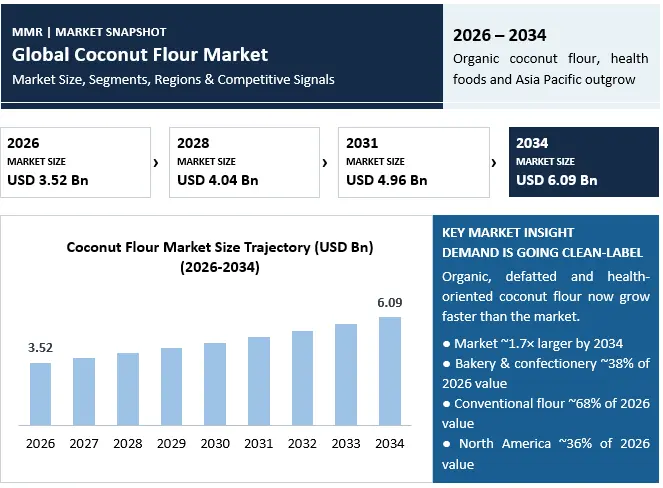
The Global Coconut Flour Market was valued at USD 3.52 billion in 2026 and is projected to reach USD 6.09 billion by 2034, growing at a CAGR of 7.1% during 2026–2034, according to Maximize Market Research (MMR). Coconut flour is a fine, high-fiber powder milled from the dried residue of coconut meat left after coconut milk and oil extraction, and it is valued as a gluten-free, grain-free, low-carbohydrate and plant-based ingredient in bakery products, snacks, breakfast cereals, health foods and household cooking.
This Coconut Flour Market analysis answers both sides of the search: what the market is worth for coconut processors, ingredient manufacturers, food brands and investors, and what bakers, formulators and procurement teams want to know, from what counts as coconut flour to the organic coconut flour market, defatted coconut flour market, full-fat coconut flour market, gluten-free coconut flour and coconut flour applications in bakery products. This Coconut Flour Market overview and Coconut Flour Market analysis offer market insights into Coconut Flour consumption, Coconut Flour demand and Coconut Flour supply, with a clear market summary and market outlook for stakeholders.
Bakery and confectionery products and industrial food manufacturing anchor the market and North America is the largest regional buyer, but Coconut Flour Market growth is shifting toward organic and clean-label grades, defatted and fine-grade flours, health and functional foods, online retail and Asia Pacific as gluten-free, keto, paleo and plant-based diets, upcycled coconut co-products and better baking performance widen the number of food uses. These industry trends and market dynamics highlight emerging markets and growth prospects across the industry landscape.
Maximize Market Research provides comprehensive analysis of global Coconut Flour Market size, share, product type, nature, application, distribution channel, end user and regional segmentation, the Coconut Flour competitive landscape, strategic scenarios and growth opportunities. The report helps global coconut flour manufacturers, coconut processors and exporters, bakery and food ingredient companies, organic and specialty flour brands, distributors, retailers and investors decide which segments, applications and countries to prioritise through 2034. The market research findings also cover market segmentation, market dynamics, key players, market strategies and market entry options, along with the revenue generated by each segment.
| 2026 | BASE YEAR | 2034 | FORECAST | GROWTH RATE | LARGEST REGION |
| USD 3.52 Bn | USD 6.09 Bn | 7.1% | North America |
Global Coconut Flour Market Overview:
The market is measured at manufacturer-selling-price level across full-fat, partially defatted, defatted, fine-grade and coarse-grade coconut flour, in organic and conventional forms, supplied in retail pouches, bulk bags and industrial packs to food manufacturers, bakeries, foodservice operators and households. Finished bakery products, snack foods and flour blends, desiccated coconut, coconut milk, coconut oil and other non-flour coconut products are excluded.
Three shifts shape 2026–2034: demand is broadening from a coconut processing by-product into a mainstream functional food ingredient; value is moving toward organic, clean-label, defatted and fine-grade flours used in gluten-free, keto and high-fiber formulations; and growth is rotating toward Asia Pacific, online retail and sustainable, upcycled supply chains. Suppliers are answering competition from almond, cassava, rice and oat flours with consistent particle size, lower residual fat, better water absorption and application support. This market synopsis reflects the key growth drivers, market opportunities and challenges, along with economic factors, technological advancements and regulatory influences affecting Coconut Flour demand and Coconut Flour supply.
Coconut Flour Market Growth Analysis
To know about the Research Methodology :- Request Free Sample Report
Key Findings: Eight Insights Shaping the Global Coconut Flour Market
MMR’s analysis of published market data, company announcements, regulatory frameworks and industry developments points to eight findings that explain where Coconut Flour Market growth and value are created through 2034. These market insights summarise the Coconut Flour Market forecast, market segmentation and competitive landscape in one view.
| Sr.No. | Findings | Evidence | So what |
| 1 | The market grows about 1.7× by 2034 | USD 3.52 Bn (2026) to USD 6.09 Bn (2034) at 7.1% CAGR | Coconut sourcing, drying and milling capacity must scale about 1.7× by 2034 |
| 2 | Conventional flour is the base, organic the growth edge | Conventional ~68% of 2026 value; organic coconut flour 9.3% CAGR | Certified supply and premium branding become the margin engine |
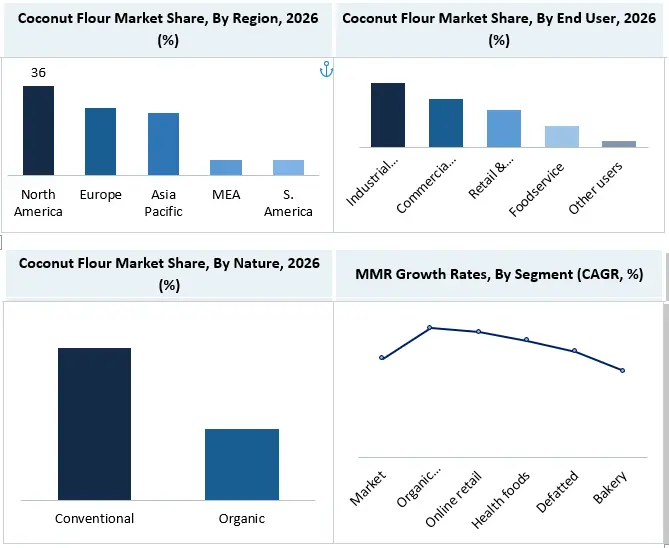
| 3 | North America is the largest region | ~36% share in 2026, led by the United States | Import reliance and specialty-diet demand set pricing in the largest region |
| 4 | Asia Pacific is the fastest-growing region | 8.6% CAGR; Philippines, Indonesia, India, Vietnam and Sri Lanka anchor supply | Local processing scale and rising domestic demand open new revenue pools |
| 5 | Bakery and confectionery remain the core application | Bakery and confectionery ~38% of 2026 value at 6.2% CAGR | Baking performance and water-absorption control anchor competitiveness |
| 6 | Health foods and online retail outgrow the market | Health and functional food 8.4% CAGR; online retail and e-commerce 9.0% CAGR | Keto, paleo and high-fiber positioning and direct-to-consumer channels lift value |
| 7 | The supply base is fragmented and origin-led | Integrated processors in Asia supply bulk flour; US and European brands lead retail | Scale, certifications and raw material access shape competitive position |
| 8 | Sustainability is a competitive lever | Upcycled co-products, traceable sourcing and recyclable packaging gain share | Circular processing and farmer-linked supply chains raise the bar for new entrants |
Global Coconut Flour Market Dynamics:
Global Coconut Flour Market Growth Drivers: Gluten-Free Demand, Low-Carbohydrate Diets, High-Fiber Nutrition and Clean-Label Preference
The Global Coconut Flour Market is supported by the shift toward gluten-free, grain-free and low-carbohydrate eating, the spread of keto and paleo diets and rising interest in plant-based, high-fiber ingredients. Coconut flour delivers dietary fiber, plant protein and a mild natural sweetness with a low net-carbohydrate profile, which makes gluten-free coconut flour a practical upgrade for bakers and formulators who want better nutrition without relying on wheat. Bakery, snack and breakfast manufacturers and health-conscious households pull Coconut Flour consumption upward, and repeat purchasing by commercial bakeries and brands gives the Coconut Flour Market a recurring revenue base. These factors support steady Coconut Flour Market growth across mature and emerging regions, although buying decisions still depend on price, texture, residual fat, certification and supply reliability. Coconut Flour Market demand and supply, innovation in the industry, Coconut Flour Market consumer preferences evolution, Coconut Flour Market drivers, Coconut Flour Market growth catalysts, Coconut Flour Market growth factors, Coconut Flour Market demand and supply dynamics act as market drivers and growth catalysts for Coconut Flour demand.
Technology and application breadth are adding new layers of demand. Fine-grade and defatted coconut flour with improved water absorption supports better bread, cake and cookie texture, coconut flour blends with almond, rice, tapioca and cassava flours widen gluten-free formulation options, and upcycled coconut residue from milk and oil extraction links Coconut Flour supply to circular, sustainable processing. Integrated coconut processors in the Philippines, Indonesia, India, Vietnam, Sri Lanka and Thailand, together with organic and specialty brands in the United States and Europe, show how commercial grades are tailored to bakeries, snack makers, premix suppliers and retail shelves. Food manufacturers and bakery chains, together with online and specialty retailers, keep B2B and retail volume demand high through repeat supply agreements. Coconut Flour Market technology trends, technological advancements, Coconut Flour Market innovation impact, Coconut Flour Market adaptability, strategic market changes, customer engagement dynamics, Coconut Flour Market emerging trends reinforce this momentum.
Global Coconut Flour Market Restraints:
Raw material cost and supply seasonality are the main restraints. Coconut flour is a co-product of coconut milk and oil extraction, so mature coconut availability, harvest seasonality, weather, crop age and agricultural commodity prices determine raw material cost, drying yield and flour pricing. Freight, currency movements and trade policy shape Coconut Flour supply and landed prices, and a limited number of origin countries concentrate sourcing. Buyers must also manage high water absorption and the need to adapt recipes, which slows switching from wheat-based flours. Coconut Flour Market constraints, Coconut Flour Market volatility, Coconut Flour Market industry fluctuations, economic factors, Coconut Flour Market macroeconomic factors, environmental factors, Coconut Flour Market fluctuation analysis, industry disruptors shape Coconut Flour supply and the Coconut Flour Market constraints that suppliers must manage.
Regulation, quality and competition also limit growth. Food safety and facility requirements, organic certification, labeling rules and export and import documentation add time and cost, while microbial, heavy-metal, pesticide-residue and moisture controls must be met batch after batch. Almond, cassava, rice, oat and other alternative flours compete for the same gluten-free and low-carbohydrate formulations, and some buyers hesitate to reformulate proven products. Coconut Flour Market regulatory influences, regulatory changes, Coconut Flour Market competitive forces, Coconut Flour Market challenges, Coconut Flour Market forces, external market influences, Coconut Flour Market industry resilience, industry evolution, Coconut Flour Market dynamics also influence how quickly new entrants can scale.
What Are the Biggest Coconut Flour Market Opportunities Through 2034?
Organic and clean-label coconut flour, health and functional food formulations and online retail represent the most significant Coconut Flour Market opportunities because they extend revenue beyond standard conventional flour sold in bulk. Organic coconut flour is projected to grow at 9.3% CAGR, online retail and e-commerce at 9.0% and health and functional food products at 8.4%, as brands specify high-fiber, low-carbohydrate, non-GMO and minimally processed ingredients. Upcycled, traceable and sustainably sourced flour shows how provenance can become a marketing advantage. Suppliers with certified supply, strong quality control and application support may be better positioned to win new contracts. Coconut Flour Market opportunities, Coconut Flour Market challenges and Coconut Flour consumer demographics, covering bakers, formulators, health-conscious households and institutional buyers, are assessed for each segment, together with Coconut Flour Market consumer behavior trends, economic indicators, Coconut Flour Market trends analysis, socioeconomic influences.
Emerging-market expansion, private-label supply and customized flour specifications offer further routes to growth. Asia Pacific is projected to be the fastest-growing region at 8.6% CAGR as India, China, Indonesia, the Philippines, Vietnam, Sri Lanka, Thailand, Japan and Australia expand processing capacity and health-food demand, while Middle East & Africa and South America benefit from specialty ingredient imports and local coconut processing. Contract manufacturing, private-label packs and co-development with bakery and snack brands can widen distribution and shorten new product cycles. Coconut Flour Market emerging trends, Coconut Flour Market gap, Coconut Flour Market segmentation shifts, competitive landscape shifts, Coconut Flour Market responsiveness, Coconut Flour Market shifts create attractive segment-specific opportunities and untapped market areas.
Coconut Flour Market Trends:
Four Coconut Flour Market trends stand out through 2034. First, organic and clean-label grades: certified, non-GMO and minimally processed flour is moving from specialty shelves into mainstream retail. Second, defatted and fine-grade flours: bakers want lower residual fat, smoother mouthfeel and predictable water absorption. Third, plant-based and functional formulations: coconut flour appears in keto, paleo, vegan and protein-enriched foods. Fourth, upcycled and sustainable supply: processors turn milk and oil extraction residue into food-grade flour and adopt recyclable packaging. Hot-air and flash drying, hammer and pin milling and automated quality monitoring enable these shifts. Coconut Flour Market consumer behavior trends, competitive forces, Coconut Flour Market growth factors, industry disruptors, Coconut Flour Market socioeconomic influences, Coconut Flour Market forces, Coconut Flour Market economic indicators, competitive landscape shifts, Coconut Flour Market consumer preferences evolution, regulatory changes, Coconut Flour Market innovation impact, Coconut Flour Market responsiveness, external market influences, Coconut Flour Market adaptability, strategic market changes, Coconut Flour Market segmentation shifts, Coconut Flour Market industry resilience determine how Coconut Flour manufacturers respond.
Global Coconut Flour Market Segment Analysis:
Coconut Flour Market by Application and Distribution Channel: Bakery, Snacks, Health Foods, Foodservice and Retail
 Organic Coconut Flour Market, Defatted Coconut Flour Market, Full-Fat Coconut Flour Market, Product Type and Nature Analysis
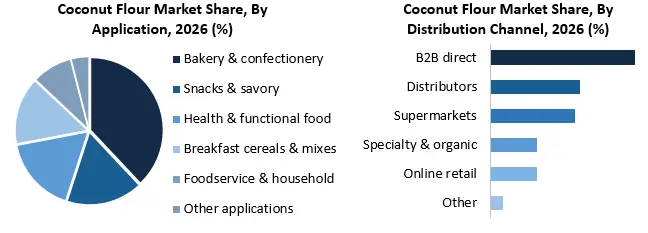
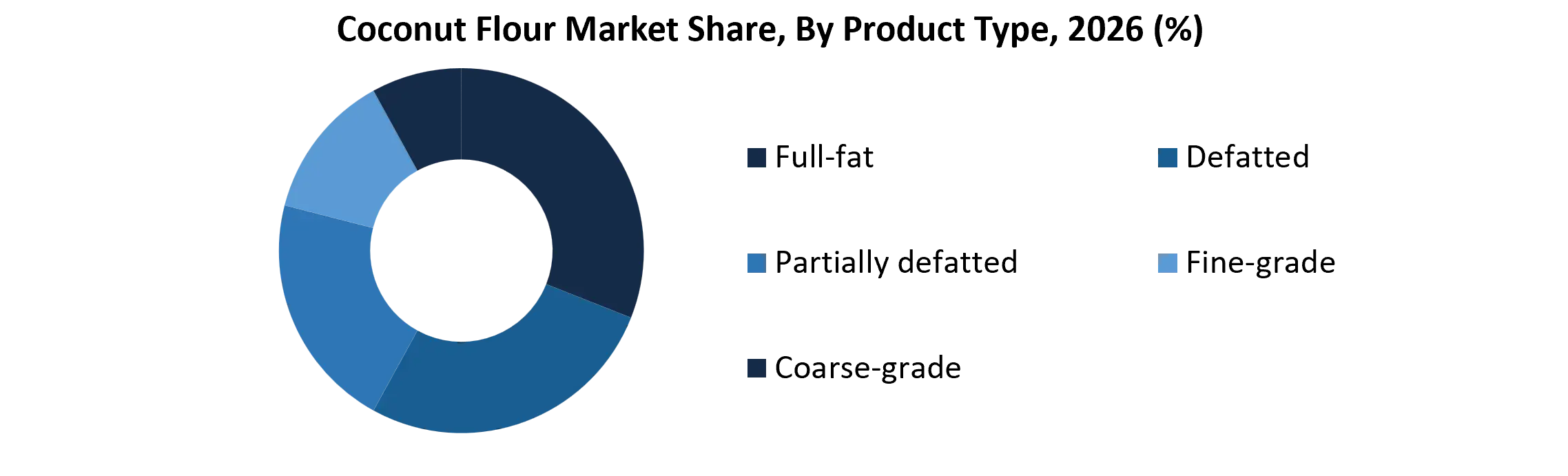
Full-fat coconut flour is the largest product type at about 31% of 2026 value, defatted coconut flour holds about 27%, partially defatted about 21%, fine-grade about 13% and coarse-grade about 8%, with defatted and fine-grade grades growing faster than the market. By nature, conventional coconut flour leads at about 68%, while organic coconut flour holds about 32% and grows at 9.3% CAGR. By application, bakery and confectionery account for about 38% of value, snacks and savory products 17%, health and functional food products 17%, breakfast cereals and prepared mixes 15%, foodservice and household cooking 9% and other food applications 4%. By distribution channel, B2B direct sales lead at about 34%, followed by food ingredient distributors and wholesalers at 21%, supermarkets and hypermarkets at 20%, specialty and organic stores at 11%, online retail at 11% and other channels at 3%. Industrial food and beverage manufacturers are the largest end user at about 36%. This Coconut Flour Market segment analysis covers Coconut Flour Market industry segmentation, target market analysis, Coconut Flour Market consumer demographics, product segmentation, Coconut Flour Market geographic segmentation, Coconut Flour Market subsegments, niche markets, customer profiling, Coconut Flour Market share by segment, segment growth analysis, Coconut Flour Market competitive segment landscape.
Segmentation insights also span emerging market segments, Coconut Flour Market segment attractiveness, behavioral segmentation, segment-based marketing, customized market strategies, Coconut Flour Market demographic profiling, Coconut Flour Market niche exploration, Coconut Flour Market micro-segmentation, segmentation strategies, Coconut Flour Market segment dynamics, customer behavior segmentation, specialized market segments, unexplored market niches, Coconut Flour Market segment-specific trends, untapped market areas, Coconut Flour Market segment-specific opportunities, tailored marketing strategies, Coconut Flour Market fragment analysis, unique market sectors, granular market breakdown, comprehensive market sector analysis across the competitive segment landscape for the Organic Coconut Flour Market, the Defatted Coconut Flour Market and the Full-Fat Coconut Flour Market.
Coconut Flour Product Types: Where Defatted and Full-Fat Coconut Flour Market Demand Sits
 Global Coconut Flour Market Regional Analysis:
North America is the largest regional market, accounting for about 36% of global value in 2026. The United States is the demand anchor, supported by a mature gluten-free, keto and paleo consumer base, strong specialty, organic and online retail and a deep base of coconut flour brands, while Canada and Mexico add steady import-led consumption. The region is expected to grow at about 6.3% CAGR, led by organic, clean-label and e-commerce sales. Europe holds about 27% of 2026 value, supported by organic and gluten-free demand in the United Kingdom, Germany, France, Italy, Spain, the Netherlands and the Nordic countries, strong bakery premix use and EU organic regulation; Europe is expected to grow at about 6.6% CAGR. Regional market trends, market performance by region and regional market share show how local consumer behavior and regional economic factors influence Coconut Flour consumption.
Asia Pacific holds about 25% of 2026 value and is projected to be the fastest-growing region at about 8.6% CAGR, as coconut-producing countries including the Philippines, Indonesia, India, Vietnam, Sri Lanka and Thailand expand processing and export capacity and China, Japan, Australia and South Korea add health-food demand. Middle East & Africa is a smaller market, about 6% of 2026 value, with growth of about 7.4% CAGR led by the United Arab Emirates, Saudi Arabia, Israel, Turkey, South Africa, Egypt and Nigeria as specialty ingredient imports and modern retail expand. South America, also about 6%, is projected to grow at about 6.9% CAGR, led by Brazil, Argentina, Chile, Colombia and Peru, where local coconut processing and health-food retail support emerging flour consumption.
The geographical analysis of the Coconut Flour Market examines regional market trends, area-specific market dynamics, and local factors influencing industry performance across key regions. It provides insights into regional market segmentation, geographical growth patterns, consumer behavior, and economic influences shaping demand for coconut flour. The analysis also evaluates regional market performance, competitive landscapes, market share distribution, and location-specific growth opportunities.
Furthermore, it explores regional economic conditions, demographic trends, consumer preferences, localized market challenges, and emerging business opportunities. Area-specific industry developments, regional competitive dynamics, market entry strategies, and economic factors are assessed to understand the evolving market landscape. The analysis also considers geopolitical influences, international trade policies, import-export regulations, and food safety standards, which play a significant role in shaping regional market conditions and the strategic outlook for global coconut flour manufacturers.
Coconut Flour Companies and Competitive Landscape:
The Coconut Flour competitive landscape includes several distinct groups rather than a single set of comparable companies. Integrated coconut processors and exporters, such as Primex Coco Products, Celebes Coconut Corporation, SC Global Coco Products, Axelum Resources, Century Pacific Agricultural Ventures, Sambu Group, Universal Coco Indonesia and Viet Delta Corporation, supply bulk and industrial flour. Organic and specialty flour brands, such as Bob’s Red Mill Natural Foods, Nutiva, Anthony’s Goods, BetterBody Foods, Coconut Secret, NOW Health Group and Viva Naturals, lead North American retail, while European brands and importers such as The Groovy Food Company, The Coconut Company, Rapunzel Naturkost, Biona Organic and KoRo serve organic and gluten-free demand. Indian and South Asian suppliers, including Cocomi Bio Organic, Urban Platter, Organic Tattva and Metshu Exports, add export and domestic supply. These groups compete on different dimensions and should not be ranked as though they were identical producers. Coconut Flour Market competitive advantage assessment help assess competitive positioning among industry players.
Competition in the Coconut Flour Market is shaped by raw material access, product grade breadth, certifications, application support, and pricing strategies. Integrated processors benefit from coconut sourcing, milk and oil co-products, and drying capacity, while brands compete through organic certification, nutrition claims, and retail presence. Smaller players differentiate through fine-grade specifications, private-label supply, and regional distribution. Capacity expansion, partnerships, and acquisitions support industry growth.
The competitive analysis examines Coconut Flour Market company revenue, company net sales, industry rivals examination, rivalry assessment, competitor benchmarking, competitive strategy review, industry player dynamics, rivalry impact analysis, competitor evaluation, competitive landscape trends, rivalry intensity, industry competition overview, player strategies, competitive benchmark analysis, rival market share, competitive market evolution, competitor differentiation, rival scrutiny, industry adversary exploration, competitive ecosystem analysis, rivalry landscape intricacies, competitive matrix investigation, business opponent profiling, sectorial rivalry dynamics, competitive maneuver examination, competing force scrutiny, rivalry intensity mapping, opponent landscape divergence, and industry opposition tactics. Strategic analysis of these factors provides a comprehensive understanding of market competition.
Global Coconut Flour Market Recent Developments
| Period | Development | Why it matters |
| 2026 | Independent research houses publish 2025–2026 coconut flour estimates ranging from about USD 0.5 billion to more than USD 6 billion | Scope definition (organic only, retail only or all coconut flour) drives wide variance, so clear market boundaries matter |
Global Coconut Flour Market Scope: Inquire before buying
| Global Coconut Flour Market | |||
|---|---|---|---|
| Report Coverage | Details | ||
| Base Year: | 2026 | Forecast Period: | 2027-2034 |
| Historical Data: | 2021 to 2026 | Market Size in 2026: | USD 3.52 Billion |
| Forecast Period 2027 to 2034 CAGR: | 7.1% | Market Size in 2034: | USD 6.09 Billion |
| Segments Covered: | By Product Type | Full-Fat Coconut Flour Partially Defatted Coconut Flour Defatted Coconut Flour Fine-Grade Coconut Flour Coarse-Grade Coconut Flour |
|
| By Nature | Organic Coconut Flour Conventional Coconut Flour |
||
| By Application | Bakery and Confectionery Snacks and Savory Products Breakfast Cereals and Prepared Mixes Health and Functional Food Products Foodservice and Household Cooking Other Food Applications |
||
| By Distribution Channel | Business-to-Business (B2B) Direct Sales Food Ingredient Distributors and Wholesalers Supermarkets and Hypermarkets Specialty and Organic Food Stores Online Retail and E-Commerce Other Distribution Channels |
||
| By End User | Industrial Food and Beverage Manufacturers Commercial Bakeries and Confectionery Manufacturers Foodservice Operators and Restaurants Retail Consumers and Households Other Commercial and Institutional Users |
||
Global Coconut Flour Market, By Region
North America (United States, Canada, Mexico, Rest of North America)
Europe (United Kingdom, Germany, France, Italy, Spain, Netherlands, Switzerland, Sweden, Denmark, Belgium, Poland, Rest of Europe)
Asia Pacific (India, China, Indonesia, Philippines, Vietnam, Sri Lanka, Thailand, Malaysia, Japan, South Korea, Australia, New Zealand, Rest of Asia Pacific)
Middle East & Africa (United Arab Emirates, Saudi Arabia, Israel, Turkey, South Africa, Egypt, Nigeria, Qatar, Kuwait, Oman, Bahrain, Rest of Middle East & Africa)
South America (Brazil, Argentina, Chile, Colombia, Peru, Rest of South America)
Global Coconut Flour Market, Key Players
A. North America
1. Bob's Red Mill Natural Foods – United States
2. Nutiva, Inc. – United States
3. Anthony's Goods – United States
4. BetterBody Foods – United States
5. Coconut Secret – United States
6. Edward & Sons Trading Company – United States
7. NOW Health Group – United States
8. Let's Do...Organic – United States
9. Arrowhead Mills – United States
10. Wildly Organic – United States
11. Healthy Traditions – United States
12. Tropical Traditions – United States
13. Viva Naturals – United States
14. King Arthur Baking Company – United States
15. Sunfood Superfoods – United States
16. Terrasoul Superfoods – United States
17. Organic Gemini – United States
18. Marx Brothers Inc. (Embe Organic) – United States
19. Shiloh Farms – United States
20. Azure Standard – United States
21. Royal Nut Company – Canada
22. Yupik – Canada
23. Nature's Path Foods – Canada
24. Prana Organic – Canada
25. Camino – Canada
26. Simply Organic – United States
B. Europe
27. The Coconut Company – United Kingdom
28. Groovy Food Company – United Kingdom
29. BATA FOOD – Germany
30. Delphi Organic GmbH – Germany
31. Naturya – United Kingdom
32. Bio Planète – France
33. Rapunzel Naturkost – Germany
34. Govinda Natur GmbH – Germany
35. MorgenLand – Germany
36. KoRo – Germany
37. Dragon Superfoods – United Kingdom
38. Sevenhills Wholefoods – United Kingdom
39. Real Food Source – United Kingdom
40. Coconut Merchant – United Kingdom
41. Clearspring – United Kingdom
42. Biona Organic – United Kingdom
C. Asia Pacific
43. Cocomi Bio Organic – India
44. Urban Platter – India
45. Kaira Organic World – India
46. Dhatu Organics & Naturals – India
47. Pure & Sure – India
48. Laurico Nutraceuticals – India
49. JAINDI Exports – India
50. Briofeed Private Limited – India
51. Copproper – India
52. Divine Food – India
53. Farm Naturelle – India
54. Organic Tattva – India
55. Pro Nature Organic Foods – India
56. Primex Coco Products Inc. – Philippines
57. Celebes Coconut Corporation – Philippines
58. SC Global Coco Products Inc. – Philippines
59. Royce Food Corporation – Philippines
60. Peter Paul Philippine Corporation – Philippines
61. Phildesco Inc. – Philippines
62. Axelum Resources Corp. – Philippines
63. Century Pacific Agricultural Ventures Inc. – Philippines
64. Cocotana Coconut Products – Philippines
65. NutriCoco – Philippines
66. C&R Gourmet Foods Trading – Philippines
67. Sambu Group – Indonesia
68. Universal Coco Indonesia – Indonesia
69. Big Tree Farms – Indonesia
70. PT. Pulau Sambu – Indonesia
71. PT. Tri Jaya Tangguh – Indonesia
72. Viet Delta Corporation – Vietnam
73. Luong Quoi Coconut Co., Ltd. – Vietnam
74. Asia Ingredients Group – Vietnam
75. Prosi Thang Long Joint Stock Company – Vietnam
76. Hang Xanh Company Limited – Vietnam
77. Metshu Exports (Pvt) Ltd. – Sri Lanka
78. NAVIK Mills (Pvt) Ltd. – Sri Lanka
79. Heritage Lanka Nature Products (Pvt) Ltd. – Sri Lanka
80. Farm Direct – Sri Lanka
81. Smith Naturals – Sri Lanka
82. Thai Coconut Public Company Limited – Thailand
83. Tropicana Products – Thailand & Malaysia
84. Cocomate – Thailand & Malaysia
85. Coconut Industries of Malaysia (CIM) – Malaysia
86. Southern Group – Thailand & Malaysia
D. Middle East & Africa
87. Al Islami Foods – United Arab Emirates
88. Barakat Group – United Arab Emirates
89. Organic Foods and Café – United Arab Emirates
90. Natureland – Middle East & Africa
E. South America
91. Coco do Vale – Brazil
92. Copra Alimentos – Brazil
93. Sococo – Brazil
94. Qualicoco – Brazil
95. Ducoco Alimentos – Brazil
96. Coco Legal – Brazil
Others
Global Coconut Flour Market FAQs Frequently Asked Questions
What is the size and forecast of the global Coconut Flour market?
MMR values the global Coconut Flour Market at USD 3.52 billion in 2026 and USD 6.09 billion in 2034, a 7.1% CAGR. Published estimates vary by scope: independent 2025–2026 estimates for coconut flour range from about USD 0.5 billion to more than USD 6 billion, while most reports cluster between roughly USD 2.8 billion and USD 6 billion depending on whether organic only, retail only or all coconut flour is counted. This market size view reflects Coconut Flour demand, Coconut Flour supply and Coconut Flour consumption trends. This Coconut Flour industry analysis, Coconut Flour Market forecast and Coconut Flour Market outlook also cover Coconut Flour processing, from drying and milling to quality control, and the use of coconut flour in bakery products.
Which region and country is the largest Coconut Flour market?
North America holds the largest Coconut Flour Market share at about 36% in 2026, with the United States as the principal demand anchor, followed by Europe at about 27% and Asia Pacific at about 25%. Asia Pacific is the fastest-growing region at about 8.6% CAGR, followed by Middle East & Africa at 7.4%, South America at 6.9%, Europe at 6.6% and North America at 6.3%. Geographic analysis and regional market performance confirm these regional insights.
Which Coconut Flour segments are growing fastest?
Full-fat coconut flour is the largest product type at about 31% of 2026 value, while organic coconut flour grows fastest by nature at 9.3% CAGR. By channel, online retail and e-commerce lead growth at 9.0% CAGR, followed by health and functional food products at 8.4% by application and defatted coconut flour at 7.6%. Bakery and confectionery is the largest application at about 38% of value, so coconut flour in bakery products remains the core volume driver of the Coconut Flour Market.
Who are the leading Coconut Flour companies?
Leading names include Bob’s Red Mill Natural Foods, Nutiva, Anthony’s Goods, BetterBody Foods, Coconut Secret, Primex Coco Products, Celebes Coconut Corporation, SC Global Coco Products, Axelum Resources, Century Pacific Agricultural Ventures, Sambu Group, Viet Delta Corporation, Cocomi Bio Organic and The Groovy Food Company. The Coconut Flour competitive landscape is fragmented by role: integrated coconut processors, dedicated flour manufacturers, organic and specialty brands, distributors and private-label suppliers each compete in different channels.
Is coconut flour still growing compared with other alternative flours?
Yes. Coconut flour competes with almond, cassava, rice, oat and other gluten-free flours, and raw coconut price swings, seasonal supply and recipe complexity are real pressures. But gluten-free, keto, paleo and plant-based demand, high fiber content, low net carbohydrates and growing use in bakery products, snacks and health foods support a 7.1% CAGR through 2034, while organic, defatted and fine-grade grades and online retail extend reach into new customers.
Global Coconut Flour Market Research Methodology
MMR sized the market top-down from a 2026 base of USD 3.52 billion and cross-checked it bottom-up using consumption of full-fat, partially defatted, defatted, fine-grade and coarse-grade coconut flour by application, distribution channel, end user and region. Inputs included company announcements and filings, product catalogues, trade and customs data, food regulatory publications, coconut production and agricultural commodity price series, and published third-party estimates, which were reconciled to MMR’s scope of coconut flour (excluding finished bakery products, desiccated coconut, coconut milk and coconut oil). Segment shares and growth rates were then modelled by product type, nature, application, distribution channel, end user and region, and reviewed for consistency with the 2026–2034 forecast. This Coconut Flour industry analysis is refreshed as new Coconut Flour Market share data becomes available.