
Global Climbing Ropes Market by Product, by Size, by Rope Configuration, by Diameter, by Distribution Channel, by Region and Forecast 2034
Overview
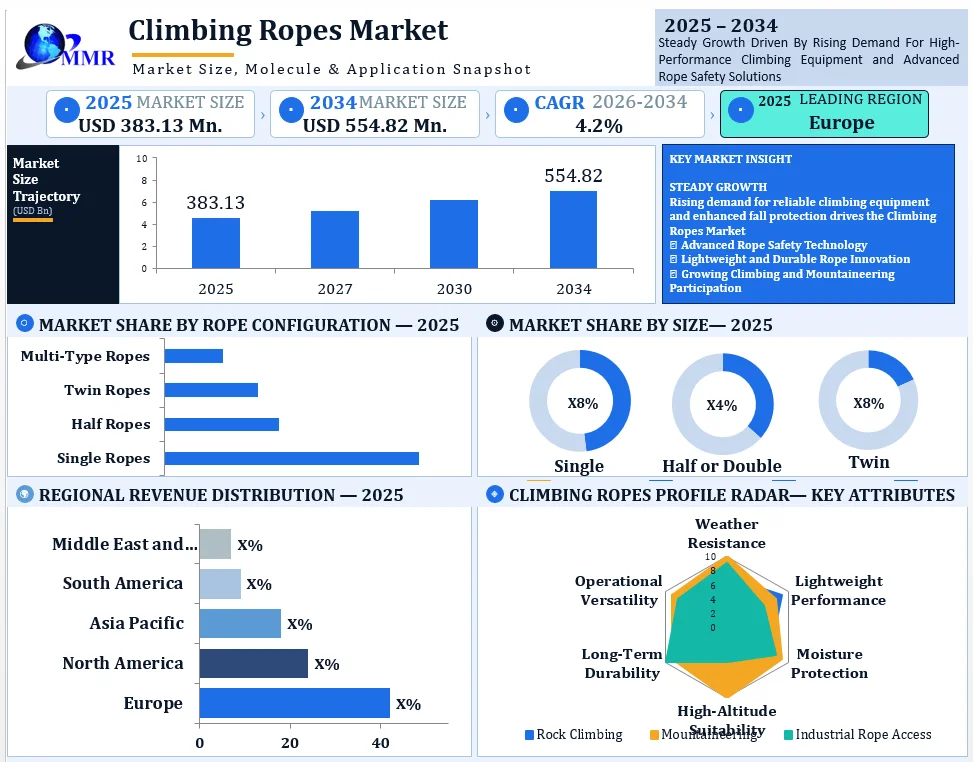
The Global Climbing Ropes Market size was valued at USD 383.13 Million in 2025 and the total Climbing Ropes revenue is expected to grow at a CAGR of 4.2% from 2026 to 2034, reaching USD 554.82 Million by 2034.
Global Climbing Ropes Market Overview
The Climbing Ropes Market comprises the manufacturing and sale of specialized ropes designed for rock climbing, mountaineering, indoor climbing, sport climbing, and other adventure activities. These ropes provide essential fall protection, load support, and climbing safety through advanced fiber materials, durable construction, abrasion resistance, and controlled elasticity. Growing awareness of climbing safety and the demand for reliable outdoor adventure equipment make climbing ropes an important part of the climbing gear industry.
The Climbing Ropes Market is growing as recreational climbing, indoor climbing gyms, mountaineering tourism, and professional climbing activities gain popularity. Key players such as Petzl, Mammut, Edelrid, and Beal strengthen market competition through product innovation, rope durability, and safety-focused designs. Europe remains an important market for climbing equipment, supported by its established mountaineering culture and outdoor recreation infrastructure, while North America and Asia Pacific offer opportunities through climbing gyms, adventure tourism, and increasing participation in outdoor sports. Safety requirements also shape product development, with the International Climbing and Mountaineering Federation (UIAA) establishing rope standards and certification frameworks that support product reliability and consumer confidence.
The MMR report provides an in-depth assessment of the Climbing Ropes Market, covering market dynamics, product segmentation, regional demand, competitive positioning, and emerging industry trends. It identifies growth opportunities in lightweight rope technology, durable and weather-resistant materials, specialized ropes for indoor and outdoor climbing, and expanding online distribution channels. These insights help manufacturers, suppliers, distributors, and investors evaluate customer demand, product innovation priorities, and strategies for sustainable market growth.
Climbing Ropes Market Growth and Share Analysis
To know about the Research Methodology:- Request Free Sample Report
Climbing Ropes Market Key Highlights
| Market Highlight |
Key Insights |
|---|---|
| Market Size and Growth |
The Climbing Ropes Market is valued at USD 383.13 million in 2025 and is projected to reach USD 554.82 million by 2034, growing at a CAGR of 4.2% from 2026 to 2034. |
| Leading Region |
Europe holds a leading position, supported by established mountaineering traditions, outdoor recreation, climbing facilities, and demand for specialized climbing equipment. |
| Key Product Segment |
Dynamic ropes represent a major product category because they absorb fall energy and support safety in sport climbing, indoor climbing, and mountaineering. |
| Product Innovation |
Lightweight construction, abrasion-resistant sheaths, improved rope handling, and water-repellent treatments are important areas of product development. |
| Distribution Channel Trends |
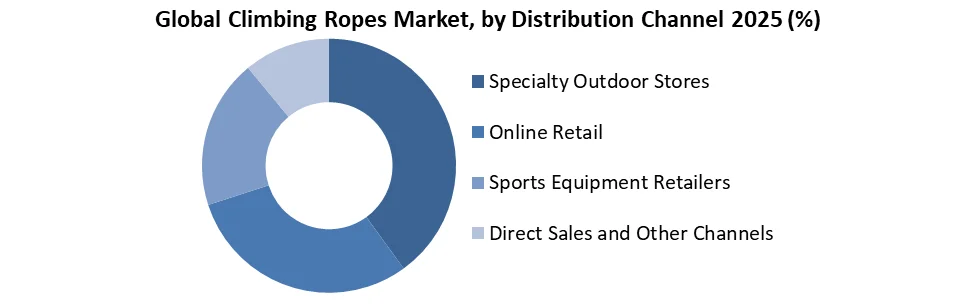
Online retail is gaining importance through broader product access and convenient comparisons, while specialty outdoor stores remain valuable for expert advice and equipment selection. |
| Growth Opportunities |
North America and Asia Pacific offer growth opportunities through climbing gyms, adventure tourism, mountaineering participation, and increasing access to climbing equipment. |
| Competitive Landscape |
Companies such as Petzl, EDELRID, BEAL, Mammut, Sterling Rope, and Black Diamond Equipment compete through product innovation, rope durability, safety performance, and specialized designs. |
Global Climbing Ropes Market Dynamics:
Rising Participation in Rock Climbing and Mountaineering Drive Demand for High-Performance Climbing Ropes
Increasing participation in rock climbing, indoor climbing gyms, mountaineering, and adventure tourism supports demand for durable and safety-focused climbing ropes. Climbing gyms, outdoor recreation operators, professional mountaineers, and individual climbers require ropes with reliable fall protection, abrasion resistance, and consistent handling. The International Climbing and Mountaineering Federation continues to strengthen climbing safety awareness and equipment standards, encouraging buyers to prioritize certified products over low-cost alternatives. With climbing activities spanning recreational training and technically demanding mountain routes, manufacturers have opportunities to develop lightweight ropes, improved sheath constructions, and specialized products for different climbing environments.
High Climbing Rope Replacement Costs and Safety Certification Requirements Limit Price-Sensitive Purchases
High-performance climbing ropes require specialized synthetic fibers, controlled manufacturing processes, quality testing, and compliance with relevant safety standards, increasing production costs and retail prices. Budget-conscious climbers, small climbing facilities, and adventure operators with limited equipment budgets may postpone purchases or select lower-priced alternatives when replacing worn equipment. Manufacturers must also maintain product traceability and conduct performance assessments to demonstrate rope reliability. The International Climbing and Mountaineering Federation's 2025 introduction of the UIAA 110 standard for static ropes established a maximum static elongation of 2.5% under its specified test conditions, illustrating the technical requirements associated with specialized rope development. These cost and compliance pressures can restrict affordability, particularly in emerging climbing markets.
Lightweight Rope Technology and Specialized Climbing Equipment Create New Product Development Opportunities
Advances in high-strength synthetic fibers, water-repellent treatments, compact rope construction, and abrasion-resistant sheaths create opportunities for climbing rope manufacturers to differentiate their products. Demand from alpine climbers, indoor climbing facilities, rescue teams, and adventure tourism operators supports specialized solutions for different operating conditions. The International Climbing and Mountaineering Federation's 2025 UIAA 110 standard specifies static strength of at least 8 kilo newtons with figure-eight knot terminations and 12 kilonewtons without terminations, providing measurable technical benchmarks for eligible static rope designs. Manufacturers can use such performance requirements to guide research and development, strengthen product positioning, and introduce premium ropes designed for durability, handling efficiency, and specific climbing applications.
Overcoming Technical Challenges in Climbing Rope Safety, Durability, and Material Performance
Maintaining consistent safety and durability across demanding climbing conditions remains a major challenge for the Climbing Ropes Market. Manufacturers must address rope wear caused by sharp rock surfaces, moisture, ultraviolet exposure, repeated loading, and temperature variations while preserving strength, flexibility, and handling performance. Developing lightweight climbing ropes with improved abrasion resistance and reliable fall protection also requires careful material selection and rigorous quality testing. In addition, manufacturers must meet different performance requirements for dynamic ropes used in fall protection and static ropes designed for low elongation. Balancing product innovation, manufacturing costs, safety compliance, and long-term durability remains essential for climbing rope manufacturers seeking to maintain customer confidence and competitive positioning.
Climbing Ropes Market Key Trends
| Trend | Description |
|---|---|
| Development of Cut-Resistant Climbing Rope Technology |
Manufacturers are improving rope construction to address damage from sharp rock edges during alpine climbing and technical mountain routes. Protective fiber layers, including aramid reinforcement, are attracting attention because they can improve resistance to localized cutting while preserving essential rope performance. |
| Growth of Fluorine-Free Water-Repellent Rope Treatments |
Rope producers are moving toward water-repellent treatments that avoid perfluoroalkyl and polyfluoroalkyl substances. Petzl's current product information identifies ropes manufactured without these substances, reflecting a shift toward lower-impact treatments while maintaining suitability for wet-weather and alpine climbing.Petzl Catalogs |
| Increasing Demand for Lightweight and Compact Climbing Ropes |
Experienced climbers increasingly consider rope weight, diameter, packability, and handling when choosing equipment for long approaches and multi-pitch routes. Manufacturers are refining fiber selection and rope construction to reduce carrying weight while maintaining the strength, durability, and dynamic performance required for the intended climbing application. |
| Improved Rope Identification and Handling Features |
Manufacturers are incorporating features such as middle marks, bi-pattern designs, and clearly differentiated rope diameters to help climbers identify rope sections and manage equipment more efficiently. These practical design improvements support safer rope handling during belaying, rappelling, and route preparation. |
| Greater Product Specialization for Different Climbing Applications |
Rope portfolios are becoming more specialized around sport climbing, traditional climbing, ice climbing, mountaineering, and rescue applications. Dynamic ropes absorb energy during a fall, whereas static ropes offer low elongation for appropriate fixed-line and rescue uses. This specialization helps manufacturers address different technical requirements rather than relying on a single rope design for every activity |
Global Climbing Ropes Market Segment Analysis:
Climbing Ropes Market, by Product
Dynamic ropes are the leading product category for climbing activities that involve fall protection, particularly sport climbing, indoor climbing, and mountaineering. Their ability to stretch under load and absorb fall energy makes them essential for climbers operating on routes where falls are possible. Demand is supported by climbing gym participation, outdoor recreation, and interest in lightweight ropes with improved handling and abrasion resistance. Static ropes remain important for rescue operations, fixed-line access, and applications requiring minimal elongation. However, dynamic ropes are the stronger candidate for the leading segment by product because of their central role in recreational and technical climbing. Static ropes continue to serve specialized professional requirements.
Climbing Ropes Market by Distribution Channel
Online retail is gaining traction as climbers compare rope diameters, certifications, weight, and prices across different brands before purchasing. However, specialty outdoor stores remain an important channel because buyers value expert guidance when selecting safety-critical climbing equipment. Sports equipment retailers attract recreational climbers through convenient access to climbing gear, while direct sales and other channels serve climbing gyms, mountaineering organizations, professional operators, and institutional buyers. For market positioning, online retail is a strong candidate for the fastest-growing channel, while specialty outdoor stores may remain the leading channel in some market estimates
Global Climbing Ropes Market Regional Analysis
Europe is the leading region in Climbing Ropes Market which has benefits from an established mountaineering culture, active climbing communities, well-developed outdoor recreation facilities, and access to specialized climbing equipment retailers. Countries such as Germany, France, Austria, Switzerland, and Italy support demand for dynamic ropes used in sport climbing, alpine routes, and indoor climbing facilities. Strong awareness of rope safety, product certification, and equipment replacement encourages climbers to choose reliable products from established manufacturers. Europe also provides opportunities for premium climbing ropes featuring lightweight construction, water-repellent treatments, and improved abrasion resistance.
North America represents a significant market for climbing ropes, supported by recreational rock climbing, established indoor climbing gyms, mountaineering activities, and adventure tourism. The United States and Canada generate demand from individual climbers, climbing schools, commercial gyms, and professional rescue organizations. Buyers value dependable rope performance, product durability, and clear safety specifications when selecting equipment for different climbing environments. The region also offers opportunities for online climbing equipment sales, premium dynamic ropes, and static ropes designed for rescue and rope access applications.
Asia Pacific offers strong growth opportunities for the Climbing Ropes Market as indoor climbing facilities, adventure tourism, and organized climbing activities attract greater consumer interest. China, Japan, South Korea, India, and Australia present opportunities for manufacturers targeting recreational climbers, training centers, outdoor sports retailers, and mountaineering operators. Increasing access to climbing equipment through online platforms and specialist distributors supports product awareness across developing climbing communities. Demand for affordable entry-level ropes, certified safety equipment, and lightweight climbing products creates opportunities for brands seeking to strengthen their presence in the region.
South America represents an emerging market for climbing ropes, with demand linked to rock climbing destinations, mountain tourism, outdoor adventure operators, and climbing communities. Countries such as Brazil, Chile, Argentina, and Mexico offer opportunities through recreational climbing, guided mountain expeditions, and specialist outdoor equipment retailers. Climbers and tourism operators require dependable ropes suitable for local terrain and varying weather conditions. Better product availability, access to certified climbing equipment, and stronger distribution partnerships can help manufacturers reach more consumers while supporting the development of organized climbing activities across the region.
The Middle East and Africa region presents developing opportunities for the Climbing Ropes Market through adventure tourism, indoor climbing centers, mountain activities, and professional training programs. Countries such as the United Arab Emirates, Saudi Arabia, and South Africa offer potential demand from climbing facilities, tourism operators, outdoor recreation businesses, and rescue service providers. The region's varied landscapes create requirements for ropes suited to recreational climbing, technical routes, and specialized access applications. Wider availability of certified products, professional equipment guidance, and reliable local distribution can support market development as climbing participation and organized adventure activities gain visibility.
Global Climbing Ropes Market Competitive Landscape
The Climbing Ropes Market comprises strong competition among established climbing equipment brands and specialized rope manufacturers, with companies focusing on product safety, rope durability, lightweight construction, and reliable performance to strengthen their market positions. Key players such as Petzl, Mammut, Edelrid, Beal, Black Diamond Equipment, and Sterling Rope compete through product innovation, certified safety performance, and specialized offerings for sport climbing, mountaineering, indoor climbing, and rescue applications. Manufacturers are differentiating their climbing ropes through improved abrasion resistance, water-repellent treatments, advanced fiber construction, and environmentally conscious production methods. Competition also depends on distribution partnerships with specialty outdoor stores, climbing gyms, professional equipment suppliers, and online retailers. As climbers increasingly prioritize reliable equipment and application-specific performance, companies that combine technical expertise, product quality, brand trust, and responsive customer support are well positioned to strengthen their presence in the Climbing Ropes Market.
| Region | Country | Key Company | Market Relevance and Competitive Differentiation |
|---|---|---|---|
| Europe | Germany | EDELRID | Develops dynamic and static climbing ropes, with differentiation through lightweight construction, recycled materials, and environmentally responsible rope manufacturing. |
| Europe | France | BEAL | Specializes in dynamic climbing ropes, mountaineering ropes, and technical safety products. Its Unicore construction and water-repellent rope treatments support product differentiation. |
| Europe | France | Petzl | Competes through climbing equipment integration, rope handling compatibility, and products designed for sport climbing, alpine activities, and professional work at height. |
| Europe | Switzerland | Mammut | Maintains strong relevance in mountaineering and technical climbing equipment, with rope offerings positioned around handling, reliability, and alpine performance. |
| North America | United States | Sterling Rope | Differentiates through rope engineering, climbing and rescue applications, United States manufacturing, and material recovery initiatives. Its XEROS technology focuses on dry-rope performance and wear resistance. |
| North America | United States |
Black Diamond Equipment |
Competes through its climbing equipment portfolio, brand recognition among climbers, and product development informed by practical climbing and mountaineering use. |
| Europe | Czech Republic | Tendon | Serves sport climbing, mountaineering, and specialist rope applications, competing through a broad rope portfolio and product configurations for different climbing techniques. |
| Europe | United Kingdom |
DMM | Adds competitive relevance through technical climbing equipment, specialist product knowledge, and integration with climbing protection and rope-handling systems. |
Global Climbing Ropes Market Recent Developments:
| Month in 2026 | Company | Recent Development |
|---|---|---|
| January 2026 | BEAL | BEAL released its 2026 Sport and Professional catalogues, presenting its current range of dynamic ropes, static ropes, and equipment for climbing and work at height. |
| January 2026 | EDELRID | EDELRID announced its 2026 sport collection, including the planned removal of perfluoroalkyl and polyfluoroalkyl substances from its water-repellent mountaineering ropes. |
| February 2026 | Sterling Rope | Sterling Rope announced its ECO yarn technology, which converts waste that cannot be mechanically recycled into high-performance nylon fibers for rope manufacturing. |
| September 2026 | C.A.M.P. | C.A.M.P. announced its Rope Tour, with climbing gym events in Northern Italy designed to introduce and test its climbing ropes. |
Global Climbing Ropes Market Scope: Inquire before buying
| Climbing Ropes Market | |||
|---|---|---|---|
| Report Coverage | Details | ||
| Base Year: | 2025 | Forecast Period: | 2026-2034 |
| Historical Data: | 2020 to 2025 | Market Size in 2025: | 383.13 USD Million |
| Forecast Period 2026-2034 CAGR: | 4.2% | Market Size in 2034: | 554.82 USD Million |
| Segments Covered: | by Product | Dynamic Static |
|
| by Size | Single Twin Half or double |
||
| by Rope Configuration | Single Ropes Half Ropes Twin Ropes Multi-Type Ropes |
||
| by Diameter | Below 8 mm, 8 mm to Below 10 mm 10 mm and Above |
||
| by Distribution Channel | Online Retail Specialty Outdoor Stores Sports Equipment Retailers Direct Sales and Other Channels |
||
Global Climbing Ropes Market, by Region
North America (United States, Canada and Mexico)
Europe (UK, France, Germany, Italy, Spain, Sweden, Austria and Rest of Europe)
Asia Pacific (China, South Korea, Japan, India, Australia, Indonesia, Malaysia, Vietnam, Taiwan, Bangladesh, Pakistan and Rest of APAC)
Middle East and Africa (South Africa, GCC, Egypt, Nigeria and Rest of ME&A)
South America (Brazil, Argentina Rest of South America)
Global Climbing Ropes Market, Key players
1. Black Diamond Equipment Ltd.
2. EDELRID GmbH & Co. KG
3. Mammut Sports Group AG
4. Sterling Rope Company Inc.
5. Edelweiss
6. BEAL
7. Petzl
8. DMM International Ltd.
9. C.A.M.P.
10. Arc'teryx
11. Salewa
12. Grivel
13. Metolius Climbing
14. Trango
15. Mad Rock
16. Singing Rock
17. BlueWater Ropes
18. Cousin Trestec
19. Tendon
20. Fixe Climbing
21. Rock Empire
22. PMI (Pigeon Mountain Industries)
23. Teufelberger
24. Marlow Ropes
25. Skylotec
26. Ocún
27. Simond
28. Climbing Technology
29. Maxim Ropes
30. New England Ropes
31. AustriAlpin
32. Blue Ice
33. Millet
34. Boreal
35. Kong
36. Edelrid North America
37. Lanex
38. Tendon Ropes
39. Kordas
40. Roca
41. Beal Planet
42. Petzl Technical Equipment
43. Edelweiss Professional
44. Rock Exotica
45. Yates Gear
46. Ropes That Rescue
47. Sterling Performance
48. American Rope Company
49. Great Rocksport
50. Stepin Adventure
Frequently Asked Questions:
1. Which region has the largest share in Global Climbing Ropes Market?
Ans: Europe region holds the highest share in 2025.
2. What was the Global Climbing Ropes Market size in 2025?
Ans: The Global Climbing Ropes Market size was USD 383.13 Million in 2025.
3. What is scope of the Global Climbing Ropes Market report?
Ans: Global Climbing Ropes Market report helps with the PESTEL, PORTER, COVID-19 Impact analysis, Recommendations for Investors & Leaders, and market estimation of the forecast period.
4. Who are the key players in Global Climbing Ropes Market?
Ans: The important key players in the Climbing Ropes Market are – Black Diamond Equipment Ltd, Edelrid GmbH & Co, Mammut Sports Group AG, Sterling Rope Company Inc., Edelweiss, BEAL, Petzl, DMM International, Camp Usa, Arc’teryx, Salewa, Grivel, Motolius Climbing, Trango, Mad Rock, Singing Rock, BlueWater Ropes.
5. What is the study period of this market?
Ans: The Climbing Ropes Market is studied from 2020 to 2034.