
Biotechnology Market by Product Type, Technology, Application and Region – Global Market Size Estimation, Industry-Wide Analysis, Competitive Landscape Assessment & Long-Term Forecast to 2032
Overview
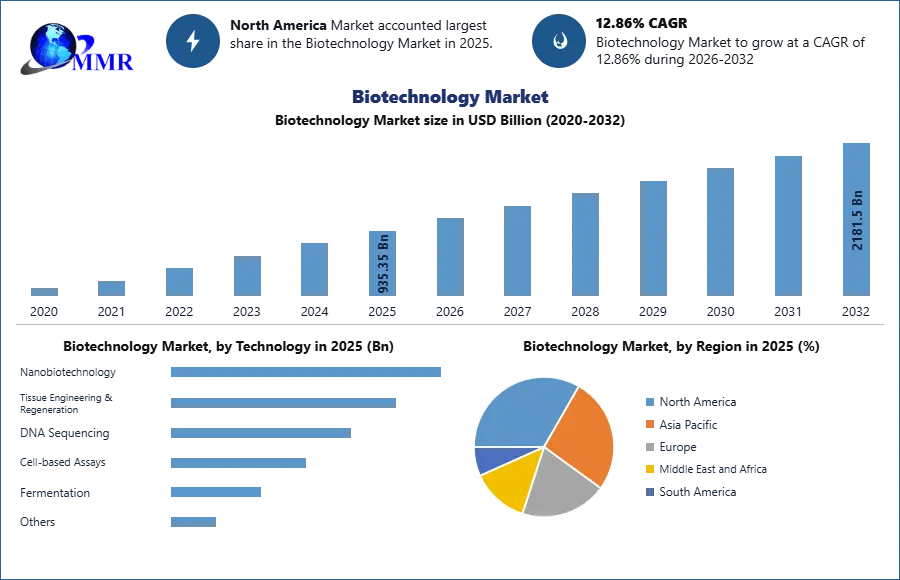
The Biotechnology Market size was valued at USD 935.35 Billion in 2025 and the total Biotechnology revenue is expected to grow at a CAGR of 12.86% from 2026 to 2032, reaching nearly USD 2181.5 Billion.
Biotechnology Market Overview:
Biotechnology is a field of science that involves the use of living organisms, biological systems, or their derivatives to develop or create products, improve processes, or solve problems for various industries. It includes a wide range of applications, including agriculture, medicine, pharmaceuticals, food production, environmental protection, and energy production.
To know about the Research Methodology :- Request Free Sample Report
The biotechnology is set to undergo substantial advancement. It holds the potential to address major national challenges, mainly in healthcare. With global healthcare expenditures estimated at approximately US$8 trillion, it's foreseeable that biotechnology market permeate everyday life by 2032. This integration include a wide array of applications, spanning from pharmaceuticals, medicines, and therapeutics to eco-friendly chemicals, fuels, and materials.
Biotechnology Market Dynamics:
The Global Biotechnology Market dynamics are thoroughly studied and explained in the report, which helps reader to understand emerging market trends, drivers, restraints, opportunities, and challenges at global and regional level for the Global Biotechnology industry. Some of the dynamics illustrate below:
Growing Demand for Personalized Medicine, R&D Investment, and Chronic Disease Burden Drive Biotechnology Market Growth:
Biotechnology products such as gene therapies, cell therapies, and biopharmaceuticals are engineered to pioneer innovative treatments across a spectrum of diseases. These therapies hold the potential to outshine traditional pharmaceuticals by offering enhanced efficacy and fewer side effects. Moreover, they play a pivotal role in enhancing agricultural methods, growing scientific comprehension, furnishing diagnostic tools, and bolstering sustainability efforts. The propulsion of the biotechnology market is steered by several factors, including the rising demand for personalized medicine, amplified investments in R&D, a surge in chronic disease prevalence, burgeoning requests for outsourcing services, and an upsurge in sustainable agriculture demands. The trend of outsourcing biotechnology research and development to contract research organizations is on the rise. Furthermore, biotechnology is instrumental in devising sustainable agricultural practices and elevating crop yields. Governmental backing and funding for biotechnology research are also on the ascent, further stimulating the growth trajectory of the biotechnology market.
Tissue Culture and Cell Engineering: Rising Research and Development Trends:
The surge in research and development endeavors focused on tissue culture and cell engineering is poised to propel growth in the global biotechnology market in the foreseeable future. A notable example occurred on August 16, 2022, when Bharat Biotech, an India-based manufacturer of vaccines and bio-therapeutics, disclosed phase III clinical trial data for its intranasal COVID-19 vaccine. The vaccine demonstrated safety, tolerability, and immunogenicity among subjects in controlled clinical trials. Additionally, the Drug Controller General of India (DCGI) has granted permission to the firm to conduct a phase-3 clinical trial comparing the immunogenicity and safety of BBV-154 (intranasal) with Covaxin. This trial is authorized to take place at 9 sites across India.
Emerging Opportunities in Biotechnology: Sustainable Agriculture, Collaboration, Economics, Personalized Medicine:
The biotechnology sector benefits from the growth of healthcare industries in emerging economies like Brazil, India, South Africa, and China. Additionally, environmental sustainability initiatives open avenues for sustainable agriculture practices, biofuel production, and renewable resource utilization.
Collaboration and partnerships among academic institutions, industry stakeholders, and government agencies present opportunities for innovation and advancement. Advancements in economics and personalized medicine drive the development of novel diagnostic tools and therapies, enhancing patient outcomes. Technological progress, particularly in synthetic biology, machine learning, and gene editing, propels innovation in the sector. Moreover, increased funding and investment, including venture capital funding, stimulate growth and innovation within the biotechnology market.
Recent Trends in the Biotechnology Market
Artificial intelligence, synthetic biology, and plant biotechnology have emerged as notable trends in the biotechnology market. The market is witnessing a growing emphasis on artificial intelligence, gene editing, synthetic biology, cell and gene therapies, and plant biotechnology. Artificial intelligence (AI) is reshaping the biotechnology landscape by revolutionizing drug discovery, optimizing clinical trials, and enhancing patient outcomes. Gene editing technologies like CRISPR-Cas9 are driving innovation in the biotechnology market by providing powerful tools for developing novel therapies and treatments.
Synthetic biology involves the design and engineering of biological systems for diverse applications, offering immense potential for innovation and advancement. Cell and gene therapies are ushering in a new era of personalized treatments for conditions such as cancer, genetic disorders, and immune system disorders. These trends underscore the dynamic nature of the biotechnology market, highlighting the ongoing pursuit of breakthrough innovations and transformative technologies.
Biotechnology Market Segment Analysis
Based on Technology, DNA sequencing segment dominated the biotechnology market in 2025 and is expected to hold the largest of nearly 36.17% global market share over the forecast period. The utilization of sequencing to comprehend diseases has experienced a surge, buoyed by government backing for genetic research. For instance, the University of Pittsburgh Graduate School of Public Health and Washington University School of Medicine in St. Louis secured a USD 10.7 million NIH grant in May to investigate the genetic underpinnings of Alzheimer's disease.
Furthermore, theranostic nanoparticles have gained traction, facilitating swift diagnosis and personalized therapy options for multiple ailments simultaneously. Nanoparticle attributes such as minimal toxicity, diminutive size, and chemical versatility have mitigated the limitations of conventional generic drug delivery methods. Additionally, the field of tissue engineering and regenerative medicine has maintained a significant presence, fueled by public and private investments, substantial healthcare expenditures, and the presence of numerous established and emerging enterprises.
By Applications, in 2025, Health segment held the dominant share of in biotechnology market and expected to grow at a CAGR of 13.22% during the forecast period. The growth of the segment is expected to be driven by several factors, including the increasing disease burden, the expanding availability of agri-biotech and bio-services, and technological advancements in the bio-industrial sector. Additionally, significant progress in Artificial Intelligence (AI), machine learning, and big data is anticipated to enhance the adoption of bioinformatics applications, particularly in industries such as food and beverages.
Furthermore, collaborative endeavors and partnerships aimed at developing and commercializing new therapeutic platforms and molecules are poised to fuel biotechnology market growth. For instance, in January , Novartis partnered with Alnylam to explore the application of the latter's siRNA technology in the development of targeted therapies for restoring liver function.
Biotechnology Market Regional Analysis:
North America dominated the Biotecnology Market in 2025, driven by strong investments, cutting-edge research, and a robust healthcare ecosystem. The United States is the dominant player, housing major biotechnology firms, research institutes, and hospitals. Key sectors in the region include pharmaceuticals, genomics, bioinformatics, agriculture biotechnology, and biomanufacturing. The demand for biologics, gene therapy, and personalized medicine continues to grow, further boosted by advancements in CRISPR technology, immunotherapy, and mRNA vaccines. The U.S. also leads in biotech venture capital investments and government support through agencies like the National Institutes of Health (NIH) and the Food and Drug Administration (FDA), which facilitate innovation and regulatory approvals. Canada contributes significantly to the market as well, focusing on biopharmaceuticals, agriculture biotechnology, and biodegradable materials. Overall, North America's strong infrastructure, research, and investment climate position it as a global leader in biotechnology.
In the Asia Pacific regional biotechnology market's growth is propelled by various factors, including the presence of key players, extensive research and development endeavors, and substantial healthcare expenditure. Notably, the region demonstrates a significant penetration of genomics, proteomics, and cell biology-based platforms, thereby expediting the adoption of life sciences tools. Furthermore, the increasing prevalence of chronic diseases and the rising adoption of personalized medicine applications for treating life-threatening disorders are poised to positively influence biotechnology market growth in the region.
The growth of the regional biotechnology Industry is attributed to escalating investments, enhancements in healthcare infrastructure, favorable government initiatives, and strategic expansion initiatives by key biotechnology market players. For instance, in February , Moderna Inc. unveiled plans for geographic expansion of its commercial network in Asia by establishing new subsidiaries in Malaysia, Singapore, Hong Kong, and Taiwan. Additionally, collaborations in the biopharmaceutical sector, such as the strategic partnership between Kiniksa Pharmaceuticals and Huadong Medicine for the development and commercialization of Kiniksa's ARCALYST and mavrilimumab in the Asia-Pacific region, are expected to significantly contribute to market growth.
The Asia Pacific region is poised to exhibit the most rapid biotechnology market growth rate, propelled by increasing investments, enhancements in healthcare infrastructure, favorable government initiatives, and strategic expansion efforts by key biotechnology market players. Such as, in February, Moderna Inc. disclosed plans for geographic expansion of its commercial network in Asia, establishing new subsidiaries in Malaysia, Singapore, Hong Kong, and Taiwan. Furthermore, collaborations in the biopharmaceutical sector, such as the strategic partnership between Kiniksa Pharmaceuticals and Huadong Medicine for the development and commercialization of Kiniksa's ARCALYST and mavrilimumab in the Asia-Pacific region, are expected to contribute significantly to the biotechnology market's growth.
Recent Developments
Gilead Sciences, Inc.
April 2025 – Gilead expanded its oncology pipeline by acquiring a leading gene-editing company, further advancing its cell and gene therapies for cancer treatment. The company is increasing R&D investment in HIV and liver disease treatments, focusing on long-acting therapies. Gilead is also enhancing its collaboration with biotech firms to explore next-generation RNA-based therapeutics.
Bristol-Myers Squibb
June 2025 – Bristol-Myers Squibb made major strides in its immuno-oncology pipeline, focusing on combination therapies for lung cancer and melanoma. The company is advancing gene therapies and AI-driven drug discovery, prioritizing targeted biologics and cellular therapies for hematologic cancers. The acquisition of biotech firm 2seventy bio supports its cell therapy strategy.
Biotechnology Market Scope: Inquire before buying
| Biotechnology Market | |||
|---|---|---|---|
| Report Coverage | Details | ||
| Base Year: | 2025 | Forecast Period: | 2026-2032 |
| Historical Data: | 2020 to 2025 | Market Size in 2025: | 935.35 USD Billion |
| Forecast Period 2026-2032 CAGR: | 12.86% | Market Size in 2032: | 2181.5 USD Billion |
| Segments Covered: | by Product Type | Instruments Reagents and Services Software |
|
| by Technology | Nanobiotechnology Tissue Engineering & Regeneration DNA Sequencing Cell-based Assays Fermentation Others |
||
| by Application | Bioinformatics Food & Agriculture Health Industrial Processing Natural Resources & Environment Others |
||
| by End User | Bioinformatics Food & Agriculture Health Industrial Processing Natural Resources & Environment Others |
||
Biotechnology Market, by Region
North America (United States, Canada and Mexico)
Europe (UK, France, Germany, Italy, Spain, Sweden, Austria and Rest of Europe)
Asia Pacific (China, South Korea, Japan, India, Australia, Indonesia, Malaysia, Vietnam, Taiwan, Bangladesh, Pakistan and Rest of APAC)
Middle East and Africa (South Africa, GCC, Egypt, Nigeria and Rest of ME&A)
South America (Brazil, Argentina Rest of South America)
Key players/Competitors profiles covered in the Biotechnology market report in strategic perspective
- Gilead Sciences, Inc.
- Bristol-Myers Squibb
- Biogen
- Abbott Laboratories
- Pfizer, Inc.
- Amgen, Inc.
- Merck KGaA
- Johnson & Johnson Services, Inc.
- Novartis AG
- AstraZeneca
- Sanofi
- Novo Nordisk A/S
- Lonza
- Biocon
- Pancea Biotech
- Bharat Biotech
- Hoffmann-La Roche Ltd.
- Regeneron Pharmaceuticals, Inc.
- Vertex Pharmaceuticals Incorporated
- Moderna, Inc.
- BioNTech SE
- Thermo Fisher Scientific Inc.
- Genentech, Inc.
- CSL Limited
- UCB S.A.
- Genmab A/S
- Alnylam Pharmaceuticals, Inc.