Biosensors Market – Global Market Size, Strategic Growth Drivers, Risk Assessment Framework, Regulatory Landscape Review, Competitive Intensity Mapping & Long-Term Industry Outlook to 2032

9.1%
CAGR (2026-2032)
32.25 USD Bn.
Market Size
319
Report Pages
141
Market Tables

Overview

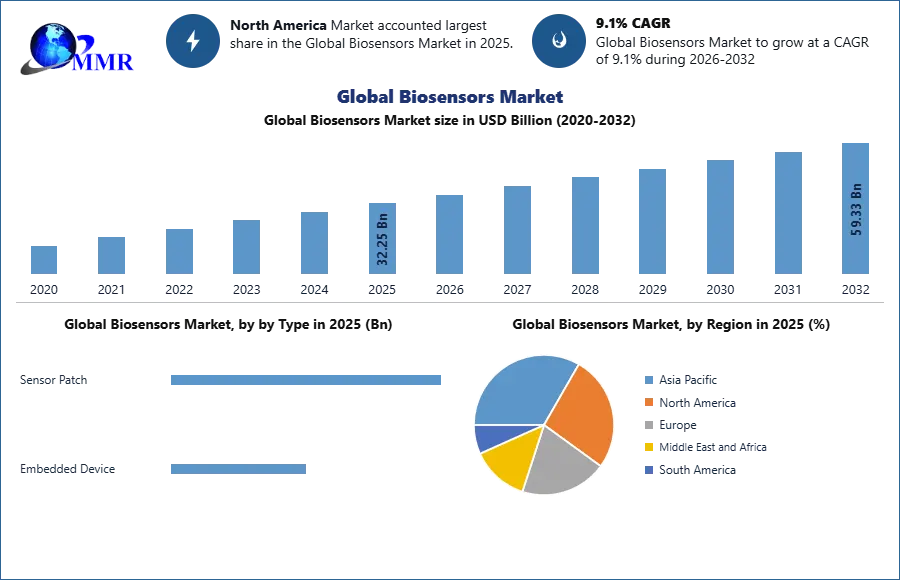
The Biosensors Market size was valued at USD 32.25 Billion in 2025 and the total Biosensors Market revenue is expected to grow at a CAGR of 9.1  % from 2026 to 2032, reaching nearly USD 59.33  Billion by 2032.

Biosensors Market Overview

A Biosensor is an analytical device that detects changes in biological processes and converts them into an electrical signal. The term biological process is any biological element or material like enzymes, tissues, microorganisms, cells, acids, etc. A biosensor is a combination of a biological sensing element and a transducer, which converts the data into electrical signals. Additionally, there will be an electronic circuit that consists of a Signal Conditioning Unit, a Processor or Microcontroller, and a Display Unit. Biosensors or biosensors are some of the most valuable and emerging technologies in recent years. These sensors are installed on smart devices such as mobile phones, smart watches, smart bracelets, smart car steering wheels, and more. The market for biosensors is categorized by type (patch sensor and built-in device), product (wearable and non-wearable), technology (electrochemical and optical), application (POC, home diagnostics, research laboratory, food, and beverage), and geography. The rising focus on preventive healthcare and the popularity of wearable devices for continuous health monitoring have boosted the demand for biosensors in wearable gadgets such as fitness trackers, smartwatches, and patches, contributing to the Biosensors Market growth.
Global Biosensors MarketTo know about the Research Methodology:- Request Free Sample Report

Air and water quality is monitored using biosensors. For example, the devices are used to detect amounts of organophosphates from pesticides or to assess the toxicity of wastewater. A biological signal is converted into an electrical signal via biosensors. Even when they don't employ a biological system directly, biosensors are used to determine the concentration of chemicals and other biologically relevant data.

Biosensors Market Dynamics

Technological Advancements and Miniaturization in Biosensors to Drive Biosensors Market Growth

The biosensors market is experiencing robust growth due to continuous technological advancements and miniaturization trends. Advances in nanotechnology, materials science, and microfabrication techniques have enabled the development of biosensors with improved sensitivity, specificity, and response time. Miniaturization allows for integrating biosensors into portable devices such as smartphones, wearables, and point-of-care diagnostic tools, expanding their applications across various industries including healthcare, food and beverage, environmental monitoring, and agriculture. These compact and portable biosensors offer real-time monitoring capabilities, facilitating rapid and on-site detection of analytes. Biosensors reduced size and cost make them more accessible to end-users, driving adoption rates and market growth.

Table: List of Some Potential Biosensors With Principles And Applications

Sr.No Type Principle Analysis of glucose in biological
sample
1 Glucose oxidase electrode-based biosensor Electrochemistry using glucose oxidation For the detection of clinical abnormalities or diseases
2 Uric acid biosensor Electrochemistry For the detection of clinical abnormalities or diseases
3 Acetylcholinesterase inhibition-based biosensors Electrochemistry Understanding pesticidal impact
4 Hydrogel (polyacrylamide)- based biosensor Optical/visual biosensor for the detection of biological warfare agents (BWAs)
5 Silicon biosensor Optical/visual/fluorescence Bioimaging, biosensing and cancer therapy
6 Nanomaterials-based biosensors Electrochemical or optical/
visual/fluorescence
For multifaceted applications including biomedicine, for example diagnostic tools
7 Genetically encoded or fluorescence- tagged biosensor Fluorescence For understanding biological process including (monitoring kinase activity, for protein–DNA 8interaction analyses, real-time assays of motor proteins)
8 Microbial fuel cell- based biosensor Optical To monitor biochemical oxygen demand and toxicity in the environment and heavy metal and pesticidal toxicity

Biosensors are being utilized extensively in home healthcare by patients, owing to their capacity to assess health status, illness starts, and progression. They are expected to boost biosensors industry growth during the forecast period 2026-2032. Besides, technical developments and a variety of non-medical applications are the other factors expected to boost the growth of the biosensor market. According to the International Diabetic Federation, the prevalence of diabetes is rising at an annual rate of roughly 8.0%, with over 590 million people expected to develop diabetes by 2035, resulting in significant biosensors industry growth during the forecast period. As a result of their ability to measure health status and monitor illness start and progression, they are widely utilized in home healthcare. They are expected to drive biosensors market growth.

Increasing Incidence of Chronic Diseases to Influence the Market

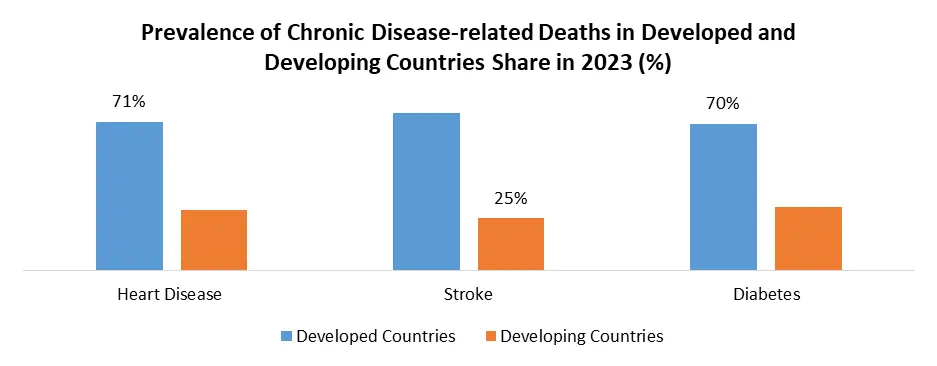
The rising prevalence of chronic diseases such as diabetes, cardiovascular diseases, and cancer. Biosensors play a crucial role in the early diagnosis, monitoring, and managing these conditions by providing accurate and timely measurements of biomarkers in bodily fluids. The growing burden of chronic diseases worldwide, coupled with the escalating demand for personalized and point-of-care healthcare solutions, is driving the adoption of biosensors in clinical settings. The shift towards preventive healthcare strategies and the emphasis on continuous monitoring and remote patient management further drive the demand for biosensor technologies in the Biosensors Market. As a result, healthcare providers, researchers, and policymakers increasingly recognize the value of biosensors in improving patient outcomes, driving market growth in the healthcare sector.

Biosensors Market

Academic institutions, private companies, and governments of various regions are heavily invested in the R&D nanobiotechnology field. This is expected to help with technological advancements, discoveries, and increased commercialization of nanobiotechnology-based products. These factors make remarkable growth in the forecast period and the report provides an in-depth explanation with a strong research basis. In 2021, approximately 130 million Americans (45% of the population) had chronic conditions and 61 million (21%) had multiple chronic conditions.

Precision medicine, which tailors medical treatment to an individual's unique characteristics, is gaining prominence in the healthcare industry. The ability of nanobiotechnology to deliver drugs directly to the affected tissues or cells, along with its potential to modulate genes or immune responses, is driving the demand for personalized therapies. This focus on precision medicine is expected to be a major growth driver for the Biosensors Market.
Biosensors Market

Government initiatives focused on the advancement of genomics and proteomics are expected to drive the growth of the biosensor market during the forecast period 2026-2032. National Information and Communication Technology Australia, for example, is expected to increase its data mining, networks, and embedded systems research in this subject. Besides, the Chinese government is investing substantially in its computing networks, which were launched by the Chinese Academy of Sciences and are funded by the Ministry of Science and Technology. The most IT companies are significantly investing in the biosensors sector. Biosensors Market growth is expected to be boosted by investments from major IT companies such as Infosys, TCS, and IBM.

Biosensors Market Key Trends

Biosensors for Genetic Disease Detection and Mutation Screening

Scientists at the University of California, San Diego, have developed a platform that detect mutations in DNA with extreme sensitivity. A huge research group led by the Center of Excellence for Nanomedicine and Engineering created a sensor that identify single nucleotide polymorphisms (SNPs) in a DNA sequence. SNPs are variations in the sequence of a single nucleotide in a gene. This mutation has been linked to a range of disorders, including cancer, heart disease, diabetes, and autoimmune diseases, even though it has no acute health consequences.

The researchers used a synthesized DNA sequence to encapsulate a graphene field effect transistor that is complimentary to the mutation being examined. An electrical signal is generated as DNA or RNA sequences with SNP mutations are found. This biosensor, according to the scientists, is a prototype for a one-day implanted device that identify SNPs and genetic alterations in real time and notify users via mobile phone. This factor is expected to boost the Biosensors Market.

Wearable Biosensors for Wellness Monitoring

In continuous health monitoring, wearable biosensors are gaining traction. Wireless sensors encased in bandages or patches, or in a body-worn form factor, are used for sensing. The data collected by biosensors is processed and used to predict the likelihood of a patient's clinical condition deteriorating, as well as to track the impact of necessary clinical measures. Sweat, blood, and other biological substances are frequent analytes used to generate clinical outcomes. The Fraunhofer Institute in Germany has created a non-invasive, wearable nano-biosensor for continuous glucose monitoring. The glucose levels are measured by the body-worn gadget using tissue fluids such as tears or sweat. This non-invasive glucose monitoring technology, which is still under development, is seen as the wearables industry's next benchmark.

Regulatory Hurdles to Restrain the Biosensors Market Growth

As the biosensors market continues its trajectory towards innovation and advancement, one significant hurdle stands firmly in its path regulatory complexities. While biosensors hold tremendous potential for revolutionizing healthcare, environmental monitoring, and food safety, stringent regulatory requirements impede their widespread adoption and hinder market growth. Regulatory agencies worldwide, such as the FDA in the United States and the EMA in Europe, impose rigorous standards to ensure the safety, efficacy, and reliability of biosensor devices. Meeting these standards demands extensive testing, validation, and compliance, which is time-consuming and resource-intensive for manufacturers. The dynamic nature of technology often outpaces regulatory frameworks, leading to challenges in aligning guidelines with the latest advancements in biosensor technology.

This disconnect delay Biosensors market entry for innovative biosensor products, stifling innovation and limiting the market's growth potential. Navigating the complex landscape of regulatory approvals requires substantial investments in time, expertise, and financial resources, particularly for smaller companies with limited budgets. As a result, regulatory hurdles pose a significant barrier to entry for new players and deter investment in the biosensors market, ultimately restraining its growth.

Biosensors Market Segment Analysis

Based on the Type, the Biosensors Market is segmented into Sensor Patch and Embedded Devices. Embedded Device segment is expected to hold the largest market share of xx% by 2032. Point-of-care, home diagnostics, food and beverage, research lab, environmental monitoring, and biodefense are just a few of the uses for these devices. The growth of Internet of Things (IoT) devices has resulted in a significant shift in connected healthcare applications. IoT allows for real-time alerting, tracking, and monitoring, allowing for hands-on treatments, increased accuracy, appropriate medical intervention, and better overall patient care.

Many healthcare facilities have begun to implement embedded solutions for IoT-enabled medical devices to solve the shortage of doctors in rural areas. These Internet of Things-enabled medical gadgets assist in identifying disorders in patients and performing various tests to deliver accurate and dependable therapy to patients in remote areas. As a result, embedded devices are becoming more popular.

Based on the Application, the Biosensors market is segmented into Point of Care, Home Diagnostics, Research Lab, Biodefense, Environmental Monitoring, Food and beverages, and Agriculture. The Home Diagnostics segment is expected to grow rapidly at a CAGR of xx% during the forecast period 2026-2032. The biosensors market is driven by rising healthcare advances, a high rate of acceptance of new diagnostic procedures, and the convenience of employing home-based medical devices. Demand for home diagnostics has increased as a result of the new coronavirus outbreak. As a result, manufacturers in the home diagnostics sector are increasing their capacity. Besides, demand for wearable devices is increasing, and as lifestyle disorders grow more widespread, the biosensors market in the home diagnostics segment has enormous potential.

Biosensors Market Regional Insight

North America dominated the largest Biosensors Market share more than 39.60% in 2025. The market growth is primarily due to the concentration of key industry players and a heightened prevalence of targeted diseases across the region. Looking ahead, advancements in technology, notably the emergence of compact diagnostic tools facilitating wider adoption of Electronic Medical Records (EMR) alongside swift and accurate diagnostics, are poised to drive market growth. legislative frameworks such as the Clean Air Act, Clean Water Act, and National Environmental Policy Act in the U.S. are anticipated to unlock further growth opportunities for the regional market.

Asia Pacific region is estimated to hold a majority market share of % 22.1 by 2032. The presence of a huge population base and the rising incidence of various lifestyle disorders are the major drivers of biosensor market growth in Asia Pacific. In terms of foreign investment, China's healthcare industry has been gradually opening up to international participation, both in terms of things removed from the National Negative List and those added to the National Encouraged List. In healthcare, biosensors offer unparalleled advantages in early disease detection, personalized medicine, and remote patient monitoring. These miniature devices provide real-time data on various biomarkers, enabling timely interventions and improving patient outcomes.

Middle East and & Africa is expected to witness the fastest CAGR of 12.3% from 2026 to 2032. The presence of significant unmet medical requirements for target diseases, such as cancer, diabetes, and other infectious diseases, as well as continuously improving healthcare expenditure in the region and increasing patient awareness, drive regional market growth. Increasing demand for home healthcare, PoC, and other healthcare businesses serving the adult population and government efforts to reduce hospital stays through the creation of outpatient care models are likely to drive biosensors market growth.

Biosensors Market Recent Development

  • In August 2025, Levels introduced Stelo, the first FDA-cleared glucose biosensor in the United States available without a prescription, significantly expanding access to continuous glucose monitoring. The launch aims to make real-time glucose tracking more accessible to the general public, supporting proactive health and metabolic management.
  • In June 2025, Nix Biosensors expanded its operations to Great Britain, Ireland, and Wales, introducing its wearable hydration monitoring technology for direct-to-consumer sales. The Nix Hydration Biosensor utilizes AI-driven sweat analysis to provide real-time and personalized hydration insights, helping athletes, industrial workers, and health-focused individuals optimize fluid and electrolyte balance for improved performance, recovery, and safety.
  • In November 2024, STMicroelectronics launched the ST1VAFE3BX, a highly integrated biosensor chip designed for next-generation healthcare wearables. The chip combines biopotential sensing, motion tracking, and embedded AI capabilities, enabling compact wearable devices to monitor physiological signals such as ECG, EEG, and muscle activity while maintaining low power consumption.


Biosensors Market Scope: Inquire before buying

Global Biosensors Market
Report Coverage Details
Base Year: 2025 Forecast Period: 2026-2032
Historical Data: 2020 to 2025 Market Size in 2025: 32.25 USD Billion
Forecast Period 2026-2032 CAGR: 9.1% Market Size in 2032: 59.33 USD Billion
Segments Covered: by Type Sensor Patch
Embedded Device
by Product Wearable Biosensors
Non-wearable Biosensors
by Technology Electrochemical Biosensors
Optical Biosensors
Piezoelectric Biosensors
Thermal Biosensors
Nanomechanical Biosensors
by Application Medical
        Cholesterol
        Blood Glucose
        Blood gas analyzer
        Pregnancy testing
        Drug discovery
        Infectious disease
Food Toxicity
Bioreactor
Agriculture
Environment
Others
by End Use Home Healthcare Diagnostics
PoC Testing
Food Industry
Research Laboratories
Security and Bio-defense

Biosensors Market, by Region

North America (United States, Canada and Mexico)
Europe (UK, France, Germany, Italy, Spain, Sweden, Austria and Rest of Europe)
Asia Pacific (China, South Korea, Japan, India, Australia, Indonesia, Malaysia, Vietnam, Taiwan, Bangladesh, Pakistan and Rest of APAC)
Middle East and Africa (South Africa, GCC, Egypt, Nigeria and Rest of ME&A)
South America (Brazil, Argentina Rest of South America)

Leading Biosensors Manufacturers include:

North America

  1. Abbott Laboratories
  2. Hoffmann-La Roche Ltd
  3. Medtronic plc
  4. Siemens Healthineers
  5. Dexcom Inc.
  6. GE HealthCare
  7. Bio-Rad Laboratories Inc.
  8. Nova Biomedical
  9. LifeScan Inc. (Johnson & Johnson)
  10. Senseonics Holdings Inc.
  11. Thermo Fisher Scientific Inc.
  12. Agilent Technologies Inc.
  13. Becton, Dickinson and Company (BD)
  14. Masimo Corporation
  15. Biosensors International Group Ltd.
  16. Universal Biosensors Inc.
  17. i-Sens Inc.
  18. AgaMatrix Inc.
  19. Nix Biosensors Inc.
  20. Strados Labs
  21. Dynamic Biosensors GmbH
  22. LifeSignals Inc.
  23. Honeywell International Inc.
  24. Sensirion AG
  25. Renesas Electronics Corporation
  26. MediaTek Inc.
  27. Abionic SA
  28. Profusa Inc.
  29. DNA Electronics Ltd.
  30. CytoSMART Technologies

Table of Contents

1. Global Biosensors Market Introduction
1.1. Study Assumption and Market Definition
1.2. Scope of the Study
1.3. Executive Summary
2. Global Global Biosensors Market: Competitive Landscape
2.1. MMR Competition Matrix
2.2. Competitive Landscape
2.3. Key Players Benchmarking
2.3.1. Company Name
2.3.2. Business Segment
2.3.3. End-user Segment
2.3.4. Revenue (2025)
2.3.5. Company Locations
2.4. Leading Global Biosensors Market Companies, by market capitalization
2.5. Market Structure
2.5.1. Market Leaders
2.5.2. Market Followers
2.5.3. Emerging Players
2.6. Mergers and Acquisitions Details
3. Global Biosensors Market: Dynamics
3.1. Global Biosensors Market Trends by Region
3.1.1. North America Global Biosensors Market Trends
3.1.2. Europe Global Biosensors Market Trends
3.1.3. Asia Pacific Global Biosensors Market Trends
3.1.4. Middle East and Africa Global Biosensors Market Trends
3.1.5. South America Global Biosensors Market Trends
3.2. Global Biosensors Market Dynamics by Region
3.2.1. North America
3.2.1.1. North America Global Biosensors Market Drivers
3.2.1.2. North America Global Biosensors Market Restraints
3.2.1.3. North America Global Biosensors Market Opportunities
3.2.1.4. North America Global Biosensors Market Challenges
3.2.2. Europe
3.2.2.1. Europe Global Biosensors Market Drivers
3.2.2.2. Europe Global Biosensors Market Restraints
3.2.2.3. Europe Global Biosensors Market Opportunities
3.2.2.4. Europe Global Biosensors Market Challenges
3.2.3. Asia Pacific
3.2.3.1. Asia Pacific Global Biosensors Market Drivers
3.2.3.2. Asia Pacific Global Biosensors Market Restraints
3.2.3.3. Asia Pacific Global Biosensors Market Opportunities
3.2.3.4. Asia Pacific Global Biosensors Market Challenges
3.2.4. Middle East and Africa
3.2.4.1. Middle East and Africa Global Biosensors Market Drivers
3.2.4.2. Middle East and Africa Global Biosensors Market Restraints
3.2.4.3. Middle East and Africa Global Biosensors Market Opportunities
3.2.4.4. Middle East and Africa Global Biosensors Market Challenges
3.2.5. South America
3.2.5.1. South America Global Biosensors Market Drivers
3.2.5.2. South America Global Biosensors Market Restraints
3.2.5.3. South America Global Biosensors Market Opportunities
3.2.5.4. South America Global Biosensors Market Challenges
3.3. PORTER's Five Forces Analysis
3.4. PESTLE Analysis
3.5. Technology Roadmap
3.6. Regulatory Landscape by Region
3.6.1. North America
3.6.2. Europe
3.6.3. Asia Pacific
3.6.4. Middle East and Africa
3.6.5. South America
3.7. Key Opinion Leader Analysis For Global Biosensors Industry
3.8. Analysis of Government Schemes and Initiatives For Global Biosensors Industry
3.9. Global Biosensors Market Trade Analysis
3.10. The Global Pandemic Impact on Global Biosensors Market
4. Global Biosensors Market: Global Market Size and Forecast by Segmentation (in USD Billion) 2025-2032
4.1. Global Biosensors Market Size and Forecast, by by Type (2025-2032)
4.1.1. Sensor Patch
4.1.2. Embedded Device
4.2. Global Biosensors Market Size and Forecast, by by Product (2025-2032)
4.2.1. Wearable Biosensors
4.2.2. Non-wearable Biosensors
4.3. Global Biosensors Market Size and Forecast, by by Technology (2025-2032)
4.3.1. Electrochemical Biosensors
4.3.2. Optical Biosensors
4.3.3. Piezoelectric Biosensors
4.3.4. Thermal Biosensors
4.3.5. Nanomechanical Biosensors
4.4. Global Biosensors Market Size and Forecast, by by Application (2025-2032)
4.4.1. Medical
4.4.2. Food Toxicity
4.4.3. Bioreactor
4.4.4. Agriculture
4.4.5. Environment
4.4.6. Others
4.5. Global Biosensors Market Size and Forecast, by End Use (2025-2032)
4.5.1. Home Healthcare Diagnostics
4.5.2. PoC Testing
4.5.3. Food Industry
4.5.4. Research Laboratories
4.5.5. Security and Bio-defense
4.6. Global Biosensors Market Size and Forecast, by Region (2025-2032)
4.6.1. North America
4.6.2. Europe
4.6.3. Asia Pacific
4.6.4. Middle East and Africa
4.6.5. South America
5. North America Global Biosensors Market Size and Forecast by Segmentation (in USD Billion) 2025-2032
5.1. North America Global Biosensors Market Size and Forecast, by by Type (2025-2032)
5.1.1. Sensor Patch
5.1.2. Embedded Device
5.2. North America Global Biosensors Market Size and Forecast, by by Product (2025-2032)
5.2.1. Wearable Biosensors
5.2.2. Non-wearable Biosensors
5.3. North America Global Biosensors Market Size and Forecast, by by Technology (2025-2032)
5.3.1. Electrochemical Biosensors
5.3.2. Optical Biosensors
5.3.3. Piezoelectric Biosensors
5.3.4. Thermal Biosensors
5.3.5. Nanomechanical Biosensors
5.4. North America Global Biosensors Market Size and Forecast, by by Application (2025-2032)
5.4.1. Medical
5.4.2. Food Toxicity
5.4.3. Bioreactor
5.4.4. Agriculture
5.4.5. Environment
5.4.6. Others
5.5. North America Global Biosensors Market Size and Forecast, by End Use (2025-2032)
5.5.1. Home Healthcare Diagnostics
5.5.2. PoC Testing
5.5.3. Food Industry
5.5.4. Research Laboratories
5.5.5. Security and Bio-defense
5.6. North America Global Biosensors Market Size and Forecast, by Country (2025-2032)
5.6.1. United States
5.6.1.1. United States Global Biosensors Market Size and Forecast, by by Type (2025-2032)
5.6.1.1.1. Sensor Patch
5.6.1.1.2. Embedded Device
5.6.1.2. United States Global Biosensors Market Size and Forecast, by by Product (2025-2032)
5.6.1.2.1. Wearable Biosensors
5.6.1.2.2. Non-wearable Biosensors
5.6.1.3. United States Global Biosensors Market Size and Forecast, by by Technology (2025-2032)
5.6.1.3.1. Electrochemical Biosensors
5.6.1.3.2. Optical Biosensors
5.6.1.3.3. Piezoelectric Biosensors
5.6.1.3.4. Thermal Biosensors
5.6.1.3.5. Nanomechanical Biosensors
5.6.1.4. United States Global Biosensors Market Size and Forecast, by by Application (2025-2032)
5.6.1.4.1. Medical
5.6.1.4.2. Food Toxicity
5.6.1.4.3. Bioreactor
5.6.1.4.4. Agriculture
5.6.1.4.5. Environment
5.6.1.4.6. Others
5.6.1.5. United States Global Biosensors Market Size and Forecast, by End Use (2025-2032)
5.6.1.5.1. Home Healthcare Diagnostics
5.6.1.5.2. PoC Testing
5.6.1.5.3. Food Industry
5.6.1.5.4. Research Laboratories
5.6.1.5.5. Security and Bio-defense
5.6.2. Canada
5.6.2.1. Canada Global Biosensors Market Size and Forecast, by by Type (2025-2032)
5.6.2.1.1. Sensor Patch
5.6.2.1.2. Embedded Device
5.6.2.2. Canada Global Biosensors Market Size and Forecast, by by Product (2025-2032)
5.6.2.2.1. Wearable Biosensors
5.6.2.2.2. Non-wearable Biosensors
5.6.2.3. Canada Global Biosensors Market Size and Forecast, by by Technology (2025-2032)
5.6.2.3.1. Electrochemical Biosensors
5.6.2.3.2. Optical Biosensors
5.6.2.3.3. Piezoelectric Biosensors
5.6.2.3.4. Thermal Biosensors
5.6.2.3.5. Nanomechanical Biosensors
5.6.2.4. Canada Global Biosensors Market Size and Forecast, by by Application (2025-2032)
5.6.2.4.1. Medical
5.6.2.4.2. Food Toxicity
5.6.2.4.3. Bioreactor
5.6.2.4.4. Agriculture
5.6.2.4.5. Environment
5.6.2.4.6. Others
5.6.2.5. Canada Global Biosensors Market Size and Forecast, by End Use (2025-2032)
5.6.2.5.1. Home Healthcare Diagnostics
5.6.2.5.2. PoC Testing
5.6.2.5.3. Food Industry
5.6.2.5.4. Research Laboratories
5.6.2.5.5. Security and Bio-defense
5.6.3. Mexico
5.6.3.1. Mexico Global Biosensors Market Size and Forecast, by by Type (2025-2032)
5.6.3.1.1. Sensor Patch
5.6.3.1.2. Embedded Device
5.6.3.2. Mexico Global Biosensors Market Size and Forecast, by by Product (2025-2032)
5.6.3.2.1. Wearable Biosensors
5.6.3.2.2. Non-wearable Biosensors
5.6.3.3. Mexico Global Biosensors Market Size and Forecast, by by Technology (2025-2032)
5.6.3.3.1. Electrochemical Biosensors
5.6.3.3.2. Optical Biosensors
5.6.3.3.3. Piezoelectric Biosensors
5.6.3.3.4. Thermal Biosensors
5.6.3.3.5. Nanomechanical Biosensors
5.6.3.4. Mexico Global Biosensors Market Size and Forecast, by by Application (2025-2032)
5.6.3.4.1. Medical
5.6.3.4.2. Food Toxicity
5.6.3.4.3. Bioreactor
5.6.3.4.4. Agriculture
5.6.3.4.5. Environment
5.6.3.4.6. Others
5.6.3.5. Mexico Global Biosensors Market Size and Forecast, by End Use (2025-2032)
5.6.3.5.1. Home Healthcare Diagnostics
5.6.3.5.2. PoC Testing
5.6.3.5.3. Food Industry
5.6.3.5.4. Research Laboratories
5.6.3.5.5. Security and Bio-defense
6. Europe Global Biosensors Market Size and Forecast by Segmentation (in USD Billion) 2025-2032
6.1. Europe Global Biosensors Market Size and Forecast, by by Type (2025-2032)
6.2. Europe Global Biosensors Market Size and Forecast, by by Product (2025-2032)
6.3. Europe Global Biosensors Market Size and Forecast, by by Technology (2025-2032)
6.4. Europe Global Biosensors Market Size and Forecast, by by Application (2025-2032)
6.5. Europe Global Biosensors Market Size and Forecast, by End Use (2025-2032)
6.6. Europe Global Biosensors Market Size and Forecast, by Country (2025-2032)
6.6.1. United Kingdom
6.6.1.1. United Kingdom Global Biosensors Market Size and Forecast, by by Type (2025-2032)
6.6.1.2. United Kingdom Global Biosensors Market Size and Forecast, by by Product (2025-2032)
6.6.1.3. United Kingdom Global Biosensors Market Size and Forecast, by by Technology (2025-2032)
6.6.1.4. United Kingdom Global Biosensors Market Size and Forecast, by by Application (2025-2032)
6.6.1.5. United Kingdom Global Biosensors Market Size and Forecast, by End Use (2025-2032)
6.6.2. France
6.6.2.1. France Global Biosensors Market Size and Forecast, by by Type (2025-2032)
6.6.2.2. France Global Biosensors Market Size and Forecast, by by Product (2025-2032)
6.6.2.3. France Global Biosensors Market Size and Forecast, by by Technology (2025-2032)
6.6.2.4. France Global Biosensors Market Size and Forecast, by by Application (2025-2032)
6.6.2.5. France Global Biosensors Market Size and Forecast, by End Use (2025-2032)
6.6.3. Germany
6.6.3.1. Germany Global Biosensors Market Size and Forecast, by by Type (2025-2032)
6.6.3.2. Germany Global Biosensors Market Size and Forecast, by by Product (2025-2032)
6.6.3.3. Germany Global Biosensors Market Size and Forecast, by by Technology (2025-2032)
6.6.3.4. Germany Global Biosensors Market Size and Forecast, by by Application (2025-2032)
6.6.3.5. Germany Global Biosensors Market Size and Forecast, by End Use (2025-2032)
6.6.4. Italy
6.6.4.1. Italy Global Biosensors Market Size and Forecast, by by Type (2025-2032)
6.6.4.2. Italy Global Biosensors Market Size and Forecast, by by Product (2025-2032)
6.6.4.3. Italy Global Biosensors Market Size and Forecast, by by Technology (2025-2032)
6.6.4.4. Italy Global Biosensors Market Size and Forecast, by by Application (2025-2032)
6.6.4.5. Italy Global Biosensors Market Size and Forecast, by End Use (2025-2032)
6.6.5. Spain
6.6.5.1. Spain Global Biosensors Market Size and Forecast, by by Type (2025-2032)
6.6.5.2. Spain Global Biosensors Market Size and Forecast, by by Product (2025-2032)
6.6.5.3. Spain Global Biosensors Market Size and Forecast, by by Technology (2025-2032)
6.6.5.4. Spain Global Biosensors Market Size and Forecast, by by Application (2025-2032)
6.6.5.5. Spain Global Biosensors Market Size and Forecast, by End Use (2025-2032)
6.6.6. Sweden
6.6.6.1. Sweden Global Biosensors Market Size and Forecast, by by Type (2025-2032)
6.6.6.2. Sweden Global Biosensors Market Size and Forecast, by by Product (2025-2032)
6.6.6.3. Sweden Global Biosensors Market Size and Forecast, by by Technology (2025-2032)
6.6.6.4. Sweden Global Biosensors Market Size and Forecast, by by Application (2025-2032)
6.6.6.5. Sweden Global Biosensors Market Size and Forecast, by End Use (2025-2032)
6.6.7. Austria
6.6.7.1. Austria Global Biosensors Market Size and Forecast, by by Type (2025-2032)
6.6.7.2. Austria Global Biosensors Market Size and Forecast, by by Product (2025-2032)
6.6.7.3. Austria Global Biosensors Market Size and Forecast, by by Technology (2025-2032)
6.6.7.4. Austria Global Biosensors Market Size and Forecast, by by Application (2025-2032)
6.6.7.5. Austria Global Biosensors Market Size and Forecast, by End Use (2025-2032)
6.6.8. Rest of Europe
6.6.8.1. Rest of Europe Global Biosensors Market Size and Forecast, by by Type (2025-2032)
6.6.8.2. Rest of Europe Global Biosensors Market Size and Forecast, by by Product (2025-2032)
6.6.8.3. Rest of Europe Global Biosensors Market Size and Forecast, by by Technology (2025-2032)
6.6.8.4. Rest of Europe Global Biosensors Market Size and Forecast, by by Application (2025-2032)
6.6.8.5. Rest of Europe Global Biosensors Market Size and Forecast, by End Use (2025-2032)
7. Asia Pacific Global Biosensors Market Size and Forecast by Segmentation (in USD Billion) 2025-2032
7.1. Asia Pacific Global Biosensors Market Size and Forecast, by by Type (2025-2032)
7.2. Asia Pacific Global Biosensors Market Size and Forecast, by by Product (2025-2032)
7.3. Asia Pacific Global Biosensors Market Size and Forecast, by by Technology (2025-2032)
7.4. Asia Pacific Global Biosensors Market Size and Forecast, by by Application (2025-2032)
7.5. Asia Pacific Global Biosensors Market Size and Forecast, by End Use (2025-2032)
7.6. Asia Pacific Global Biosensors Market Size and Forecast, by Country (2025-2032)
7.6.1. China
7.6.1.1. China Global Biosensors Market Size and Forecast, by by Type (2025-2032)
7.6.1.2. China Global Biosensors Market Size and Forecast, by by Product (2025-2032)
7.6.1.3. China Global Biosensors Market Size and Forecast, by by Technology (2025-2032)
7.6.1.4. China Global Biosensors Market Size and Forecast, by by Application (2025-2032)
7.6.1.5. China Global Biosensors Market Size and Forecast, by End Use (2025-2032)
7.6.2. S Korea
7.6.2.1. S Korea Global Biosensors Market Size and Forecast, by by Type (2025-2032)
7.6.2.2. S Korea Global Biosensors Market Size and Forecast, by by Product (2025-2032)
7.6.2.3. S Korea Global Biosensors Market Size and Forecast, by by Technology (2025-2032)
7.6.2.4. S Korea Global Biosensors Market Size and Forecast, by by Application (2025-2032)
7.6.2.5. S Korea Global Biosensors Market Size and Forecast, by End Use (2025-2032)
7.6.3. Japan
7.6.3.1. Japan Global Biosensors Market Size and Forecast, by by Type (2025-2032)
7.6.3.2. Japan Global Biosensors Market Size and Forecast, by by Product (2025-2032)
7.6.3.3. Japan Global Biosensors Market Size and Forecast, by by Technology (2025-2032)
7.6.3.4. Japan Global Biosensors Market Size and Forecast, by by Application (2025-2032)
7.6.3.5. Japan Global Biosensors Market Size and Forecast, by End Use (2025-2032)
7.6.4. India
7.6.4.1. India Global Biosensors Market Size and Forecast, by by Type (2025-2032)
7.6.4.2. India Global Biosensors Market Size and Forecast, by by Product (2025-2032)
7.6.4.3. India Global Biosensors Market Size and Forecast, by by Technology (2025-2032)
7.6.4.4. India Global Biosensors Market Size and Forecast, by by Application (2025-2032)
7.6.4.5. India Global Biosensors Market Size and Forecast, by End Use (2025-2032)
7.6.5. Australia
7.6.5.1. Australia Global Biosensors Market Size and Forecast, by by Type (2025-2032)
7.6.5.2. Australia Global Biosensors Market Size and Forecast, by by Product (2025-2032)
7.6.5.3. Australia Global Biosensors Market Size and Forecast, by by Technology (2025-2032)
7.6.5.4. Australia Global Biosensors Market Size and Forecast, by by Application (2025-2032)
7.6.5.5. Australia Global Biosensors Market Size and Forecast, by End Use (2025-2032)
7.6.6. Indonesia
7.6.6.1. Indonesia Global Biosensors Market Size and Forecast, by by Type (2025-2032)
7.6.6.2. Indonesia Global Biosensors Market Size and Forecast, by by Product (2025-2032)
7.6.6.3. Indonesia Global Biosensors Market Size and Forecast, by by Technology (2025-2032)
7.6.6.4. Indonesia Global Biosensors Market Size and Forecast, by by Application (2025-2032)
7.6.6.5. Indonesia Global Biosensors Market Size and Forecast, by End Use (2025-2032)
7.6.7. Malaysia
7.6.7.1. Malaysia Global Biosensors Market Size and Forecast, by by Type (2025-2032)
7.6.7.2. Malaysia Global Biosensors Market Size and Forecast, by by Product (2025-2032)
7.6.7.3. Malaysia Global Biosensors Market Size and Forecast, by by Technology (2025-2032)
7.6.7.4. Malaysia Global Biosensors Market Size and Forecast, by by Application (2025-2032)
7.6.7.5. Malaysia Global Biosensors Market Size and Forecast, by End Use (2025-2032)
7.6.8. Vietnam
7.6.8.1. Vietnam Global Biosensors Market Size and Forecast, by by Type (2025-2032)
7.6.8.2. Vietnam Global Biosensors Market Size and Forecast, by by Product (2025-2032)
7.6.8.3. Vietnam Global Biosensors Market Size and Forecast, by by Technology (2025-2032)
7.6.8.4. Vietnam Global Biosensors Market Size and Forecast, by by Application (2025-2032)
7.6.8.5. Vietnam Global Biosensors Market Size and Forecast, by End Use (2025-2032)
7.6.9. Taiwan
7.6.9.1. Taiwan Global Biosensors Market Size and Forecast, by by Type (2025-2032)
7.6.9.2. Taiwan Global Biosensors Market Size and Forecast, by by Product (2025-2032)
7.6.9.3. Taiwan Global Biosensors Market Size and Forecast, by by Technology (2025-2032)
7.6.9.4. Taiwan Global Biosensors Market Size and Forecast, by by Application (2025-2032)
7.6.9.5. Taiwan Global Biosensors Market Size and Forecast, by End Use (2025-2032)
7.6.10. Rest of Asia Pacific
7.6.10.1. Rest of Asia Pacific Global Biosensors Market Size and Forecast, by by Type (2025-2032)
7.6.10.2. Rest of Asia Pacific Global Biosensors Market Size and Forecast, by by Product (2025-2032)
7.6.10.3. Rest of Asia Pacific Global Biosensors Market Size and Forecast, by by Technology (2025-2032)
7.6.10.4. Rest of Asia Pacific Global Biosensors Market Size and Forecast, by by Application (2025-2032)
7.6.10.5. Rest of Asia Pacific Global Biosensors Market Size and Forecast, by End Use (2025-2032)
8. Middle East and Africa Global Biosensors Market Size and Forecast by Segmentation (in USD Billion) 2025-2032
8.1. Middle East and Africa Global Biosensors Market Size and Forecast, by by Type (2025-2032)
8.2. Middle East and Africa Global Biosensors Market Size and Forecast, by by Product (2025-2032)
8.3. Middle East and Africa Global Biosensors Market Size and Forecast, by by Technology (2025-2032)
8.4. Middle East and Africa Global Biosensors Market Size and Forecast, by by Application (2025-2032)
8.5. Middle East and Africa Global Biosensors Market Size and Forecast, by End Use (2025-2032)
8.6. Middle East and Africa Global Biosensors Market Size and Forecast, by Country (2025-2032)
8.6.1. South Africa
8.6.1.1. South Africa Global Biosensors Market Size and Forecast, by by Type (2025-2032)
8.6.1.2. South Africa Global Biosensors Market Size and Forecast, by by Product (2025-2032)
8.6.1.3. South Africa Global Biosensors Market Size and Forecast, by by Technology (2025-2032)
8.6.1.4. South Africa Global Biosensors Market Size and Forecast, by by Application (2025-2032)
8.6.1.5. South Africa Global Biosensors Market Size and Forecast, by End Use (2025-2032)
8.6.2. GCC
8.6.2.1. GCC Global Biosensors Market Size and Forecast, by by Type (2025-2032)
8.6.2.2. GCC Global Biosensors Market Size and Forecast, by by Product (2025-2032)
8.6.2.3. GCC Global Biosensors Market Size and Forecast, by by Technology (2025-2032)
8.6.2.4. GCC Global Biosensors Market Size and Forecast, by by Application (2025-2032)
8.6.2.5. GCC Global Biosensors Market Size and Forecast, by End Use (2025-2032)
8.6.3. Nigeria
8.6.3.1. Nigeria Global Biosensors Market Size and Forecast, by by Type (2025-2032)
8.6.3.2. Nigeria Global Biosensors Market Size and Forecast, by by Product (2025-2032)
8.6.3.3. Nigeria Global Biosensors Market Size and Forecast, by by Technology (2025-2032)
8.6.3.4. Nigeria Global Biosensors Market Size and Forecast, by by Application (2025-2032)
8.6.3.5. Nigeria Global Biosensors Market Size and Forecast, by End Use (2025-2032)
8.6.4. Rest of ME&A
8.6.4.1. Rest of ME&A Global Biosensors Market Size and Forecast, by by Type (2025-2032)
8.6.4.2. Rest of ME&A Global Biosensors Market Size and Forecast, by by Product (2025-2032)
8.6.4.3. Rest of ME&A Global Biosensors Market Size and Forecast, by by Technology (2025-2032)
8.6.4.4. Rest of ME&A Global Biosensors Market Size and Forecast, by by Application (2025-2032)
8.6.4.5. Rest of ME&A Global Biosensors Market Size and Forecast, by End Use (2025-2032)
9. South America Global Biosensors Market Size and Forecast by Segmentation (in USD Billion) 2025-2032
9.1. South America Global Biosensors Market Size and Forecast, by by Type (2025-2032)
9.2. South America Global Biosensors Market Size and Forecast, by by Product (2025-2032)
9.3. South America Global Biosensors Market Size and Forecast, by by Technology (2025-2032)
9.4. South America Global Biosensors Market Size and Forecast, by by Application (2025-2032)
9.5. South America Global Biosensors Market Size and Forecast, by End Use (2025-2032)
9.6. South America Global Biosensors Market Size and Forecast, by Country (2025-2032)
9.6.1. Brazil
9.6.1.1. Brazil Global Biosensors Market Size and Forecast, by by Type (2025-2032)
9.6.1.2. Brazil Global Biosensors Market Size and Forecast, by by Product (2025-2032)
9.6.1.3. Brazil Global Biosensors Market Size and Forecast, by by Technology (2025-2032)
9.6.1.4. Brazil Global Biosensors Market Size and Forecast, by by Application (2025-2032)
9.6.1.5. Brazil Global Biosensors Market Size and Forecast, by End Use (2025-2032)
9.6.2. Argentina
9.6.2.1. Argentina Global Biosensors Market Size and Forecast, by by Type (2025-2032)
9.6.2.2. Argentina Global Biosensors Market Size and Forecast, by by Product (2025-2032)
9.6.2.3. Argentina Global Biosensors Market Size and Forecast, by by Technology (2025-2032)
9.6.2.4. Argentina Global Biosensors Market Size and Forecast, by by Application (2025-2032)
9.6.2.5. Argentina Global Biosensors Market Size and Forecast, by End Use (2025-2032)
9.6.3. Rest Of South America
9.6.3.1. Rest Of South America Global Biosensors Market Size and Forecast, by by Type (2025-2032)
9.6.3.2. Rest Of South America Global Biosensors Market Size and Forecast, by by Product (2025-2032)
9.6.3.3. Rest Of South America Global Biosensors Market Size and Forecast, by by Technology (2025-2032)
9.6.3.4. Rest Of South America Global Biosensors Market Size and Forecast, by by Application (2025-2032)
9.6.3.5. Rest Of South America Global Biosensors Market Size and Forecast, by End Use (2025-2032)
10. Company Profile: Key Players
10.1. Abbott Laboratories
10.1.1. Company Overview
10.1.2. Business Portfolio
10.1.3. Financial Overview
10.1.4. SWOT Analysis
10.1.5. Strategic Analysis
10.1.6. Scale of Operation (small, medium, and large)
10.1.7. Details on Partnership
10.1.8. Regulatory Accreditations and Certifications Received by Them
10.1.9. Awards Received by the Firm
10.1.10. Recent Developments
10.2. F. Hoffmann-La Roche Ltd
10.3. Medtronic plc
10.4. Siemens Healthineers
10.5. Dexcom Inc.
10.6. GE HealthCare
10.7. Bio-Rad Laboratories Inc.
10.8. Nova Biomedical
10.9. LifeScan Inc. (Johnson & Johnson)
10.10. Senseonics Holdings Inc.
10.11. Thermo Fisher Scientific Inc.
10.12. Agilent Technologies Inc.
10.13. Becton
10.14. Dickinson and Company (BD)
10.15. Masimo Corporation
10.16. Biosensors International Group Ltd.
10.17. Universal Biosensors Inc.
10.18. i-Sens Inc.
10.19. AgaMatrix Inc.
10.20. Nix Biosensors Inc.
10.21. Strados Labs
10.22. Dynamic Biosensors GmbH
10.23. LifeSignals Inc.
10.24. Honeywell International Inc.
10.25. Sensirion AG
10.26. Renesas Electronics Corporation
10.27. MediaTek Inc.
10.28. Abionic SA
10.29. Profusa Inc.
10.30. DNA Electronics Ltd.
10.31. CytoSMART Technologies
11. Key Findings
12. Industry Recommendations
13. Global Biosensors Market: Research Methodology
14. Terms and Glossary

Custom Market Research Services

We Will Customise The Research For You, In Case The Report Listed Above Does Not Meet With Your Requirements