
Bio based Organic Acids Market by Raw Material, Product Type, Application, and Region – Global Market Size Estimation, Industry-Wide Analysis, Competitive Landscape Assessment & Long-Term Forecast to 2032
Overview
The Bio-Based Organic Acids Market was valued at USD 7.2 Bn in 2025 and is projected to reach USD 14.95 Bn by 2032, growing at a CAGR of 9.2% during the forecast period (2025–2032).
Bio Based Organic Acids Market overview
Increasing demand to produce a more sustainable bioprocess for the production of material, chemical, and fuels are expanding the demand for the bio-based organic acid market. The use of Bio-Based Organic Acid is increasing due to a growing awareness of the conventional acid market from a renewable source such as feedstock where more organic acid is being produced. This is due to the rising popularity on the global market due to different types of sustainable Bio-Based Organic Acid. The bio based organic acids are one of the key substitutes for petrochemicals application such as in food, healthcare, polymer, and coating. The petrochemical industry is dominant in the global market but has also emerged as value-budged-effective goods with various applications across the different segments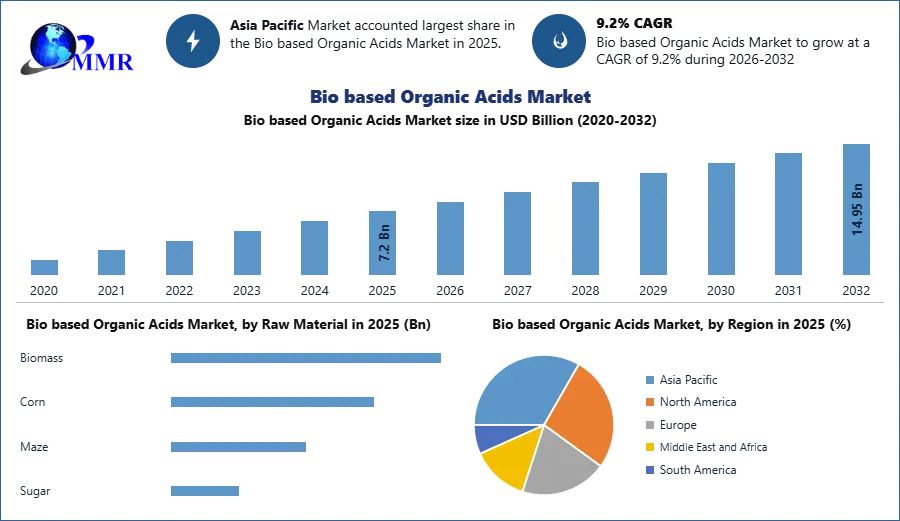 To know about the Research Methodology :- Request Free Sample Report
Bio Based Organic Acids Market Dynamics
Bio-based alternatives to organic acid are environmentally sustainable and economical compared to synthetic products. Bio-based organic acid manufacturers are more focused on innovation in bio-based organic acid. Innovation in the organic acid industry in recent years are now entirely capable of replacing traditional synthetic organic acid. In the petrochemical industry, organic acids are one of the major building blocks as it produces various end-use petrochemical products. Some of the applications that are expected to use bio-based organic acids include pharmaceuticals, polymers, lubricating oil, food, cosmetics, solvents, oxygenated diesel fuel, coatings, and other products.
There is a high demand in production industries for bio lactic acids owing to its wide range of application and usage in the production of polylactic acid. These are some of the factors that are responsible for high demand in industries such as pharmaceuticals, textiles, and packaging for their production process. Different organic acids that are used in the bio-based organic acid for various applications include lactic acid, fumaric acid, succinic acid, acrylic acid, acetic acid, and other applications. Among these, bio lactic acid dominates the market globally in bio based organic acid market.
The manufacturers of petrochemical industries have a huge demand for organic acids in the production process. Furthermore, preservative food items in functional and conventional food application to improve the shelf life of the food product are also boosting the demand for the bio-organic acid market. In addition, the bio-organic based flavor is used to enhance the flavor of the food products which is also increasing the demand for the Bio-based organic acid market.
The by-products chemicals such as polylactic acid (PLA), polyhydroxyalkanoate (PHA) and bio-ethylene, which are used in the production of bio-based plastics, are expected to have strong growth over the years.
Growing consumer inclination and regulations imposed by the FDA and EU with growing environmental industrial compliance towards bio organic acid are also boosting the demand. Furthermore, the disadvantages and environmental issues based on conventional organic acids are, therefore, promoting the use of bio-based products and growing the customer base in many countries for these products.
The manufacturers are focusing on the fermentation techniques in extraction of key material elements of organic acids based on bio organic. The shortages of oil resources and steadily rising oil prices are boosting the demand for bio based organic acid market. In addition, increasing industrial, political, and technical interest are also boosting the demand for production of chemicals that are made from renewable compounds. Fermentation products with the use of bio based organic acid have created various end-use applications such as to improve the shelf life of the product, add flavours, and aroma to various food products has built various opportunities for the manufacturers and consumers.
The disadvantages and environmental issues based on conventional organic acids are, therefore, promoting the use of crops for producing bio-based organic acid such as maize, sugarcane, and corn-based regulation imposed on some countries are strictly prohibited; this leads to an impact on the bio-based organic acids restricting the growth of the market. In addition, cost-effective production of bio-based organic acid can also lead to hampering the market growth for the bio-organic acid market. The use of bio-based products and growing the customer base in many countries for these products is rising the growth of Bio based organic acids market.
Bio Based Organic Acids Market: Market Segmentation
Global Bio based Organic Acids Market is segmented by Raw Material (Biomass, Corn, Maize, Sugar), by Product Type (Acetic Acid, Fumaric Acid, Succinic Acid, Lactic Acid, Formic Acid, Gluconic Acid, Ascorbic Acid, Citric Acid), by Application(Petrochemicals, Polymers, Pharmaceuticals, Dyes, Coatings, Food Products), by Region (North America, Europe, Asia-Pacific, South America and Middle East & Africa).
Bio Based Organic Acids Market: Regional Analysis
By region, Europe held the highest market share in 2021 and is expected to keep its dominance over the forecast period. Europe has market share of approx. 34% in the bio based organic acids market as manufacturers are taking keen interest towards bio based organic products. The regulation laid down by the government and subsidiaries provided on petrochemicals-based products are the major drivers for bio organic acid market in Europe. In addition, manufacturers are continuously innovating and developing bio organic acids new products to fulfil the consumer demand. The Asia Pacific is expected to witness a promising growth with a market share of 16% over the forecast period thanks to the rising demand in textile industry, pharmaceutical industry and food & beverages. E-commerce platform provided by various manufacturers are also boosting the demand for bio based organic acid market in the Asia Pacific.
Factors such as urbanisation, changing lifestyle, customer preference for natural food ingredients and increased demand for convenience foods drive the Bio-Based Organic Acid market in the European market.
Key manufacturers are more focused on researching and designing activities to broaden their present product range. In addition, the growing demand for fermentation products for raw materials such as rubber, leather, plastic and textile also boost the demand for the bio-organic acid market.
Report covers in-depth analysis of key development, marketing strategies, supply-side and demand side indicators and company profiles of market leaders, potential players, and new entrants. Key players operating in this market are adopting various organic and inorganic growth strategies such as merger& acquisitions, joint ventures, collaborations, expansion, new product launches and patents to increase their regional presence and business operations.
The objective of the report is to present a comprehensive analysis of the Global Bio based Organic Acids Market including all the stakeholders of the industry. The past and current status of the industry with forecasted market size and trends are presented in the report with the analysis of complicated data in simple language. The report covers all the aspects of the industry with a dedicated study of key players that includes market leaders, followers, and new entrants.
PORTER, SVOR, PESTEL analysis with the potential impact of micro-economic factors of the market have been presented in the report. External as well as internal factors that are supposed to affect the business positively or negatively have been analysed, which will give a clear futuristic view of the industry to the decision-makers.
The report also helps in understanding Global Bio Based Organic Acids Market dynamics, structure by analyzing the market segments and project Global Bio-based Organic Acids Market Clear representation of competitive analysis of key players by price, financial position, Product portfolio, growth strategies, and regional presence in the Global Bio Based Organic Acids Market make the report investor’s guide.
Bio Based Organic Acids Market Scope: Inquire before buying
| Bio based Organic Acids Market | |||
|---|---|---|---|
| Report Coverage | Details | ||
| Base Year: | 2025 | Forecast Period: | 2026-2032 |
| Historical Data: | 2020 to 2025 | Market Size in 2025: | 7.2 USD Billion |
| Forecast Period 2026-2032 CAGR: | 9.2% | Market Size in 2032: | 14.95 USD Billion |
| Segments Covered: | by Raw Material | Biomass Corn Maze Sugar |
|
| by Application | Petrochemicals Polymers Pharmaceuticals Dyes Coatings Food Products |
||
| by Product Type | Acetic Acid Fumaric Acid Succinic Acid Lactic Acid Formic Acid Gluconic Acid Ascorbic Acid Citric Acid |
||
| by Source | Plant-Based (Corn, Sugarcane, Cassava, etc.) Animal-Based Microbial Fementation Biomass / Cellulosic Feedstock |
||
| By Production Technology | Fermentation Chemical Synthesis Enzymatic Process |
||
Bio Based Organic Acids Market, by Region
• North America (United States, Canada and Mexico)
• Europe (UK, France, Germany, Italy, Spain, Sweden, Austria and Rest of Europe)
• Asia Pacific (China, South Korea, Japan, India, Australia, Indonesia, Malaysia, Vietnam, Taiwan, Bangladesh, Pakistan and Rest of APAC)
• Middle East and Africa (South Africa, GCC, Egypt, Nigeria and Rest of ME&A)
• South America (Brazil, Argentina Rest of South America)
key players / competitors profiles covered in the Bio based Organic Acids Market report in strategic perspective
Abengoa (Spain)
BASF SE(Germany)
BioAmber Inc. (Canada)
Cargill (United States)
Corbion NV(Netherlands)
Methanex (Canada)
Mitsubishi Chemical Corporation (Japan)
Mitsui & Co. Ltd. (Japan)
Novozymes A/S(Denmark)
Zhejiang Hisun Biomaterials Co. (China)
Myriant(United States)
Genomatica(United States)
Natureworks LLC (United States)
Archer Daniels Midland Company (ADM)
Tate & Lyle PLC
DSM-Firmenich
Roquette Frères
Jungbunzlauer Suisse AG
Galactic S.A.
Henan Jindan Lactic Acid Technology Co., Ltd.
COFCO Biochemical (Anhui) Co., Ltd.
Futerro
BASF-YPC Company Limited
Shandong Baisheng Biotechnology Co., Ltd.
Henan Lactic Acid Industry Co., Ltd.
Shanghai Tong-Jie-Liang Biomaterials Co., Ltd.
Godavari Biorefineries Ltd.
Table of Contents
16.3.15 Tate & Lyle PLC
16.3.16 DSM-Firmenich
16.3.17 Roquette Frères
16.3.18 Jungbunzlauer Suisse AG
16.3.19 Galactic S.A.
16.3.20 Henan Jindan Lactic Acid Technology Co., Ltd.
16.3.21 COFCO Biochemical (Anhui) Co., Ltd.
16.3.22 Futerro
16.3.23 BASF-YPC Company Limited
16.3.24 Shandong Baisheng Biotechnology Co., Ltd.
16.3.25 Henan Lactic Acid Industry Co., Ltd.
16.3.26 Shanghai Tong-Jie-Liang Biomaterials Co., Ltd.
16.3.27 Godavari Biorefineries Ltd.