
Ball Clay Market by Form, Price Range, Application, Sales Channel and Region – Global Market Size Estimation, Industry-Wide Analysis, Competitive Landscape Assessment & Long-Term Forecast to 2034
Overview
Ball Clay Market size was valued at US$ 622.2 Mn. in 2025 and expected to reach US$ 777.04 Mn. by 2034 at a CAGR of 2.5% during the forecast period.
The Ball Clay market report is a comprehensive analysis of the industry, market, and key players. The report has covered the market by demand and supply-side by segments. The Ball Clay report also provides trends by market segments, technology, and investment with a competitive landscape.
Ball Clay Market Overview:
Ball clay is an extremely rare aerial and found only in a handful of places across the globe. They are highly plastic and sedimentary in nature and used mostly for ceramics applications. Ball clay is a composite of 10-20% Kaolinite, 10-25% mica, and 6-60% of quartz. Significant physical properties of ball clay including high plasticity and high carbonaceous material content are the factors considered to drive the growth of the ball clay market. Ball clay market is valued at approximately 550 million USD in the year 2025 and expected to register a sluggish CAGR of approximately 2.5% during the forecast period.
Ball Clay Market Growth and Share Analysis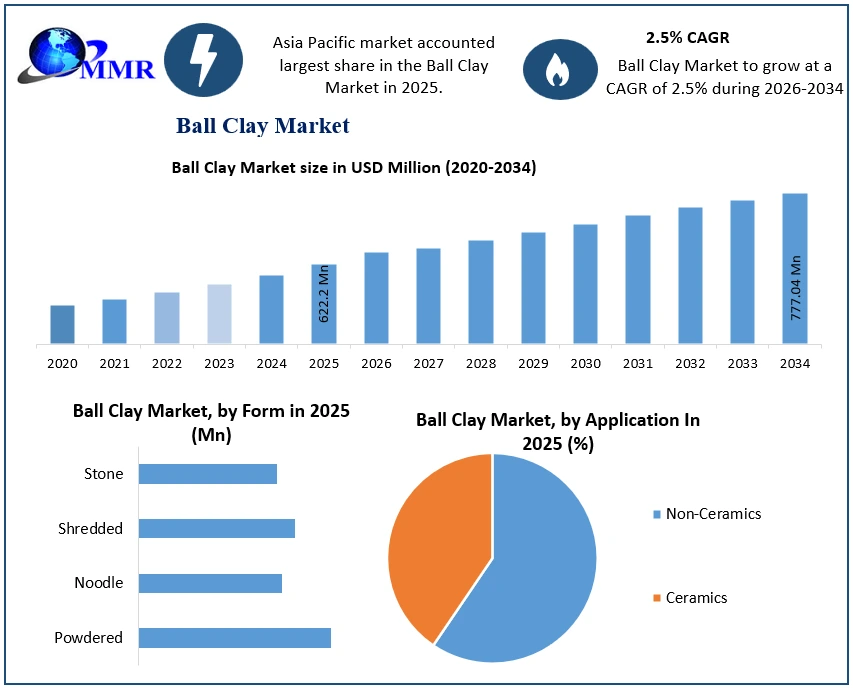
To know about the Research Methodology:- Request Free Sample Report
Ball Clay Market Dynamics:
Increasing use of ball clays in ceramics for the pre-firing operation of the ceramic content owing to high workability and strength of ball clays and increasing demand for ball clays among potters and ceramic manufacturers across the globe are the factors considered to drive the growth of the ball clay market. Moreover, owing to the sedimentary origin of the ball clays, they are available in a wide range of colors and have gained popularity in Europe since the 17th century.
Furthermore, the increasing construction sector across the globe and the use of ceramics for interior aesthetics and higher strength are the factors considered to drive the growth of the ball clay market. In addition, the proven essential ability of the ball clays for pottery and china clay making is boosting the growth of the market during the forecast period. Drying properties of ceramic material are key factor manufacturers are really worried about and hence, demand for ball clay market is bolstering in the industry as ball clays are very good for maintaining the water content trapped in the raw material form.
Increasing urbanization and increasing development by manufacturers to provide optimizable designs for clay making is the factors expected to create opportunities for prominent players in the market. Moreover, increasing sanitation wears demand in the construction industry is further bolstering the demand for key players in the market.
Negative environmental impact owing to the mining of ball clay and high price range of the product owing to the rarity of the material are the factors considered to restrain the market growth. Henceforth, sustainable techniques of manufacturing is the key development issue considered to challenge the market growth.
Ball Clay Market Segment Analysis:
Powdered Ball Clay Segment is dominating the Ball Clay Market:
Factors attributing to the growth of the segment are the increasing need for powdered form of ball clays in ceramic facilities and the use of ball clays in drainage and insulation facilities in making natural ovens in restaurants owing to its heat-trapping capacity. Powdered clay gives more stability to the finished product and offers resistance to any internal damage to the finished ceramic product. According to Grindwell Norton Ltd., powdered form of the ball clay is used extensively in making ceramic tiles for basins and bathrooms owing to the plasticity provided by them. The powdered segment was accounted for approximately 230 million USD in the year 2025.
Commercial Segment is posing as Fastest Growing in Ball Clay Market:
The commercial sector was accounted for approximately 68% of the ball clay market share owing to extensive urbanization in developing nations and thereby increasing domination of the commercial sector along with it. Moreover, the increasing population moving from developing regions to urban areas in search of jobs and subsequent increase in residential constructions are the factors considered to drive the growth of the segment in the ball clay market.
Impact of Covid pandemic on the Ball Clay market:
Covid pandemic has a major impact on the market in terms of sales as more than 60% of sales of units are hampered owing to disruption in transport capabilities of the manufacturers due to stringent norms of lockdown and increasing safety concerns. Furthermore, disruption of residential construction activities and commercial segments across the globe owing to the low no. of workers working on site is the key supporting factor considered to hamper the market growth.
According to IMERYS Ceramics, as lockdown restrictions ease and various manufacturing activities are retaining to normal, Ball Clay is once again gaining a full-scale prominence in the market as halted shipments have reached their destinations and inventories are now filled with new materials and products for use in ceramics and noon-ceramics.
Ball Clay Market Regional Insights:
The Asia Pacific held the major share in the Ball Clay market with approximately 45%, market share. Increasing disposable income of consumers owing to economic growth in the region is the key factor considered to drive the market growth. Moreover, the increasing inclination of domestic manufacturers towards ball clay integration and the development of new material applications including adhesives, sealants, and fixers for the construction sector is the key supporting factors considered to drive the growth of the market. In addition, the high no. of ceramic manufacturers operating in the region has boosted the growth of Ball Clay in the region.
North America is expected to pose as the fastest-growing region in the Ball Clay Market with approximately 31% market share. Increasing infrastructure activities and growing construction sites in the region for high-end hotels, large theme parks and commercial complexes are the key factors considered to drive the growth of the region in the market. Moreover, sanitary ware, tableware, and glazes and engobes market is boosting in the region and expected to create future growth in the market.
Europe holds the prominent share in the market owing to increasing sales in the market and increasing no. prominent players in the ceramics manufacturing segment. In addition, growing demand for cost-effective ball clay manufacturing is the key factor considered to drive the ball clay market in the region.
The objective of the report is to present a comprehensive analysis of the Global Ball Clay Market to the stakeholders in the industry. The past and current status of the industry with the forecasted market size and trends are presented in the report with the analysis of complicated data in simple language. The report covers all the aspects of the industry with a dedicated study of key players that include market leaders, followers, and new entrants.
PORTER, SVOR, PESTEL analysis with the potential impact of micro-economic factors of the market have been presented in the report. External as well as internal factors that are supposed to affect the business positively or negatively have been analyzed, which will give a clear futuristic view of the industry to the decision-makers.
The report also helps in understanding the Global Ball Clay Market dynamics, structure by analyzing the market segments and project the Global Ball Clay Market size. Clear representation of competitive analysis of key players by Type, price, financial position, Type portfolio, growth strategies, and regional presence in the Global Ball Clay Market make the report investor’s guide.
Ball Clay Market Recent Industry Development
| Date | Company | Development | Impact |
|---|---|---|---|
| 15 September 2025 | Ashapura Minechem Ltd. | Ashapura Minechem expanded its clay and mineral product portfolio by increasing supply capabilities for ceramic and industrial applications. | The expansion addresses surging regional demand for high-plasticity ceramic-grade ball clay raw materials across Asia-Pacific. |
| 18 December 2025 | Thiele Kaolin Company | Thiele Kaolin expanded its clay mineral product offerings by improving processing capabilities for ceramic-grade materials, including ball clay solutions. | The upgraded processing capacity enhances particle size consistency and dry strength in specialized ceramic formulations. |
| 12 March 2026 | Sibelco | Sibelco expanded its industrial minerals operations by enhancing ball clay processing technologies to support demand from ceramic, tile, and construction industries. | The technological upgrades improve energy efficiency and rheological stability in porcelain stoneware production. |
| 20 May 2026 | Imerys | Imerys expanded its specialty minerals portfolio by increasing production capabilities for high-quality ball clay used in ceramics, sanitaryware, and advanced material applications. | The investment secures long-term supply of ultra-plastic white-firing ball clays for European and global ceramic manufacturers. |
Ball Clay Market Scope: Inquire before buying
| Ball Clay Market | |||
|---|---|---|---|
| Report Coverage | Details | ||
| Base Year: | 2025 | Forecast Period: | 2026-2034 |
| Historical Data: | 2020 to 2025 | Market Size in 2025: | 622.2 USD Million |
| Forecast Period 2026 to 2034 CAGR: | 2.5% | Market Size in 2034: | 777.04 USD Million |
| Segments Covered: | by Form | • Powdered • Noodle • Shredded • Stone |
|
| by Price Range | • Below 40 USD • 40 USD-50 USD • Above 50 USD |
||
| by Application | • Non-Ceramics • Ceramics |
||
| by Sales Channel | • Channel Sales • Direct Sales |
||
Ball Clay Market, by Region
• North America (United States, Canada and Mexico)
• Europe (UK, France, Germany, Italy, Spain, Sweden, Austria and Rest of Europe)
• Asia Pacific (China, South Korea, Japan, India, Australia, Indonesia, Malaysia, Vietnam, Taiwan, Bangladesh, Pakistan and Rest of APAC)
• Middle East and Africa (South Africa, GCC, Egypt, Nigeria and Rest of ME&A)
• South America (Brazil, Argentina Rest of South America)
Ball Clay Market Key Players are:
• Ashok Alco-Chem Ltd.
• G&W Mineral Resources
• Amarnath Industries
• IMERYS Ceramics
• Ashapura Group
• Finore Minerals LLP
• Kothari Minerals
• Old Hickery Clay Co.
• Modkha Marine SDN Bhd
• Sibelco
• Jayesh Mineral Industries
• JLD Minerals
• Garg Minerals and Chemicals
• Intercity Enterprises
• Gujarat Mineral Development Corporation Ltd.
Frequently Asked Questions:
1. Which region has the largest share in Ball Clay Market?
Ans: Asia Pacific region held the highest share in 2025.
2. What is the growth rate of Ball Clay Market?
Ans: The Ball Clay Market is growing at a CAGR of 2.5% during forecasting period 2026-2034.
3. What is scope of the Global Ball Clay market report?
Ans: Global Ball Clay market report helps with the PESTEL, PORTER, COVID-19 impact analysis, recommendations for investors and leaders, and market estimation of the forecast period.
4. Who are the key players in Ball Clay market?
Ans: The important key players in the Ball Clay Market are Ashok Alco-Chem Ltd., G&W Mineral Resources, Amarnath Industries, IMERYS Ceramics, Ashapura Group, Finore Minerals LLP, Kothari Minerals, Old Hickery Clay Co.
5. What is the study period of this market?
Ans: The Ball Clay Market is studied from 2025 to 2034.