
Aviation Cyber Security Market by Component and Deployment – Global Market Size Estimation, Industry-Wide Analysis, Competitive Landscape Assessment & Long-Term Forecast to 2032
Overview
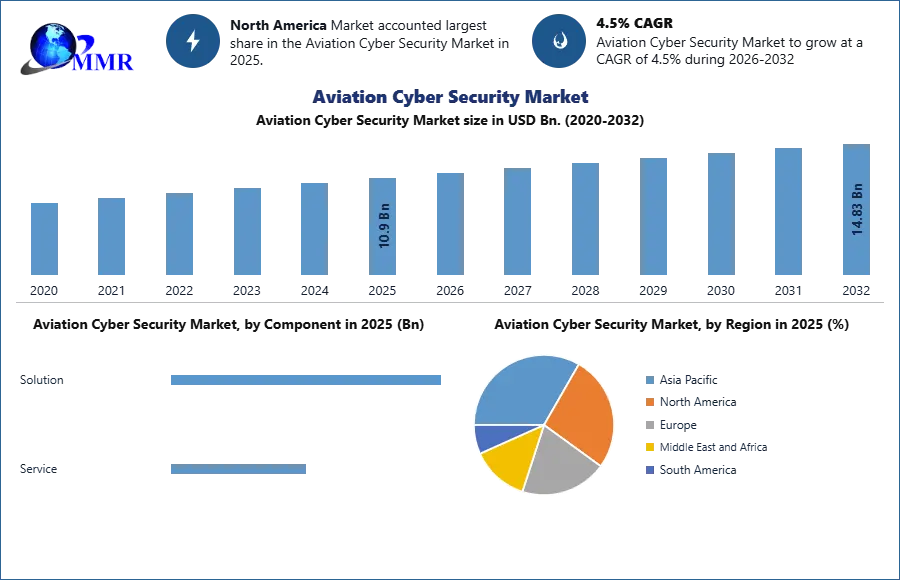
Aviation Cyber Security Market is expected to grow at a CAGR of 4.5% during the forecast period. Global Aviation Cyber Security Market is expected to reach USD 14.83 Bn by 2032.
Aviation Cyber Security Market Overview:
Aviation sector is experiencing enormous technological advancements, which are creating huge opportunities for the market growth. As these advancements facilitates the improved passenger experience both on the ground and in the air with better customer service, security, flight efficiency, and operations. Technological advancements are integral part of Aviation industry and its impact will rise drastically in forecast period. The aviation sector is also benefitting from the increasing level of connectivity. But the adverse effect of the advancement of technology and connectivity is the market has become prone and vulnerable to cyber-attacks of malicious malware activities creating a major challenge for the aviation sector. The report study has analyzed revenue impact of covid-19 pandemic on the sales revenue of market leaders, market followers and disrupters in the report and same is reflected in our analysis.
To know about the Research Methodology :- Request Free Sample Report
There are several cases where major amount of sensitive security data was stolen. Even the world’s largest airline companies also had suffered from data breach, with the hacker accessing personal information. For instance, data was stolen from Cathay Pacific Airways Ltd. of more than 9.4 million customers. Such incidences keep happening all around the world and as these threats are becoming more stealth with upcoming every attack, detection, exposure and prevention are the most sought-after solutions. Due to such threats and incidences happened earlier the aviation sector is demanding to utilize services of domain experts, which ultimately creating an opportunity for the market growth.
Aviation Cyber Security Market Dynamics:
The aerospace industry is becoming extremely dependent on IT, and is progressively facing malicious cyber-attacks. The global aviation cyber security market is projected to grow explicitly and this growth is mainly attributed to the rising incidences of cyber-attacks and cybercrimes on the aerospace sector. On other hand, increasing severity of cyber-attacks, increasing popularity of cloud security solutions and emergence of social media are influencing the growth of this market. Further, as the aviation sector moves toward the autonomy of air travel and is investing billions in developing aviation technologies, the need to protect the infrastructure becomes critical and a high security support is needed.
These things are leading players in the aviation sector to the procurement of advanced cyber security solutions and services and the trend will increase in the forecast period. On the contrary, some other factors such as lack of awareness about latest technologies, attitude of negligence toward security, delayed in authorization and highly skilled workforce in security organizations are restraining the growth of this market.
Aviation Cyber Security Market Segmentation Analysis:
The deployment segment includes on-premise and on-cloud deployment types. Whereas, among the two deployment types studied in the report, the aviation cyber security market was dominated by the on-cloud segment in 2025. This growth is primarily credited to the shifting market trends of cyber security solutions and the noticeable shift from on-premise deployment to on-cloud deployment, owing to its economic-cost, flexibility, and less complexities in operations. The component segment is further categorized into solution and service.
In this segment both solution and service held the prominent market share 2025. Similarly, all the segments and their sub segments with their current market share, expected growth percentage, factors boosting & hampering the growth and region wise anticipated market share during the each year in forecast period along with their graphical representation are illustrated in the report.
Aviation Cyber Security Market Regional Analysis:
North America has become the most dominant region in the global aviation cyber security, as of 2025, Whereas Europe stands as the second most contributing region. The market in North America is likely to grow at the highest CAGR during the forecast period. Factors accelerating to the growth of this market include the highest use of internet and social media in this region with advance wavelength capacity and uninterrupted connection service. Owing to these reasons effective and technologically advanced cyber security solutions and services are demand most in this region, driving the market growth.
Latin American countries such as Brazil, Argentina, Colombia, Venezuela, Mexico, Chile, Panama and Peru are the major victims of rising cybercrime activities. Hence the governments of these countries need to deploy stringent regulations and to pass legislations, which is absolutely impacting the overall demand of cyber security services and solutions in Latin America. Similarly, the report covers the detail analysis of all the regions such as, Asia Pacific and Middle East & Africa. Their growth rate and the reason for growth along with the expected value to be reached by end of the 2032 are mentioned in the final report.
Aviation Cyber Security Market Objective of the Report:
The objective of the report is to present a comprehensive analysis of the Global Aviation Cyber Security Market including all the stakeholders of the industry. The past and current status of the industry with forecasted market size and trends are presented in the report with the analysis of complicated data in simple language. The report covers all the aspects of the industry with a dedicated study of key players that includes market leaders, followers and new entrants. PORTER, SVOR, PESTEL analysis with the potential impact of micro-economic factors of the market have been presented in the report.
External as well as internal factors that are supposed to affect the business positively or negatively have been analyzed, which will give a clear futuristic view of the industry to the decision-makers. The report also helps in understanding Global Aviation Cyber Security Market dynamics, structure by analyzing the market segments and projects the Global Aviation Cyber Security Market size. Clear representation of competitive analysis of key players by Application, price, financial position, Product portfolio, growth strategies, and regional presence in the Global Aviation Cyber Security Market make the report investor’s guide.
Aviation Cyber Security Market Scope : Inquire before buying
| Aviation Cyber Security Market | |||
|---|---|---|---|
| Report Coverage | Details | ||
| Base Year: | 2025 | Forecast Period: | 2026-2032 |
| Historical Data: | 2020 to 2025 | Market Size in 2025: | 10.9 USD Bn. |
| Forecast Period 2026-2032 CAGR: | 4.5% | Market Size in 2032: | 14.83 USD Bn. |
| Segments Covered: | by Component | Solution Service |
|
| by Deployment | On-cloud On-premise |
||
Aviation Cyber Security Market, By Region
North America (United States, Canada and Mexico)
Europe (UK, France, Germany, Italy, Spain, Sweden, Austria and Rest of Europe)
Asia Pacific (China, South Korea, Japan, India, Australia, Indonesia, Malaysia, Vietnam, Taiwan, Bangladesh, Pakistan and Rest of APAC)
Middle East and Africa (South Africa, GCC, Egypt, Nigeria and Rest of ME&A)
South America (Brazil, Argentina and Rest of South America)
Key Players / Competitors Profiles Covered in Brief in Global Aviation Cyber Security Market Report in Strategic Perspective:
- Honeywell International Inc.
- BAE Systems
- Unisys Corporation
- Lockheed Martin Corporation
- Thales Group
- Cisco Systems Inc.
- Palo Alto Networks Inc.
- The Raytheon Company
- Northrop Grumman Corporation
- Collins Aerospace
- Airbus SE
- SITA
- General Dynamics Corporation
- IBM Corporation
- Fortinet Inc.
- Check Point Software Technologies Ltd.
- Kaspersky Lab
- L3Harris Technologies, Inc.
- Indra Sistemas, S.A.
- Leonardo S.p.A.
- Cyberbit Ltd.
- Sopra Steria
- Safran
- Booz Allen Hamilton Holding Corp.
- Trend Micro Inc.