
Automotive Wheel Speed Sensor Market by Sensor Type, Vehicle Type, Application, and Region - Global Market Size Estimation, Industry-Wide Analysis, Competitive Landscape Assessment & Long-Term Forecast to 2034
Overview
Automotive Wheel Speed Sensor Market was valued US$ 7.91 Bn in 2025 and is expected to reach US$ 10.88 Bn by 2034 at a CAGR of 3.61% during the forecast period.
Increase in adoption of anti-lock braking system in vehicles and strict Government mandates for minimum stoppages distance are the key factors for the growth of global automotive wheel speed sensor market.Also increase in automotive sales across the globe helps to boost the global automotive wheel speed sensor market. Increase in penetration of electric vehicles across the globe and rise in demand for autonomous vehicles provides opportunities for the market. On the other hand high cost of automotive wheel speed sensor restrain the market.
Automotive Wheel Speed Sensor Market Growth Outlook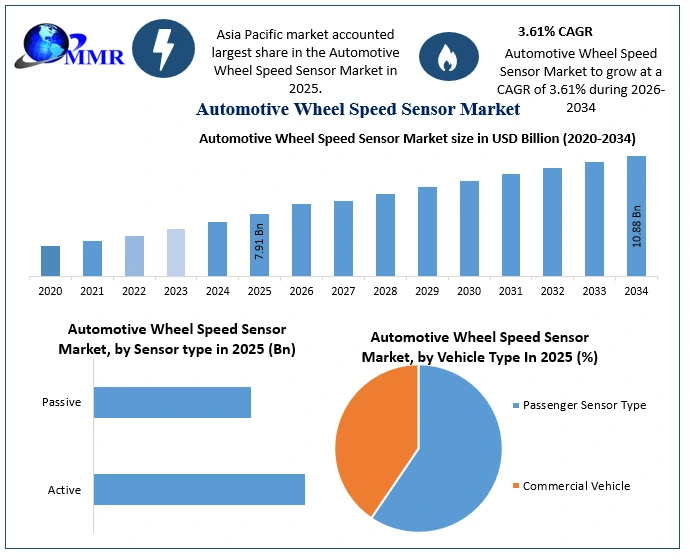
To know about the Research Methodology:-Request Free Sample Report
By sensor Type, active segment accounted for more than three-fourth of the total market in 2025 and is expected to dominate throughout the forecast period. This is because of its property Hall Effect principle, true zero speed capability, and precise switch point measurement that helps in reading accurate wheel movement even when the vehicle is not in motion. On the other hand, the passive segment is expected to be the fastest growing sector, growing at a CAGR of xx% during 2025–2034.
Based on vehicle Sensor Type, passenger vehicle contributed to nearly three-fourth of the total market in 2025 and is estimated to maintain its top status during the forecast period. Cumulative sales, growing disposable income, and compulsion of ABS system in passenger vehicles have increased the growth for the automotive wheel speed sensors market. Simultaneously, commercial vehicle has come up as the fastest growing segment, registering a CAGR of xx% during the forecast period.
By region, Asia-Pacific held the largest market share in 2025 and turned out to be dominant throughout the forecast period. Increasing government support for the automotive industry, rapid industrialization, and constant focus on developing newer products to meet diverse changes in consumer demands in the region have influenced the growth. Also, the province has showcased a CAGR of xx% throughout the forecast period and has been cited as the fastest growing region.
Major industry participant like Bosch focus on research and development to ensure product differentiation. The company’s R&D efforts have focused on development of efficient methods for ensuring reliability, precise 3D environment recognition, and securing the electronics architecture through constant plausibility checks on the data supplied. Other importantcompanies like First Sensor AG, Hitachi Metal provide products that cater to a wide range of applications like body electronics, chassis and safety, etc.
The objective of the report is to present a comprehensive assessment of the market and contains thoughtful insights, facts, historical data, industry-validated market data and projections with a suitable set of assumptions and methodology. The report also helps in understanding dynamics, structure by analyzing the market segments by Product, End User and region and, project the global market size. The report also provides a clear representation of competitive analysis of key players by product, price, financial position, product portfolio, growth strategies, and regional presence in the Automotive Wheel Speed Sensor Market. The report also provides PEST analysis, PORTER’s analysis, SWOT analysis to address the question of shareholders in arranging the efforts and investment in the near future to a particular market segment.
Automotive Wheel Speed Sensor Market Recent Industry Development
| Date | Company | Development | Impact |
|---|---|---|---|
| 08 May 2025 | Continental AG | Secured major multi-billion Euro series production orders for advanced safety-critical sensors scheduled to ramp up beginning in 2026. | The contract strengthens the company's long-term OEM platform alignment and increases the value of electronic sensor contents per vehicle chassis. |
| 01 June 2025 | Bosch Mobility | Launched the SMP290 intelligent combo sensor platform, which integrates acceleration, pressure, and temperature data with built-in wireless connectivity. | The wireless architecture eliminates traditional wheel-well harness wiring, optimizing space and robustness inside tight, safety-critical wheel spaces. |
| 01 July 2025 | ZF Friedrichshafen AG | Introduced a second-generation smart chassis sensor designed to nest directly into the vehicle's suspension ball joint. | The innovation enables advanced three-dimensional wheel acceleration tracking for structural health alerts and active road noise cancellation. |
| 19 March 2026 | Infineon Technologies AG | Released its high-precision TLE55493iC wheel speed sensor featuring linearized Tunnel Magnetoresistive (TMR) technology. | The chip achieves ASIL D safety compliance and ensures robust external magnetic field disturbance rejection for modern electric vehicle drivetrains. |
| 11 June 2026 | NOVOSENSE Microelectronics | Showcased its comprehensive customized magnetic sensing portfolio, including its custom wheel speed sensor projects developed for Aumovio. | The partnership significantly reduces application-specific development complexity while maximizing hardware reliability in safety-critical vehicle modules. |
| 02 July 2026 | Allegro MicroSystems, Inc. | Unveiled the A81415 safety PMIC, the industry's first power management integrated circuit to embed a dedicated wheel-speed sensor interface. | The device eliminates up to nine external components, cutting semiconductor bill-of-materials costs by $4 per vehicle for next-generation brake-by-wire configurations. |
Automotive Wheel Speed Sensor Market Scope :Inquire before buying
| Global Automotive Wheel Speed Sensor Market | |||
|---|---|---|---|
| Report Coverage | Details | ||
| Base Year: | 2025 | Forecast Period: | 2026-2034 |
| Historical Data: | 2020 to 2025 | Market Size in 2025: | US $ 7.91 Bn. |
| Forecast Period 2026 to 2034 CAGR: | 3.61% | Market Size in 2034: | US $ 10.88 Bn. |
| Segments Covered: | by Sensor Type | Active Passive |
|
| by Vehicle Type | Passenger Sensor Type Commercial Vehicle |
||
Automotive Wheel Speed Sensor Market, by Region
• North America (United States, Canada and Mexico)
• Europe (UK, France, Germany, Italy, Spain, Sweden, Austria and Rest of Europe)
• Asia Pacific (China, South Korea, Japan, India, Australia, Indonesia, Malaysia, Vietnam, Taiwan, Bangladesh, Pakistan and Rest of APAC)
• Middle East and Africa (South Africa, GCC, Egypt, Nigeria and Rest of ME&A)
• South America (Brazil, Argentina Rest of South America)
Automotive Wheel Speed Sensor Market Key players
1. Robert Bosch GmbH
2. Continental AG
3. WABCO
4. Denso Corporation
5. ZF Friedrichshafen AG
6. NTN-SNR
7. Melexis
8. HELLA KGaA
9. Delphi Automotive PLC
10. NXP Semiconductors N.V
11. InnoSenT
12. First Sensor AG
13. Hitachi Metal
Frequently Asked Questions:
1. Which region has the largest share in Global Automotive Wheel Speed Sensor Market?
Ans: Asia Pacific region held the highest share in 2025.
2. What is the growth rate of Global Automotive Wheel Speed Sensor Market?
Ans: The Global Automotive Wheel Speed Sensor Market is growing at a CAGR of 3.61% during forecasting period 2026-2034.
3. What is scope of the Global Automotive Wheel Speed Sensor Market report?
Ans: Global Automotive Wheel Speed Sensor Market report helps with the PESTEL, PORTER, COVID-19 Impact analysis, Recommendations for Investors & Leaders, and market estimation of the forecast period.
4. Who are the key players in Global Automotive Wheel Speed Sensor Market?
Ans: The important key players in the Global Automotive Wheel Speed Sensor Market are – Robert Bosch GmbH, Continental AG, WABCO, Denso Corporation, ZF Friedrichshafen AG, NTN-SNR, Melexis, HELLA KGaA, Delphi Automotive PLC, NXP Semiconductors N.V, InnoSenT, First Sensor AG, and Hitachi Metal
5. What is the study period of this Market?
Ans: The Global Automotive Wheel Speed Sensor Market is studied from 2025 to 2034.