
Automotive Trailer Market Size – Industry Structure Evaluation, Demand Drivers Analysis, Regional Growth Analysis and Identification, Competitive Positioning Review & Global Market Size Forecast to 2032
Overview
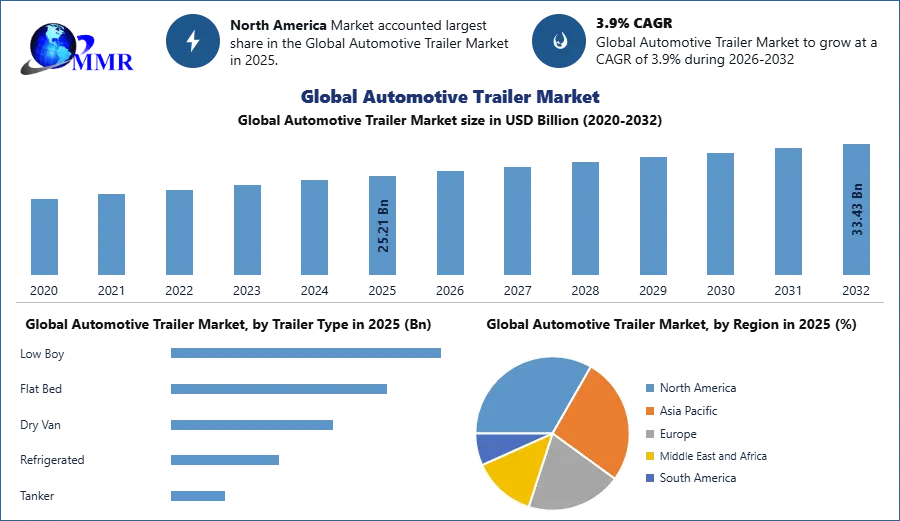
Automotive Trailer Market size was valued at USD 25.21 Billion in 2025 and the total Global Automotive Trailer Market revenue is expected to grow at a CAGR of 3.9% from 2026 to 2032, reaching nearly USD 33.43 Billion.
Automotive Trailer Market Overview:
The automotive trailer is a type of container or a long rear that is pulled by a car or other vehicles and which used for transporting large or heavy goods. These automotive trailers are sold in the piece. Trailers are used for personal work with any motorized vehicle equipped with a suitable attachment, as well as freight transportation with semi-trailer vehicles that are part of larger trucks. Depending on the requirements, automobile trailers come in single and multiple-axle configurations such as utility trailers, trip trailers, or campers. Automotive trailers are commonly used to transport a variety of things such as large cargo, bicycles, lifeboats, fish bots, and mobile houses.
As per freight transportation industry estimates, automotive trailer orders were projected to reach around 31,800 units in December 2025 globally, reflecting a moderate recovery compared to previous years due to improving logistics demand and fleet replacement cycles. This represented a slight month-on-month growth of approximately 6% and a year-on-year increase of nearly 12% supported by rising e-commerce and cross-border freight activities. According to market estimations, nearly 272,000 units were sold globally in 2025. The automotive travel trailer market remained vast, competitive, and well-established, with regional strategies and competitive landscapes continuing to evolve across North America, Europe, and Asia-Pacific.
 To know about the Research Methodology :- Request Free Sample Report
Automotive Trailer Market Dynamics:
The growing popularity of outdoor recreation and road-trip tourism, especially in North America and Europe. Rising disposable income and shifting consumer preferences toward flexible, cost-effective travel solutions significantly drove market demand. The expansion of camping infrastructure, RV parks, and tourism facilities further accelerated trailer adoption. Additionally, the growing trend toward remote work and mobile lifestyles has encouraged long-term travel, boosting sales of travel trailers. Technological advancements such as lightweight materials, improved towing efficiency, and smart interior features also enhanced product appeal, while rising e-commerce logistics indirectly supported demand for specialised trailer manufacturing.
The growing integration of smart and connected travel trailer technologies, including solar power systems, IoT-enabled monitoring, and energy-efficient appliances. This trend differentiated modern travel trailers from traditional recreational vehicles by offering enhanced self-sufficiency and off-grid travel capabilities. Additionally, the rising adoption of electric tow vehicles created a niche demand for lightweight and aerodynamic trailer designs optimised for battery efficiency. The increasing preference for customizable and modular trailer interiors also opened new revenue streams for manufacturers. Furthermore, the expansion of adventure tourism and remote work lifestyles uniquely positioned travel trailers as flexible, long-duration mobility solutions globally.
Automotive Trailer Market Segment Analysis:
Automotive Trailer Market, dry van trailers dominated the market in 2025. The segment held the largest share due to its extensive use in logistics, retail, e-commerce, and general merchandise transportation across global supply chains. Dry vans were widely preferred because they provided enclosed protection from weather, theft, and damage, making them ideal for long-haul freight. Their standardized dimensions, high cargo capacity, and compatibility with automated loading systems increased operational efficiency for fleet operators. Additionally, the rapid expansion of e-commerce, intercity freight movement, and retail distribution networks significantly boosted demand, while other types such as flatbed, tanker, refrigerated, and low boy trailers served more specialized and niche transport applications.
Automotive Trailer Market Regional Analysis :
North America dominated the Automotive Trailer Market due to its advanced freight transportation infrastructure, strong logistics networks, and high adoption of technologically advanced trailers across the U.S., Canada, and Mexico. The region experienced strong demand for dry van, refrigerated, and flatbed trailers driven by e-commerce growth, retail distribution, and long-haul trucking operations. Well-established fleet operators, strict regulatory standards, and continuous investments in trailer modernization further supported market leadership.
Meanwhile, Asia-Pacific (APAC) emerged as the fastest-growing region due to rapid industrialization, expanding manufacturing activities, and rising infrastructure development in China, India, and Southeast Asia. Increasing logistics demand, growing construction projects, and the expansion of domestic and cross-border trade significantly accelerated trailer fleet adoption, supporting strong regional growth in 2025.
Automotive Trailer Market Market Scope: Inquire before buying
| Global Automotive Trailer Market | |||
|---|---|---|---|
| Report Coverage | Details | ||
| Base Year: | 2025 | Forecast Period: | 2026-2032 |
| Historical Data: | 2020 to 2025 | Market Size in 2025: | 25.21 USD Billion |
| Forecast Period 2026-2032 CAGR: | 3.9% | Market Size in 2032: | 33.43 USD Billion |
| Segments Covered: | by Trailer Type | Low Boy Flat Bed Dry Van Refrigerated Tanker |
|
| by Number of Axles | Single Axle Multi Axles |
||
| by Length | Upto 7 m 7 to 13.6 m More than 13.6 m |
||
| by Tonnage | Upto 3.5 tons 3.5 to 10 tons More than 10 tons |
||
| by Application | Construction Industrial Agriculture Mining Port |
||
Automotive Trailer Market, by Region
North America (United States, Canada and Mexico)
Europe (UK, France, Germany, Italy, Spain, Sweden, Austria and Rest of Europe)
Asia Pacific (China, South Korea, Japan, India, Australia, Indonesia, Malaysia, Vietnam, Taiwan, Bangladesh, Pakistan and Rest of APAC)
Middle East and Africa (South Africa, GCC, Egypt, Nigeria and Rest of ME&A)
South America (Brazil, Argentina Rest of South America)
Key Players are:
Great Dane
Wabash National Corporation
Utility Trailer Manufacturing Company
Schmitz Cargobull
Hyundai Translead
China International Marine Containers (CIMC) Vehicles
Krone (Fahrzeugwerk Bernard Krone)
Kögel Trailer GmbH
Fontaine Commercial Trailer
Manac Inc.
Dennison Trailers Ltd
Ifor Williams Trailers Ltd
Humbaur GmbH
Böckmann Fahrzeugwerke GmbH
East Manufacturing Company
MAC Trailer Manufacturing
Stoughton Trailers
Wielton S.A.
Fliegl Fahrzeugbau
Heil Trailer International