
Global Automotive Telematics Insurance Market By Vehicle Type, By Device Type, By Usage-Based Insurance Type, By Telematics Technology, By End User, by Region and Forecast 2034
Overview
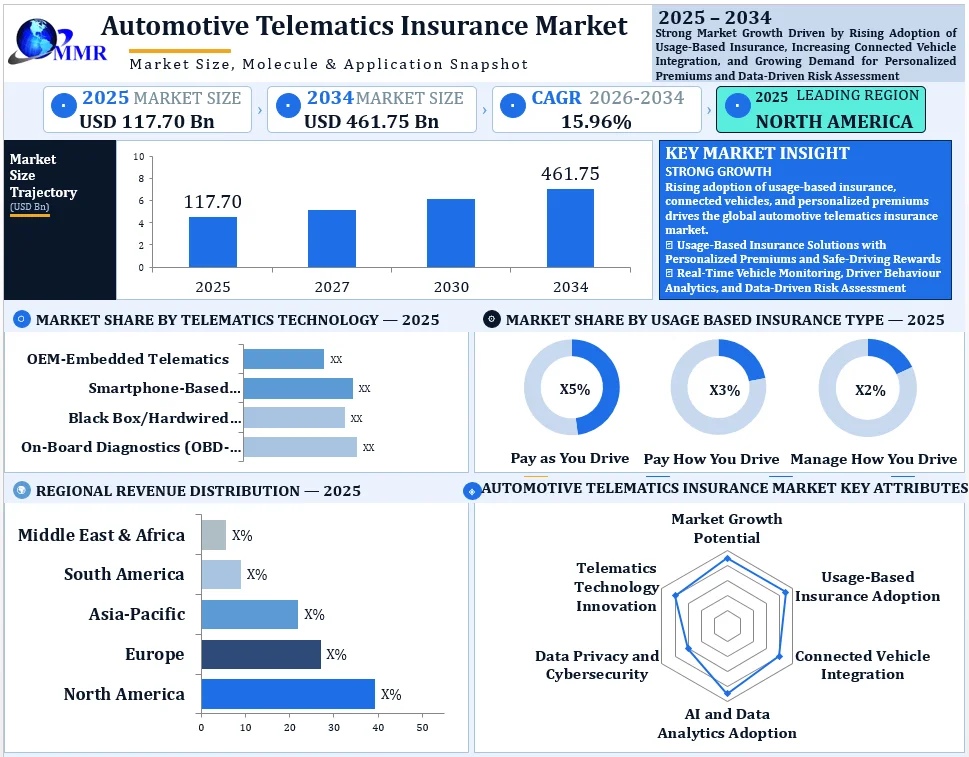
The Global Automotive Telematics Insurance Market size was valued at USD 117.70 billion in 2025 and the total Automotive Telematics Insurance revenue is expected to grow at a CAGR of 15.96% from 2026 to 2034, approaching to USD 461.75 Billion.
Global Automotive Telematics Insurance Market Overview
Automotive telematics can significantly help to improve driving behaviour, improve road safety, position insurance rewards with actual requirements over UBI, and boost the productivity of motor insurance companies. The use of automotive telematics can dramatically improve driving habits, increase traffic safety, align insurance premiums with real usage through usage-based insurance, and upsurge the financial success of motor insurance providers.
The automotive industry faces many issues such as control of environmental emissions, rising road safety concerns, and cost optimization of many resources within the supply chain – all of which organized account for a major share of research investment. These issues collectively account for a significant portion of research expenditure. Understanding the consumers' (drivers') driving ecosystem will help to solve these problems. One of the options that aim to lessen a commuter's effort to accomplish numerous activities while driving in the car is in-cabin smart service integration.
Automotive Telematics Insurance Market Growth and Share Analysis
To know about the Research Methodology :- Request Free Sample Report
Global Automotive Telematics Insurance Market: Key Highlights
- Market Growth: The Global Automotive Telematics Insurance Market is valued at USD 117.70 billion in 2025 and is projected to reach USD 461.75 billion by 2034, growing at a CAGR of 15.96% during the forecast period. Increasing adoption of automotive telematics, connected vehicles, and usage-based insurance (UBI) supports market expansion.
- Regional Dominance: North America leads the automotive telematics insurance market, supported by widespread adoption of usage-based car insurance, advanced telematics technology, connected vehicle solutions, and personalized insurance premiums. Established insurance providers and digital infrastructure further strengthen regional growth.
- Key Market Drivers: Rising demand for personalized auto insurance, real-time driving behaviour monitoring, AI-powered risk assessment, and vehicle data analytics drives market growth. Increasing adoption of Pay-As-You-Drive (PAYD), Pay-How-You-Drive (PHYD), and Internet of Things (IoT)-enabled telematics also supports industry development.
- Segmental Growth Opportunities: The passenger vehicle segment, smartphone-based telematics, and usage-based insurance models create significant growth opportunities. Increasing demand for black-box devices, On-Board Diagnostics (OBD-II), embedded telematics, and driver behaviour analysis enables insurers to develop flexible, data-driven insurance policies.
- Competitive Landscape and Innovation: Key players, including Progressive Corporation, Cambridge Mobile Telematics, Octo Telematics, Allstate Corporation, and LexisNexis Risk Solutions, focus on AI-driven telematics, predictive analytics, connected car insurance, driver safety monitoring, and data-driven underwriting. Strategic partnerships and technological advancements strengthen competition in the global automotive telematics insurance market.
Global Automotive Telematics Insurance Market Dynamics
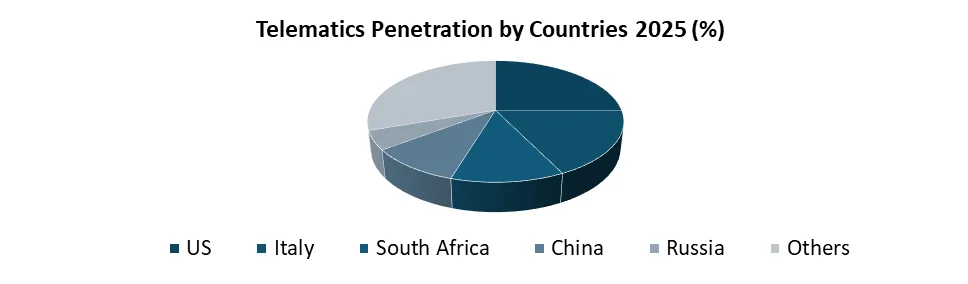
The Automotive Telematics Insurance Market grows through the increasing adoption of usage-based insurance, connected vehicle technologies, and AI-driven risk assessment. In 2025, usage-based insurance serves more than 60 million customers across 59 countries, demonstrating the growing adoption of telematics-based insurance solutions. However, data privacy concerns, cybersecurity risks, and implementation costs continue to influence market growth.
Global Automotive Telematics Insurance Market Drivers
Increasing Adoption of Usage-Based Insurance and Personalized Premiums: The demand for personalized insurance premiums drives the automotive telematics insurance market. Pay-as-you-drive (PAYD) and pay-how-you-drive (PHYD) models assess mileage, speed, braking, and driving behaviour to determine premiums. According to PTOLEMUS Consulting Group, usage-based insurance policyholders grow by almost 17% annually during the period covered by its study. These models encourage safer driving and allow insurers to offer more flexible coverage.
Enhancing Fleet Management and Operational Efficiency: Telematics improves fleet management through real-time vehicle tracking, driver monitoring, and maintenance analysis. SambaSafety's 2025 report indicates that 88% of surveyed fleets use telematics for safety, while only 30% share telematics data with insurers. This gap creates opportunities for insurers to improve risk assessment and develop customized commercial vehicle policies.
Advancements in Connected Vehicle Technologies: Advancements in AI, IoT, 5G, and cloud computing improve vehicle data collection and insurance risk assessment. The International Energy Agency reports that global electric car sales exceed 20 million in 2025, accounting for approximately 25% of new car sales. The increasing adoption of connected and electric vehicles creates opportunities for insurers to introduce specialized coverage and data-driven insurance products.
Global Automotive Telematics Insurance Market Restraints
Data Privacy Concerns and Limited Consumer Trust: Telematics systems collect sensitive information, including vehicle locations, travel routes, mileage, and driving behaviour. Concerns about unauthorized data sharing and continuous monitoring may discourage customers from adopting usage-based insurance. Insurers must implement transparent data policies, obtain appropriate consent, and strengthen data protection to maintain consumer trust.
High Implementation and Infrastructure Costs Telematics insurance requires investment in tracking devices, cloud infrastructure, analytics software, and cybersecurity systems. Smaller insurers may experience difficulties managing these expenses and integrating telematics with existing insurance platforms. Smartphone-based solutions help reduce hardware dependency, but reliable data management and technical support remain necessary.
Global Automotive Telematics Insurance Market Opportunities
Expansion of Pay-As-You-Drive and Pay-How-You-Drive Insurance: The expansion of flexible insurance products creates opportunities for insurers. In 2025, usage-based insurance serves more than 60 million customers through over 450 programmes across 59 countries. Insurers can expand PAYD and PHYD policies by offering mileage-based premiums, safe-driving rewards, and personalized driving assessments.
Growth in Electric and Connected Vehicle Insurance: Global electric car sales exceed 20 million in 2025, creating opportunities for specialized telematics insurance. Insurers use vehicle usage and available performance data to improve risk assessment and develop coverage for electric and connected vehicles. Partnerships with automotive manufacturers also support insurance integration into vehicle purchasing and leasing.
Integration of AI and Predictive Risk Analytics: AI and predictive analytics help insurers improve underwriting, detect potential fraud, and assess driving risks. SambaSafety's 2025 report indicates that 64% of surveyed insurers use telematics for underwriting. These technologies support personalized premiums, more efficient claims management, and proactive risk prevention.
Global Automotive Telematics Insurance Market Challenges
Cybersecurity Risks and Protection of Connected Vehicle Data: Connected vehicles and telematics platforms face cybersecurity risks, including unauthorized data access and information manipulation. Insurers require encryption, authentication controls, secure software updates, and continuous monitoring to protect sensitive customer information and maintain confidence in digital insurance services.
Standardization and Integration of Telematics Data: Differences in telematics devices, data formats, and driving-score methodologies create integration challenges. The fact that only 30% of surveyed fleets share telematics data with insurers in SambaSafety's 2025 report highlights the need for improved data-sharing practices. Standardized systems and stronger industry collaboration can improve data compatibility and risk assessment.
Global Automotive Telematics Insurance Market Future Trends
AI-Driven Underwriting and Real-Time Risk Assessment: Insurers increasingly use AI to analyse driving behaviour, identify risk patterns, and calculate personalized premiums. With 64% of surveyed insurers using telematics for underwriting in 2025, data-driven risk assessment remains an important development in the market.
Smartphone-Based and Embedded Telematics Solutions: Smartphone applications and embedded vehicle systems provide convenient ways to collect driving information. These technologies support digital driving scores, safe-driving rewards, and personalized policies while reducing dependence on separate tracking devices.
Partnerships Between Insurers and Automotive Technology Providers: Collaboration among insurers, vehicle manufacturers, and technology providers supports embedded insurance and connected vehicle coverage. With over 450 usage-based insurance programmes operating across 59 countries in 2025, partnerships offer opportunities to expand personalized insurance products and improve access to telematics services.
Global Automotive Telematics Insurance Market Segment Analysis:
By Vehicle Type
Based on vehicle type, the global automotive telematics insurance market is segmented into passenger vehicles and commercial vehicles. Passenger vehicles represent a significant segment due to the increasing adoption of usage-based insurance policies that calculate premiums based on mileage, driving behaviour, and vehicle usage. The growing availability of connected cars and smartphone-based telematics applications supports the adoption of personalized insurance among private vehicle owners. Commercial vehicles also contribute to market growth as fleet operators use telematics to monitor driver performance, vehicle utilization, and road safety. Insurance providers use this information to assess fleet risks, improve underwriting, and develop insurance policies tailored to commercial transportation requirements.
By Device Type
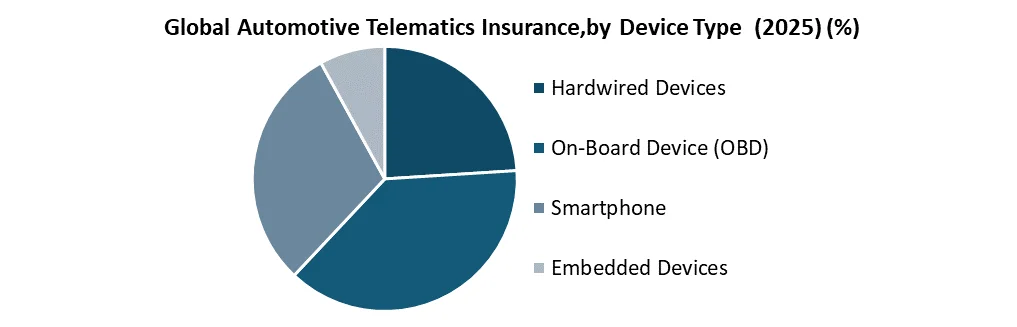
Based on device type, the market is segmented into hardwired devices, on-board devices (OBD), smartphone-based devices, and embedded devices. Hardwired devices are permanently installed in vehicles and collect driving information, including speed, location, and acceleration. OBD devices connect to a vehicle's diagnostic port to collect information about vehicle performance and driving patterns. Smartphone-based devices use mobile sensors and GPS to record selected driving data without requiring dedicated telematics hardware. Embedded devices are integrated into vehicles during manufacturing and support continuous data collection through built-in connectivity systems. The availability of these different technologies enables insurers to select suitable solutions according to vehicle compatibility, data requirements, and implementation costs.
By End User
Based on end user, the market is segmented into individual policyholders and commercial fleet operators. Individual policyholders adopt telematics insurance to access personalized premiums, monitor driving behaviour, and potentially receive rewards for safe driving or lower vehicle usage. Smartphone-based applications and connected vehicle systems make these policies increasingly accessible to private vehicle owners. Commercial fleet operators use telematics insurance to manage risks across multiple vehicles, monitor driver performance, and improve operational safety. Insurers analyse fleet-related data to support underwriting, identify high-risk driving patterns, and develop coverage tailored to commercial transportation needs. Increasing demand for data-driven risk management supports adoption among both individual customers and business users.
Automotive Telematics Insurance Market Regional Insights:
North America is the leading region of the global automotive telematics insurance market, supported by the widespread adoption of usage-based insurance (UBI), established insurance providers, advanced connected vehicle infrastructure, and growing demand for personalized auto insurance premiums. In 2025, North America accounts for 39.34% of the global insurance telematics market, reflecting the strong presence of telematics-enabled insurance programs in the United States and Canada. Insurers increasingly use real-time driving data, driver behavior analytics, and risk-based pricing to improve underwriting accuracy, encourage safer driving, and optimize claims management.
Europe represents another significant regional market, driven by connected vehicle adoption, road safety initiatives, and the use of black-box telematics devices for motor insurance. Countries such as the United Kingdom, Italy, and Germany support market development through established insurance ecosystems and increasing use of Pay-As-You-Drive (PAYD) and Pay-How-You-Drive (PHYD) insurance models. Data privacy requirements also influence how insurers collect and process vehicle and driver behavior data.
Asia-Pacific is emerging as a high-growth region for the automotive telematics insurance market, supported by rising vehicle ownership, expanding digital insurance services, smartphone penetration, and growing interest in personalized insurance policies. China, India, and Japan create opportunities for insurers to introduce telematics-based motor insurance, mobile applications, and connected vehicle solutions. The region also benefits from the expansion of digital mobility services and increasing demand for affordable premiums based on driving behavior.
South America is gradually expanding its presence as insurers and fleet operators adopt digital vehicle monitoring, driver behavior analysis, and usage-based insurance solutions. Growing interest in fleet safety, vehicle tracking, and operational efficiency creates opportunities for telematics-enabled motor insurance across developing automotive markets.
The Middle East and Africa market is developing through increasing vehicle connectivity, digital transformation in insurance services, and growing demand for commercial fleet monitoring. Insurers and fleet operators use telematics solutions to assess driving risks, improve vehicle safety, support claims evaluation, and develop more flexible insurance products
Overall, the automotive telematics insurance market benefits from the expansion of usage-based insurance, real-time vehicle data analytics, connected car technology, and personalized premium models. While North America maintains a leading position, Asia-Pacific offers significant growth opportunities as digital insurance adoption and connected vehicle penetration increase.
Global Automotive Telematics Insurance Market Competitive Landscape
The automotive telematics insurance market is highly competitive, with key players focusing on developing advanced usage-based insurance solutions, real-time vehicle monitoring, driver behavior analytics, and personalized insurance premiums. Companies integrate artificial intelligence, connected vehicle technology, smartphone-based telematics, and predictive analytics to improve risk assessment, enhance road safety, and optimize insurance claims management.
Key players operating in the automotive telematics insurance market include Progressive Corporation, Allstate Corporation, State Farm, Cambridge Mobile Telematics, Octo Telematics, and LexisNexis Risk Solutions. These companies strengthen their market positions through innovative telematics platforms, data-driven underwriting, mobile applications, and partnerships with insurance providers and automotive manufacturers.
Companies increasingly focus on expanding Pay-As-You-Drive (PAYD) and Pay-How-You-Drive (PHYD) insurance programs that calculate premiums based on mileage, driving behavior, and vehicle usage. Progressive offers its Snapshot program to evaluate driving patterns, while Allstate provides its Drivewise program to deliver driving insights and encourage safer driving habits. Cambridge Mobile Telematics develops telematics solutions that help insurers analyze driving behavior and assess insurance risks. These strategies support product innovation, improve customer engagement, and increase the adoption of automotive telematics insurance solutions.
Global Automotive Telematics Insurance Market: Key Companies by Region and Country
| REGION | COUNTRY | COMPANY NAME / KEY PLAYER |
|---|---|---|
| North America |
United States |
Progressive Corporation |
| State Farm Mutual Automobile Insurance Company | ||
| The Allstate Corporation | ||
| Nationwide Mutual Insurance Company | ||
| Liberty Mutual Insurance Group | ||
| The Travelers Companies, Inc. | ||
| United Services Automobile Association (USAA) | ||
| Farmers Insurance Group | ||
| Government Employees Insurance Company (GEICO) | ||
| American Family Mutual Insurance Company | ||
| Canada | Intact Insurance | |
| belairdirect | ||
| Desjardins General Insurance Group | ||
| TD Insurance | ||
| Aviva Canada Inc. | ||
| CAA Insurance Company | ||
| Allstate Insurance Company of Canada | ||
| Europe | United Kingdom |
Admiral Group plc (LittleBox) |
| Hastings Group (Hastings Direct YouDrive) | ||
| Germany | Allianz Versicherungs-AG (BonusDrive) | |
| HUK-COBURG Insurance Group | ||
| France | AXA France IARD (Direct Assurance – YouDrive) | |
| Italy | Unipol Assicurazioni S.p.A. | |
| Generali Italia S.p.A. | ||
| Asia Pacific |
Japan | Aioi Nissay Dowa Insurance Co., Ltd. |
| South Korea |
Samsung Fire & Marine Insurance Co., Ltd. | |
| Hyundai Marine & Fire Insurance Co., Ltd. | ||
| KB Insurance Co., Ltd. | ||
| India | ICICI Lombard General Insurance Company Limited | |
| Zuno General Insurance Limited | ||
| Australia | Insurance Australia Limited (ROLLiN' Insurance) | |
| Middle East & Africa |
South Africa |
Discovery Insure Limited |
| Momentum Insure | ||
| Bahrain | Solidarity Bahrain B.S.C. | |
| Pakistan | IGI General Insurance Limited | |
| South America |
Brazil | Justos Seguros S.A. |
| Colombia | Seguros Generales Suramericana S.A. (SURA) |
Global Automotive Telematics Insurance Market: Recent Developments
| Date | Company | Development | Impact |
| March 24, 2026 | Cambridge Mobile Telematics, Allianz X, TPG and State Farm | Announce a USD 350 million strategic investment to expand AI-powered road safety technology, real-time driving risk assessment, crash detection, and the Universal Driving Score. | Strengthens AI-driven risk assessment, expands telematics capabilities, and supports data-driven insurance services. |
| March 25, 2026 | LEEO | Launches a telematics-powered commercial auto insurance product that integrates real-world driving data into policy pricing and safe-driving rewards. | Supports behaviour-based premiums, encourages safer fleet operations, and connects insurance costs more closely with driving performance. |
| May 5, 2026 | OCTO Telematics and Sedgwick | Announce a strategic partnership that combines vehicle telematics insights with claims management and risk assessment services. | Improves crash reporting, supports faster claims processing, strengthens fraud validation, and helps reduce claims-related costs. |
| July 22, 2026 | Root Insurance | Expands its mobile-first, behaviour-based car insurance offering to New Jersey, extending its availability to 37 U.S. states. | Broadens access to smartphone-based telematics insurance and increases opportunities for personalised premiums based on driving behaviour. |
| September 22, 2026 | Cambridge Mobile Telematics and Lemonade | Extend their collaboration by integrating CMT's DriveWell Tag vehicle sensor into Lemonade Car's insurance offering. | Expands access to sensor-based driving data and supports safe-driving rewards through vehicle-connected insurance solutions. |
| September 24, 2026 | LexisNexis Risk Solutions and IMS | Integrate the LexisNexis Drive Metrics scoring model into the IMS EdgeSDK to deliver smartphone-based driving analytics using on-device processing. | Reduces dependence on cloud processing, supports data privacy, and helps insurers implement more cost-efficient usage-based insurance programs. |
| September 28, 2026 | OCTO Telematics and TruckerCloud | Announce a partnership to combine in-vehicle telematics solutions with commercial auto insurance telematics data for U.S. fleets. | Expands commercial telematics adoption and improves access to fleet driving insights for insurance risk assessment and management. |
Automotive Telematics Insurance Market Scope: Inquire before buying
| Automotive Telematics Insurance Market | |||
|---|---|---|---|
| Report Coverage | Details | ||
| Base Year: | 2025 | Forecast Period: | 2026-2034 |
| Historical Data: | 2020 to 2025 | Market Size in 2025: | 117.7 USD Billion |
| Forecast Period 2026-2034 CAGR: | 15.96% | Market Size in 2034: | 461.75 USD Billion |
| Segments Covered: | by Vehicle Type | Passenger Vehicle Commercial Vehicle |
|
| by Device Type | Hardwired On-board Device (OBD) Smartphone Embedded |
||
| by Usage-Based Insurance Type | Pay-As-You-Drive (PAYD) Pay-How-You-Drive (PHYD) Manage-How-You-Drive (MHYD) |
||
| by Telematics Technology | On-Board Diagnostics (OBD-II) Black Box/Hardwired Devices Smartphone-Based Telematics OEM-Embedded Telematics |
||
| by End User | Individual Policyholders Commercial Fleet Operators |
||
Automotive Telematics Insurance Market, by Region
North America (United States, Canada and Mexico)
Europe (UK, France, Germany, Italy, Spain, Sweden, Austria, Turkey, Russia and Rest of Europe)
Asia Pacific (China, India, Japan, South Korea, Australia, ASEAN and Rest of APAC)
Middle East and Africa (South Africa, GCC, Egypt, Nigeria and Rest of ME&A)
South America (Brazil, Argentina, Columbia and Rest of South America)
Frequently Asked Questions: Global Automotive Telematics Insurance Market
1] What segments are covered in the Global Automotive Telematics Insurance Market report?
Ans. The segments covered in the Global Automotive Telematics Insurance Market report are based on Vehicle Type, Device Type, Usage-Based Insurance Type, Telematics Technology, and End User.
2] Which region holds the highest share in the Global Automotive Telematics Insurance Market?
Ans. North America holds the highest share in the Global Automotive Telematics Insurance Market, driven by the widespread adoption of usage-based insurance, connected vehicle technologies, and advanced telematics solutions.
3] What is the market size of the Global Automotive Telematics Insurance Market by 2034?
Ans. The Global Automotive Telematics Insurance Market is projected to reach USD 461.75 billion by 2034.
4] What is the forecast period for the Global Automotive Telematics Insurance Market?
Ans. The forecast period for the Global Automotive Telematics Insurance Market is 2026–2034.
5] What was the market size of the Global Automotive Telematics Insurance Market in 2025?
Ans. The Global Automotive Telematics Insurance Market is estimated to reach USD 117.70 billion in 2025.