
Automotive Electric Oil Pump Market - Industry Structure Evaluation, Demand Drivers Analysis, Regional Growth Analysis and Identification, Competitive Positioning Review & Global Market Size Forecast to 2032
Overview
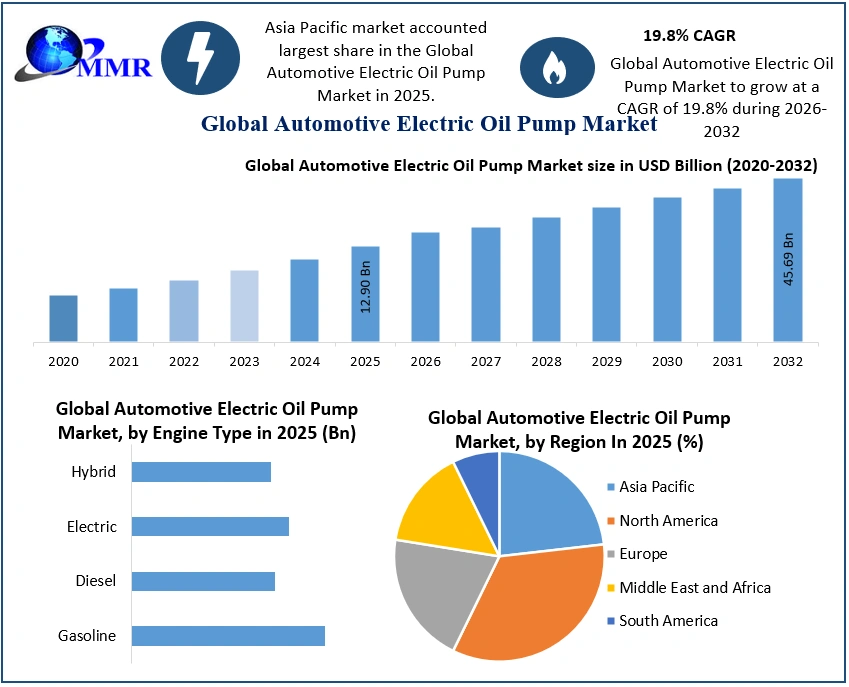
The Automotive Electric Oil Pump Market size was valued at USD 12.90 Billion in 2025 and the total Automotive Electric Oil Pump revenue is expected to grow at a CAGR of 19.8% from 2026 to 2032, reaching nearly USD 45.69 Billion by 2032.
Global Automotive Electric Oil Pump Market Overview
Automotive electrical oil pumps are sophisticated devices that are designed to circulate oil or lubricant fluid through a system at a specific pressure, which is used for applications such as engine lubrication, transmission cooling, and braking. While traditional oil pumps are driven by mechanically driven sources (whether a gear or a belt), these modern pumps are driven by dedicated electric motors. This provides the benefits of pump independence, higher efficiency, and controllable fluid flow. These pumps have also been shown to greatly reduce friction, cause less wear and tear on components, thereby improving engine performance, fuel consumption, and reliability. The pumps are quieter, produce less vibration, and draw less power than their mechanical counterparts, which is why electric oil pumps are being adopted more frequently across all modern vehicle platforms.
As vehicles move toward increased electrification and hybridization, and stricter emissions and fuel economy regulations come into place, the global acceptance of electric oil pumps will continue to accelerate. The Asia-Pacific region dominates electric oil pump sales, particularly in China, Japan, and South Korea. Given the dominance of leading OEMs in the region, the high volume of vehicle production in the region, and higher hybrid and electric vehicle penetration. Globally, in 2025, electric oil pump demand was chiefly driven by the unrelenting adoption of automatic transmission systems and BEVs and HEVs, with the majority of demand still coming from the APAC region.
Even as markets contend with significant challenges such as escalated raw material prices and substantial installation costs, manufacturers are responding through technology, optimized costs, and partnerships with automakers. Developments in 48V architectures, brushless motors, IoT-enabled pumps, and energy-efficient lubrication systems are defining the market direction. The focus of automakers on sustainability and operating performance provides disruption opportunities through electric oil pumps in the transition toward next-generation vehicles, providing ample opportunity for Tier-1 suppliers while also creating opportunities for boutique manufacturers.
To know about the Research Methodology :- Request Free Sample Report
Automotive Electric Oil Pump Market Dynamics
Enhancing Vehicle Efficiency and Reducing Mechanical Wear to Drive Automotive Electric Oil Pump Market
Electric oil pump circulates oil or a lubricant fluid under pressure in an intelligent way, so that the fluid flow is controlled electrically and independently. This flow mechanism of fluid is utilized for transmission, engine, and break in vehicle. Insufficiency in lubrication can create problem in vehicle component such as friction, wear and tear. The use of electric oil pump improves engine efficiency of a vehicle. Improper functioning of oil pump hinders performance of different systems like transmission, engine and braking system, which leads to huge loss, therefore, electric pumps are preferred over conventional pump. An electric oil pump is driven by an electric motor to produces minimal noise, vibration, maintains oil pressure with low power consumption and high fuel efficiency. These are factors influencing the automotive electric oil pump market.
Rising Raw Material Costs and High Installation Expenses to Pose Challenges for the Electric Oil Pump Market
Increase in raw material price and high cost of electric pump installation in vehicle that may restraining the market growth at global level. Growing demand for automatic transmission systems in vehicles and increasing government regulations for fuel efficient vehicles in developing nations to control pollution provide opportunities for the growth of the automotive electric oil pump market. Manufacturers in the automotive electric oil pump are focusing on competitive pricing as the strategy to capture significant market share. Moreover, strategic mergers and acquisitions and technological innovations are also the key focus areas of the manufacturers.
Rising EV Adoption and Aftermarket Expansion to Create Opportunities in the Automotive Electric Oil Pump Market
The Global Automotive Electric Oil Pump Market has growth opportunities due to the rapid expansion of electric and hybrid vehicles. Adoption of electric oil pumps improves efficiency, reduces energy loss, and allows for features such as quiet starts. Government regulations and improvements in emissions and fuel efficiency continue to be the driving factors for the adoption of electric oil pumps. In addition, new aftermarket opportunities for replacements, new installations, and retrofits throughout the Original Equipment Manufacturer (OEM) and aftermarket supply chain are contributing to growth potential. New technology developments in hybrid/electric applications, including industrial and off-highway applications, may even spur new product development and willingness for new opportunities. In terms of region, the largest share of the Global Automotive Electric Oil Pump Market comes from Asia-Pacific, supported by a strong automotive base, adoption of low emission regulations, government-favorable EV policies, and electrification growth momentum.
Global Automotive Electric Oil Pump Market Segment Analysis
Based on Distribution Channel, the automotive electric oil pump market is segmented into OEM and aftermarket. The OEM segment is expected to grow at the largest CAGR of xx% during the forecast period, owing to more number of electric oil pump units are produced per year. It is backed by low labour expenses and steady economies that helps in localizing the manufacturing units for key OEMs, which is likely to eliminate heavy import duty taxes. Cost of one unit of electric oil pump is less for OEM, considering the deals between OEM and component supplier, incentives provided to OEMs, and lesser production cost as the production for OEMs is undertaken at a mass level.
Based on Vehicle Type, the passenger cars segment is expected to grow at the largest CAGR of xx% during the forecast period. This can be attributed to increasing production and demand for passenger vehicles in developing countries such as India, China, and Brazil. Stringent government regulations regarding lower emission vehicles and standards such as EURO 6 will further supplement the growth of the segment. Furthermore, fast increasing demand for commercial vehicles in developing countries, due to rising industrialization and expansion of the construction industry, is likely to fuel the growth of the commercial vehicles segment during the forecast period.
Automotive Electric Oil Pump Market Regional Insights
Geographically, Asia Pacific held the largest market share at the 57.0% in 2025. It is expected to grow at the highest CAGR of xx% during the forecast period owing to the presence of key automobile manufacturers such as Toyota, Hyundai, Honda, and Suzuki, have established their manufacturing plants in APAC. Strong demand for passenger cars and commercial vehicles among consumers and industrial applications across key developing countries, such as India, China, and Korea are likely to drive the growth of the Asia Pacific market during the forecast period. Asia Pacific is leading to reduction of overall vehicle prices and subsequently increasing passenger vehicle adoption across the region.
Automotive Electric Oil Pump Market Competitive Landscape
There are many well-established global and regional players in the market, which are competing on technology innovations, product reliability, cost-effectiveness, and OEM relationships. The leading electric oil-pump manufacturers, including DENSO Corporation, AISIN (Aisin Seiki), Robert Bosch GmbH, ZF Friedrichshafen AG, Nidec Corporation, Hitachi Astemo (Hitachi Automotive), MAHLE Group, Rheinmetall Automotive (KS), SHW AG, Mitsubishi Electric, BorgWarner, Johnson Electric, Magna International, Aptiv, and FTE (Valeo), are particularly strong in R&D, have demonstrated expertise in brushless e-motor and power electronics expertise, and have a global supply network that is tightly coordinated with OEM vehicle programs. They focus on high-efficiency, low-NVH, variable-flow, electric oil pumps for HEV/PHEV/BEV thermal and lubrication circuits, with embedded controllers, diagnostics, and CAN/LIN connectivity that work towards electrification and strengthening CO₂/Euro 7/EPA norms.
Tier-1 suppliers co-develop with OEMs such that duty cycles, thermal strategies, and calibration are customized to specific transmission (AT/DCT/Hybrid) architectures, e-axles, and start-stop systems, so they can increase SOP schedules and reduce integration risk. Smaller manufacturers and new entrants are targeting niche use-cases (aftermarket upgrades, motorsport, special off-highway) and/or value-engineered pumps for emerging markets to capture share either as a disconnected independent or in partnership with automotive aftermarket parts retailers.
Global Automotive Electric Oil Pump Market Trends
| Category | Trend | Example | Market Impact |
| Technology Advancement | Integration of electric oil pumps in hybrid and electric vehicles (EVs) | Aisin Seiki developed high-efficiency pumps for HEVs/EVs | Boosts demand as automakers transition to electrification |
| Efficiency & Sustainability | Focus on fuel efficiency and CO₂ emission reduction | Bosch’s low-power consuming electric oil pumps | Strengthens adoption due to global emission norms (Euro 7, EPA) |
| Smart Control & Connectivity | Use of intelligent, electronically controlled pumps with variable flow | Hitachi Astemo introduced smart control oil pump systems | Enhances engine performance, reduces wear, and supports advanced powertrains |
Automotive Electric Oil Pump Market Recent Development
• In 2025, Aisin Seiki launched the E-Oil Pump Gen 2, the next generation of their existing product with enhanced integration and efficiency for hybrid and electric vehicles.
• In 2025, Denso Corporation integrated an oil cooler into the E-Oil Pump Plus, thus enhancing thermal management of components and providing enhanced operational life.
• In 2024, Bosch integrated AI-driven efficiency, smart lubrication monitoring, and EV capability into its electric oil pump solutions.
• In 2024, Hitachi Automotive Systems also launched compact, low-noise electric oil pumps for hybrid transmissions that include motor and control electronics in their construction.
• In 2025, Nidec Corporation / Rheinmetall Automotive increased its investment in R&D for electric oil pumps to enhance pump efficiency, durability, and integration capabilities. Their work targets EVs and start-stop applications.
Automotive Electric Oil Pump Market Scope: Inquire before Buying
| Automotive Electric Oil Pump Market | |||
|---|---|---|---|
| Report Coverage | Details | ||
| Base Year: | 2025 | Forecast Period: | 2026-2032 |
| Historical Data: | 2020 to 2025 | Market Size in 2025: | USD 12.90 Bn. |
| Forecast Period 2026 to 2032 CAGR: | 19.8% | Market Size in 2032: | USD 45.69 Bn. |
| Segments Covered: | by Electric Vehicle Type | Battery Electric Vehicle Hybrid Electric Vehicle Plug-in Hybrid Electric Vehicle |
|
| by Engine Type | Gasoline Diesel Electric Hybrid |
||
| by Vehicle Type | Passenger Vehicles Commercial Vehicles |
||
| by Distribution Channel | OEM Aftermarket |
||
| by Application | Transmission Oil Pump Engine Oil Pump Brake Oil Pump |
||
Global Automotive Electric Oil Pump Market by Region
North America (United States, Canada, and Mexico)
Europe (UK, France, Germany, Italy, Spain, Sweden, Austria, and the Rest of Europe)
Asia Pacific (China, South Korea, Japan, India, Australia, ASEAN, Indonesia, Philippines, Malaysia, Vietnam, Thailand, ASEAN, Rest of Asia Pacific)
Middle East & Africa (South Africa, GCC, Nigeria, Rest of ME&A)
South America (Brazil, Argentina, Rest of South America)
Global Automotive Electric Oil Pump Market, Key Players
1. Automotive Electric Oil Pump Manufacturers
These companies develop and manufacture electric oil pumps for engine lubrication, transmission systems, and hybrid vehicle applications.
North America
1. Johnson Electric Holdings Limited – United States Operations
2. BorgWarner Inc. – United States
3. Engineered Machined Products (EMP) – United States
4. Mikuni American Corporation – United States
Europe
1. Rheinmetall AG (Power Systems Division) – Germany
2. MAHLE GmbH – Germany
3. Robert Bosch GmbH – Germany
4. SHW AG – Germany
Asia Pacific
1. DENSO Corporation – Japan
2. Nidec Corporation – Japan
3. Mitsubishi Electric Corporation – Japan
4. Hitachi Astemo, Ltd. – Japan
5. Aisin Corporation – Japan
2. Hybrid & Electric Vehicle Thermal Management Suppliers
These companies provide electric pumps and thermal management solutions for hybrid and battery electric vehicles.
North America
1. BorgWarner Inc. – United States
2. Hanon Systems – South Korea/United States Operations
Europe
1. MAHLE GmbH – Germany
2. Robert Bosch GmbH – Germany
3. Rheinmetall AG – Germany
Asia Pacific
1. DENSO Corporation – Japan
2. Nidec Corporation – Japan
3. Aisin Corporation – Japan
3. Automotive Powertrain & Lubrication System Companies
These companies develop powertrain components, lubrication systems, and fluid management technologies.
North America
1. BorgWarner Inc. – United States
2. Engineered Machined Products (EMP) – United States
Europe
1. ZF Friedrichshafen AG – Germany
2. SHW AG – Germany
3. FTE Automotive GmbH – Germany
Asia Pacific
1. Mitsubishi Electric Corporation – Japan
2. Hitachi Astemo, Ltd. – Japan
3. Aisin Corporation – Japan
4. Automotive Mechatronics & Precision Motor Suppliers
These companies specialize in electric motors, mechatronic systems, and precision automotive pump technologies.
North America
1. Johnson Electric Holdings Limited – United States Operations
Europe
1. Robert Bosch GmbH – Germany
Asia Pacific
1. Nidec Corporation – Japan
2. Mitsubishi Electric Corporation – Japan
3. DENSO Corporation – Japan
5. Transmission & Auxiliary Pump Technology Providers
These companies supply electric pumps for automatic transmissions, start-stop systems, and advanced vehicle architectures.
North America
1. BorgWarner Inc. – United States
2. Mikuni American Corporation – United States
Europe
1. ZF Friedrichshafen AG – Germany
2. FTE Automotive GmbH – Germany
Asia Pacific
1. Aisin Corporation – Japan
2. Hitachi Astemo, Ltd. – Japan
3. DENSO Corporation – Japan
Frequently Asked Questions
1. Which region has the largest share in the Global Automotive Electric Oil Pump Market?
Ans: The Asia Pacific held the highest share in the Global Automotive Electric Oil Pump Market in 2025.
2. What is the growth rate of the Global Automotive Electric Oil Pump Market?
Ans: The Global Automotive Electric Oil Pump Market is expected to grow at a CAGR of 19.8% during the forecast period 2026-2032.
3. What is the scope of the Global Automotive Electric Oil Pump Market report?
Ans: The Global Automotive Electric Oil Pump Market report helps with the PESTEL, Porter's, Recommendations for Investors and leaders, and market estimation for the forecast period.
4. Who are the key players in the Global Automotive Electric Oil Pump Market?
Ans: The important key players in the Global Automotive Electric Oil Pump Market are Hitachi Automotive (Japan), Nidec Corporation (Japan), Mitsubishi Electric (Japan), DENSO CORPORATION (Japan), AISIN SEIKI (Japan), Johnson Electric (USA), Mikuni American Corporation (USA), Magna International (Canada), and HUSCO Automotive (USA).
5. What is the study period of this market?
Ans: The Global Automotive Electric Oil Pump Market is studied from 2025 to 2032.