
Automotive Active Body Panel Market Size – Industry Structure Evaluation, Demand Drivers Analysis, Regional Growth Analysis and Identification, Competitive Positioning Review & Global Market Size Forecast to 2032
Overview
The Automotive Active Body Panel Market was valued at USD 1.78 billion in 2024. The market is expected to reach USD 2.9 billion by 2032, exhibiting a compound annual growth rate (CAGR) of 6.3 % from 2025 to 2032.
Active body panels are responsive parts with the ability to adapt to changing conditions, such as accidents or impacts. As a revolutionary technology, they are expected to record robust growth in the coming years. The growing popularity of automation and autonomous vehicles, backed by reliability improvements, is leading to increased adoption of advanced auto technologies. This move towards intelligent, responsive car systems is one of the primary reasons behind the growing demand for active body panels.
The Automotive Active Body Panel market is gaining significant momentum as manufacturers increasingly focus on smarter and more dynamic vehicle designs. These body panels are no longer just for appearance purposes; they are actively adapting to driving scenarios, assisting in aerodynamics, fuel consumption, and even noise reduction. A mix of increasing demand for electric vehicles, stricter emission regulations, and the constant competition for improved driving performance. Automakers are increasingly looking at lightweight, shape-Energy Storage Automotive Body Panels materials that react to data in real time, enhancing overall vehicle performance without weight. With the increasing integration of sensors and electronics in body structures, the old distinction between mechanical and digital elements is rapidly disappearing. In addition, consumer expectations about style, performance, and sustainability are forcing OEMs to think outside the box. The issues of cost and scalability of production still exist, as the market is highly promising, with luxury and EV segments driving early uptake.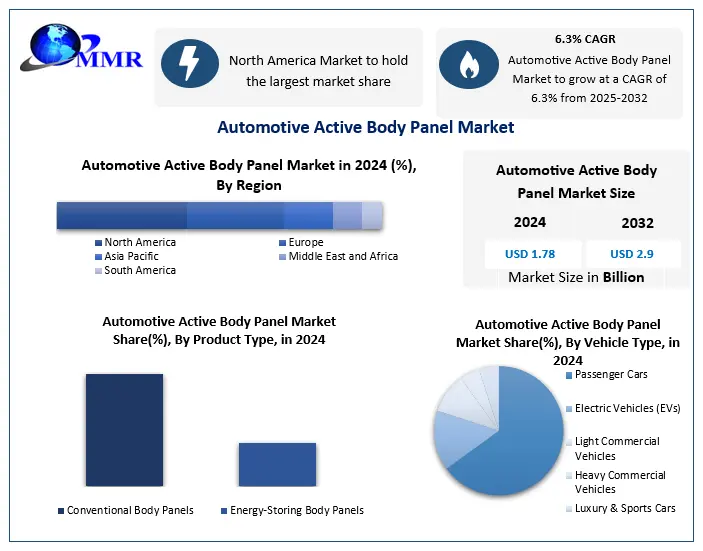 To know about the Research Methodology :- Request Free Sample Report
Global Automotive Active Body Panel Market Dynamics:
Active Aerodynamic Tech Widely Adopted is a Key Automotive Active Body Panel Market Trend
The increasing adoption of active aerodynamic technology has emerged as a dominant trend in the Automotive active body panel market primarily due to its deep impact on vehicle performance and energy efficiency. OEMs are launching advanced features such as active grille shutters, adjustable spoilers, and shape-shifting underbody Product Types that adapt to varying driving conditions. These technologies are engineered to reduce air drag, enhance fuel or battery utilization, and provide more driving stability, particularly at increased speeds. Growing utilization of such technologies in mid-range and electric cars reflects their growing applicability. This is reinforced by tighter standards worldwide for emissions and energy consumption, compelling automakers to implement solutions that enhance performance while not altering fundamental design fundamentals. Active aerodynamic parts provide an effective and real-world solution for achieving these standards while also presenting competitive benefits, hence placing them at the forefront in the development of future vehicle models of all types.
Surge in EV & Hybrid Vehicle Production to Drive the Automotive Active Body Panel Market Growth
The rapid growth in hybrid and electric vehicle manufacturing is one of the key drivers accelerating the world Automotive Active body panel market. With the automotive sector going electric, there is a greater demand for systems that increase energy efficiency and aerodynamic performance, both are important to achieve the optimal driving range. Features such as active grille shutters and movable spoilers are required to increase airflow control, reduce drag, and regulate battery temperature. These panels find perfect harmony with the performance as well as efficiency expectations of electric and hybrid cars. Concurrently, encouraging government policies for low-emission vehicles and increasing investments in EV-related infrastructure are accelerating worldwide EV production. Automakers are also employing active body panels to give a visual premium and technological advantage to their electric and hybrid vehicles. This emerging wave of production activity is laying the ground for sustained growth in the active body panel market, particularly in the EV category.
High Production & Integration Costs to Restrain Automotive Active Body Panel Market Growth
The automobile active body panel industry is significantly hindered by production as well as system-integration-based high costs. The manufacturing of these panels requires specialized materials, advanced engineering processes, and embedded electronics technologies, which significantly increase overall production costs compared to conventional body panels. Further, integrating these elements into existing vehicle platforms necessitates dedicated tooling, software setup, and extensive testing, with additional cost layers added. This budgetary strain is particularly challenging for volume producers targeting the midrange and budget segments, where price is paramount. In these instances, consumers are less inclined to choose features that inflate the vehicle price. Producers are therefore forced into a delicate balance between innovation and affordability in the marketplace, resulting in a challenging compromise between advanced features and mass market penetration. Such high-cost drivers, coupled with supply chain complexity and low scale benefits, are likely to hold back the rate of adoption, particularly in developing markets where price sensitivity is high.
Advancements in Lightweight Materials create an opportunity for the Automotive Active Body Panel Market
Advances in lightweight material technology are a major growth opportunity for the Automotive active body panel market. Applications of advanced composite, high-strength aluminum, and engineered thermoplastic provide significant benefits in strength, design freedom, and weight savings. Application of these materials in active panels enables vehicle manufacturers to increase energy efficiency, increase vehicle mobility, and increase driving range for electric vehicles. Moreover, lighter panel structures simplify the integration of sensors, actuators, and electronic control units, essential Product Types of active systems. As the focus on emissions reduction and sustainability grows stronger in regulations, manufacturers are stepping up their willing by using materials that help them meet compliance standards without sacrificing performance. They also help to create more durable and recycled vehicle parts. They help in creating more sustainable and recyclable vehicle parts as well. The capacity to balance lightweight with high functionality makes lightweight materials a worthwhile resource, allowing both cost savings and technical breakthroughs in a globally competitive car market.
Global Automotive Active Body Panel Market Segment Analysis:
Based on Product Type, the Automotive Active Body Panel Market is segmented into Conventional Automotive Body Panels, Energy Storage Automotive Body Panels. The Conventional Automotive Body Panels segment dominated the market in 2024 and is expected to capture the largest market share during the forecast period, due to its extensive use in a variety of vehicles, such as traditional, hybrid, and electric cars. Active grilles and aerodynamic spoilers are established technologies that are simpler and less expensive for manufacturers to introduce. Their common use in both replacement and original equipment markets, especially because of damage from low-impact incidents, continues to generate consistent demand. By contrast, energy storage body panels remain in the development stage and have not yet reached commercial scale, which restricts their existing application within the marketplace.
Based on Material Type, the Automotive Active Body Panel Market is segmented into Steel, Aluminium, Carbon Fiber, Plastic, and Composite. Steel segment dominated the market in 2024 and is expected to capture the largest market share during the forecast period, due to its cost-effectiveness, hard-wearing, and readily available. Steel has decent structural features that make it suitable for application in body panels, while compatibility with current plant equipment reduces the cost of production. Steel panels are simpler and cheaper to repair or replace, something that fuels demand in both OEM and aftermarket constantly. While materials such as aluminum, carbon fiber, and composites are being utilized in some high-end and performance models, steel remains the most practical and widely utilized material among mainstream automotive uses.
Global Automotive Active Body Panel Market Regional Insights:
North America dominates the active body panel market due to high demand for premium vehicles, a priority for large models such as SUVs and trucks, and a strong focus on efficiency. Advanced consumer expectations and a well-developed innovation ecosystem further support adopting active aerodynamic technologies, making the region a major development center for the smart body panel.
Europe is a major market for luxury vehicles, which is inspired by strong consumer demand for advanced automotive features, such as high disposable income and active body panels. The region is expected to experience stable growth as buyers prefer rapid performance, efficiency, and design. In addition, the need for continuous active body panel replacement due to minor dents and scratches, combined with market speed, supports the ongoing expansion in European countries. Countries such as Germany, France, Italy, and the UK are expected to continuously expand the entire region during the forecast period.
Asia-Pacific is experiencing robust growth in the active body panel market, led by increased passenger car sales and cost-saving technological developments. With huge vehicle manufacturing in nations such as China, India, South Korea, and Japan, the region is gaining significant power in the global market.
Competitive Landscape
Audi AG is a key player in the automotive active body panel industry with its ability to integrate highly advanced aerodynamic devices into its high-end vehicle lineup. Vehicles such as the A6 Sedan and A6 e-tron feature active grille shutters, optimized air curtains, and underbody airflow systems to improve vehicle performance and fuel efficiency. With its reputation as an engineering master, Audi takes these technologies to increase both functional aerodynamics and aesthetics. The brand’s commitment to electrification and lightweight design indeed shines through in its use of active panels. Audi’s ongoing investment in smart body technologies showcases its dedication to creating high-end, sustainable, and efficient vehicles.
General Motors is pursuing a forward-looking strategy for the active body panel segment, blending futuristic styling and functional aerodynamics. Its new UK design center unveiled a Corvette-bred concept with reconfigurable aero components, 3D-printed body parts, and integrated EV battery structures. The styling boasts "Apex Vision," highlighting a structural and aesthetic breakthrough with adaptive airflow systems. GM's focus is on defining what next-generation vehicle bodies might be, combining innovative materials with active functions. Through global design reach and courageous conceptual efforts, GM is positioning itself as a major force in active body panel innovation, focused on future mobility and performance.
Recent Developments
In April 2025, Audi unveiled its latest A6 business sedan, setting new benchmarks in design, comfort, and aerodynamics. With a drag coefficient of just 0.23, it boasts the lowest figure for any Audi combustion vehicle. Plus, the incorporation of MHEV mild hybrid technology enhances both efficiency and performance. Adaptive air suspension and all-wheel steering aid in smooth and tight handling, rendering the A6 perfect for daily use and long road trip ventures.
On April 2025, General Motors launched an advanced design studio at the Royal Leamington Spa, UK, and unveiled a Corvette-inspired concept car with additive manufacturing, integrated body panels with EV capabilities, Apex vision, and reconfigurable aero surfaces for dual-mode performance. The new development reinforces the GM's global design appearance and displays its innovation in active body panel technology, aerodynamics, and next-generation mobility solutions.
Automotive Active Body Panel Market Scope: Inquire before buying
| Automotive Active Body Panel Market | |||
|---|---|---|---|
| Report Coverage | Details | ||
| Base Year: | 2024 | Forecast Period: | 2025-2032 |
| Historical Data: | 2019 to 2024 | Market Size in 2024: | USD 1.78 Bn. |
| Forecast Period 2025 to 2032 CAGR: | 6.3 % | Market Size in 2032: | USD 2.9 Bn. |
| Segments Covered: | by Product Type | Conventional Automotive Body Panels Energy Storage Automotive Body Panels |
|
| by Vehicle Type | Passenger Cars Light Commercial Vehicles (LCVs) Heavy Commercial Vehicles (HCVs) Electric Vehicles (EVs) Luxury & Sports Cars |
||
| by Material | Steel Aluminium Carbon Fiber Plastic Composite |
||
| by Application | Hoods Doors Trunk Lids Fenders Bumpers |
||
Automotive Active Body Panel Market, By Region
North America (United States, Canada, and Mexico)
Europe (UK, France, Germany, Italy, Spain, Sweden, Austria, and the Rest of Europe)
Asia Pacific (China, South Korea, Japan, India, Australia, Indonesia, Philippines, Malaysia, Vietnam, Thailand, Rest of Asia Pacific)
Middle East & Africa (South Africa, GCC, Nigeria, Rest of ME&A)
South America (Brazil, Argentina, Rest of South America)
Key players operating in the Automotive Active Body Panel Market
1. BMW AG
2. Audi AG
3. Hyundai Mobis
4. Mercedes-Benz
5. Porsche AG
6. Honda Motor Company
7. Nissan Motor Company
8. Adient PLC
9. Continental AG
10. Ford Motor Company
11. General Motors
12. Volkswagen AG
13. Toyota Motor Corporation
14. Hyundai Motor Company
15. Daimler AG
16. Volvo Cars
17. Subaru Corporation
18. FCA US LLC
19. Renault SA
20. Kia Motors
21. Mazda Motor Corporation
22. SAIC Motor Corporation
23. Other Players
Frequently Asked Questions:
1. Which region has the largest share in Global Market?
Ans: North America region held the highest share in 2024.
2. What is the growth rate of Global Automotive Active Body Panel Market?
Ans: The Global Automotive Active Body Panel Market is growing at a CAGR of 6.3 % during forecasting period 2025-2032.
3. What is scope of the Global Automotive Active Body Panel Market report?
Ans: Global Automotive Active Body Panel Market report helps with the PESTEL, PORTER, COVID-19 Impact analysis, Recommendations for Investors & Leaders, and market estimation of the forecast period.
4. Who are the key players in Global Automotive Active Body Panel Market?
Ans: The important key players in the Global Automotive Active Body Panel Market are Daimler AG, General Motors, Honda Motor Company, Ford Motor Company, Volvo Cars Nissan Motor Company Ltd, and Porsche AG.
5. What is the study period of this Market?
Ans: The Global Automotive Active Body Panel Market is studied from 2024 to 2032.