
Automatic Labeling Machine Market – Global Market Size, Strategic Growth Drivers, Risk Assessment Framework, Regulatory Landscape Review, Competitive Intensity Mapping & Long-Term Industry Outlook to 2032
Overview
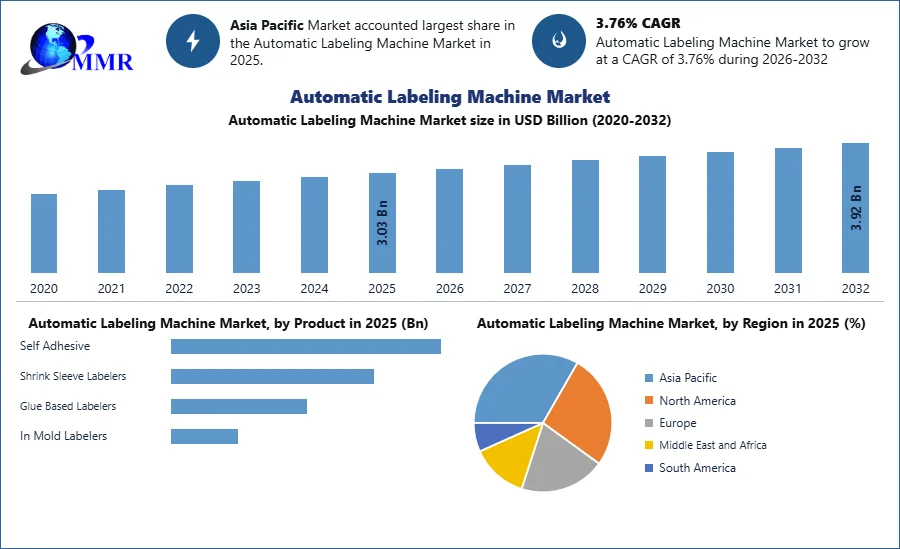
Global Automatic Labeling Machine Market size was valued at USD 3.03 Bn in 2025, and the total Automatic Labeling Machine Market revenue is expected to grow at a CAGR of 3.76% from 2026 to 2032, reaching nearly USD 3.92 Bn.
Automated labeling technologies are now supporting green labeling, or 'Eco-labels,' a practice adopted worldwide. According to the Food and Drink Federation, approximately 73% of food and beverage manufacturers have automated their processes, including cartoning, labeling, and packaging, to increase resource efficiency. The rise of e-commerce is significantly boosting the demand for precise, high-speed labeling solutions, which often incorporate anti-counterfeiting and tracking features. These advanced labels ensure security, enhance fraud protection, and drive the growth of the automatic labeling machine market.
Automatic Labeling Machine Market Overview:
Automatic labeling machines are used to print or apply labels to various shapes, with ovals, cylinders, squares, and flats. These machines produce labels that have written or quantitative information about products, inventory pricing, and more. The trend of green branding is on the increase, with eco-friendly labels developing product security by preventing tampering. Furthermore, technological developments and evolving consumer perceptions of labeled products are key factors driving the growth of the automatic labeling machine market.

The revenue of the "packaging and labeling services" industry in the U.S. from 2019 to 2024, measured in billions of U.S. dollars, is closely tied to the automatic labeling machine market. Technological advancements in labeling, such as anti-counterfeiting features and tracking capabilities, enhance product security and compliance, further boosting the adoption of automatic labeling machine market in the US. Furthermore, the trend towards green branding and eco-labels aligns with consumer preferences and regulatory requirements, promoting the use of these machines.
Automatic Labeling Machine Market Dynamics:
Regulatory Compliance in the Automatic Labeling Machine Market:
Regulations governing labeling are crucial to ensuring that products are used safely and correctly by everyone. These regulations can vary by region and are frequently updated to improve labeling documentation. For instance, in March 2024, the Bureau of Energy Efficiency (BEE) introduced the Standards and Labeling Program to assess the performance of grid-connected solar inverters, predicting significant energy savings. In June 2022, Canada's Minister of Health introduced new nutrition labeling standards for packaged foods high in sugar, sodium, or saturated fat, requiring a new symbol on the front of the packaging. Similarly, in June 2021, the Food Safety and Standards Authority of India (FSSAI) revised its Food Safety and Standards (Labelling and Display) Regulations to empower consumers to make informed food choices from packaged goods, restaurants, and online retailers.
These regulations increase the demand for automatic labeling machine that can apply labels precisely and accurately to prevent tampering, ensure consumer safety, and maintain product integrity. As companies strive to meet these strict regulatory requirements, the need for innovative and reliable labeling solutions grows, further driving the growth of the automatic labeling machine market.
 To know about the Research Methodology :- Request Free Sample Report
High Demand for Automation in a Competitive Food and Beverage Industry
With heightened competition, the food and beverage industry are experiencing a surge in demand for automation. The role of labels and packaging in product management has evolved significantly over time, alongside consumers' increasing ability to understand the contents of the products they choose to purchase. This shift is driving the industry's adoption of automation, particularly in the food and beverage sectors. Labels are pivotal in conveying product information and boosting sales as consumer awareness of product features grows. Consequently, manufacturers are increasingly investing in automated labeling solutions to meet these escalating demands. In 2020, nearly 127.92 million Americans consumed fully frozen meals, underscoring the rising popularity of packaged foods and driving the automatic labeling machine market. As competition intensifies, there is a growing emphasis on timely delivery and consistent quality. In the US, the frozen food sector is supported by 567 companies employing 97,873 people in 2022. This competitive environment is compelling manufacturers to adopt automated labeling technologies to streamline production processes and increase consumer satisfaction.
Restraints: Inconsistent Labeling Practices
The labeling process involves numerous supply chain participants and must navigate constant changes in laws, rebranding, mergers, downsizing, scaling, and economic fluctuations. With so many factors to consider, the labeling process can easily become complicated. Fragmented labeling procedures and restricted supply chain visibility often lead to redundancies and errors, resulting in higher expenses due to relabeling caused by mistakes and substandard procedures. For example, a medical equipment company growing into a new international market may face challenges with global labeling as they strive to meet localization and legislative requirements throughout their supply chain. This lack of visibility increases the likelihood of errors and misunderstandings, potentially limiting automatic labeling machine market growth during the forecast period.
Automatic Labeling Machine Market Opportunities: Transition to Eco-Friendly Solutions
A sustainable label highlights a product's environmental safety compared to others. Recyclable labels reuse materials, reducing the need for additional resources to produce new labels. As many consumers prefer environmentally friendly products, sustainability has become a top priority for many businesses. Customers who buy eco-friendly products are informed that they are picking more sustainable and environmentally mindful options. Some customers exclusively purchase products with eco-friendly labels and packaging, knowing they are protecting the environment. Labels that emphasize a product's lower environmental impact can lead customers to choose these goods over those of a competitor.
Automatic Labeling Machine Market Segment Analysis:
Based on Automation Level, Automatic Labeling Machine Market is segmented into Semi Automatic Labeling Machines, Automatic Labeling Machines, Fully Automatic Labeling Machines. Automatic Labeling Machines segment dominated the Automatic Labeling Machine Market in 2025 and is expected to hold the largest market share over the forecast period. Dominance due to their high efficiency, speed, and minimal manual intervention. These machines are widely adopted in industries like pharmaceuticals, food & beverage, and logistics, where large-scale production, precision, and compliance are critical. Fully automatic systems enhance productivity, consistency, and reduce labor costs, making them ideal for high-volume, 24/7 operations. With the growing focus on automation, smart manufacturing, and Industry 4.0 integration, many companies are upgrading from semi-automatic to fully automated systems to gain competitive advantages, driving strong demand and reinforcing their dominant market position.
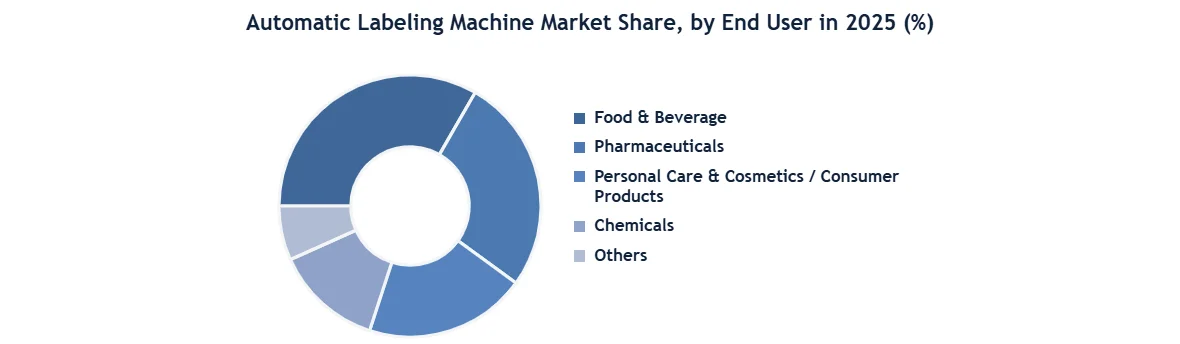
Based on End Use, the Food & Beverages segment held the largest market share of about 43.12% for the automatic labelling machine market in 2025 and is expected to dominate the market at the end of the forecast period. This dominance is primarily driven by increasing regulatory compliance and safety standards aimed at ensuring product safety and consumer protection. Furthermore, increasing consumer demand for transparency is expected to contribute to the segment's growth in the automatic labelling machine market globally. Food labels play a crucial role in providing consumers with information about the products they are considering purchasing. By correctly following the information on food labels, including handling directions, expiration dates, and allergy warnings, consumers can reduce the risk of foodborne illnesses and allergic reactions.
Automatic Labeling Machine Market Regional Analysis:
The Asia-Pacific automatic labeling machine market region is expected to experience substantial growth. With the largest population in the world, the APAC area is seeing an increased need for packaging in the food industry. This demand is driven by rising consumer awareness of packaging, leading to a greater need for high-speed, high-quality labeling solutions. China and Taiwan are the leading exporters of automatic labeling machinery in the region.
China's rapidly increasing economy has attracted significant international investment. The growing demand for brand awareness among its vast consumer base has driven advertising to new heights. Many Chinese companies are incorporating new technologies into automatic labeling equipment. With numerous producers and an increasing demand for frozen foods, China is a significant consumer of packaging. The country boasts 35,000 processing and manufacturing facilities that supply food to its population. Rising consumer spending on packaged foods and improving lifestyles may further influence regional product demand in automatic labeling machine market.
North America is also expected to see considerable growth in the automatic labeling machine market share during the projected period. Factors such as rising health consciousness and the implementation of automated technologies are driving this growth. Wet glue-based automatic labelers are expected to gain traction in the food and beverage industries over the forecast period, attributed to the region's significant demand for premium packaging. Urbanization, automation, and industrial growth are all contributing to automatic labeling equipment market growth. Increased awareness of the benefits of automated labeling equipment in various sectors to boost productivity is expected to benefit the automatic labeling machine market.
In the cosmetics industry, 161 million Americans, or 80% of American women, are estimated to use cosmetics daily. The typical American woman spends between USD 200,000 and USD 300,000 on skincare and cosmetics throughout her lifetime, using at least 16 facial care or cosmetic products daily (or approximately USD 250 per month). The rising use of cosmetic items, particularly among women, is expected to drive growth in the packaging market in the upcoming years.
Automatic Labeling Machine Market Competitive Analysis:
The automatic labeling machine market is highly competitive, with keyplayers such as Krones and SACMI leading the way. Krones holds a strong position owing to its comprehensive product range, with cold-glue, self-adhesive, shrink-sleeve, hot-melt glue, and modular labelers. The company excels in creating complete production lines for the food and beverage industry and serves various other sectors like pharmaceuticals, personal care, and home care. Krones is characterized by its advanced technology integration and innovation, though its high product costs may limit its automatic labeling machine market to large-scale manufacturers.
SACMI is a considerable provider of machinery automation solutions, with a vast range of packaging solutions, with cold-glue, pressure-sensitive, hot-melt, roll-fed, modular, shrink-sleeve, and Kube labelers. SACMI operates through four business segments Ceramics, Packaging, Food, and Automation & Service—and caters to diverse industries such as food and beverages, pharmaceuticals, household, personal care, and chemicals. SACMI's strength lies in its diverse product offerings and ability to require end-to-end packaging solutions. The automatic labeling machine market is driven by the increasing demand for high-quality, efficient labeling solutions, influenced by increasing consumer awareness, stringent regulatory standards, and developments in automation technology.
Automatic Labeling Machine Market Key Finding:
1. Automatic Labeling Machine Market size is projected to reach at US$ 3.92 Bn by 2032 at a CAGR of 3.76% during the forecast period.
2. The demand for automated labeling machines is being driven by rising consumer consciousness of packaging as well as increased packaging demand in the food industry.
3. The Food & Beverages segment held the largest market share of about 43.12% for the automatic labeling machine market in 2025.
4. As E-Commerce continues its increasing trajectory, reaching USD 65.5 trillion by 2033, the demand for efficient logistics solutions intensifies. Weigh price labeling machines play a crucial role in accurately and swiftly labeling packages for shipment. They have become indispensable tools in the dynamic landscape of online retail operations.
Global Automatic Labeling Machine Market Scope: Inquire before buying
| Global Automatic Labeling Machine Market | |||
|---|---|---|---|
| Report Coverage | Details | ||
| Base Year: | 2025 | Forecast Period: | 2026-2032 |
| Historical Data: | 2020 to 2025 | Market Size in 2025: | USD 3.03 Bn. |
| Forecast Period 2026 to 2032 CAGR: | 3.76% | Market Size in 2032: | USD 3.92 Bn. |
| Segments Covered: | by Product | Self Adhesive Shrink Sleeve Labelers Glue Based Labelers In Mold Labelers |
|
| by Specialty | Multi Purpose Machines Label Type Specific Machines Material Type Specific Machines |
||
| by Automation Level | Semi Automatic Labeling Machines Automatic Labeling Machines Fully Automatic Labeling Machines |
||
| by Labelling Speed | Low Speed (≤ 60 bottles/min) Medium Speed (60–200 bottles/min) High Speed (> 200 bottles/min) |
||
| by End User | Food & Beverage Pharmaceuticals Personal Care & Cosmetics / Consumer Products Chemicals Others |
||
Automatic Labeling Machine Market, by Region
Asia Pacific (China, South Korea, Japan, India, Australia, Indonesia, Malaysia, Vietnam, Taiwan, Bangladesh, Pakistan and Rest of APAC)
Europe (UK, France, Germany, Italy, Spain, Sweden, Austria and Rest of Europe)
North America (United States, Canada and Mexico)
Middle East and Africa (South Africa, GCC, Egypt, Nigeria and Rest of ME&A)
South America (Brazil, Argentina Rest of South America)
Automatic Labeling Machine Market, Key Players:
1. The Krones Group - Germany
2. Sacmi - Italy
3. Sidel - France (part of the Tetra Laval Group)
4. KHS - Germany
5. Herma - Germany
6. ProMach - USA
7. Marchesini Group - Italy
8. Etiquette - United Kingdom
9. Pack Leader - Taiwan
10. Novexx Solutions - Germany
11. Fuji Seal International - Japan
12. Sleever International - France
13. IMA Group - Italy
14. Tech-Long - China
15. Bausch+Ströbel - Germany
16. Accutek - USA
17. Quadrel Labeling Systems - USA
18. Logopak - Germany
19. Topjet - China
20. Videojet - USA
FAQs:
1] Which region is expected to hold the highest share in the Automatic Labeling Machine Market?
Ans. North America region is expected to hold the highest share in the Market.
2] Who are the top key players in the Automatic Labeling Machine Market?
Ans. Krones, Sacmi, KHS are the top key players in the Automatic Labeling Machine Market.
3] Which type segment is expected to hold the largest market share in the Automatic Labeling Machine Market by 2032?
Ans. Self Adhesive segment is expected to hold the largest market share in the Market by 2032.
4] What is the market size of the Automatic Labeling Machine Market by 2032?
Ans. The market size of the Automatic Labeling Machine Market is expected to reach USD 3.92 Bn. by 2032.
5] What was the market size of the Automatic Labeling Machine Market in 2025?
Ans. The market size of the Automatic Labeling Machine Market was worth USD 3.03 Bn. in 2025.