
Global Asperger Syndrome Market Size 2026-2032: Innovative Therapies, Parent Training, and Diagnostic Advancements
Overview
Global Asperger Syndrome Market size valued at USD 2.58 Bn. in 2025, projected to reach USD 4.47 Bn. by 2032, growing at a CAGR of 8.2% driven by therapy demand.
Asperger Syndrome Market Overview:
Asperger syndrome is characterized by poor social competence, repetitive patterns of conduct, impaired motor motion skills, sensory sensitivities, a reduced range of interests, obsessive and ritualized behavior, and verbal communication impairments. People with this condition are thought to be on the higher functioning end of the autistic spectrum. Despite possessing ordinary to above-average intellect, they often have a limited grasp of basic social conceptions and a poor ability to detect social signs. Despite the huge and expanding amount of literature on the autism spectrum, there has been comparatively little study on the actual experiences of individuals with Asperger syndrome.
Clinical investigations have revealed that AS persons have unique talents that distinguish them from neurotypicals and are prized by recruiters, especially in technology-related fields where their expertise and preferences are actively sought. These qualities include intense focus, independence, a love of technology, strong formal essay writing, attention to detail and accuracy, creative ideas, consistent ability to fulfill deadlines, the ability to absorb and retain expert information, and a higher-than-average Intelligence Quotient. Employment-based research has revealed ordinary or above-average work performance, with common patterns surfacing, indicating that AS persons excel at data-intensive jobs and may like occupations hated by others due to their tediousness or social alienation.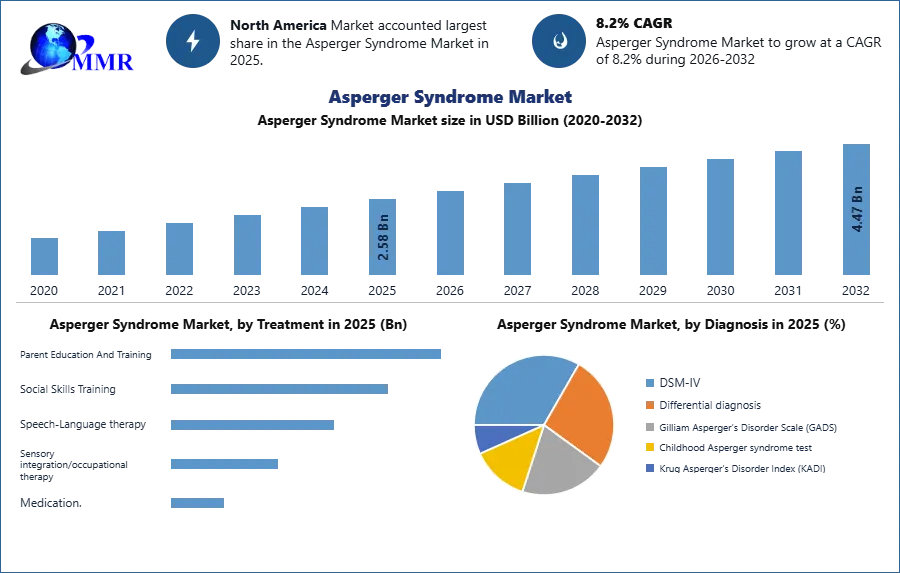 To know about the Research Methodology :- Request Free Sample Report
In this report, the Asperger Syndrome market's growth reasons, as well as the market's many segments (Diagnosis, Treatment, End-Users, and Region), are discussed. Data has been given by market players, regions, and specific requirements. This market report includes a comprehensive overview of all the significant improvements that are presently prevailing in all market segments. Key data analysis is presented in the form of statistics, infographics, and presentations. The study discusses the Asperger Syndrome market's Drivers, Restraints, Opportunities, and Challenges. The report helps to assess the market growth drivers and determines how to use these drivers as a tool. The report also helps to rectify and resolve issues related to the global Asperger Syndrome market situation.
Asperger Syndrome Market Dynamics:
The cause of Asperger syndrome is unknown; however, it is thought to be hereditary. The genetic alterations that are thought to cause Asperger syndrome have yet to be found. According to World Health Organization estimates, around one in every 160 children has autism spectrum disorder. Evidence-based psychosocial therapies, e.g. training programs and behavioral treatments, can help patients with communication and social behavior issues. The primary drivers driving the global Asperger disorder market include rising inventive breakthroughs, state-supported awareness campaigns for excessive introversion, and an increase in the incidence of autism spectrum disorder and related problems.
However, side effects from the prescriptions, tight drug administration regulations, and a weak healthcare insurance system in low- and middle-income regions are projected to limit the market growth. The symptoms experienced in two distinct patients might be quite diverse, and the therapy offered to the patients is often a trial and error approach that is time demanding, as well as the predominance of differing perspectives of the patients regarding their symptoms. As a result of these difficulties, the Asperger syndrome market has grown slowly.
The greatest impediment to the growth of the Asperger syndrome sector is a lack of understanding about the disorder. The diagnosis and treatment of Asperger Syndrome Disorder necessitate the use of trained specialists and can be time-consuming. To provide a plan of care for a patient, effective collaboration and in-depth investigation are essential. Poor economic conditions are increasingly becoming a major issue in the Asperger Syndrome business.
Segment Analysis:
By Treatment, Parent Education and Training emerges as the dominant segment, accounting for around 40% of the Asperger Syndrome treatment Market share in 2025. This segment led due to its effectiveness in equipping caregivers with strategies to manage behavioral and social challenges. Social Skills Training and Speech-Language Therapy follow, supporting improved communication and peer interactions, while Sensory Integration/Occupational Therapy and Medication hold smaller shares, primarily targeting specific symptoms or associated conditions.
Regional Insights:
In the North American region, the United States is expected to be the dominant market by 2032. In 2019, it was approximated that 19 out of every 1,000 children in the United States had ASD, which was more than twice the incidence of 6.5 per 1,000 in 2000. There is no clear reason for the spike in Asperger rates that began in the 1978s, although genetics, external conditions, and modifications in the classification and diagnosis of Asperger’s are all likely to have a role. The prevalence of Asperger’s varies by gender, with men being diagnosed with such diseases at a disproportionately high rate.
The objective of the report is to present a comprehensive analysis of the Asperger Syndrome market to the stakeholders in the industry. The past and current status of the industry with the forecasted market size and trends are presented in the report with the analysis of complicated data in simple language. The report covers all the aspects of the industry with a dedicated study of key players that include market leaders, followers, and new entrants.
PORTER, PESTEL analysis with the potential impact of micro-economic factors of the market have been presented in the report. External as well as internal factors that are supposed to affect the business positively or negatively have been analyzed, which will give a clear futuristic view of the industry to the decision-makers.
The report also helps in understanding the Asperger Syndrome market dynamics, structure by analyzing the market segments and projecting the Asperger Syndrome market size. Clear representation of competitive analysis of key players by product, price, financial position, product portfolio, growth strategies, and regional presence in the Asperger Syndrome market make the report investor’s guide.
Asperger Syndrome Market Scope: Inquire before buying
| Asperger Syndrome Market | |||
|---|---|---|---|
| Report Coverage | Details | ||
| Base Year: | 2025 | Forecast Period: | 2026-2032 |
| Historical Data: | 2020 to 2025 | Market Size in 2025: | 2.58 USD Billion |
| Forecast Period 2026-2032 CAGR: | 8.2% | Market Size in 2032: | 4.47 USD Billion |
| Segments Covered: | by Diagnosis | DSM-IV Differential diagnosis Gilliam Asperger’s Disorder Scale (GADS) Childhood Asperger syndrome test Krug Asperger’s Disorder Index (KADI) |
|
| by Treatment | Parent Education And Training Social Skills Training Speech-Language therapy Sensory integration/occupational therapy Medication. |
||
| by Age Group | Children Adolescents Adults |
||
| by End-Users | Hospitals Clinics Diagnostics Centers Drug Stores Pharmacies |
||
Asperger Syndrome Market, by Region
North America (United States, Canada and Mexico)
Europe (UK, France, Germany, Italy, Spain, Sweden, Austria and Rest of Europe)
Asia Pacific (China, South Korea, Japan, India, Australia, Indonesia, Malaysia, Vietnam, Taiwan, Bangladesh, Pakistan and Rest of APAC)
Middle East and Africa (South Africa, GCC, Egypt, Nigeria and Rest of ME&A)
South America (Brazil, Argentina Rest of South America)
Key Player/Competitors Profiles Covered in Brief Asperger Syndrome Market Report in Strategic Perspective
- Eli Lilly and Company
- Shire
- Jazz Pharmaceuticals
- Pfizer
- GlaxoSmithKline
- Forest Laboratories
- Johnson & Johnson
- Bristol‑Myers Squibb
- Otsuka Pharmaceutical
- AstraZeneca
- Allergan
- Takeda Pharmaceutical Company Limited
- Hoffmann‑La Roche
- AbbVie Inc.
- Aquestive Therapeutics Inc.
- Eisai Co., Ltd.
- Novartis AG
- Merck & Co., Inc.
- Sanofi S.A.
- Bayer AG
- Takeda Pharmaceutical (global operations)
- Sun Pharmaceutical Industries Ltd.
- UCB SA
- Emisphere Technologies
- Lundbeck A/S
- Biogen Inc.
- Neuren Pharmaceuticals
- Acadia Pharmaceuticals Inc.
- Alkermes plc
- Psyched Wellness Ltd.