Artificial Intelligence in Aviation Market Size by Offering, Application, Technology, Region, Industry-Wide Analysis, Competitive Landscape Assessment & Long-Term Forecast to 2032

47.07%
CAGR (2026-2032)
887.48 USD Mn.
Market Size
304
Report Pages
138
Market Tables

Overview

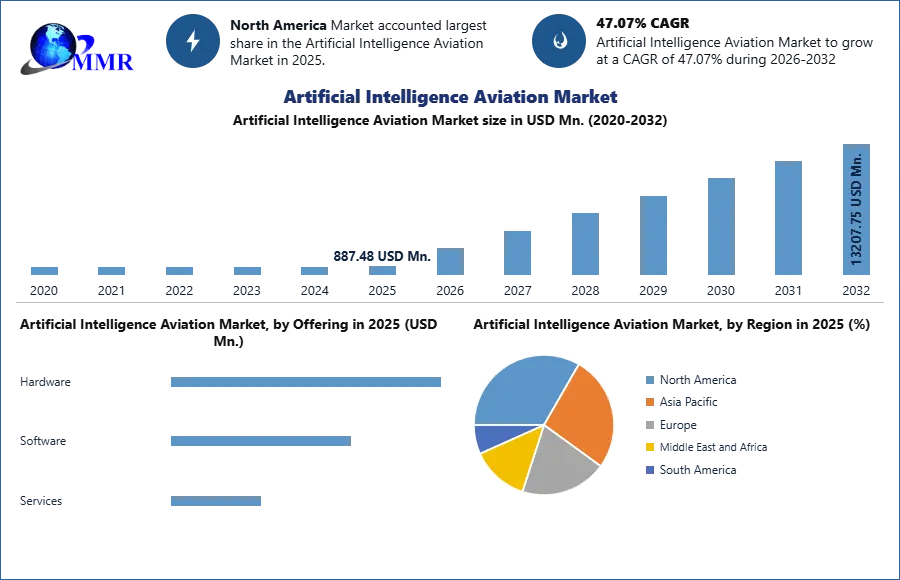
Artificial Intelligence in Aviation Market was valued at US$ 887.48 Mn. in 2025 and is expected to grow at US$ 13207.75 Mn in 2032. Artificial Intelligence in Aviation Market size is expected to grow at a CAGR of 47.07% through the forecast period.

Artificial Intelligence in Aviation Market Overview:

Artificial Intelligence (AI) is steadily being adopted in a multitude of commercial products and services. AI can revolutionize the design, manufacturing as well as operations and provide operational advantages if incorporated well. Artificial intelligence (AI) is intelligence demonstrated by machines, as opposed to the natural intelligence displayed by animals including humans. AI research has been defined as the field of study of intelligent agents, which refers to any system that perceives its environment and takes actions that maximize its chance of achieving its goals. AI can be used to assist customers in the airport and it can help a company reduce its operational costs and labor costs at the same time. Airlines companies are now using AI technologies to help their customers to resolve issues quickly by getting accurate information on future flights trips on their internet-enabled devices.
Artificial Intelligence Aviation Market

To know about the Research Methodology :- Request Free Sample Report

Artificial intelligence in aviation helps technicians to access the historical and real-time data from any location, and the systems are compatible with mobile and desktop that gives alerts and notifications of the aircraft ‘s existing technical condition and it also helps the technician to spot the issues pointing at possible malfunction and replace parts proactively. The adoption of artificial intelligence in the aviation market is expected to increase because AI uses powerful algorithms that automates large amount of data across the airport and it improves the factors such as productivity and decreases queue length.

The report explores the Artificial Intelligence in Aviation Market segments (Offerings, Application, Technology and Region). Data has been provided by market participants, and regions (North America, Asia Pacific, Europe, Middle East & Africa, and South America). The MMR market report provides a thorough analysis of the rapid advances that are currently taking place across all industry sectors. Facts and figures, illustrations, and presentations are used to provide key data analysis for the historical period from 2020  to 2025. The report investigates the Artificial Intelligence in Aviation Market drivers, limitations, prospects, and barriers. This MMR report includes investor recommendations based on a thorough examination of the Artificial Intelligence in Aviation Market contemporary competitive scenario.

Artificial Intelligence in Aviation Market Dynamics:

Drivers:

The growing adoption of IoT, big data, and factory automation is one of the prominent drivers in artificial intelligence in manufacturing market. The utilization of massive data within the aerospace industry, a big increase in capital investments by aviation companies, and the rising adoption of cloud-based applications and services within the aviation industry leads to the growth of the Artificial Intelligence in Aviation Market. The Artificial Intelligence in Aviation Market includes various factors such as the presence of services and systems, such as baggage screening, passenger identification, and maintenance, providing customer support, facial recognition and aircraft fuel optimization.

Artificial intelligence in the aviation market can easily permit airlines to control if there is a chance to positively interfere in the customer journey and turn a bad experience into a pleasant one. It also allows the company to respond faster in a synchronized, systematic way that is on-brand and consistent with the business’s values. The increasing investment in artificial intelligence globally and the rise in the adoption of smart manufacturing initiatives are the factors which drives the growth of the Artificial Intelligence in Aviation Market. Big data implementation in the aviation industry can aid in smart maintenance, optimizing fuel efficiency, improving services, and improving security. AI is also cost-effective, and it can provide more efficient and timely management of services, which is propelling the growth of artificial intelligence in the aviation market.

Restrains:

The lack of skills and experience associated with AI are one of the restrains which hinders the growth of the Artificial Intelligence in Aviation Market. The smaller number of experts in artificial intelligence and high investment cost will hamper the market’s growth rate. Also, concerns linked with data privacy will further pose a challenge to the market. Another factor is the lack of skilled labour for analysing huge data recorded will obstruct the market’s growth. Lack of skilled labour to analyze massive amounts of data collected & derived insights, security concerns, and system malfunctions are the major impediments to artificial intelligence in the aviation market.

Opportunities:

There is a huge opportunity in the artificial intelligence market in aviation as airline companies are eager to adopt advanced technologies to avoid disruptions in passenger services. AI will also help to improve real-time decision making in order to keep the business running smoothly. It will allow for least amount of human intervention. However, the systems can make mistakes while performing analysis and making real-time decisions which leads to the growth of artificial intelligence in the aviation market opportunity.

Challenges:

Security concerns and system malfunctions are challenging the growth of artificial intelligence in the aviation market. One of the biggest challenges in Artificial Intelligence in Aviation Market is security of data and malfunctioning of systems in the right time. Artificial Intelligence relies on good data. One needs to identify not only the right sources but the right amount of data. Overloading the system with too many data sources can slow things down significantly. Sudden malfunction of systems in the process abrupt the processes. On the other hand, Ground handling is often one of the biggest challenges keeping an airport on schedule. AI can help predict handling times, plan ideal schedules, and prevent teams from stepping on each other’s toes. AI is an incredible tool for improving communication to make the entire ground handling process move smoothly and more efficiently.

COVID-19 Impact on Artificial Intelligence in Aviation Market:

The current COVID-19 pandemic has had a negative impact on the market, with manufacturing activities being temporarily halted across major manufacturing hubs, resulting in a significant production slowdown. Due to the increased restrictions on public meetings and travel, the people are getting isolated. Due to supply chain delays, stock market instability, halting of airlines, business dealing in the artificial intelligence in aviation business are also feeling the effects of the COVID-19 epidemic. It has directly impacted production and demand of artificial intelligence in aviation causing supply chain and market disruption. As airports are shut down due to lockdown restrictions, the use of artificial intelligence in aviation is halted, negatively impacting the market share.

Artificial Intelligence in Aviation Market Segment Analysis:

Based on Offering, the software held the largest share of the overall market. This is due to the developments in AI software for applications such as surveillance, flight operations, and airport operations. AI systems comprise software including application interfaces, such as language, speech, vision, and sensor data, alongside machine learning algorithms, to understand various applications within the aviation industry. The increase in investment in R&D to develop advanced AI software for applications such as surveillance, flight operations, and airport operations leads to the growth of the software segment of Market.

Artificial Intelligence in Aviation Market, by Offering in 2025 (%)

Artificial Intelligence in Aviation Market


Based on the Application, the segment Virtual assistants are dominating the market with the highest CAGR throughout the forecast period. AI-based virtual assistants help airline companies improve their productivity and increase the efficiency of pilots by reducing recurring works, such as changing radio channels, reading wind forecasts, and providing position information on requests. These recurring jobs are taken care of by the AI-enabled virtual assistants. Garmin (US) offers AI-enabled audio panels that help pilots operate these panels without taking their hands off the controls. These all factors lead to the growth of the Market.

Artificial Intelligence in Aviation Market, by  Application in 2025 (%)

Artificial Intelligence in Aviation Market


Based on Technology, The machine learning segment holds the largest market share in 2025. Machine learning’s ability to gather and handle big data, alongside its increased ability to perform previously impossible calculations, is fueling the expansion of the marketplace for machine learning. Machine learning helps to manage a large amount of data and understand the trends and pattern that could have been not possible to manage that large amount of data by humans. The machine learning also helps in managing and improving the multi-dimensional and large amount data and improving their skills in having no errors in them with the help of Al technology. Machine learning is helpful for those who are in the field of e-commerce or the healthcare providers from which they can make use of ML to get immense help in their market growth and also it helps in the increase of the human work efficiency. The use of this application gives the customers a very personal experience to use this while targeting the right customers which leads to the growth of the machine learning segment of Market.

Artificial Intelligence in Aviation Market, by Technology in 2025 (%)

Artificial Intelligence in Aviation Market

Artificial Intelligence in Aviation Market Regional Insights:

The Asia-Pacific region is expected to witness significant growth through the forecast period. The huge demand for AI technologies from countries such as China and Japan to increase the efficiency of their aviation sector leads to the growth of the Artificial Intelligence in Aviation Market. The developing countries are mostly focusing on implementation of new technologies are focusing on adoption of virtual assistants to several airports to serve air travellers. For instance, Alibaba Group from China has announced to supply AI based solutions to avoid congestion at the Beijing airport. These solutions would help pilots find a parking slot for their aircraft easily. Additionally, the increasing adoption of machine learning and NLP technologies for virtual assistance and training applications within the aviation sector is driving the expansion of the market in this region.

North America region is considered to be the second fastest growing market during the forecast period because of the new technological software that includes application program interfaces, such as speech, language, sensor data, and vision along with machine learning algorithms, to realize various applications in the aviation industry. Virtual assistance, smart maintenance, manufacturing, and surveillance are some key application areas in North America. Additionally, the US is one of the important countries in the world in terms of accepting Market technologies in many application areas. Continuous development in air travellers is boosting airline companies to accept all.

Recent Industry Developments (2025–2026)

Exact Date Company Development Impact
15 January 2025 Honeywell Launched the Anthem avionics system integrated with AI-driven processors to enhance cockpit autonomy and fuel efficiency. Strengthens Honeywell’s market leadership in next-generation flight deck technologies and autonomous flight safety.
14 May 2025 Amadeus Partnered with Google Cloud to embed generative AI into its global travel technology stack for personalized passenger interactions. Accelerates the transition toward hyper-personalized travel experiences and AI-driven customer service in the airline sector.
12 June 2025 Amazon Web Services (AWS) Formed a strategic collaboration with Iberia to modernize digital infrastructure using advanced AI and cloud analytics. Improves operational efficiency and reduces maintenance downtime through cloud-native AI deployment.
22 June 2025 Tata Consultancy Services (TCS) Signed a 7-year deal with Virgin Atlantic to deploy AI-driven customer tools and real-time operational data pipelines. Enables scalable IT modernization and enhances real-time decision-making for complex airline flight schedules.
10 November 2025 Boeing Introduced the Virtual Airplane Procedures Trainer using AI and Azure cloud to provide high-fidelity digital pilot training. Enhances pilot readiness and reduces the physical infrastructure costs associated with traditional flight simulators.
17 February 2026 International Airlines Group (IAG) Successfully commercialized an AI-powered engine optimization system that runs millions of "what-if" scenarios for fleet maintenance. Optimizes aircraft availability and significantly lowers MRO (Maintenance, Repair, and Overhaul) expenditures via predictive modeling.


The objective of the report is to present a comprehensive analysis of the Market to the stakeholders in the industry. The past and current status of the industry with the forecasted market size and trends are presented in the report with the analysis of complicated data in simple language. The report covers all the aspects of the industry with a dedicated study of key players that include market leaders, followers, and new entrants.

PORTER, PESTEL analysis with the potential impact of micro-economic factors of the market have been presented in the report. External as well as internal factors that are supposed to affect the business positively or negatively have been analyzed, which will give a clear futuristic view of the industry to the decision-makers.

The reports also help in understanding the Market dynamic, structure by analyzing the market segments and projecting the Market size. Clear representation of competitive analysis of key players by Vehicle type, price, financial position, product portfolio, growth strategies, and regional presence in the Market make the report investor’s guide.

Artificial Intelligence in Aviation Market Scope: Inquire before buying

Artificial Intelligence Aviation Market
Report Coverage Details
Base Year: 2025 Forecast Period: 2026-2032
Historical Data: 2020 to 2025 Market Size in 2025: 887.48 USD Mn.
Forecast Period 2026-2032 CAGR: 47.07% Market Size in 2032: 13207.75 USD Mn.
Segments Covered: by Application Virtual Assistants
Smart Maintenance
Manufacturing
Training
Surveillance
Flight Operations
Dynamic Pricing
Others
by Technology Machine Learning
Natural Language Processing
Context Awareness Computing
Computer Vision
by Offering Hardware
Software
Services

Artificial Intelligence in Aviation Market, by Region

North America (United States, Canada and Mexico)
Europe (UK, France, Germany, Italy, Spain, Sweden, Austria, Turkey, Russia and Rest of Europe)
Asia Pacific (China, India, Japan, South Korea, Australia, ASEAN and Rest of APAC)
Middle East and Africa (South Africa, GCC, Egypt, Nigeria and Rest of ME&A)
South America (Brazil, Argentina, Columbia and Rest of South America)

Key Players / Competitors Profiles Covered in Brief in Global Artificial Intelligence in Aviation Market Report in Strategic Perspective:

  1. Airbus
  2. Boeing
  3. General Electric
  4. Honeywell International
  5. IBM
  6. Intel
  7. Lockheed Martin
  8. Microsoft
  9. NVIDIA
  10. Samsung Electronics
  11. Thales Group
  12. Amazon Web Services
  13. Xilinx
  14. Micron
  15. Mitsubishi Electric
  16. Amadeus IT Group
  17. Indra Sistemas
  18. SITA
  19. Garmin
  20. Collins Aerospace
  21. Embross
  22. Elenium Automation
  23. Optym
  24. Neurala
  25. Iris Automation

Table of Contents

1. Artificial Intelligence Aviation Market Introduction
1.1. Study Assumption and Market Definition
1.2. Scope of the Study
1.3. Executive Summary
2. Global Artificial Intelligence Aviation Market: Competitive Landscape
2.1. MMR Competition Matrix
2.2. Competitive Landscape
2.3. Key Players Benchmarking
2.3.1. Company Name
2.3.2. Business Segment
2.3.3. End-user Segment
2.3.4. Revenue (2025)
2.3.5. Company Locations
2.4. Leading Artificial Intelligence Aviation Market Companies, by market capitalization
2.5. Market Structure
2.5.1. Market Leaders
2.5.2. Market Followers
2.5.3. Emerging Players
2.6. Mergers and Acquisitions Details
3. Artificial Intelligence Aviation Market: Dynamics
3.1. Artificial Intelligence Aviation Market Trends by Region
3.1.1. North America Artificial Intelligence Aviation Market Trends
3.1.2. Europe Artificial Intelligence Aviation Market Trends
3.1.3. Asia Pacific Artificial Intelligence Aviation Market Trends
3.1.4. Middle East and Africa Artificial Intelligence Aviation Market Trends
3.1.5. South America Artificial Intelligence Aviation Market Trends
3.2. Artificial Intelligence Aviation Market Dynamics by Region
3.2.1. North America
3.2.1.1. North America Artificial Intelligence Aviation Market Drivers
3.2.1.2. North America Artificial Intelligence Aviation Market Restraints
3.2.1.3. North America Artificial Intelligence Aviation Market Opportunities
3.2.1.4. North America Artificial Intelligence Aviation Market Challenges
3.2.2. Europe
3.2.2.1. Europe Artificial Intelligence Aviation Market Drivers
3.2.2.2. Europe Artificial Intelligence Aviation Market Restraints
3.2.2.3. Europe Artificial Intelligence Aviation Market Opportunities
3.2.2.4. Europe Artificial Intelligence Aviation Market Challenges
3.2.3. Asia Pacific
3.2.3.1. Asia Pacific Artificial Intelligence Aviation Market Drivers
3.2.3.2. Asia Pacific Artificial Intelligence Aviation Market Restraints
3.2.3.3. Asia Pacific Artificial Intelligence Aviation Market Opportunities
3.2.3.4. Asia Pacific Artificial Intelligence Aviation Market Challenges
3.2.4. Middle East and Africa
3.2.4.1. Middle East and Africa Artificial Intelligence Aviation Market Drivers
3.2.4.2. Middle East and Africa Artificial Intelligence Aviation Market Restraints
3.2.4.3. Middle East and Africa Artificial Intelligence Aviation Market Opportunities
3.2.4.4. Middle East and Africa Artificial Intelligence Aviation Market Challenges
3.2.5. South America
3.2.5.1. South America Artificial Intelligence Aviation Market Drivers
3.2.5.2. South America Artificial Intelligence Aviation Market Restraints
3.2.5.3. South America Artificial Intelligence Aviation Market Opportunities
3.2.5.4. South America Artificial Intelligence Aviation Market Challenges
3.3. PORTER's Five Forces Analysis
3.4. PESTLE Analysis
3.5. Technology Roadmap
3.6. Regulatory Landscape by Region
3.6.1. North America
3.6.2. Europe
3.6.3. Asia Pacific
3.6.4. Middle East and Africa
3.6.5. South America
3.7. Key Opinion Leader Analysis For Artificial Intelligence Aviation Industry
3.8. Analysis of Government Schemes and Initiatives For Artificial Intelligence Aviation Industry
3.9. Artificial Intelligence Aviation Market Trade Analysis
3.10. The Global Pandemic Impact on Artificial Intelligence Aviation Market
4. Artificial Intelligence Aviation Market: Global Market Size and Forecast by Segmentation (in USD Mn.) 2025-2032
4.1. Artificial Intelligence Aviation Market Size and Forecast, by Application (2025-2032)
4.1.1. Virtual Assistants
4.1.2. Smart Maintenance
4.1.3. Manufacturing
4.1.4. Training
4.1.5. Surveillance
4.1.6. Flight Operations
4.1.7. Dynamic Pricing
4.1.8. Others
4.2. Artificial Intelligence Aviation Market Size and Forecast, by Technology (2025-2032)
4.2.1. Machine Learning
4.2.2. Natural Language Processing
4.2.3. Context Awareness Computing
4.2.4. Computer Vision
4.3. Artificial Intelligence Aviation Market Size and Forecast, by Offering (2025-2032)
4.3.1. Hardware
4.3.2. Software
4.3.3. Services
4.4. Artificial Intelligence Aviation Market Size and Forecast, by Region (2025-2032)
4.4.1. North America
4.4.2. Europe
4.4.3. Asia Pacific
4.4.4. Middle East and Africa
4.4.5. South America
5. North America Artificial Intelligence Aviation Market Size and Forecast by Segmentation (in USD Mn.) 2025-2032
5.1. North America Artificial Intelligence Aviation Market Size and Forecast, by Application (2025-2032)
5.1.1. Virtual Assistants
5.1.2. Smart Maintenance
5.1.3. Manufacturing
5.1.4. Training
5.1.5. Surveillance
5.1.6. Flight Operations
5.1.7. Dynamic Pricing
5.1.8. Others
5.2. North America Artificial Intelligence Aviation Market Size and Forecast, by Technology (2025-2032)
5.2.1. Machine Learning
5.2.2. Natural Language Processing
5.2.3. Context Awareness Computing
5.2.4. Computer Vision
5.3. North America Artificial Intelligence Aviation Market Size and Forecast, by Offering (2025-2032)
5.3.1. Hardware
5.3.2. Software
5.3.3. Services
5.4. North America Artificial Intelligence Aviation Market Size and Forecast, by Country (2025-2032)
5.4.1. United States
5.4.1.1. United States Artificial Intelligence Aviation Market Size and Forecast, by Application (2025-2032)
5.4.1.1.1. Virtual Assistants
5.4.1.1.2. Smart Maintenance
5.4.1.1.3. Manufacturing
5.4.1.1.4. Training
5.4.1.1.5. Surveillance
5.4.1.1.6. Flight Operations
5.4.1.1.7. Dynamic Pricing
5.4.1.1.8. Others
5.4.1.2. United States Artificial Intelligence Aviation Market Size and Forecast, by Technology (2025-2032)
5.4.1.2.1. Machine Learning
5.4.1.2.2. Natural Language Processing
5.4.1.2.3. Context Awareness Computing
5.4.1.2.4. Computer Vision
5.4.1.3. United States Artificial Intelligence Aviation Market Size and Forecast, by Offering (2025-2032)
5.4.1.3.1. Hardware
5.4.1.3.2. Software
5.4.1.3.3. Services
5.4.2. Canada
5.4.2.1. Canada Artificial Intelligence Aviation Market Size and Forecast, by Application (2025-2032)
5.4.2.1.1. Virtual Assistants
5.4.2.1.2. Smart Maintenance
5.4.2.1.3. Manufacturing
5.4.2.1.4. Training
5.4.2.1.5. Surveillance
5.4.2.1.6. Flight Operations
5.4.2.1.7. Dynamic Pricing
5.4.2.1.8. Others
5.4.2.2. Canada Artificial Intelligence Aviation Market Size and Forecast, by Technology (2025-2032)
5.4.2.2.1. Machine Learning
5.4.2.2.2. Natural Language Processing
5.4.2.2.3. Context Awareness Computing
5.4.2.2.4. Computer Vision
5.4.2.3. Canada Artificial Intelligence Aviation Market Size and Forecast, by Offering (2025-2032)
5.4.2.3.1. Hardware
5.4.2.3.2. Software
5.4.2.3.3. Services
5.4.3. Mexico
5.4.3.1. Mexico Artificial Intelligence Aviation Market Size and Forecast, by Application (2025-2032)
5.4.3.1.1. Virtual Assistants
5.4.3.1.2. Smart Maintenance
5.4.3.1.3. Manufacturing
5.4.3.1.4. Training
5.4.3.1.5. Surveillance
5.4.3.1.6. Flight Operations
5.4.3.1.7. Dynamic Pricing
5.4.3.1.8. Others
5.4.3.2. Mexico Artificial Intelligence Aviation Market Size and Forecast, by Technology (2025-2032)
5.4.3.2.1. Machine Learning
5.4.3.2.2. Natural Language Processing
5.4.3.2.3. Context Awareness Computing
5.4.3.2.4. Computer Vision
5.4.3.3. Mexico Artificial Intelligence Aviation Market Size and Forecast, by Offering (2025-2032)
5.4.3.3.1. Hardware
5.4.3.3.2. Software
5.4.3.3.3. Services
6. Europe Artificial Intelligence Aviation Market Size and Forecast by Segmentation (in USD Mn.) 2025-2032
6.1. Europe Artificial Intelligence Aviation Market Size and Forecast, by Application (2025-2032)
6.2. Europe Artificial Intelligence Aviation Market Size and Forecast, by Technology (2025-2032)
6.3. Europe Artificial Intelligence Aviation Market Size and Forecast, by Offering (2025-2032)
6.4. Europe Artificial Intelligence Aviation Market Size and Forecast, by Country (2025-2032)
6.4.1. United Kingdom
6.4.1.1. United Kingdom Artificial Intelligence Aviation Market Size and Forecast, by Application (2025-2032)
6.4.1.2. United Kingdom Artificial Intelligence Aviation Market Size and Forecast, by Technology (2025-2032)
6.4.1.3. United Kingdom Artificial Intelligence Aviation Market Size and Forecast, by Offering (2025-2032)
6.4.2. France
6.4.2.1. France Artificial Intelligence Aviation Market Size and Forecast, by Application (2025-2032)
6.4.2.2. France Artificial Intelligence Aviation Market Size and Forecast, by Technology (2025-2032)
6.4.2.3. France Artificial Intelligence Aviation Market Size and Forecast, by Offering (2025-2032)
6.4.3. Germany
6.4.3.1. Germany Artificial Intelligence Aviation Market Size and Forecast, by Application (2025-2032)
6.4.3.2. Germany Artificial Intelligence Aviation Market Size and Forecast, by Technology (2025-2032)
6.4.3.3. Germany Artificial Intelligence Aviation Market Size and Forecast, by Offering (2025-2032)
6.4.4. Italy
6.4.4.1. Italy Artificial Intelligence Aviation Market Size and Forecast, by Application (2025-2032)
6.4.4.2. Italy Artificial Intelligence Aviation Market Size and Forecast, by Technology (2025-2032)
6.4.4.3. Italy Artificial Intelligence Aviation Market Size and Forecast, by Offering (2025-2032)
6.4.5. Spain
6.4.5.1. Spain Artificial Intelligence Aviation Market Size and Forecast, by Application (2025-2032)
6.4.5.2. Spain Artificial Intelligence Aviation Market Size and Forecast, by Technology (2025-2032)
6.4.5.3. Spain Artificial Intelligence Aviation Market Size and Forecast, by Offering (2025-2032)
6.4.6. Sweden
6.4.6.1. Sweden Artificial Intelligence Aviation Market Size and Forecast, by Application (2025-2032)
6.4.6.2. Sweden Artificial Intelligence Aviation Market Size and Forecast, by Technology (2025-2032)
6.4.6.3. Sweden Artificial Intelligence Aviation Market Size and Forecast, by Offering (2025-2032)
6.4.7. Austria
6.4.7.1. Austria Artificial Intelligence Aviation Market Size and Forecast, by Application (2025-2032)
6.4.7.2. Austria Artificial Intelligence Aviation Market Size and Forecast, by Technology (2025-2032)
6.4.7.3. Austria Artificial Intelligence Aviation Market Size and Forecast, by Offering (2025-2032)
6.4.8. Rest of Europe
6.4.8.1. Rest of Europe Artificial Intelligence Aviation Market Size and Forecast, by Application (2025-2032)
6.4.8.2. Rest of Europe Artificial Intelligence Aviation Market Size and Forecast, by Technology (2025-2032)
6.4.8.3. Rest of Europe Artificial Intelligence Aviation Market Size and Forecast, by Offering (2025-2032)
7. Asia Pacific Artificial Intelligence Aviation Market Size and Forecast by Segmentation (in USD Mn.) 2025-2032
7.1. Asia Pacific Artificial Intelligence Aviation Market Size and Forecast, by Application (2025-2032)
7.2. Asia Pacific Artificial Intelligence Aviation Market Size and Forecast, by Technology (2025-2032)
7.3. Asia Pacific Artificial Intelligence Aviation Market Size and Forecast, by Offering (2025-2032)
7.4. Asia Pacific Artificial Intelligence Aviation Market Size and Forecast, by Country (2025-2032)
7.4.1. China
7.4.1.1. China Artificial Intelligence Aviation Market Size and Forecast, by Application (2025-2032)
7.4.1.2. China Artificial Intelligence Aviation Market Size and Forecast, by Technology (2025-2032)
7.4.1.3. China Artificial Intelligence Aviation Market Size and Forecast, by Offering (2025-2032)
7.4.2. S Korea
7.4.2.1. S Korea Artificial Intelligence Aviation Market Size and Forecast, by Application (2025-2032)
7.4.2.2. S Korea Artificial Intelligence Aviation Market Size and Forecast, by Technology (2025-2032)
7.4.2.3. S Korea Artificial Intelligence Aviation Market Size and Forecast, by Offering (2025-2032)
7.4.3. Japan
7.4.3.1. Japan Artificial Intelligence Aviation Market Size and Forecast, by Application (2025-2032)
7.4.3.2. Japan Artificial Intelligence Aviation Market Size and Forecast, by Technology (2025-2032)
7.4.3.3. Japan Artificial Intelligence Aviation Market Size and Forecast, by Offering (2025-2032)
7.4.4. India
7.4.4.1. India Artificial Intelligence Aviation Market Size and Forecast, by Application (2025-2032)
7.4.4.2. India Artificial Intelligence Aviation Market Size and Forecast, by Technology (2025-2032)
7.4.4.3. India Artificial Intelligence Aviation Market Size and Forecast, by Offering (2025-2032)
7.4.5. Australia
7.4.5.1. Australia Artificial Intelligence Aviation Market Size and Forecast, by Application (2025-2032)
7.4.5.2. Australia Artificial Intelligence Aviation Market Size and Forecast, by Technology (2025-2032)
7.4.5.3. Australia Artificial Intelligence Aviation Market Size and Forecast, by Offering (2025-2032)
7.4.6. Indonesia
7.4.6.1. Indonesia Artificial Intelligence Aviation Market Size and Forecast, by Application (2025-2032)
7.4.6.2. Indonesia Artificial Intelligence Aviation Market Size and Forecast, by Technology (2025-2032)
7.4.6.3. Indonesia Artificial Intelligence Aviation Market Size and Forecast, by Offering (2025-2032)
7.4.7. Malaysia
7.4.7.1. Malaysia Artificial Intelligence Aviation Market Size and Forecast, by Application (2025-2032)
7.4.7.2. Malaysia Artificial Intelligence Aviation Market Size and Forecast, by Technology (2025-2032)
7.4.7.3. Malaysia Artificial Intelligence Aviation Market Size and Forecast, by Offering (2025-2032)
7.4.8. Vietnam
7.4.8.1. Vietnam Artificial Intelligence Aviation Market Size and Forecast, by Application (2025-2032)
7.4.8.2. Vietnam Artificial Intelligence Aviation Market Size and Forecast, by Technology (2025-2032)
7.4.8.3. Vietnam Artificial Intelligence Aviation Market Size and Forecast, by Offering (2025-2032)
7.4.9. Taiwan
7.4.9.1. Taiwan Artificial Intelligence Aviation Market Size and Forecast, by Application (2025-2032)
7.4.9.2. Taiwan Artificial Intelligence Aviation Market Size and Forecast, by Technology (2025-2032)
7.4.9.3. Taiwan Artificial Intelligence Aviation Market Size and Forecast, by Offering (2025-2032)
7.4.10. Rest of Asia Pacific
7.4.10.1. Rest of Asia Pacific Artificial Intelligence Aviation Market Size and Forecast, by Application (2025-2032)
7.4.10.2. Rest of Asia Pacific Artificial Intelligence Aviation Market Size and Forecast, by Technology (2025-2032)
7.4.10.3. Rest of Asia Pacific Artificial Intelligence Aviation Market Size and Forecast, by Offering (2025-2032)
8. Middle East and Africa Artificial Intelligence Aviation Market Size and Forecast by Segmentation (in USD Mn.) 2025-2032
8.1. Middle East and Africa Artificial Intelligence Aviation Market Size and Forecast, by Application (2025-2032)
8.2. Middle East and Africa Artificial Intelligence Aviation Market Size and Forecast, by Technology (2025-2032)
8.3. Middle East and Africa Artificial Intelligence Aviation Market Size and Forecast, by Offering (2025-2032)
8.4. Middle East and Africa Artificial Intelligence Aviation Market Size and Forecast, by Country (2025-2032)
8.4.1. South Africa
8.4.1.1. South Africa Artificial Intelligence Aviation Market Size and Forecast, by Application (2025-2032)
8.4.1.2. South Africa Artificial Intelligence Aviation Market Size and Forecast, by Technology (2025-2032)
8.4.1.3. South Africa Artificial Intelligence Aviation Market Size and Forecast, by Offering (2025-2032)
8.4.2. GCC
8.4.2.1. GCC Artificial Intelligence Aviation Market Size and Forecast, by Application (2025-2032)
8.4.2.2. GCC Artificial Intelligence Aviation Market Size and Forecast, by Technology (2025-2032)
8.4.2.3. GCC Artificial Intelligence Aviation Market Size and Forecast, by Offering (2025-2032)
8.4.3. Nigeria
8.4.3.1. Nigeria Artificial Intelligence Aviation Market Size and Forecast, by Application (2025-2032)
8.4.3.2. Nigeria Artificial Intelligence Aviation Market Size and Forecast, by Technology (2025-2032)
8.4.3.3. Nigeria Artificial Intelligence Aviation Market Size and Forecast, by Offering (2025-2032)
8.4.4. Rest of ME&A
8.4.4.1. Rest of ME&A Artificial Intelligence Aviation Market Size and Forecast, by Application (2025-2032)
8.4.4.2. Rest of ME&A Artificial Intelligence Aviation Market Size and Forecast, by Technology (2025-2032)
8.4.4.3. Rest of ME&A Artificial Intelligence Aviation Market Size and Forecast, by Offering (2025-2032)
9. South America Artificial Intelligence Aviation Market Size and Forecast by Segmentation (in USD Mn.) 2025-2032
9.1. South America Artificial Intelligence Aviation Market Size and Forecast, by Application (2025-2032)
9.2. South America Artificial Intelligence Aviation Market Size and Forecast, by Technology (2025-2032)
9.3. South America Artificial Intelligence Aviation Market Size and Forecast, by Offering (2025-2032)
9.4. South America Artificial Intelligence Aviation Market Size and Forecast, by Country (2025-2032)
9.4.1. Brazil
9.4.1.1. Brazil Artificial Intelligence Aviation Market Size and Forecast, by Application (2025-2032)
9.4.1.2. Brazil Artificial Intelligence Aviation Market Size and Forecast, by Technology (2025-2032)
9.4.1.3. Brazil Artificial Intelligence Aviation Market Size and Forecast, by Offering (2025-2032)
9.4.2. Argentina
9.4.2.1. Argentina Artificial Intelligence Aviation Market Size and Forecast, by Application (2025-2032)
9.4.2.2. Argentina Artificial Intelligence Aviation Market Size and Forecast, by Technology (2025-2032)
9.4.2.3. Argentina Artificial Intelligence Aviation Market Size and Forecast, by Offering (2025-2032)
9.4.3. Rest Of South America
9.4.3.1. Rest Of South America Artificial Intelligence Aviation Market Size and Forecast, by Application (2025-2032)
9.4.3.2. Rest Of South America Artificial Intelligence Aviation Market Size and Forecast, by Technology (2025-2032)
9.4.3.3. Rest Of South America Artificial Intelligence Aviation Market Size and Forecast, by Offering (2025-2032)
10. Company Profile: Key Players
10.1. Airbus
10.1.1. Company Overview
10.1.2. Business Portfolio
10.1.3. Financial Overview
10.1.4. SWOT Analysis
10.1.5. Strategic Analysis
10.1.6. Scale of Operation (small, medium, and large)
10.1.7. Details on Partnership
10.1.8. Regulatory Accreditations and Certifications Received by Them
10.1.9. Awards Received by the Firm
10.1.10. Recent Developments
10.2. Boeing
10.3. General Electric
10.4. Honeywell International
10.5. IBM
10.6. Intel
10.7. Lockheed Martin
10.8. Microsoft
10.9. NVIDIA
10.10. Samsung Electronics
10.11. Thales Group
10.12. Amazon Web Services
10.13. Xilinx
10.14. Micron
10.15. Mitsubishi Electric
10.16. Amadeus IT Group
10.17. Indra Sistemas
10.18. SITA
10.19. Garmin
10.20. Collins Aerospace
10.21. Embross
10.22. Elenium Automation
10.23. Optym
10.24. Neurala
10.25. Iris Automation
11. Key Findings
12. Industry Recommendations
13. Artificial Intelligence Aviation Market: Research Methodology
14. Terms and Glossary

Custom Market Research Services

We Will Customise The Research For You, In Case The Report Listed Above Does Not Meet With Your Requirements