
Anti-Tacking Agents Market by Type, Application, End-User, and Region – Global Market Size Estimation, Industry-Wide Analysis, Competitive Landscape Assessment & Long-Term Forecast to 2032
Overview
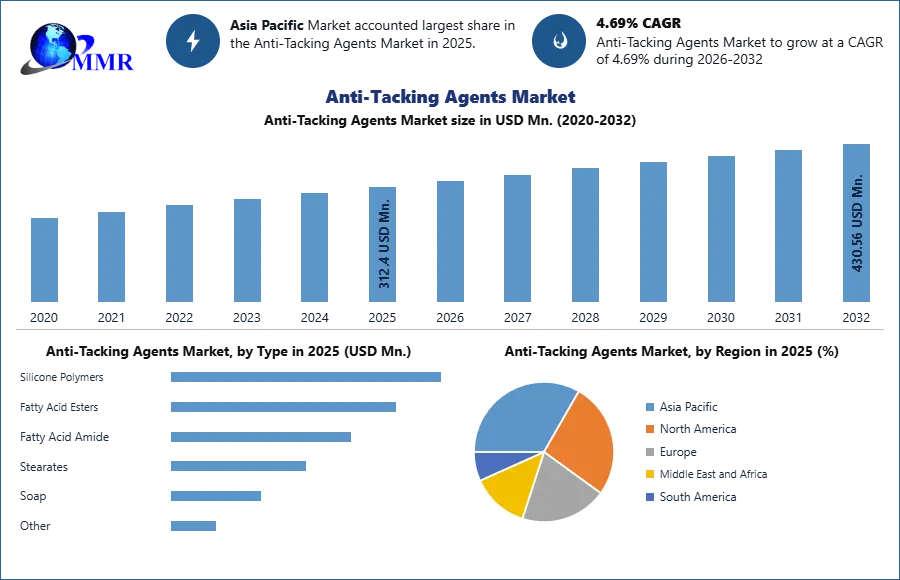
Anti-Tacking Agents Market is expected to grow at a CAGR of 4.69% during the forecast period and market is projected to reach USD 430.57 Mn. by 2032.
Anti-Tacking Agents Market Definition:
The Anti-Tacking Agents Market refers to the industry involved in the production and supply of chemical or mineral-based materials used to prevent rubber and polymer surfaces from sticking together during manufacturing, storage, and transportation. These agents are widely applied in the rubber processing industry, particularly in tire manufacturing, rubber sheets, hoses, belts, and other molded rubber products. Anti-tacking agents typically consist of powders, dispersions, or liquids based on materials such as fatty acid derivatives, soaps, silica, talc, calcium carbonate, and specialty polymers, which create a protective barrier on rubber surfaces and improve handling efficiency in production processes.
Anti-Tacking Agents Market Dynamics:
The market is primarily driven by increasing global demand for tires and rubber products, supported by expanding automotive production and industrial manufacturing activities. Growth in construction, transportation, and consumer goods sectors also increases demand for rubber components, indirectly boosting the use of anti-tacking agents in rubber processing. Additionally, technological advancements in water-based and environmentally friendly anti-tacking formulations are gaining traction as manufacturers aim to meet sustainability and regulatory standards. However, the market faces restraints such as volatility in raw material prices and environmental concerns related to certain chemical formulations. Despite these challenges, opportunities are emerging through the development of eco-friendly, non-dusting anti-tack solutions and the rapid expansion of rubber manufacturing in emerging economies, particularly in Asia Pacific.
To know about the Research Methodology :- Request Free Sample Report
Anti-Tacking Agents Market Influencer:
Development and high sales rate of automobile will demand for huge number of tyres in future will boost the anti-tacking market growth during the forecast period. High demand from rubber industries for anti-tacking compounds, since uncured rubber as easily deforms is used on the surface of the uncured rubbers to separate it after storage, which eases the handling and transportation of uncured rubber thus eliminate the self-adhesive characteristics of rubber during its storage. Anti-tacking agents are applied on Space and boundaries in the rubber industry will increase the necessity of anti-tacking agents, as if rubber could be mixed, milled, and then cured without ever coming in contact with itself, anti-tacking agents would not be necessary.
Furthermore, fluctuation in raw material cost and lack of awareness about product will hamper the market growth in future.
Anti-Tacking Agents Market Segment analysis:
By Type segment, Stearates sub segment is expected to dominate the Anti-Tacking Agents market during the forecast years in 2025. Stearates is majorly utilised as stabilizers and lubricants in the rubber and plastic manufacturing industries, since they are considered as effective elastomer processing aid and releasing agent in rubber industries; is expected to help the market growth. Furthermore; rise in awareness about the new technology and trends amongst the population is attracting the vendors to invest in by which it is generating various opportunity for anti-tacking agents market to grow in near future.
Anti-Tacking Agents Market Regional Analysis:
The Anti-Tacking Agents Market shows clear regional variation due to differences in automotive production, rubber processing capacity, and environmental regulations.
Asia Pacific dominates the Anti-Tacking Agents market, supported by the region’s massive rubber and tire manufacturing base in China, India, Japan, and Southeast Asia. The region accounts for over 40–54% of global demand, largely because Asia functions as a global hub for automotive production and industrial rubber processing, where anti-tack agents are essential to prevent rubber surfaces from sticking during manufacturing. Rapid industrialization, expanding vehicle production, and strong export-oriented rubber industries further strengthen regional consumption.
North America represents a technologically advanced but mature market driven by the well-established automotive and replacement tire industry in the United States and Canada. Strong regulatory frameworks from environmental and workplace safety agencies push manufacturers toward low-VOC and water-based anti-tack formulations, while the region’s focus on automation and advanced rubber compounding processes increases demand for high-performance specialty agents.
Europe maintains a stable market share due to its highly developed automotive manufacturing sector and strong emphasis on sustainable chemical solutions. Countries such as Germany, France, and Italy drive demand through tire production and industrial rubber components, while stringent environmental policies encourage the adoption of bio-based and eco-friendly anti-tack agents, accelerating innovation and R&D investment in green formulations.
Middle East and Africa remain an emerging market where demand grows gradually with expanding automotive assembly operations, infrastructure development, and industrial rubber manufacturing. However, limited domestic production capacity and high reliance on imports constrain rapid growth, though economic diversification programs and manufacturing investments in countries such as Saudi Arabia and South Africa are gradually strengthening regional demand.
South America shows moderate growth driven mainly by expanding automotive and tire manufacturing sectors in Brazil and Mexico and increasing industrial modernization. Regional trade partnerships and technology transfer from North American manufacturers support adoption of improved rubber processing chemicals, while rising environmental awareness encourages gradual transition toward water-based anti-tack formulations.
Recent Industry Developments (2025–2026):
| Exact Date | Company | Development | Impact |
|---|---|---|---|
| 12 February 2026 | Lion Specialty Chemicals | The company introduced a new line of biodegradable anti-tack agents derived from plant-based renewable raw materials. | This launch strengthens the company's position in the green chemistry segment, catering to strict global environmental regulations. |
| 18 November 2025 | King Industries | The company completed the investment in a new production facility dedicated to high-performance fatty acid esters. | The expansion significantly increases regional supply capacity for specialty rubber additives in the North American market. |
| 22 September 2025 | Polymer Solutions Group | The group finalized the strategic acquisition of the anti-tack division of Blachford to consolidate its SASCO brand portfolio. | The merger creates a dominant market leader in the specialty rubber processing aids sector with a wider global footprint. |
| 14 July 2025 | Lanxess AG | The manufacturer expanded its portfolio with the commercial release of low-VOC anti-tack formulations for automotive tire production. | This development enhances workplace safety and emission compliance for large-scale industrial tire manufacturers. |
| 30 April 2025 | Evonik Industries AG | The company announced a technical collaboration with regional universities to integrate predictive modeling into anti-tack agent performance. | The initiative aims to optimize chemical consumption and reduce waste in automated rubber dipping processes. |
The objective of the report is to present a comprehensive analysis of the Global Anti-Tacking Agents Market including all the stakeholders of the industry. The past and current status of the industry with forecasted market size and trends are presented in the report with the analysis of complicated data in simple language. The report covers all the aspects of the industry with a dedicated study of key players that includes market leaders, followers and new entrants. PORTER, SWOT, PESTEL analysis with the potential impact of micro-economic factors of the market have been presented in the report. External as well as internal factors that are supposed to affect the business positively or negatively have been analysed, which will give a clear futuristic view of the industry to the decision-makers.
The report also helps in understanding Global Anti-Tacking Agents Market dynamics, structure by analysing the market segments and project the Global Anti-Tacking Agents Market size. Clear representation of competitive analysis of key players by Application, price, financial position, Product portfolio, growth strategies, and regional presence in the Global Anti-Tacking Agents Market make the report investor’s guide.
Anti-Tacking Agents Market Scope: Inquire before buying
| Anti-Tacking Agents Market | |||
|---|---|---|---|
| Report Coverage | Details | ||
| Base Year: | 2025 | Forecast Period: | 2026-2032 |
| Historical Data: | 2020 to 2025 | Market Size in 2025: | 312.4 USD Mn. |
| Forecast Period 2026-2032 CAGR: | 4.69% | Market Size in 2032: | 430.56 USD Mn. |
| Segments Covered: | by Type | Silicone Polymers Fatty Acid Esters Fatty Acid Amide Stearates Soap Other |
|
| by Application | Molded Rubber Goods Profile and Hoses Gaskets and Seals Medical Gloves Tire and Tubes Wire and Cable Footwear Belting Others |
||
| by End User | Building and Construction Automotive and Transportation Electricals and Electronics Medical Footwear Others |
||
Anti-Tacking Agents Market, by Region:
• North America (United States, Canada and Mexico)
• Europe (UK, France, Germany, Italy, Spain, Sweden, Austria and Rest of Europe)
• Asia Pacific (China, South Korea, Japan, India, Australia, Indonesia, Malaysia, Vietnam, Taiwan, Bangladesh, Pakistan and Rest of APAC)
• Middle East and Africa (South Africa, GCC, Egypt, Nigeria and Rest of ME&A)
• South America (Brazil, Argentina Rest of South America)
Key Players / Competitors Profiles Covered in Brief in Global Anti-Tacking Agents Market Report in Strategic Perspective:
- Stephenson Alkon Solutions
- Kettlitz-Chemie Gmbh
- Peter Greven GmbH & Co. KG
- Fragon Produtos Para Indústria De Borracha
- Struktol GmbH
- Lion Specialty Chemicals Co. Ltd
- SASCO Chemical Group
- Parabor Brasil
- Baerlocher GmbH
- Hans W. Barbe Chemische Erzeugnisse GmbH
- Chem-Trend L.P.
- Croda International plc
- Hallstar Innovations Corp
- McGee Industries
- Evonik Industries AG
- Polmann India Ltd
- FERRO-PLAST S.r.l
- H.L. Blachford Ltd
- Polymer Solutions Group
- King Industries, Inc
- Lanxess AG
- Miller-Stephenson, Inc
- Pukhraj Additives LLP
- Qingdao Fihonor Chemical Science & Technology Co., Ltd
- Performance Additives