
Airport Supply Chain Management Market Size – Industry Structure Evaluation, Demand Drivers Analysis, Regional Growth Analysis and Identification, Competitive Positioning Review & Global Market Size Forecast to 2029
Overview
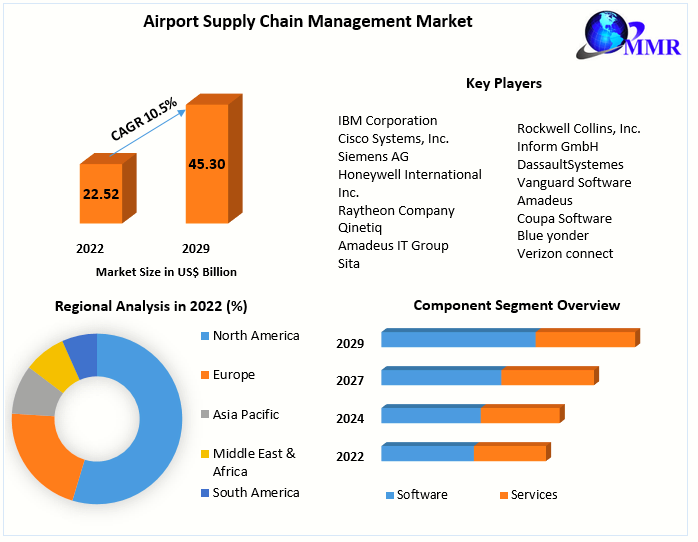
Global Airport Supply Chain Management Market is expected to reach US$ 45.30 billion at a CAGR of 10.5% during the forecast period 2029.
The report includes an analysis of the impact of COVID-19 lockdown on the revenue of market leaders, followers, and disruptors. Since the lockdown was implemented differently in various regions and countries; the impact of the same is also seen differently by regions and segments. The report has covered the current short-term and long-term impact on the market, and it would help the decision-makers to prepare the outline and strategies for companies by region.
 To Know About The Research Methodology :- Request Free Sample Report
Airport Supply Chain Management Definition:
Airport Supply Chain is a network of multiple organizations and their relationship, which encompasses suppliers, airlines, airport operators, government agencies such as customs, security, and immigration, and other service providers. SCM decisions have a direct impact on the airport’s operation and financial performance.
Global Airport Supply Chain Management Market Dynamics:
Airports play a key role in the regional and global supply chain process, moving goods from market to market. Shipping by air is used for products that are either time-sensitive or of high value and can justify higher transportation costs compared to other methods. Air cargo is used regularly for the delivery of emergency parts for industrial machinery where on-site inventories of replacement parts are low due to high carrying costs.
Other products such as seafood and pharmaceuticals, which expire quickly, also rely on air cargo to be delivered within a short time frame, which has increased the need for supply chain management in airports. The air cargo industry has grown dramatically over the last two decades. By 2006, airfreight has accounted for approximately 35 percent of global merchandise trade by value, which is equivalent to US$4.2 trillion of the US$12 trillion value of trade (International Air Transport Association, 2008 (IATA)).
There is an industry trend towards the productions of high-value lightweight goods. For these new economy products like microelectronics and pharmaceuticals, as much as 80–90 percent of their international movements are by air. Second, the shortening of product life cycles and adoption of just-in-time (JIT) manufacturing philosophy necessitates the need for speedy transportations to ensure quick market launches and deliveries.
Third, more companies are recognizing that higher linehaul costs of air services can be offset by reductions of costs corresponding to inventory, warehousing, and packaging. Fourth, air service cost is significantly driven down in the last 20 years partly due to the entry of large numbers of wide-body freighters and passenger aircraft and partly to the increased efficiencies that have been built into the materials handling and air cargo system. All these factors act as the driving factors for the growth of the Global Airport Supply Chain Management Market.
Globalization and e-commerce have further generated new opportunities for the aviation sector, including a wider range of goods being shipped by air such as electronics, high fashion clothing, and consumer products, which is also expected to boost the Global Airport Supply Chain Management Market.
While economic considerations are key drivers for the growth of air service demand, air transportation itself can be a key cause and facilitator of economic growth. Greater connections to the global air transport network can boost the productivity and growth of an economy by providing better access to markets, enhancing links within and between businesses, and attracting foreign resources and capital investments.
The volume of passengers and cargo at an airport is an important determinant for the scale of activity around airports. The larger the airport, the more complexity of the task, the greater demand for supply chain management. Airports, which have a limited flight network or small passenger volumes have less diversity in terms of workflow management. The size of the airport facilities the need for proper management of the airport.
Although air transportation is more expensive relative to other modes, it provides faster shipping times, greater damage control for products, and higher levels of security. However, as other modes of transportation are improving on their efficiency and safety, it can act as a restraint to the growth of the Global Airport Supply Chain Management Market.
Segment Analysis:
The report groups the Global Supply Chain Management Market in different segments like by component, application, and regionto forecast the revenues and analyze the market share of each segment over the forecast period.
Based on Component, the Software segment was dominant in 2019 and is expected to command a market share of xx% by 2026. The software segment consists of both the passenger system and non-passenger system. With the use of the software, the airports can operate with increased flexibility and mass-customize their products and services. The growing demand for enhanced services by the passenger is also driving the growth of the service segment.
Based on Application, the market is segmented into Security, Content Management, Logistics, Integration, Collaboration, Gate Management, Performance Management, Business Applications and Others. The Security segment was dominant in 2019 and is expected to command a market share of xx% by 2029.The stringent government regulations regarding airport and passenger safety and the trading of illegal products through air cargo have contributed to the growth of the segment.
Regional Insights:
North Americais expected to command the largest market share of xx% by 2029
According to Federal Aviation Administration (FAA), the US is considered to have the world's largest number of airports approximately 19,633. Canada has 1620 airports out of, which 17 are international airports and the remaining are domestic airports.
E-commerce and ongoing trade diversity with China, U.S., and Europe, in particular,are expected to provide long-term stability to the Canadian air cargo sector generating new sources of industrial demand as a result. The adoption of new technology and the need for fast services at the airports have driven the growth of the demand for the Airport Supply Chain Management Market in the region.
The objective of the report is to present a comprehensive analysis of the Global Airport Supply Chain Management Market to the stakeholders in the industry. The past and current status of the industry with forecasted market size and trends are presented in the report with the analysis of complicated data in simple language.
The report covers all the aspects of the industry with a dedicated study of key players that include market leaders, followers, and new entrants. PORTER, SVOR, PESTEL analysis with the potential impact of micro-economic factors of the market have been presented in the report. External as well as internal factors that are supposed to affect the business positively or negatively have been analyzed, which will give a clear futuristic view of the industry to the decision-makers.
The report also helps in understanding the Global Airport Supply Chain Management Marketdynamics, structure by analyzing the market segments and projects the Global Airport Supply Chain Management Market size. Clear representation of competitive analysis of key players by product, price, financial position, product portfolio, growth strategies, and regional presence in the Global Airport Supply Chain Management Market make the report investor’s guide.
Scope of the Global Airport Supply Chain Management Market: Inquire before buying
| Airport Supply Chain Management Market | |||
|---|---|---|---|
| Report Coverage | Details | ||
| Base Year: | 2022 | Forecast Period: | 2023-2029 |
| Historical Data: | 2018 to 2022 | Market Size in 2022: | US $ 22.52 Bn. |
| Forecast Period 2023 to 2029 CAGR: | 10.5% | Market Size in 2029: | US $ 45.30 Bn. |
| Segments Covered: | by Component | Software Services |
|
| by Application | Security Content Management Logistics, Integration Collaboration Gate Management Performance Management Business Applications Others |
||
Global Airport Supply Chain Management Market, by Region:
North America (United States, Canada and Mexico)
Europe (UK, France, Germany, Italy, Spain, Sweden, Austria and Rest of Europe)
Asia Pacific (China, South Korea, Japan, India, Australia, Indonesia, Malaysia, Vietnam, Taiwan, Bangladesh, Pakistan and Rest of APAC)
Middle East and Africa (South Africa, GCC, Egypt, Nigeria and Rest)
South America (Brazil, Argetina and Rest of South America)
Global Airport Supply Chain Management Market Key Players:
1. IBM Corporation
2. Cisco Systems, Inc.
3. Siemens AG
4. Honeywell International Inc.
5. Raytheon Company
6. Qinetiq
7. Amadeus IT Group
8. Sita
9. Rockwell Collins, Inc.
10. Inform GmbH
11. DassaultSystemes
12. Vanguard Software
13. Amadeus
14. Coupa Software
15. Blue yonder
16. Verizon connect
Frequently Asked Questions:
1. What is the growth rate of Global Airport Supply Chain Management Market?
Ans: The Global Airport Supply Chain Management Market is growing at a CAGR of 10.5 % during forecasting period 2023-2029.
2. What is scope of the Global Airport Supply Chain Management Market report?
Ans: Global Airport Supply Chain Management Market report helps with the PESTEL, PORTER, COVID-19 Impact analysis, Recommendations for Investors & Leaders, and market estimation of the forecast period.
3. What was the Global Airport Supply Chain Management Market size in 2022?
Ans: The Global Airport Supply Chain Management market was valued at US$ 22.52 Bn. In 2022.
4. What is the study period of this Market?
Ans: The Global Airport Supply Chain Management Market is studied from 2022 to 2029.