Aircraft Flight Control System Market Size – Industry Structure Evaluation, Demand Drivers Analysis, Regional Growth Analysis and Identification, Competitive Positioning Review & Global Market Size Forecast to 2032

4.55%
CAGR (2026-2032)
15.85 USD Bn.
Market Size
301
Report Pages
163
Market Tables

Overview

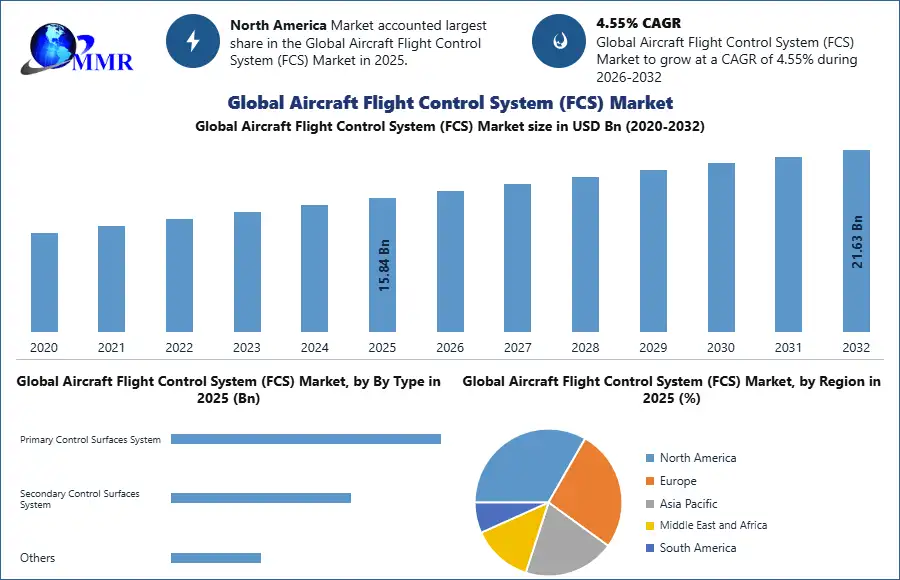
Aircraft Flight Control System Market size was valued at USD 15.84 Bn. in 2025 and the total revenue is expected to grow at a CAGR of 4.55% through 2026 to 2032, reaching nearly USD 21.64 Bn.

Aircraft Flight Control System Market Overview:

The Aircraft Flight Control System Market is expected to reach US$ 18.93 billion by 2029, thanks to growth in the component segment. The report analyzes Aircraft Flight Control system market dynamics by region, component, type, technology, and end-user.

Flight control surfaces, respective cockpit controls, connecting linkages, and the essential operational mechanisms for controlling an aircraft's direction in flight make up a traditional fixed-wing aircraft flight control system. Because they modify speed, aircraft engine controls are also considered flying controls.

In-flight dynamics, the principles of aircraft controls are explained. The basic technique used on airplanes initially debuted in a recognizable form on Louis Bleriot’s pioneer-era monoplane design, the Bleriot VIII, in April 1908.
Global Aircraft Flight Control System (FCS) Market

To know about the Research Methodology:- Request Free Sample Report

Aircraft Flight Control System Market Dynamics:

Orders and delivery of aircraft are increasing:

Air travel has become more inexpensive as per capita income has increased across countries. This has led to the global surge in aviation passenger travel. According to a study conducted by the International Air Transport Association (IATA) in May 2021, the number of passengers is expected to exceed 8 billion by 2035, with an annual growth rate of 5.21%. Over the next 20 to 30 years, demand for commercial aviation is expected to quadruple. Also, the profitability of airlines has improved as a result of better fuel economy in aircraft operations. Factors such as aircraft design, navigation and flight patterns, and weather conditions all influence aircraft operational efficiency.

The efficiency of aircraft operations has been improved thanks to advancements in navigational technologies and efficient aircraft operations such as flight operations, technical operations, and ground operations. These factors have resulted in an increase in aircraft orders around the world, which may drive the global market over the forecast period.

The Asia Pacific has a slew of new aircraft producers:

One of the biggest opportunities for the global market to expand during the forecast period is for an emerging aircraft manufacturer in the Asia Pacific and Latin America. Commercial Aircraft Corporation of China, Ltd. (COMAC), Embraer SA (Brazil), and Mitsubishi Aircraft Corporation (Japan) are just a few of the new aircraft manufacturers on the stage. COMAC makes commercial, business, and regional aircraft, while Mitsubishi Aircraft Corporation manufactures regional aircraft.

Increased air passenger traffic is expected to increase demand for commercial aircraft, business jets, and regional transport aircraft, which may provide these manufacturers with growth opportunities for new aircraft production and, as a result, growth in the aircraft flight control system market during the forecast period.

Stringent rules and regulations:

Because of the inherent danger connected with flying operations, the aviation business is one of the most heavily regulated industries. Aircraft and aircraft component manufacturers, particularly aircraft flight control system makers, are bound by a slew of bilateral, national, and international regulations and standards. Different regulatory agencies oversee the standards of safety connected with aircraft operating in different countries across the world.

Aircraft Flight Control System Segment Analysis:

In 2025, the Primary Flight Control System (Surfaces System) segment dominates the market due to its critical role in controlling aircraft stability and maneuverability during all phases of flight. These systems, including ailerons, elevators, and rudders, are essential for safe operation, making them indispensable across all aircraft categories.

The Secondary Control Surfaces System segment also shows strong demand, particularly in enhancing aerodynamic efficiency and passenger comfort through components such as flaps, slats, and spoilers. The Others segment, including trim and auxiliary systems, maintains steady demand, primarily supporting performance optimization and redundancy functions.

Based on Component, Flight Control Computers (FCC) hold the largest market share in 2025 due to their central role in processing pilot inputs and managing automated flight operations. Increasing adoption of digital and autonomous systems further strengthens this segment.

Actuators and Control Surfaces also represent significant demand, as they directly execute flight commands and influence aircraft movement. Meanwhile, Sensors & Feedback Devices are the fastest-growing segment, driven by rising demand for real-time data monitoring and enhanced system accuracy. Cockpit Controls maintain stable demand, while the Others segment supports auxiliary and integration functions.

Global Aircraft Flight Control System (FCS) Market
Report Coverage Details
Base Year: 2025 Forecast Period: 2026-2032
Historical Data: 2020 to 2025 Market Size in 2025: 15.84 USD Bn
Forecast Period 2026-2032 CAGR: 4.55% Market Size in 2032: 21.63 USD Bn
Segments Covered: By Type Primary Control Surfaces System
Secondary Control Surfaces System
Others
By Fit Line Fit
Retrofit
By Component Flight Control Computers (FCC)
Actuators
Cockpit Controls
Sensors & Feedback Devices
Control Surfaces
Others
By Technology Hydromechanical Systems
Fly-by-Wire (FBW) Systems
Power-by-Wire (PBW) Systems
Fly-by-Light (FBL) Systems
Others
By Aircraft Platform Commercial Aircraft
    Narrow Body
    Wide Body
    Regional Jet
Military Aircraft
    Combat & Multirole
    Military Transport Aircraft
    Military Helicopter
    Others
General Aviation
    Business Jets
    Light Aircraft
Unmanned Aerial Systems
    Civil and Commercial Drones
    Defense and Government Drones
Advanced Air Mobility (AAM)
    eVTOL
    Urban Air Mobility (UAM)
By Application Commercial Aviation
Military Aviation
Business & General Aviation
Others

Aircraft Flight Control System Regional Insights:

Based on Region, North America leads the global Aircraft Flight Control System market in 2025, driven by the presence of major aircraft manufacturers, strong defense spending, and rapid adoption of advanced avionics technologies.

Europe follows closely, supported by established aerospace infrastructure and increasing investments in next-generation aircraft programs.

Asia Pacific is the fastest-growing region, fueled by expanding commercial aviation, rising air passenger traffic, and increasing defense budgets in countries such as China and India.

Other regions, including Latin America, Middle East & Africa, show moderate growth, supported by gradual fleet expansion and improving aviation infrastructure.

Recent Industry Developments (2025–2026)

Exact Date Company Development Impact
23 March 2026 Collins Aerospace The company expanded its digital avionics portfolio by launching a next-generation flight management solution with integrated real-time data analysis capabilities. Enhances the company's competitive positioning in the high-growth software-defined flight control segment.
14 January 2026 BAE Systems Successfully completed the first flight test of its lightweight fly-by-wire system specifically designed for autonomous eVTOL platforms. Positions the firm as a first-mover in the emerging Urban Air Mobility (UAM) flight control market.
12 November 2025 Airbus Released a critical software firmware update for over 6,000 A320 aircraft to mitigate control system data corruption risks from solar radiation. Directly addresses operational safety standards and reinforces the necessity of cybersecurity in flight control.
15 July 2025 Safran S.A. Finalized the strategic acquisition of the flight control and actuation business unit from Collins Aerospace. Significantly increases Safran's global market share and technical capacity in digital flight control architectures.
18 May 2025 Honeywell Announced an expanded partnership with Vertical Aerospace to certify flight control systems for the VX4 electric air taxi. Strengthens its supply chain presence within the sustainable aviation and electric propulsion sub-sectors.
02 April 2025 FAA The Federal Aviation Administration committed to a September 2025 rollout for the modernized NOTAM database to improve pilot messaging reliability. Drives demand for avionics hardware upgrades compatible with advanced digital messaging protocols.


The objective of the report is to present a comprehensive analysis of the market to the stakeholders in the industry. The past and current status of the industry with the forecasted market size and trends are presented in the report with the analysis of complicated data in simple language. The report covers all the aspects of the industry with a dedicated study of key players that include market leaders, followers, and new entrants.

PORTER, PESTEL analysis with the potential impact of micro-economic factors of the market have been presented in the report. External as well as internal factors that are supposed to affect the business positively or negatively have been analyzed, which will give a clear futuristic view of the industry to the decision-makers.

The report also helps in understanding the global market dynamics, structure by analyzing the market segments and projecting the global market size. Clear representation of competitive analysis of key players by product, price, financial position, product portfolio, growth strategies, and regional presence in the global market makes the report investor's guide.

Aircraft Flight Control Industry EcosystemAircraft Flight Control Industry Ecosystem

Aircraft Flight Control System Market Scope: Inquire before buying

Aircraft Flight Control System Market, by Region

North America (United States, Canada and Mexico)
Europe (UK, France, Germany, Italy, Spain, Sweden, Austria and Rest of Europe)
Asia Pacific (China, South Korea, Japan, India, Australia, Indonesia, Malaysia, Vietnam, Taiwan, Bangladesh, Pakistan and Rest of APAC)
Middle East and Africa (South Africa, GCC, Egypt, Nigeria and Rest of ME&A)
South America (Brazil, Argentina Rest of South America)

Key Players / Competitors Profiles Covered in Brief in Global Aircraft Flight Control System Market Report in Strategic Perspective:

  1.  Honeywell International Inc.
  2. Moog Inc.
  3. Safran S.A.
  4. BAE Systems PLC
  5. Parker Hannifin Corporation
  6. Thales Group
  7. Collins Aerospace (Raytheon Technologies Corporation)
  8. Curtiss-Wright Corporation
  9. Liebherr Group
  10. Woodward, Inc.
  11. Nabtesco Corporation
  12. Leonardo S.p.A.
  13. Saab AB
  14. Northrop Grumman Corporation
  15. The Boeing Company
  16. Airbus S.A.S.
  17. Embraer S.A.
  18. Dassault Aviation
  19. Mitsubishi Heavy Industries Ltd.
  20. Triumph Group Inc.
  21. TE Connectivity Ltd.
  22. Sensata Technologies Holding PLC

Table of Contents

1. Aircraft Flight Control System Market: Executive Summary 1.1. Executive Summary 1.2. Market Size (2025) & Forecast (2026-2032), 1.3. Market Size (Value in USD, Volume in 000'Units) and Market Share (%) – By Segments, Regions, and Country 2. Competitive Landscape 2.1. MMR Competition Matrix 2.2. Competitive Positioning Of Global Key Players 2.3. Key Players Benchmarking 2.3.1 Company Name 2.3.2 Headquarters 2.3.3 Product Portfolio 2.3.4 Integration Expertise with Avionics and Autopilot Systems 2.3.5 Technological Innovation 2.3.6 Pricing Strategy 2.3.7 Certification & Compliance Strength 2.3.8 R&D Investment 2.3.9 Manufacturing Footprint & Vertical Integration 2.3.10 Aftermarket and MRO Capabilities 2.3.11 Supply Chain Resilience and Localization Strategy 2.3.12 Revenue (2025) 2.3.13 Market Share (%) 2.3.14 Revenue Growth Rate (%) 2.3.15 Global Presence 2.4. Market Structure 2.4.1 Market Leaders 2.4.2 Market Followers 2.4.3 Emerging Players 2.5. Mergers and Acquisitions Details 2.6. Market Share Analysis (2025–2032) 2.6.1 Market share by leading manufacturers (Honeywell, Moog, Safran, BAE Systems, etc.) 2.6.2 Regional share analysis (North America, Europe, Asia-Pacific, etc.) 2.7. Strategic Developments (2020–2025) 2.7.1 Partnerships and collaborations with OEMs and avionics suppliers 2.7.2 Mergers, acquisitions, and technology licensing deals 2.7.3 New product introductions (PBW actuators, digital flight computers, etc.) 2.7.4 Investments in manufacturing, testing, and R&D centers 2.8. Competitive Positioning and Leadership Mapping 2x2 matrix: Technology Advancement vs. Market Reach 2.1 Categorization: Global Leaders, Specialists, Regional Players, and Innovators 2.2 Segment-wise positioning (Actuation, Control Computers, Flight Sensors) 2.3 Emerging tech companies in electric and hybrid actuation 2.9. Technology & Product Differentiation Analysis 2.9.1 Comparison of key system architectures (FBW, PBW, FBL) 2.9.2 Sensor and actuator innovation benchmarking 2.9.3 AI, redundancy management, and safety architecture leadership 2.9.4 Patent-backed technology differentiators 2.9.5 Digital twin and simulation-based design strengths 2.10. Partnership and Collaboration Network Mapping 2.10.1 OEM–Supplier partnership networks 2.10.2 Cross-sector collaborations (with avionics, electronics, and sensor firms) 2.10.3 Joint development programs for PBW/FBL systems 2.10.4 Academic and research partnerships for AI & autonomy 2.10.5 Open innovation initiatives and consortium participation 3. Market Dynamics 3.1. Market Trends 3.2. Aircraft Flight Control System Market Dynamics 3.2.1 Drivers 3.2.2 Restraints 3.2.3 Opportunities 3.2.4 Challenges 3.3. PORTER’s Five Forces Analysis 3.4. PESTLE Analysis 4. Regulatory and Certification Framework 4.1. FAA and EASA Certification Standards 4.2. MIL-SPEC Standards for Military Aircraft Control Systems 4.3. DO-178C and DO-254 Software and Hardware Compliance 4.4. Safety and Redundancy Requirements 4.5. Environmental and EMI/EMC Regulations 5. Pricing Analysis (2025) 5.1. Overview of Pricing Trends in Flight Control Systems 5.2. Average System and Component Prices by Type (2020–2025) 5.3. Price Benchmarking by Technology 5.4. Cost Structure Analysis 5.4.1 Material, Electronics, Software, and Integration Costs 5.4.2 Impact of Certification and Testing Requirements 5.5. Regional Price Variation 5.6. Aftermarket and Retrofit Pricing Models 6. Market Ecosystem & Value Chain Mapping 6.1. Overview of the Flight Control System Value Chain 6.2. Key Stakeholders – OEMs, Tier-1 & Tier-2 Component Suppliers 6.3. Value Addition Across Design, Manufacturing, and Integration Stages 6.4. Supplier–OEM–MRO Collaboration Framework 6.5. Cost Distribution and Margin Analysis Across the Supply Chain 6.6. Strategic Partnerships and Outsourcing Trends in FCS Development 7. Technology Landscape 7.1. Mechanical and Hydromechanical Flight Control Systems 7.2. Fly-by-Wire (FBW) Systems – Design, Integration, and Benefits 7.3. Power-by-Wire (PBW) Systems – Advancing “More Electric Aircraft” 7.4. Fly-by-Light (FBL) and Optical Data Transmission Systems 7.5. AI-Based Flight Control Algorithms and Predictive Stability Controls 7.6. Role of Digital Twins and Simulation in Control System Development 7.7. Integration with Avionics and Digital Cockpit Systems 7.7.1 Digital Convergence of Flight Control and Avionics Architectures 7.7.2 Flight Control Computer (FCC) and Autopilot System Integration 7.7.3 Role of Control Laws, Software Algorithms, and Sensor Fusion 7.7.4 Integration Challenges and Redundancy Management 7.7.5 Impact of AI, Data Connectivity, and Real-Time Diagnostics on FCS Performance 7.7.6 Future Trends: Autonomous and AI-Enabled Control Systems 8. Supply Chain and Manufacturing Analysis 8.1. Tier Structure and Key Suppliers (Tier-1 to Tier-3) 8.2. Material and Component Procurement Patterns 8.3. Manufacturing and Assembly Processes 8.4. Cost Breakdown and Value Addition by Stage 8.5. Supply Chain Risks and Logistics Optimization 8.6. Impact of Geopolitical and Raw Material Challenges 9. Aftermarket and MRO Landscape 9.1. Lifecycle Analysis of Flight Control Components 9.2. Maintenance and Overhaul Intervals by Aircraft Type 9.3. Key MRO Service Providers and Strategic Partnerships 9.4. Predictive Maintenance Enabled by Smart Sensors and IoT 9.5. Retrofit Demand Analysis – Upgrading Legacy Aircraft 9.6. Revenue Potential in Aftermarket and Support Services 10. Sustainability and Environmental Considerations 10.1. Flight Control Systems’ Role in Fuel Efficiency and Emission Reduction 10.2. Lightweight and Energy-Efficient Material Innovations 10.3. Green Manufacturing Practices Across OEMs and Suppliers 10.4. Compliance with Global Aviation Sustainability Targets (IATA, ICAO) 10.5. Integration with “More Electric Aircraft” and Net-Zero Initiatives 10.6. Environmental Lifecycle Impact Assessment 11. Patent and Innovation Analysis 11.1. Overview of Global Patent Filing Trends in FCS Technologies 11.2. Key Patents Across Fly-by-Wire, Power-by-Wire, and Electro-Hydrostatic Systems 11.3. Leading Innovators and Regional Concentration of IP Ownership 11.4. Emerging Research Domains: AI Integration, Control Algorithms, and Redundancy Systems 11.5. R&D Investment Trends and Innovation Pipelines of Major OEMs 11.6. Implications of Patents on Competitive Strategy and Market Entry Barriers 12. Production and Fleet Statistics 12.1. Aircraft Deliveries and Backlog by OEM 12.2. Installed Base of Flight Control Systems by Region 12.3. Annual Production Capacity of Key Component Manufacturers 12.4. Forecasted Fleet Expansion and Replacement Cycles (2025–2032) 12.5. Correlation Between Aircraft Orders and FCS Demand 13. Production and Manufacturing Ecosystem 13.1. Global Manufacturing Footprint and Assembly Facilities 13.2. Country-Level Production Capacities (U.S., France, Germany, China, Japan) 13.3. Major Production Programs (Airbus A320neo, Boeing 737 MAX, F-35, etc.) 13.4. Advanced Manufacturing Techniques (Additive Manufacturing, Automation, Robotics) 13.5. Industrial Collaborations Between Aerospace Clusters 14. Aircraft Flight Control System Market: Global Market Size and Forecast by Segmentation (by Value in USD Billion and Volume In 000'Units) (2025-2032) 14.1. Aircraft Flight Control System Market Size and Forecast, By Type 14.1.1 Primary Control Surfaces System 14.1.2 Secondary Control Surfaces System 14.1.3 Others 14.2. Aircraft Flight Control System Market Size and Forecast, By Fit 14.2.1 Line Fit 14.2.2 Retrofit 14.3. Aircraft Flight Control System Market Size and Forecast, By Component 14.3.1 Flight Control Computers (FCC) 14.3.2 Actuators 14.3.3 Cockpit Controls 14.3.4 Sensors & Feedback Devices 14.3.5 Control Surfaces 14.3.6 Others 14.4. Aircraft Flight Control System Market Size and Forecast, By Technology 14.4.1 Hydromechanical Systems 14.4.2 Fly-by-Wire (FBW) Systems 14.4.3 Power-by-Wire (PBW) Systems 14.4.4 Fly-by-Light (FBL) Systems 14.4.5 Others 14.5. Aircraft Flight Control System Market Size and Forecast, By Aircraft Platform 14.5.1 Commercial Aircraft 14.5.2 Narrow Body 14.5.3 Wide Body 14.5.4 Regional Jet 14.5.5 Military Aircraft 14.5.6 Combat & Multirole 14.5.7 Military Transport Aircraft 14.5.8 Military Helicopter 14.5.9 Others 14.5.10 General Aviation 14.5.11 Business Jets 14.5.12 Light Aircraft 14.5.13 Unmanned Aerial Systems 14.5.14 Civil and Commercial Drones 14.5.15 Defense and Government Drones 14.5.16 Advanced Air Mobility (AAM) 14.5.17 eVTOL 14.5.18 Urban Air Mobility (UAM) 14.6. Aircraft Flight Control System Market Size and Forecast, By Application 14.6.1 Commercial Aviation 14.6.2 Military Aviation 14.6.3 Business & General Aviation 14.6.4 Others 14.7. Aircraft Flight Control System Market Size and Forecast, by Region 14.7.1 North America 14.7.2 Europe 14.7.3 Asia Pacific 14.7.4 Middle East and Africa 14.7.5 South America 15. North America Aircraft Flight Control System Market Size and Forecast by Segmentation (by Value in USD Billion and Volume In 000'Units) (2025-2032) 15.1. North America Market Size and Forecast, By Type 15.2. North America Market Size and Forecast, By Fit 15.3. North America Market Size and Forecast, By Component 15.4. North America Market Size and Forecast, By Technology 15.5. North America Market Size and Forecast, By Aircraft Platform 15.6. North America Market Size and Forecast, By Application 15.7. North America Market Size and Forecast, By Country 15.7.1 United States 15.7.2 United States Market Size and Forecast, By Type 15.7.3 United States Market Size and Forecast, By Fit 15.7.4 United States Market Size and Forecast, By Component 15.7.5 United States Market Size and Forecast, By Technology 15.7.6 United States Market Size and Forecast, By Aircraft Platform 15.7.7 United States Market Size and Forecast, By Application 15.7.8 Canada 15.7.9 Mexico 16. Europe Aircraft Flight Control System Market Size and Forecast by Segmentation (by Value in USD Billion and Volume In 000'Units) (2025-2032) 16.1. Europe Market Size and Forecast, By Type 16.2. Europe Market Size and Forecast, By Fit 16.3 Europe Market Size and Forecast, By Component 16.4. Europe Market Size and Forecast, By Technology 16.5. Europe Market Size and Forecast, By Aircraft Platform 16.6. Europe Market Size and Forecast, By Application 16.7. Europe Market Size and Forecast, By Country 16.7.1 United Kingdom 16.7.2 France 16.7.3 Germany 16.7.4 Italy 16.7.5 Spain 16.7.6 Sweden 16.7.7 Russia 16.7.8 Rest of Europe 17. Asia Pacific Aircraft Flight Control System Market Size and Forecast by Segmentation (by Value in USD Billion and Volume In 000'Units) (2025-2032) 17.1. Asia Pacific Market Size and Forecast, By Type 17.2. Asia Pacific Market Size and Forecast, By Fit 17.3. Asia Pacific Market Size and Forecast, By Component 17.4. Asia Pacific Market Size and Forecast, By Technology 17.5. Asia Pacific Market Size and Forecast, By Aircraft Platform 17.6. Asia Pacific Market Size and Forecast, By Application 17.7. Asia Pacific Market Size and Forecast, By Country 17.7.1 China 17.7.2 South Korea 17.7.3 Japan 17.7.4 India 17.7.5 Australia 17.7.6 Indonesia 17.7.7 Philippines 17.7.8 Malaysia 17.7.9 Vietnam 17.7.10 Thailand 17.7.11 Rest of Asia Pacific 18. Middle East and Africa Aircraft Flight Control System Market Size and Forecast by Segmentation (by Value in USD Billion and Volume In 000'Units) (2025-2032) 18.1. Middle East and Africa Market Size and Forecast, By Type 18.2. Middle East and Africa Market Size and Forecast, By Fit 18.3. Middle East and Africa Market Size and Forecast, By Component 18.4. Middle East and Africa Market Size and Forecast, By Technology 18.5. Middle East and Africa Market Size and Forecast, By Aircraft Platform 18.6. Middle East and Africa Market Size and Forecast, By Application 18.7. Middle East and Africa Market Size and Forecast, By Country 18.7.1 South Africa 18.7.2 GCC 18.7.3 Egypt 18.7.4 Nigeria 18.7.5 Rest of MEA 19. South America Aircraft Flight Control System Market Size and Forecast by Segmentation (by Value in USD Billion and Volume In 000'Units) (2025-2032) 19.1. South America Market Size and Forecast, By Type 19.2. South America Market Size and Forecast, By Fit 19.3. South America Market Size and Forecast, By Component 19.4. South America Market Size and Forecast, By Technology 19.5. South America Market Size and Forecast, By Aircraft Platform 19.6. South America Market Size and Forecast, By Application 19.7. South America Market Size and Forecast, By Country 19.7.1 Brazil 19.7.2 Argentina 19.7.3 Colombia 19.7.4 Chile 19.7.5 Rest of South America 20. Company Profile: Key Players 20.1. Honeywell International Inc. 20.1.1 Company Overview 20.1.2 Business Portfolio 20.1.3 Financial Overview 20.1.4 SWOT Analysis 20.1.5 Strategic Analysis 20.1.6 Recent Developments 20.2. Moog Inc. 20.3. Safran S.A. 20.4. BAE Systems PLC 20.5. Parker Hannifin Corporation 20.6. Thales Group 20.7. Collins Aerospace (Raytheon Technologies Corporation) 20.8. Curtiss-Wright Corporation 20.9. Liebherr Group 20.10. Woodward, Inc. 20.11. Nabtesco Corporation 20.12. Leonardo S.p.A. 20.13. Saab AB 20.14. Northrop Grumman Corporation 20.15. The Boeing Company 20.16. Airbus S.A.S. 20.17. Embraer S.A. 20.18. Dassault Aviation 20.19. Mitsubishi Heavy Industries Ltd. 20.20. Triumph Group Inc. 20.21. TE Connectivity Ltd. 20.22. Sensata Technologies Holding PLC 20.22.1 Others 21. Key Findings 22. Strategic Recommendations and Risk–Opportunity Matrix 22.1 Key Success Factors for OEMs and Tier-1 Suppliers 22.2 Market Entry and Expansion Strategies 22.3 Technology Development Priorities 22.4 Collaboration and Partnership Opportunities 22.5 Risk–Opportunity Matrix (Short-, Medium-, and Long-Term Outlook) 23. Research Methodology

Custom Market Research Services

We Will Customise The Research For You, In Case The Report Listed Above Does Not Meet With Your Requirements