
Aerogel Market - Industry Structure Evaluation, Demand Drivers Analysis, Regional Growth Analysis and Identification, Competitive Positioning / Landscape Review & Global Market Size Forecast to 2030
Overview
Global Aerogel market was valued at USD 1.41 Billion in 2025 and the total revenue is expected to grow at a CAGR of 12.5% from 2026 to 2032, reaching nearly USD 3.14 Billion.
Aerogel Market Introduction:
Global Aerogel is a porous solid having the lowest bulk density of any known substance. It's made out of a gel in which the liquid component has been replaced with a gas. The result is a solid with an exceptionally low density and a number of unique features, the most notable of which is its ability to act as a thermal insulator. Because of the material's trans light scattering, it's known as frozen smoke, smoke, solid air, or blue smoke, nonetheless, it feels like expanded polystyrene (styrofoam) to the touch.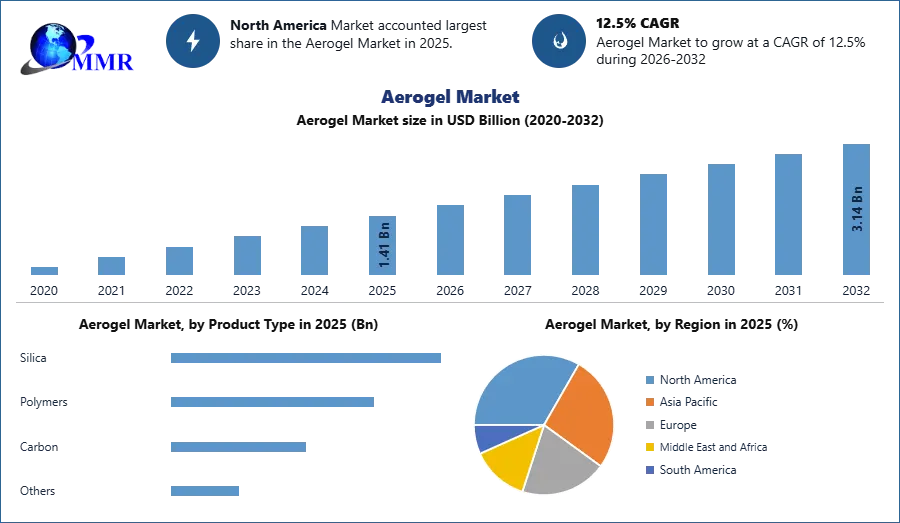 To know about the Research Methodology :- Request Free Sample Report
The Market for Aerogels:
The future markets for aerogels appear promising, given their unique qualities of being incredibly lightweight, a fantastic thermal insulator, and given the many applications already discovered for this material type.
The material has attracted the attention of several industries, with applications in automotive, oil and gas, construction, cryogenics, shipping, and other fields.
Production and demand for various types of aerogels are continuing to be strong as new applications are discovered and innovation activity around the creation of aerogels remains high. Aerogels are currently quite expensive due to the high production costs, which can cost up to $1000 per ounce. However, this does not appear to have dampened demand, and as with other new materials, the analyst should expect costs to fall as the product matures.
Silica Blanket Capacity Expansions
Over the last decade, there has been a dramatic shift in the installed capacity for silica aerogels. Historically, this was primarily concentrated in North America and Europe, but China has seen significant growth, with companies such as NanoTech, Alison Aerogel, IBIH, and many others creating significant capacity.
Some of these businesses have faced difficulties, such as the outcome of a patent infringement lawsuit, but as more people take advantage of the technology, increased availability and competition is further expand the market and assist growth.
Aerogel Market Trends:
The suspension of production activities resulted in a lack of precursor materials for the synthesis of aerogels. Also, the lockdown methods limited mobility, disrupting the worldwide supply chain. These trends have resulted in a shortage of aerogel materials in the end-use sectors, putting a damper on the market in 2025.
The United States government is continually providing incentives and encouraging the usage of electric vehicles (EVs). In addition, it is assisting OEMs and part suppliers with product development and increasing EV manufacturing through various aids. So, the market is likely to benefit from the recent development of a product line of aerogel thermal barriers for use in lithium-ion batteries in electric vehicles.
Thin polymer aerogels are being investigated by industry participants for usage in shelter applications such as insulated tents, renovating historical structures, and other insulation requirements. Interior insulation options for building retrofit, thin facade insulation for historical monument refurbishment, roof balcony, and side balcony constructions are all gaining popularity.
The market has a highly consolidated structure due to the existence of a few companies, most of whom are based in North America and Europe. The industry's major players are investing in R&D to lower manufacturing costs and increase production capacity to meet future demand.
Predictions and Future Research
Future research and development of thermal insulation technologies with aerogel should focus on lowering manufacturing costs, increasing the competitiveness of aerogel products in comparison to conventional materials. For example, the cost of an aerogel window is roughly 20 £/m2, which is six times greater than the cost of a typical double-glazed window. By 2025, however, the cost of aerogel could fall below US$1500/m3. Despite its high cost, aerogel has the potential to be a future insulation material for a variety of other industries, including the textile industry and cryogenic and high-temperature thermal insulation for space launch applications.
Other goals could include achieving a better balance of thermal and mechanical qualities, as well as preserving or increasing the valuable properties of aerogel materials. Aerogels' excellent performance can be found in translucency and, why not, transparency, which can be used to create energy-efficient windows and skylights, as well as to design and build energy-efficient structures. Researchers and companies can also improve the high flexibility, adaptability, and ease of use of aerogels as insulation material requirements. In this sense, ensuring the long-term performance of aerogel-enhanced construction products is critical.
Aerogel Market Segment Analysis:
Based On Product Type: In 2025, the silica aerogel product segment dominated the aerogel market, accounting for more than 68 percent of total revenue. This is mainly because of the products' non-organic structures, which are non-combustible and can withstand temperatures of up to 1,4000°C. As a result, they have great heat endurance and thermal insulation capabilities, which increases demand for them.
Silica aerogel is used to make aerogel blankets with fiber reinforcements that turn inelastic aerogels into strong, stretchable, and water-resistant textiles. These nonflammable blankets constructed of silica aerogels are expected to be extremely successful at preventing fire spread in residential buildings, factories, and other infrastructures.
Because of their superior chemical and physical qualities compared to their silica counterparts, polymer aerogel products are expected to grow at the fastest rate of 20% during the estimated period. Polymer aerogels are used in a variety of end-use industries, including defense, electrical and electronics, and building and construction.Moreover, these materials have a unique combination of features, such as low thermal conductivity, low energy emission, non-flammability, and low density. Using ambient pressure or supercritical drying processes, these aerogels are created as panels or thin films. Polyimides, polyurethanes, polyurea, polyamides, and other polymers are being investigated for usage in diverse applications.
In terms of End-use Industry:
With a revenue share of more than 65% in 2025, the oil & gas end-use category led the market. Aerogel, a versatile insulating material with high porosity, low density, low dielectric constant, and excellent heat insulation qualities, is used in the construction, manufacturing, and operation of pipelines and other systems.
Aerogel blankets are primarily used to improve the insulation of deep-sea pipes and oil & gas pipelines to lower production costs, increase pipeline compression resistance, and reduce the amount of steel used in construction. The Aerogel insulators also offer hydrophobicity, mechanical robustness, and great thermal performance as additional advantages.
Over the forecast period, the performance coatings end-use segment is expected to grow at a CAGR of more than 17 percent. Traditional insulating additive materials such as polyurethanes, polyolefins, and polystyrene have poor mechanical stability, but aerogel has a low heat conductivity and a strong moisture resistance.
Because of its low density and great porosity, aerogel has significant benefits over other composite materials in the coatings business. During adhesion, it serves as a coupling agent, forming a strong link between the aerogel particles and the coated surface. The industry is expected to grow thanks to the high demand for the product as a result of the aforementioned factors.
Aerogel Industry Ecosystem
Aerogel Market Recent Industry Developments (2025–2026)
| Date | Company | Development | Impact |
|---|---|---|---|
| 15 January 2025 | Aspen Aerogels, Inc. | Announced expansion of its second aerogel manufacturing facility in Statesboro, Georgia to scale production of PyroThin® thermal barrier materials for EV battery safety. | The expansion increases aerogel supply capacity for electric vehicle battery insulation, supporting rapid growth in the EV market. |
| 28 February 2025 | Armacell International S.A. | Launched a new generation of aerogel-based insulation solutions under the ArmaGel® portfolio designed for oil & gas and industrial infrastructure. | The product introduction strengthens high-performance thermal insulation applications and enhances energy efficiency across industrial operations. |
| 10 April 2025 | Svenska Aerogel Holding AB | Signed a strategic distribution partnership to commercialize its Quartzene® aerogel material in advanced building materials and coatings. | The collaboration expands global commercialization of aerogel-based lightweight insulation materials in the construction sector. |
| 17 June 2025 | JIOS Aerogel Corporation | Announced development progress of its large-scale aerogel production facility in Singapore to support advanced EV battery thermal insulation materials. | The facility strengthens Asia-Pacific aerogel supply chains and supports the growing EV manufacturing ecosystem. |
| 05 September 2025 | Cabot Corporation | Introduced advanced ENERMAX™ aerogel insulation materials designed for industrial energy efficiency and cryogenic insulation. | The innovation supports energy-efficient insulation solutions and expands aerogel adoption in industrial and infrastructure projects. |
Aerogel Market Regional Insights:
With a revenue share of more than 46% in 2025, North America dominated the global market and is expected to maintain its leading position over the forecast period 2026–2032. This dominance is supported by strong technological advancements, high R&D investments, and the presence of key aerogel manufacturers, particularly in the United States.
Asia Pacific is expected to grow at a steady CAGR of around 14.1% during the forecast period. The growth is attributed to increasing industrialization, rising demand for energy-efficient materials, and expanding applications across construction, oil & gas, and automotive sectors.
Europe is anticipated to witness significant growth from 2026 to 2032. Regulatory frameworks such as energy efficiency directives across countries like Germany, the United Kingdom, Spain, and Italy are driving the adoption of aerogels in building insulation and sustainable infrastructure.
Middle East & Africa is projected to experience moderate growth due to increasing investments in oil & gas insulation applications and infrastructure development activities.
South America is expected to show gradual growth, supported by rising industrial activities and increasing awareness regarding energy-efficient materials.
PORTER and PESTEL analyses, along with the potential impact of micro-economic factors, have been incorporated to provide a comprehensive view of the market. Both external and internal factors influencing the industry have been examined to help stakeholders understand future market dynamics.
The report also provides insights into Aerogel market structure by analyzing various segments and projecting market size. It includes a detailed competitive landscape covering key players’ product offerings, pricing strategies, financial performance, growth strategies, and regional presence, making it a valuable guide for investors.
Aerogel Market Scope: Inquiry Before Buying
| Aerogel Market | |||
|---|---|---|---|
| Report Coverage | Details | ||
| Base Year: | 2025 | Forecast Period: | 2026-2032 |
| Historical Data: | 2020 to 2025 | Market Size in 2025: | 1.41 USD Billion |
| Forecast Period 2026-2032 CAGR: | 12.5% | Market Size in 2032: | 3.14 USD Billion |
| Segments Covered: | by Product Type | Silica Polymers Carbon Others |
|
| by Form | Blanket Particle Panel Monolith |
||
| by End Use Industry | Oil & Gas Building & Construction Automotive & Transportation Aerospace & Defense Healthcare Others |
||
| by Technology | Supercritical Drying Ambient Pressure Drying Freeze Drying Others |
||
Aerogel Market, by Region
North America (United States, Canada and Mexico)
Europe (UK, France, Germany, Italy, Spain, Sweden, Austria and Rest of Europe)
Asia Pacific (China, South Korea, Japan, India, Australia, Indonesia, Malaysia, Vietnam, Taiwan, Bangladesh, Pakistan and Rest of APAC)
Middle East and Africa (South Africa, GCC, Egypt, Nigeria and Rest)
key players / competitors profiles covered in the Aerogel Market report in strategic perspective
Cabot Corp.
BASF SE
Nano Technology Co., Ltd.
Dow, Inc.
Enersens
Armacell International S.A
Active Aerogels
Aerogel Technologies LLC
Aspen Aerogel Inc.
JIOS Aerogel
Svenska Aerogel AB
Thermablok Aerogels Limited.
Green Earth Aerogel Technologies
3MCompany
HoneywellInternationalInc.
Saint-Gobain
RockwoolInternationalAS
KnaufInsulation
ZhejiangUGOOTechnologyCo.,Ltd.
GuangdongAlisonHi-TechCo.,Ltd.
BeerenbergAS
IBI-International
KCCCorporation
SolvaySA
Aspen Aerogels, Inc.
Armacell International S.A.
Svenska Aerogel Holding AB
JIOS Aerogel Corporation
Cabot Corporation
Frequently Asked Questions:
1. Which region has the largest share in Global Aerogel Market?
Ans: North America region held the highest share in 2025.
2. What is the growth rate of Global Aerogel Market?
Ans: The Global Aerogel Market is expected to grow at a CAGR of 12.5% during forecast period 2026-2032
3. What is scope of the Global Aerogel Market report?
Ans: Global Aerogel Market report helps with the PESTEL, PORTER, Recommendations for Investors & Leaders, and market estimation of the forecast period.
4. Who are the key players in Global Aerogel Market?
Ans: The important key players in the Global Aerogel Market Cabot Corp., BASF SE, Nano Technology Co., Ltd., Dow, Inc., Enersens, Armacell International S.A, Active Aerogels, Aerogel Technologies LLC, Aspen Aerogel Inc., JIOS Aerogel, Svenska Aerogel AB, Thermablok Aerogels Limited., American Aerogel Corporation, Green Earth Aerogel Technologies, TAASI Corporation, Airglass AB, Acoustiblok UK Ltd., and.