Adiabatic Cooler Market Size by Product Type, Cooling Technology, Orientation, Distribution Channel, Cooling Capacity, Installation Type, Application, End-Use Industry and Region – Industry Structure Analysis, Demand Assessment, Regional Growth Opportunities, Competitive Landscape & Global Forecast to 2034

5.3%
CAGR (2026-2034)
1.55 USD Bn.
Forecast Market Size
302
Report Pages
140
Market Tables

Overview

The Global Adiabatic Cooler Market was valued at USD 1.55 Billion in 2025 and is projected to reach USD 2.46 Billion by 2034, growing at a CAGR of 5.3% during the forecast period 2026–2034.

Global Adiabatic Cooler Market Overview

Adiabatic cooler is a type of cooling system that lowers the temperature of air or a fluid without adding or removing heat from the surrounding environment. Global adiabatic cooler market has been growing by increasing demand from data centers, power generation, industrial processing and HVAC industries. Growing need for energy efficient, water saving and low maintenance cooling solutions to ensure performance reliability, process efficiency and operational safety is fuelling market demand. Increasing applications of adiabatic coolers in temperature-sensitive operations, commercial building systems and industrial heat rejection support their role in both traditional and high tech environments. Advancements in cooling technology, smart control systems and automation are enhancing efficiency, scalability and environmental compliance of adiabatic cooler systems. Emphasis on sustainability, energy optimization and demand for standardized, application specific cooling systems is driving market across data center operators, utility providers and industrial infrastructure developers. North America dominates adiabatic cooler market by region's strong presence of hyperscale data centers, robust industrial infrastructure, growing emphasis on sustainable cooling and strict environmental regulations encouraging water conserving technologies. Region also benefits from high technology adoption and the presence of major global cooling system providers and engineering firms. Key players in adiabatic cooler market include Baltimore Aircoil Company, EVAPCO Inc., SPX Cooling Technologies and Guntner GmbH & Co. KG. Companies are focusing on product innovation, expanding high efficiency and hybrid cooler portfolios and investing in environmentally responsible manufacturing and automation technologies to meet growing global demand.

Report covers Global adiabatic cooler market dynamics, structure by analyzing market segments and projecting Global adiabatic cooler market size. Clear representation of competitive analysis of key players By Type, price, financial position, product portfolio, growth strategies and regional presence in Global adiabatic cooler market.

Adiabatic Cooler Market Growth Outlook
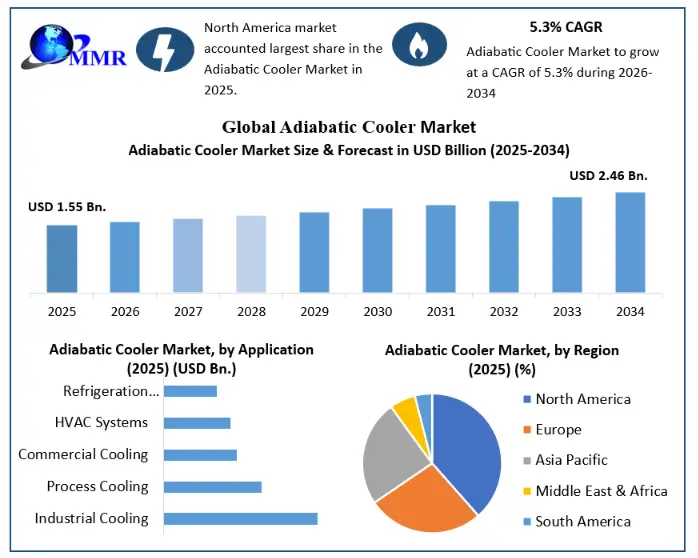
Adiabatic Cooler Market Growth Outlook

To Know About The Research Methodology :- Request Free Sample Report

Global Adiabatic Cooler Market Dynamics

Increasing Demand for Energy-Efficient Industrial Cooling and Data Center Infrastructure Accelerates Market Growth

The global Adiabatic Cooler Market experiences significant growth due to increasing demand for energy-efficient cooling systems across data centers, industrial manufacturing, food processing, pharmaceuticals, and commercial HVAC applications. Rising electricity costs, expanding industrial infrastructure, and growing requirements for efficient heat rejection encourage industries to adopt adiabatic cooling systems, hybrid dry coolers, and industrial process cooling solutions. Adiabatic coolers combine dry heat exchange with evaporative pre-cooling to improve thermal performance while limiting water consumption. Commercial industrial adiabatic cooler product ranges offer cooling capacities from 50 kW to 2,400 kW, supporting applications ranging from compressor cooling to large industrial heat-rejection systems. The expansion of hyperscale data centers, AI computing infrastructure, industrial refrigeration, and temperature-sensitive manufacturing strengthens demand for high-capacity cooling equipment. Increasing investments in sustainable cooling technologies, water-efficient cooling systems, and advanced thermal management solutions support Adiabatic Cooler Market growth through 2034.

High Initial Equipment Investment and Climate-Dependent Cooling Performance Limit Wider Adoption

The Adiabatic Cooler Market faces financial limitations associated with higher initial equipment costs, specialized installation requirements, water treatment provisions, and periodic maintenance of evaporative cooling components. Adiabatic cooling systems incorporate heat exchangers, high-efficiency fans, water distribution systems, control valves, sensors, and automated operating controls, which increase upfront capital expenditure compared with basic dry cooling equipment. Performance also depends on ambient temperature and humidity, as evaporative pre-cooling provides greater benefits in hot, dry climates than in highly humid environments. Industrial facilities operating under strict budget constraints face difficulties justifying equipment upgrades when existing cooling infrastructure remains operational. Water quality requirements, mineral scaling, evaporative pad replacement, and preventive maintenance further influence the total cost of ownership of adiabatic cooling systems. These financial and operating considerations affect procurement decisions across small manufacturing plants, commercial facilities, and cost-sensitive industrial cooling applications.

Expansion of AI Data Centers and Water-Efficient Cooling Infrastructure Creates New Commercial Potential

The global Adiabatic Cooler Market presents substantial business potential through expanding artificial intelligence data centers, industrial automation, semiconductor manufacturing, and environmentally responsible cooling infrastructure. Increasing heat generation from high-density computing equipment creates demand for adiabatic dry coolers, closed-loop cooling systems, and high-performance data center thermal management solutions. Adiabatic cooling technology supports efficient heat rejection during elevated ambient temperatures while enabling dry operation when evaporative assistance is unnecessary. Under specified operating conditions, certain industrial system designs achieve up to 95% lower annual water consumption than conventional cooling tower configurations, creating value for facilities seeking to reduce water-related operating expenses. Opportunities also emerge through retrofitting conventional HVAC equipment, expanding industrial refrigeration networks, and installing modular cooling systems at manufacturing facilities. Growing demand for water-saving cooling technologies, industrial energy efficiency, modular cooling equipment, and sustainable data center infrastructure creates opportunities for manufacturers, engineering contractors, and cooling system integrators through 2034.

Water Quality Management, Installation Complexity and Continuous Operating Reliability Increase Technical Requirements

The Adiabatic Cooler Market encounters technical difficulties involving water quality management, system integration, operating reliability, and cooling performance under variable environmental conditions. Industrial adiabatic cooling equipment requires precise coordination between fan speed, water distribution, evaporative media, heat exchanger performance, and temperature control systems. Poor water quality increases the risk of mineral deposits, nozzle blockage, evaporative pad deterioration, and reduced heat-transfer efficiency. Facilities such as data centers, pharmaceutical manufacturing plants, cold storage facilities, and industrial production units require consistent cooling performance to protect equipment and maintain uninterrupted operations. Integration with existing chillers, cooling loops, building management systems, and industrial process equipment increases engineering complexity. Manufacturers must also address water hygiene, maintenance accessibility, corrosion protection, and seasonal operating requirements. The need to maintain reliable industrial cooling performance, precise temperature control, and continuous thermal management increases technical and service requirements across global markets.

Smart Cooling Controls, Hybrid Operating Modes and Low-Water Technologies Transform Industrial Thermal Management

The global Adiabatic Cooler Market demonstrates increasing adoption of smart cooling controls, hybrid dry-wet operating systems, variable-speed fans, IoT-based monitoring, and automated water management technologies. Manufacturers integrate electronically commutated (EC) fans, advanced heat exchangers, intelligent sensors, and predictive maintenance solutions to optimize cooling performance according to temperature, humidity, and industrial heat loads. Hybrid adiabatic cooling systems automatically shift between dry cooling and evaporative pre-cooling, enabling water conservation during moderate ambient conditions and additional cooling capacity during peak temperatures. Advanced control systems also support remote performance monitoring, equipment diagnostics, and integration with building management platforms. Growing demand for low-water-consumption cooling systems, sustainable HVAC technologies, intelligent industrial coolers, and energy-efficient data center cooling encourages investment in modular equipment designs and connected thermal management platforms. These developments strengthen product differentiation and influence the long-term evolution of the Adiabatic Cooler Market through 2034.

Global Adiabatic Cooler Market Segment Analysis

Adiabatic Cooler Market, by Cooling Technology

Based on Cooling Technology, the Adiabatic Cooler Market is segmented into Direct Adiabatic Cooling, Indirect Adiabatic Cooling, and Hybrid Adiabatic Cooling. Direct Adiabatic Cooling supports cost-effective temperature reduction through evaporative cooling, making it suitable for industrial ventilation and commercial HVAC applications. Indirect Adiabatic Cooling gains demand across data centers, pharmaceutical facilities, and industrial applications by reducing temperatures without adding moisture to the primary air stream. Hybrid Adiabatic Cooling combines dry cooling and evaporative pre-cooling to improve energy efficiency, optimize water consumption, and maintain reliable thermal performance. Increasing demand for energy-efficient cooling systems, sustainable HVAC solutions, industrial process cooling, and advanced data center cooling technologies supports global Adiabatic Cooler Market growth through 2034.
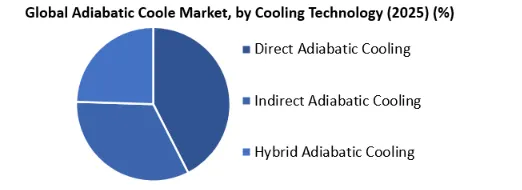
Adiabatic Cooler Market by Cooling Technology

Adiabatic Cooler Market, by Product Type

Based on Product Type, the Adiabatic Cooler Market is segmented into Dry Air Coolers and Liquid Coolers. The Dry Air Coolers segment dominates the global Adiabatic Cooler Market, supported by increasing demand for energy-efficient industrial cooling systems, commercial HVAC applications, and sustainable heat rejection technologies. The Liquid Coolers segment experiences significant growth due to expanding adoption of liquid cooling solutions in data centers, industrial manufacturing, pharmaceutical processing, and high-performance computing facilities. Increasing investments in hybrid adiabatic cooling systems, water-efficient cooling technologies, advanced thermal management solutions, and industrial process cooling equipment strengthen Adiabatic Cooler Market growth and create business opportunities for cooling equipment manufacturers through 2034.
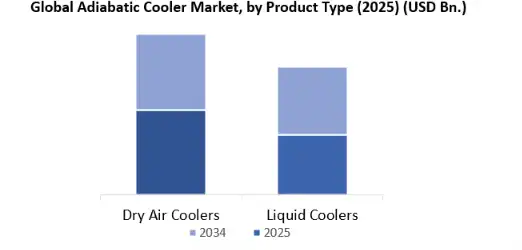
Adiabatic Cooler Market by Product Type

Global Adiabatic Cooler Market Regional Insights

North America holds a strong position in the global Adiabatic Cooler Market, supported by increasing investments in hyperscale data centers, industrial refrigeration, commercial HVAC systems, and energy-efficient cooling infrastructure. The United States leads regional demand through expanding AI data centers, semiconductor manufacturing, and industrial automation. Growing adoption of water-efficient cooling systems, hybrid adiabatic coolers, and sustainable thermal management technologies strengthens market growth across the region.

Europe represents a significant market for adiabatic cooling systems, driven by stringent environmental regulations, industrial energy efficiency requirements, and increasing demand for sustainable cooling technologies. Germany, France, the United Kingdom, and Italy support regional demand through manufacturing facilities, industrial refrigeration, and commercial HVAC applications. Growing investments in low-water-consumption cooling systems, energy-efficient industrial coolers, and smart cooling technologies strengthen the European Adiabatic Cooler Market.

Asia Pacific presents substantial growth potential in the Adiabatic Cooler Market, supported by rapid industrialization, expanding data center infrastructure, and increasing investments in manufacturing and commercial construction. China, India, Japan, and South Korea generate demand for industrial adiabatic coolers, process cooling equipment, and energy-efficient HVAC solutions. Expansion of electronics manufacturing, pharmaceutical production, food processing, and industrial automation strengthens regional adoption of advanced thermal management systems.

The Middle East & Africa Adiabatic Cooler Market benefits from expanding industrial infrastructure, data center investments, and increasing demand for energy-efficient cooling solutions. Saudi Arabia, the UAE, and South Africa support regional demand through commercial construction, industrial development, and digital infrastructure projects. Growing requirements for hybrid dry coolers, water-saving cooling technologies, and industrial heat rejection systems create business opportunities, particularly in areas where water availability and high ambient temperatures influence cooling system selection.

South America experiences growing demand for adiabatic cooling systems, supported by industrial modernization, expanding food processing facilities, and investments in refrigeration and commercial HVAC infrastructure. Brazil, Argentina, and Chile contribute to regional demand through manufacturing, cold storage, and data center development. Increasing adoption of energy-efficient industrial cooling, sustainable refrigeration technologies, and advanced heat rejection solutions supports Adiabatic Cooler Market expansion and creates opportunities for cooling equipment manufacturers and system integrators through 2034.

Global Adiabatic Cooler Market Competitive Landscape

Top key players in global adiabatic cooler market include Baltimore Aircoil Company, EVAPCO Inc. and SPX Cooling Technologies. Companies are focused on continuous innovation in air side heat exchange systems, advanced control technologies and development of environmentally responsible, energy and water efficient adiabatic cooling solutions. Manufacturers are producing cost effective and high-performance adiabatic coolers, used in data centers, industrial processing plants, power generation facilities and commercial HVAC system. Baltimore Aircoil Company known for advanced hybrid and adiabatic cooling systems, offering modular, low maintenance solutions to meet high heat load demands while minimizing water and energy usage. Leading players are also advancing smart automation, integrated monitoring systems and scalable modular designs to meet evolving performance, sustainability and regulatory requirements. EVAPCO Inc. highlights green technology and durable construction materials, serving a broad range of industries with a strong global supply network and engineered-to-order systems. SPX Cooling Technologies focuses on R&D driven product innovations, offering high efficiency adiabatic coolers designed for low emissions, quiet operation and minimal resource consumption. Players collectively support transition toward sustainable, intelligent cooling infrastructure in both established and emerging markets, especially across North America and Europe, where adoption of high end cooling solutions is driven by technological advancement and strict environmental standards.

Global Adiabatic Cooler Market Trends

• Rising Demand from Data Centers and Industrial Applications
Rapid expansion of data centers, especially in North America and Europe, is boosting demand for energy-efficient, high-performance cooling systems to manage rising heat loads.

• Integration of Smart Controls and IoT
Manufacturers are incorporating intelligent control systems, remote monitoring, and automation, enabling real-time optimization of cooling performance and maintenance scheduling.

• Technological Advancements in Hybrid Cooling
Development of hybrid cooling systems that combine dry and adiabatic technologies to maximize cooling efficiency while minimizing resource consumption is gaining momentum.

Global Adiabatic Cooler Market Recent Development

• On January 9, 2025, Baltimore Aircoil Company (USA) announced it would showcase its latest sustainable cooling innovations, including the TrilliumSeries adiabatic cooler, at the AHR Expo 2025 in Orlando, Florida.

• On September 16, 2024, Kaltra GmbH (Germany) announced the Q4 2024 release of its redesigned Mistral W hybrid adiabatic cooler, featuring a new gravity-fed wetting system, reduced water usage, no spray pads, and automatic dry/wet mode switching.

• On March 7, 2024, Frigel Firenze S.p.A. (Italy) unveiled its extended HYBRID ADIABATIC COOLER PLATFORM, showcasing next-generation Ecodry 4DK and LDK models designed for reduced water usage and improved PUE/WUE performance.

Adiabatic Cooler Market Scope: Inquire before buying

Adiabatic Cooler Market
Report Coverage Details
Base Year: 2025 Forecast Period: 2026-2034
Historical Data: 2020 to 2025 Market Size in 2025: USD 1.55 Bn.
Forecast Period 2026 to 2034 CAGR: 5.3% Market Size in 2034: USD 2.46 Bn.
Segments Covered: by Product Type Dry Air Coolers
Liquid Coolers
by Cooling Technology Direct Adiabatic Cooling
Indirect Adiabatic Cooling
Hybrid Adiabatic Cooling
by Orientation V-Type
Horizontal
Vertical
by Distribution Channel Direct Sales (OEMs)
Distributors & Dealers
EPC Contractors/System Integrators
by Cooling Capacity Below 500 kW
500–1,500 kW
Above 1,500 kW
by Installation Type New Installations
Retrofit/Replacement Installations
by Application Industrial Cooling
Commercial Cooling
Process Cooling
Refrigeration Systems
HVAC Systems
by End-Use Industry Data Centers
Power Generation
Oil & Gas
Chemical & Petrochemical
Food & Beverage
Industrial Manufacturing
HVAC & Commercial Buildings
Pharmaceuticals
Others

Global Adiabatic Cooler Market, by Region

North America (United States, Canada and Mexico)
Europe (UK, France, Germany, Italy, Spain, Sweden, Austria, Turkey, Russia and Rest of Europe)
Asia Pacific (China, India, Japan, South Korea, Australia, ASEAN and Rest of APAC)
Middle East and Africa (South Africa, GCC, Egypt, Nigeria and Rest of ME&A)
South America (Brazil, Argentina, Columbia and Rest of South America)

Global Adiabatic Cooler Market, Key Players

  1. Baltimore Aircoil Company (BAC)
  2. EVAPCO, Inc.
  3. Kelvion Holding GmbH
  4. Alfa Laval AB
  5. Danfoss A/S
  6. Thermofin GmbH
  7. LU-VE Group
  8. Airedale International Air Conditioning Ltd.
  9. SPX Cooling Technologies, Inc.
  10. ENEX S.r.l.
  11. FRITERM A.Ş.
  12. MTA S.p.A.
  13. Hamon & Cie International SA
  14. Paharpur Cooling Towers Ltd.
  15. Cenk Endüstri Tesisleri İmalat ve Taahhüt A.Ş.
  16. Delta Cooling Towers, Inc.
  17. Frigel Firenze S.p.A.
  18. Thermex Ltd.
  19. KKT Chillers AG
  20. Blue Box Group
  21. Trane Technologies plc
  22. Johnson Controls International plc
  23. Carrier Global Corporation
  24. Daikin Industries Ltd.
  25. Mitsubishi Electric Corporation
  26. Hitachi Global Air Power
  27. SPIG S.p.A.
  28. Refrion Inc.
  29. Kaltra GmbH
  30. Nortek Air Solutions
  31. ThermoKey S.p.A.
  32. Rosenberg Ventilatoren GmbH
  33. Baltimore Aircoil Company Europe
  34. Güntner Group Europe GmbH
  35. Evapco Europe S.r.l.
  36. Asetek A/S
  37. Marechal Electric Group
  38. Munters Group AB

FAQs:

1. Which region has the largest share in the Adiabatic Cooler Market?
Ans: The North America region held the highest share in 2025 in the Adiabatic Cooler Market.

2. What are the key factors driving the growth of the Market?
Ans: Emission Reduction, Performance Needs, and Global Industrial Growth to boost the Adiabatic Cooler Market growth.

3. Who are the key competitors in the Market?
Ans: Baltimore Aircoil Company, EVAPCO Inc., and SPX Cooling Technologies are the key competitors in the Adiabatic Cooler Market.

4. What are the opportunities for the Market?
Ans: Rising demand from data centers and industrial applications creates opportunities in the Adiabatic Cooler Market.

5. Which application segment dominates the Market?
Ans: The industrial application segment dominated the Market.

Table of Contents

1. Executive Market Landscape and Industry Overview 1.1. Global Adiabatic Cooler Market Size and Forecast (Value in USD Million and Volume in Thousand Units), 2025–2034 1.2. Global Adiabatic Cooler Industry Overview 1.3. Market Definition, Scope, and Product Classification 1.4. Key Market Highlights and Strategic Industry Insights 1.5. Historical Market Evolution and Industry Development, 2020–2025 1.6. Adiabatic Cooling Industry Stakeholder Ecosystem 1.7. Global Adiabatic Cooler Market Outlook Through 2034 2. Global Adiabatic Cooler Market Dynamics and Strategic Analysis 2.1. Adiabatic Cooler Market Trends 2.2. DROC Analysis 2.2.1. Drivers 2.2.2. Restraints 2.2.3. Opportunities 2.2.4. Challenges 2.3. Porter's Five Forces Analysis 2.3.1. Supplier Bargaining Power 2.3.2. Buyer Bargaining Power 2.3.3. Threat of New Entrants 2.3.4. Threat of Substitutes 2.3.5. Competitive Rivalry 2.4. PESTLE Analysis 3. Advanced Cooling Technologies, Digitalization, and Sustainable Infrastructure 3.1. Smart Cooling System Adoption and Digital Facility Management 3.2. IoT-Enabled Monitoring and Remote Cooling Performance Optimization 3.3. Artificial Intelligence-Based Predictive Maintenance and Asset Performance Analytics 3.4. Intelligent Water Management and Water Optimization Technologies 3.5. Hybrid Adiabatic Cooling and Conventional Dry Cooling Technology Comparison 3.6. Modular Cooling Infrastructure for Industrial and Data Center Applications 3.7. Greenfield Cooling Infrastructure Development and Capacity Expansion 3.8. Brownfield Facility Modernization and Cooling System Retrofits 3.9. Renewable Energy Integration With Industrial Cooling Systems 3.10. High-Efficiency Heat Rejection and Thermal Performance Enhancement 3.11. Closed-Loop and Open-Loop Cooling System Comparison 3.12. Sustainable Cooling Infrastructure and Industrial Decarbonization 3.13. Smart Building and Data Center Cooling Integration 3.14. Advanced Cooling Control Systems and Energy Optimization 4. System Reliability, Performance Optimization, and Lifecycle Assessment 4.1. Adiabatic Cooling System Reliability and Operational Performance 4.2. Heat Exchange Efficiency and Thermal Performance Evaluation 4.3. Water Consumption Optimization and Cooling System Sustainability 4.4. Corrosion Resistance, Fouling Control, and Equipment Durability 4.5. Climate Adaptability and High Ambient Temperature Performance 4.6. Cooling Equipment Reliability Benchmarking and Performance Metrics 4.7. Asset Lifecycle Extension, Refurbishment, and Technology Upgrades 4.8. Risk Assessment and Business Continuity for Critical Cooling Infrastructure 5. Operations, Maintenance, and Lifecycle Cost Management 5.1. Cooling System Operation and Maintenance Business Models 5.2. Predictive and Preventive Maintenance Strategies 5.3. IoT-Based Remote Monitoring and Performance Diagnostics 5.4. AI-Driven Asset Performance Optimization and Fault Detection 5.5. Energy Consumption Management and Operational Efficiency 5.6. Total Cost of Ownership and Lifecycle Cost Assessment 5.7. Spare Parts Management and Aftermarket Service Optimization 5.8. Service Contracts, Cooling System Retrofits, and Maintenance Planning 6. Regulatory Framework, Sustainability Standards, and Industry Policies 6.1. Energy Efficiency Regulations and Compliance Frameworks 6.2. Water Conservation Standards and Sustainable Cooling Guidelines 6.3. Environmental Regulations and Industrial Emission Compliance 6.4. Refrigerant Regulations and Cooling Technology Requirements 6.5. Green Building Certifications and Sustainable Infrastructure Standards 6.6. Industrial Safety Standards and Cooling Equipment Certification 6.7. Government Incentives for Energy-Efficient Cooling Systems 6.8. ESG Policies and Corporate Sustainability Initiatives 6.9. Regulatory and Compliance Outlook Through 2034 7. Investment, Financing Models, and Project Economics 7.1. Capital Investment in Sustainable Cooling Infrastructure 7.2. Private Equity and Venture Capital Investment in Thermal Management Technologies 7.3. Industrial Retrofit Investment and Greenfield Cooling Infrastructure Development 7.4. Economic Feasibility Across Major End-Use Industries 7.5. Energy Cost Savings and Cooling Equipment Payback Period 7.6. Leasing, Engineering Procurement and Construction, and Build-Own-Operate Models 7.7. Manufacturing Capacity Expansion and Localization Investment 7.8. Long-Term Revenue Generation and Cooling Asset Monetization 7.9. Adiabatic Cooling Investment Outlook Through 2034 8. Regional Market Development and Growth Opportunities 8.1. Climate Suitability Across Major Geographic Markets 8.2. Industrialization, Urbanization, and Cooling Infrastructure Demand 8.3. Data Center Expansion and Regional Cooling Equipment Demand 8.4. Adiabatic Cooling Adoption in Water-Stressed and Water-Abundant Regions 8.5. Developed and Emerging Market Growth Comparison 8.6. Regional Manufacturing Capacity and Supply Chain Competitiveness 8.7. Country-Level Investment Opportunities and Market Attractiveness 8.8. Regional Import-Export Dynamics and Cooling Equipment Trade 8.9. Regional Adiabatic Cooler Market Opportunities Through 2034 9. Sustainability, Decarbonization, and Energy Transition 9.1. Net-Zero Carbon Initiatives and Sustainable Cooling Technology Adoption 9.2. Water-Efficient Cooling Solutions for Industrial Applications 9.3. Adiabatic Cooling and Conventional Air-Cooled Heat Rejection Comparison 9.4. Waste Heat Recovery and Circular Resource Utilization 9.5. Sustainable Data Center Cooling and Green Building Requirements 9.6. Renewable Energy Integration With Industrial Cooling Infrastructure 9.7. Carbon Emission Reduction Across Major End-Use Industries 9.8. Industrial Cooling Decarbonization Roadmap Through 2034 10. Smart Technologies, Automation, and Next-Generation Cooling Solutions 10.1. AI-Driven Cooling Performance Optimization 10.2. Edge Computing and Intelligent Cooling Control Platforms 10.3. Digital Twin Applications for Cooling Equipment Lifecycle Management 10.4. Autonomous Cooling Operations and Self-Diagnostic Systems 10.5. Cloud-Based Asset Intelligence and Operational Analytics 10.6. Wireless Sensor Networks and Real-Time Environmental Monitoring 10.7. Centralized and Decentralized Cooling Architecture Comparison 10.8. Next-Generation Intelligent Thermal Management Technologies 10.9. Smart Cooling Technology Outlook Through 2034 11. Sustainability, Environmental Impact, and ESG Assessment 11.1. Sustainable Cooling Practices and Energy Efficiency Improvement 11.2. ESG Performance Benchmarking Across Cooling Equipment Manufacturers 11.3. Environmental Compliance and Sustainable Equipment Operations 11.4. Carbon Emission Reduction Through Adiabatic Cooling Adoption 11.5. Water Conservation and Industrial Resource Optimization 11.6. Eco-Friendly Materials and Sustainable Cooling Equipment Design 11.7. Green Financing and Sustainability-Linked Investment Opportunities 12. Industrial Expansion, Application Growth, and Cooling Demand Assessment 12.1. Industrial Cooling Infrastructure Expansion and Capacity Requirements 12.2. Data Center Cooling Demand and Digital Infrastructure Development 12.3. Process Industry Cooling Requirements and Application Diversification 12.4. District Cooling Network Expansion and Urban Infrastructure 12.5. Cooling System Reliability and Industrial Operational Continuity 12.6. Strategic Cooling Infrastructure Projects Across End-Use Industries 12.7. Climate Change and Long-Term Cooling Demand Through 2034 13. Supply Chain, Manufacturing, and Component Assessment 13.1. Global Adiabatic Cooler Manufacturing Capacity and Production Landscape 13.2. Heat Exchanger, Fan, Pump, and Component Supplier Ecosystem 13.3. Raw Material Availability and Manufacturing Cost Structure 13.4. Supplier Assessment and Strategic Procurement 13.5. Manufacturing Localization and Regional Production Development 13.6. Supply Chain Disruption Risks and Mitigation Strategies 13.7. Logistics, Equipment Installation, and Technical Service Networks 14. Project Pipeline, Capacity Expansion, and Market Development 14.1. Industrial and Commercial Cooling Installation Pipeline 14.2. Data Center Cooling Infrastructure Expansion Projects 14.3. Cooling Equipment Retrofit and Replacement Opportunities 14.4. Large-Scale Cooling System Deployment Across Industries 14.5. Future Cooling Capacity Additions by End-Use Industry 14.6. Project Development Timelines and Investment Opportunities 14.7. Cooling Technology Adoption and Capacity Expansion Roadmap Through 2034 15. Major Adiabatic Cooling Project Case Studies and Industry Best Practices 15.1. Large-Scale Data Center Adiabatic Cooling Deployments 15.2. Industrial Process Cooling Applications and Operational Performance 15.3. High Ambient Temperature Cooling System Implementation 15.4. Water-Saving Cooling Infrastructure Modernization 15.5. Hybrid Cooling System Deployment and Performance Improvement 15.6. Commercial Building Cooling Efficiency Projects 15.7. Industrial Cooling Project Best Practices and Operational Insights 16. Future Market Opportunities and Strategic Development Roadmap 16.1. Growth Opportunities Across Industrial, Commercial, and Data Center Applications 16.2. Emerging Adiabatic Cooling Technologies and Product Innovation 16.3. Smart Cooling Infrastructure and Digital Transformation 16.4. Sustainable Thermal Management Investment Opportunities 16.5. AI, IoT, and Automation in Cooling System Optimization 16.6. Strategic Recommendations for OEMs, Facility Operators, and Investors 16.7. Global Adiabatic Cooler Market Development Outlook Through 2034 17. Procurement, EPC Models, and Vendor Strategies 17.1. Industrial Cooling Equipment Procurement and Purchasing Criteria 17.2. EPC, Design-Build, and Turnkey Cooling Project Delivery Models 17.3. Vendor Selection, Qualification, and Technical Performance Assessment 17.4. Equipment Supply Contracts, Service Agreements, and Warranty Structures 17.5. Strategic Sourcing and Component Supplier Diversification 17.6. Regional Customer Procurement and Purchasing Preferences 17.7. Long-Term Maintenance Partnerships and Aftermarket Service Models 18. Installation, Regulatory Approvals, and Site Development 18.1. Cooling Equipment Site Assessment and Installation Planning 18.2. Building Codes, Environmental Regulations, and Compliance Requirements 18.3. Water Usage Permits and Environmental Approval Procedures 18.4. Project Execution Risks and Installation Management 18.5. Facility Integration and Existing Infrastructure Compatibility 18.6. Regional Regulatory Approval and Installation Requirements 18.7. Stakeholder Coordination and Cooling Project Implementation 19. Cooling Demand Constraints, Efficiency, and Capacity Optimization 19.1. Regional Cooling Stress and Extreme Climate Conditions 19.2. Thermal Load Variability and Seasonal Cooling Demand 19.3. Cooling Efficiency Benchmarking Across Operating Conditions 19.4. High Temperature and Humidity Performance Optimization 19.5. Energy Consumption Reduction in Large-Scale Cooling Applications 19.6. Cooling System Oversizing, Underutilization, and Capacity Optimization 19.7. Cooling Demand Forecasting and Infrastructure Readiness Through 2034 20. Specialized Cooling Applications and Emerging Deployment Areas 20.1. Adiabatic Cooling for AI and Hyperscale Data Centers 20.2. Semiconductor Manufacturing and Cleanroom Cooling 20.3. District Cooling Networks and Urban Thermal Management 20.4. Battery Manufacturing and Energy Storage Cooling Systems 20.5. Hydrogen Production and Renewable Energy Infrastructure Cooling 20.6. Marine, Offshore, and Remote Industrial Cooling Applications 20.7. Emerging Thermal Management Applications Through 2034 21. Advanced Thermal Engineering, Product Development, and Industry Evolution 21.1. Next-Generation Adiabatic Cooler Design and Engineering 21.2. Advanced Heat Transfer Materials and Component Development 21.3. Noise Reduction, Space Optimization, and Compact Cooling Systems 21.4. Product Customization for Industry-Specific Cooling Requirements 21.5. Standardization, Certification, and Product Quality Improvement 21.6. OEM Technology Innovation and Product Differentiation 21.7. Sustainable and Intelligent Cooling Equipment Development Through 2034 22. Global Adiabatic Cooler Market Size and Forecast by Segmentation (Value: USD Million; Volume: Thousand Units), 2025–2034 22.1. By Product Type 22.1.1. Dry Air Coolers 22.1.2. Liquid Coolers 22.2. By Cooling Technology 22.2.1. Direct Adiabatic Cooling 22.2.2. Indirect Adiabatic Cooling 22.2.3. Hybrid Adiabatic Cooling 22.3. By Orientation 22.3.1. V-Type 22.3.2. Horizontal 22.3.3. Vertical 22.4. By Distribution Channel 22.4.1. Direct Sales (OEMs) 22.4.2. Distributors & Dealers 22.4.3. EPC Contractors/System Integrators 22.5. By Cooling Capacity 22.5.1. Below 500 kW 22.5.2. 500–1,500 kW 22.5.3. Above 1,500 kW 22.6. By Installation Type 22.6.1. New Installations 22.6.2. Retrofit/Replacement Installations 22.7. By Application 22.7.1. Industrial Cooling 22.7.2. Commercial Cooling 22.7.3. Process Cooling 22.7.4. Refrigeration Systems 22.7.5. HVAC Systems 22.8. By End-Use Industry 22.8.1. Data Centers 22.8.2. Power Generation 22.8.3. Oil & Gas 22.8.4. Chemical & Petrochemical 22.8.5. Food & Beverage 22.8.6. Industrial Manufacturing 22.8.7. HVAC & Commercial Buildings 22.8.8. Pharmaceuticals 22.9. By Region 22.9.1. North America 22.9.1.1. United States 22.9.1.2. Mexico 22.9.1.3. Canada 22.9.2. Europe 22.9.2.1. United Kingdom 22.9.2.2. France 22.9.2.3. Germany 22.9.2.4. Italy 22.9.2.5. Switzerland 22.9.2.6. Spain 22.9.2.7. Sweden 22.9.2.8. Russia 22.9.3. Asia Pacific 22.9.3.1. China 22.9.3.2. South Korea 22.9.3.3. Japan 22.9.3.4. India 22.9.3.5. Australia 22.9.3.6. Indonesia 22.9.3.7. Philippines 22.9.3.8. Malaysia 22.9.3.9. Vietnam 22.9.3.10. Thailand 22.9.4. Middle East & Africa 22.9.4.1. South Africa 22.9.4.2. Saudi Arabia 22.9.4.3. UAE 22.9.4.4. Qatar 22.9.4.5. Egypt 22.9.4.6. Nigeria 22.9.5. South America 22.9.5.1. Brazil 22.9.5.2. Argentina 22.9.5.3. Colombia 22.9.5.4. Chile 23. Competitive Landscape and Market Positioning 23.1. MMR Competition Matrix 23.2. Competitive Positioning of Leading Adiabatic Cooler Manufacturers by Revenue and Market Share 23.3. Key Player Benchmarking 23.3.1. Company Name 23.3.2. Headquarters Location 23.3.3. Product Portfolio and Technology Offerings 23.3.4. Product Pricing Competitiveness 23.3.5. Revenue Performance, 2025 23.3.6. Research and Development Investment 23.3.7. Profitability and Operating Margin Performance 23.3.8. Year-on-Year Revenue Growth Rate 23.3.9. Patent Portfolio and Technology Ownership 23.3.10. Sustainability and ESG Initiatives 23.3.11. Cooling Project Portfolio and Major Installations 23.3.12. Smart Cooling and Digital Monitoring Capabilities 23.3.13. Manufacturing Capability and Component Integration 23.3.14. Geographic Presence and Market Coverage 23.4. Market Structure 23.4.1. Market Leaders 23.4.2. Market Followers 23.4.3. Emerging Players 23.5. Recent Strategic Developments 23.6. Mergers and Acquisitions 24. Mergers, Acquisitions, and Strategic Partnership Analysis 24.1. Mergers and Acquisitions in the Global Cooling Equipment Industry, 2020–2025 24.2. Acquisitions of Adiabatic Cooler and Thermal Management Companies 24.3. Strategic Investment in Energy-Efficient Cooling Technologies 24.4. Partnerships Between Cooling Equipment OEMs and Data Center Operators 24.5. Technology Collaboration Agreements for Advanced Cooling Systems 24.6. Joint Ventures and Regional Manufacturing Expansion 24.7. Vertical Integration Across Cooling Equipment Manufacturing 24.8. Private Equity and Infrastructure Investment in Cooling Technologies 24.9. Strategic Alliances for Smart Cooling and Digital Monitoring 24.10. Distribution Channel Partnerships and International Market Expansion 25. Adiabatic Cooler Cost Structure and Manufacturing Economics 25.1. Raw Material Costs for Heat Exchangers and Structural Components 25.2. Fan, Pump, Control System, and Electrical Component Costs 25.3. Water Management and Treatment Component Costs 25.4. Manufacturing Process and Equipment Assembly Cost Structure 25.5. Engineering Design, Customization, and System Integration Costs 25.6. Installation, Commissioning, and Project Execution Costs 25.7. Labor and Technical Workforce Expenditure 25.8. Transportation, Logistics, and Site Installation Costs 25.9. Maintenance, Spare Parts, and Lifecycle Cost Assessment 25.10. Total Cost of Ownership Comparison Across Cooling Technologies 26. Leading Adiabatic Cooler Manufacturers by Revenue and Market Position 26.1. Global Market Positioning of Leading Adiabatic Cooler Manufacturers, 2025 26.2. Revenue Contribution by Product Type and Cooling Technology 26.3. Competitive Benchmarking of Major Cooling Equipment Manufacturers 26.4. Regional Market Leadership and Customer Base Assessment 26.5. Revenue Distribution Across Industrial, Data Center, and Commercial Applications 26.6. Strategic Growth Initiatives of Leading Market Players 26.7. Product Portfolio Benchmarking Across Major Manufacturers 26.8. Manufacturing Capacity and Global Production Footprint 26.9. Distribution Networks, Technical Services, and Aftermarket Support 26.10. Technology Innovation and Sustainability Positioning 27. Strategic Investment and Manufacturing Expansion Initiatives 27.1. Adiabatic Cooling Equipment Manufacturing Capacity Expansion 27.2. Investment in Sustainable and Energy-Efficient Cooling Technologies 27.3. Production Facility Expansion Across Emerging Markets 27.4. Research and Development Investment in Heat Transfer Technologies 27.5. Data Center and Industrial Cooling Infrastructure Investments 27.6. Regional Manufacturing Localization and Supply Chain Development 27.7. Strategic Investment in Smart Cooling and Automation 27.8. Water Conservation and Sustainable Infrastructure Financing 27.9. Government Incentives for Energy-Efficient Cooling Adoption 27.10. Strategic Expansion Programs of Leading Cooling Equipment Manufacturers 28. Cooling Technology and Innovation Landscape 28.1. Hybrid Adiabatic Cooling Technology Advancements 28.2. High-Efficiency Heat Exchanger Design and Development 28.3. Water-Saving Cooling System Innovation 28.4. Smart Sensors and Real-Time Cooling Performance Monitoring 28.5. AI-Based Cooling Optimization and Predictive Controls 28.6. Advanced Thermal Management for High-Density Applications 28.7. Digital Twin Technology in Cooling System Design and Operation 28.8. Energy-Efficient Fan, Pump, and Control System Innovation 28.9. Modular and Compact Adiabatic Cooling Equipment 28.10. Next-Generation Sustainable Cooling Technology Outlook Through 2034 29. Supply Chain, Raw Materials, and Manufacturing Ecosystem 29.1. Global Adiabatic Cooler Manufacturing Supply Chain 29.2. Aluminum, Copper, Steel, and Heat Exchanger Material Availability 29.3. Fan, Pump, Sensor, and Control Component Supply 29.4. Water Treatment and Cooling System Component Procurement 29.5. Critical Component Availability and Supplier Risk Assessment 29.6. Regional Manufacturing Capacity and Production Capabilities 29.7. Manufacturing Localization and Import Dependency 29.8. Logistics, Transportation, and Installation Supply Chain 29.9. Supply Chain Resilience and Disruption Management 29.10. Vendor Ecosystem and Supplier Capability Benchmarking 30. Competitive Benchmarking and Product Portfolio Assessment 30.1. Adiabatic Cooler Product Portfolio Comparison Across Leading Manufacturers 30.2. Direct, Indirect, and Hybrid Cooling Technology Benchmarking 30.3. Cooling Capacity Range and Application Portfolio Assessment 30.4. Manufacturing Capability and Production Scale Comparison 30.5. Geographic Presence and Market Penetration 30.6. End-Use Industry Coverage and Customer Base Comparison 30.7. Product Innovation Pipeline and Patent Activity 30.8. Water Efficiency, Sustainability, and ESG Benchmarking 30.9. Installation Support and After-Sales Service Capabilities 30.10. Strategic Competitive Positioning of Leading Manufacturers 31. Customer Procurement, EPC Contracting, and Vendor Selection 31.1. Industrial and Commercial Cooling Equipment Procurement Practices 31.2. EPC, Design-Build, and Turnkey Cooling Project Contracting 31.3. Vendor Qualification and Technical Assessment Criteria 31.4. Cooling System Performance and Supplier Selection 31.5. Regional Purchasing Preferences and Customer Buying Behavior 31.6. Long-Term Service Agreements and Maintenance Contracts 31.7. Contractor Capabilities and Project Execution Benchmarking 31.8. Multi-Vendor Sourcing and Supply Risk Management 31.9. Contract Terms, Warranty Structures, and Performance Guarantees 31.10. Preferred Supplier Assessment Across Major End-Use Industries 32. Project Pipeline, Cooling Infrastructure Development, and Capacity Expansion 32.1. Existing Adiabatic Cooling Equipment Installation Base 32.2. Upcoming Industrial Cooling Deployment Projects 32.3. Data Center Cooling Infrastructure Expansion Pipeline 32.4. Cooling System Replacement and Retrofit Projects 32.5. Emerging Application-Based Cooling Infrastructure Development 32.6. Industrial Capital Investment Pipeline 32.7. Regional Cooling Infrastructure Expansion 32.8. Major Commercial and Industrial Cooling Installations 32.9. Project Execution Timelines and Installation Outlook 32.10. Cooling Infrastructure Capacity Expansion Roadmap Through 2034 33. Adiabatic Cooler Market Company Profiles – 40 Key Players 33.1. Baltimore Aircoil Company (BAC) 33.2. EVAPCO, Inc. 33.3. Modine Manufacturing Company 33.4. Kelvion Holding GmbH 33.5. Alfa Laval AB 33.6. Danfoss A/S 33.7. Thermofin GmbH 33.8. LU-VE Group 33.9. Güntner GmbH & Co. KG 33.10. Airedale International Air Conditioning Ltd. 33.11. SPX Cooling Technologies, Inc. 33.12. ENEX S.r.l. 33.13. FRITERM A.Ş. 33.14. MTA S.p.A. 33.15. Hamon & Cie International SA 33.16. Paharpur Cooling Towers Ltd. 33.17. Cenk Endüstri Tesisleri İmalat ve Taahhüt A.Ş. 33.18. Delta Cooling Towers, Inc. 33.19. Frigel Firenze S.p.A. 33.20. Thermex Ltd. 33.21. KKT Chillers AG 33.22. Blue Box Group 33.23. Trane Technologies plc 33.24. Johnson Controls International plc 33.25. Carrier Global Corporation 33.26. Daikin Industries Ltd. 33.27. Mitsubishi Electric Corporation 33.28. Hitachi Global Air Power 33.29. SPIG S.p.A. 33.30. Refrion Inc. 33.31. Kaltra GmbH 33.32. Nortek Air Solutions 33.33. ThermoKey S.p.A. 33.34. Rosenberg Ventilatoren GmbH 33.35. Baltimore Aircoil Company Europe 33.36. Güntner Group Europe GmbH 33.37. Evapco Europe S.r.l. 33.38. Asetek A/S 33.39. Marechal Electric Group 33.40. Munters Group AB 33.41. Company Profile Assessment Framework 33.41.1. Company Overview 33.41.2. Business Portfolio 33.41.3. Financial Overview 33.41.4. Product Portfolio and Cooling Technology Capabilities 33.41.5. Manufacturing Capacity and Geographic Presence 33.41.6. SWOT Analysis 33.41.7. Strategic Analysis 33.41.8. Recent Developments 34. Key Findings 34.1. Global Adiabatic Cooler Market Performance and Industry Findings 34.2. Product Type and Cooling Technology Market Insights 34.3. Industrial and Data Center Cooling Demand Assessment 34.4. Regional Market Growth and Investment Opportunities 34.5. Competitive Landscape and Technology Innovation 34.6. Sustainable Cooling and Water Conservation Insights 34.7. Strategic Market Findings Through 2034 35. Strategic Moves and Industry Outlook 35.1. Strategic Recommendations for Adiabatic Cooler Manufacturers 35.2. Industrial Cooling Market Entry and Business Expansion 35.3. Advanced Cooling Technology Investment Priorities 35.4. Data Center Cooling Infrastructure Development 35.5. Sustainable Cooling Product Innovation and Energy Efficiency 35.6. Geographic Expansion and Strategic Partnerships 35.7. Global Adiabatic Cooler Market Outlook Through 2034 36. Research Methodology 36.1. Research Objectives and Market Scope 36.2. Primary Research Methodology 36.3. Secondary Research Methodology 36.4. Market Size Estimation and Forecasting Approach 36.5. Bottom-Up and Top-Down Market Assessment 36.6. Data Triangulation and Validation 36.7. Value and Volume Market Forecast Methodology 36.8. Market Segmentation and Regional Analysis 36.9. Competitive Benchmarking and Market Share Estimation 36.10. Forecast Assumptions and Scenario Analysis, 2026–2034 36.11. Research Limitations and Quality Assurance

Custom Market Research Services

We Will Customise The Research For You, In Case The Report Listed Above Does Not Meet With Your Requirements