
Global Acrylic Elastomers Market by Type, by End-Use Industry, by Region and Forecast 2034
Overview
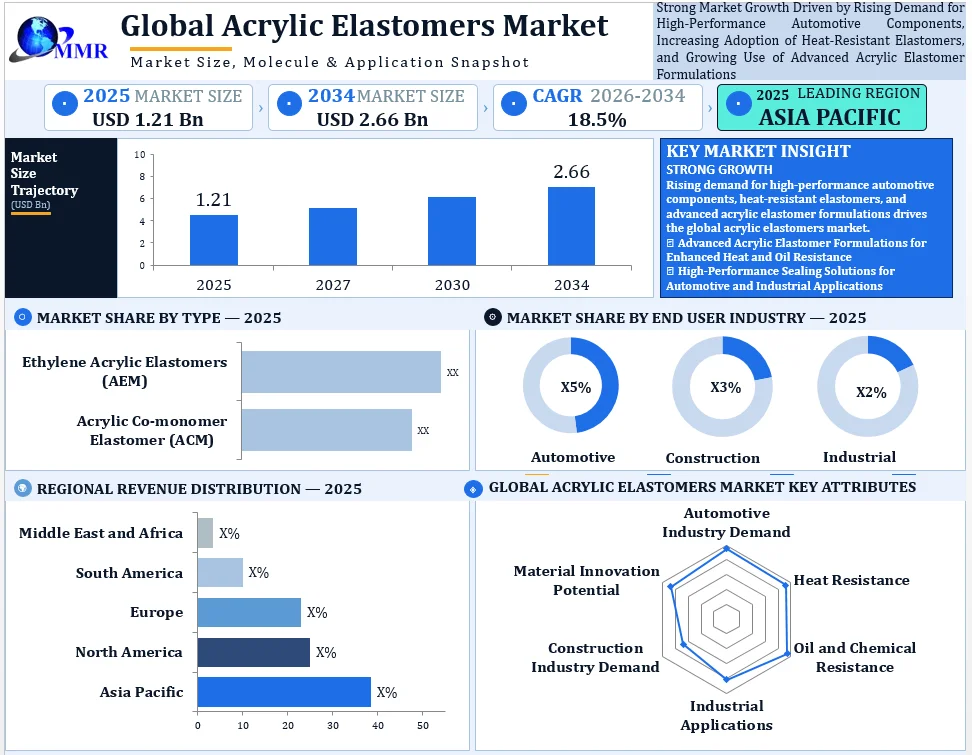
The Global Acrylic Elastomers Market is valued at USD 1.21 billion in 2025 and is projected to reach USD 2.66 billion by 2034, growing at a CAGR of 9.1% during the 2025–2034 forecast period.
Global Acrylic Elastomers Market Overview:
Acrylic elastomers are synthetic rubber materials known for their excellent oil resistance, heat resistance, weatherability, and durability under demanding operating conditions. These properties make them suitable for applications that require reliable performance under high temperatures and prolonged exposure to oils, lubricants, and automotive fluids. Acrylic elastomers serve as essential materials in automotive components, including oil seals, gaskets, hoses, O-rings, and other sealing systems. Their ability to maintain flexibility and sealing performance under challenging conditions supports their use in automotive engines, transmissions, and industrial equipment. In addition to conventional vulcanized rubber applications, acrylic elastomers find growing use in automotive manufacturing, industrial machinery, and specialized sealing solutions. Increasing demand for durable automotive components, improved engine efficiency, and materials that withstand harsh operating environments supports the expansion of the global acrylic elastomers market.
Global Acrylic Elastomers Market: Key Highlights
• The Global Acrylic Elastomers Market is valued at USD 1.21 billion in 2025 and is projected to reach USD 2.66 billion by 2034, registering a CAGR of 9.1% during the 2025–2034 forecast period.
• Asia Pacific leads the market due to expanding automotive manufacturing, rapid industrialization, and increasing demand for high-performance elastomer materials across China, Japan, India, and South Korea.
• Automotive represents a major end-use industry, driven by the growing use of acrylic elastomers in oil seals, gaskets, hoses, O-rings, and transmission components requiring excellent heat and oil resistance.
• Acrylic Co-monomer Elastomers (ACM) represent a key market segment due to their resistance to automotive oils, elevated temperatures, and demanding operating conditions.
• Technological advancements in elastomer formulations, increasing electric and hybrid vehicle production, and growing demand for durable industrial sealing components create opportunities for market expansion through 2034.
Global Acrylic Elastomers Market Growth Outlook
To know about the Research Methodology :- Request Free Sample Report
Global Acrylic Elastomers Market Dynamics:
Global Acrylic Elastomers Market Drivers
Growing Demand for High-Performance Automotive Components: The global acrylic elastomers market experiences increasing demand from the automotive industry because of their excellent resistance to heat, oils, lubricants, and oxidation. Manufacturers use acrylic elastomers in oil seals, gaskets, hoses, O-rings, and transmission components that require reliable performance under demanding operating conditions. In 2025, automotive applications account for 46.3% of the European acrylic elastomers market, highlighting the importance of automotive manufacturing in driving regional demand. Increasing demand for durable sealing materials in conventional vehicles, hybrid vehicles, and electric vehicles strengthens market growth.
Increasing Industrial Demand for Heat- and Oil-Resistant Elastomers: Industrial machinery, hydraulic systems, pumps, compressors, and fluid-handling equipment require elastomers that maintain their mechanical properties under elevated temperatures and exposure to industrial oils. Acrylic elastomers offer operating-temperature capabilities of up to 150°C in typical applications, with certain formulations supporting higher temperatures for limited periods. These properties encourage their use in industrial sealing systems, vibration-damping components, and specialized rubber products. Increasing demand for durable materials that improve component reliability and reduce maintenance requirements supports market expansion.
Global Acrylic Elastomers Market Restraints
Competition from Alternative Elastomer Materials: Acrylic elastomers face competition from silicone rubber, fluorocarbon elastomers, nitrile rubber, and thermoplastic elastomers. These materials offer different combinations of temperature resistance, flexibility, chemical compatibility, and processing characteristics. Manufacturers select materials according to application requirements, operating environments, and component costs. In applications requiring superior low-temperature flexibility or resistance to specific chemicals, alternative elastomers offer performance advantages that limit acrylic elastomer adoption.
Raw Material Costs and Manufacturing Complexity: Acrylic elastomer production depends on acrylic monomers, specialized additives, curing agents, and controlled processing methods that influence manufacturing costs. Fluctuations in feedstock prices and supply chain conditions create cost pressures for producers. Manufacturers also require precise formulation and curing processes to achieve consistent heat resistance, oil compatibility, flexibility, and mechanical strength. These requirements increase production complexity and create challenges for suppliers serving price-sensitive automotive and industrial applications.
Global Acrylic Elastomers Market Opportunities
Expanding Applications in Electric and Hybrid Vehicles: The expansion of electric and hybrid vehicle production creates opportunities for acrylic elastomers in specialized sealing systems, thermal management components, cooling circuits, and protective applications. Vehicle manufacturers require durable materials that withstand temperature fluctuations, lubricant exposure, and demanding operating conditions. Acrylic elastomer formulations designed for specific automotive fluids and operating environments support these requirements. Continued development of application-specific elastomer grades creates opportunities for material suppliers and automotive component manufacturers.
Development of Advanced Acrylic Elastomer Formulations: Advances in polymer formulation and crosslinking technologies create opportunities to improve the heat resistance, oil resistance, compression-set performance, and durability of acrylic elastomers. Manufacturers focus on developing formulations that maintain sealing performance under prolonged thermal exposure and repeated mechanical stress. Specialized grades with improved low-temperature flexibility and compatibility with modern automotive fluids expand the range of suitable applications. These developments create opportunities across automotive manufacturing, industrial equipment, and high-performance sealing applications.
Global Acrylic Elastomers Market Challenges
Maintaining Performance Under Extreme Operating Conditions: Acrylic elastomer manufacturers face challenges in balancing heat resistance, oil resistance, flexibility, and long-term mechanical stability. Components exposed to continuous thermal cycling, aggressive lubricants, and repeated compression require carefully optimized formulations. Performance limitations under specific low-temperature or chemical-exposure conditions restrict suitability across certain applications. Manufacturers invest in material testing, formulation development, and quality control to meet demanding component specifications and maintain product reliability.
Meeting Cost, Quality, and Application-Specific Requirements: Acrylic elastomer producers must maintain consistent material quality while managing raw material costs, processing requirements, and customer-specific performance specifications. Automotive and industrial component manufacturers require materials that meet strict durability, dimensional stability, and sealing standards. Differences in operating temperatures, fluid exposure, and mechanical stress also require application-specific formulations. Balancing production efficiency, cost competitiveness, and reliable performance remains a key challenge for manufacturers expanding acrylic elastomer adoption across automotive and industrial markets.
Global Acrylic Elastomers Market Segment Analysis:
By Type, the acrylic elastomers market is bifurcated into Acrylic Co-monomer Elastomer/ACM & Ethylene Acrylic Elastomers/AEM. The Acrylic Co-monomer Elastomer segment held the largest share of the acrylic elastomers market in 2025 and is expected to grow during the forecast period thanks to increasing demand for ACM in the Asia Pacific region.
By End-Use Industry, the market is bifurcated into automotive, construction, industrial. The automotive end-use industry segment accounted for the largest share of the acrylic elastomers market in 2025. Increasing use of acrylic elastomers to develop under-the-hood automotive components are expected to propel the demand of the automotive end-use industry segment. An increase in automobile production worldwide is fueling the growth of the automotive end-use industry segment of the acrylic elastomers market
Global Acrylic Elastomers Market Regional Insights:
Asia Pacific leads the global acrylic elastomers market, supported by strong automotive manufacturing, rapid industrialization, and expanding demand for high-performance elastomer materials. China, Japan, India, and South Korea contribute to regional demand through vehicle production, industrial equipment manufacturing, and the development of durable sealing components. Acrylic elastomers find extensive applications in automotive oil seals, gaskets, hoses, and O-rings because of their excellent heat resistance, oil resistance, flexibility, and durability. Growing investment in electric vehicles, manufacturing infrastructure, and advanced automotive components further strengthens the region’s market position.
North America represents a significant market for acrylic elastomers, driven by established automotive manufacturing, industrial machinery production, and demand for reliable sealing solutions. The United States, Canada, and Mexico support regional consumption through automotive component manufacturing and industrial applications that require resistance to heat, oils, lubricants, and harsh operating conditions. Increasing emphasis on vehicle durability, equipment reliability, and high-performance materials supports the adoption of acrylic elastomers across automotive and industrial sectors.
Europe maintains a strong position in the global acrylic elastomers market due to its established automotive industry, advanced engineering capabilities, and demand for high-quality industrial components. Germany, France, Italy, and the United Kingdom contribute through automotive production, machinery manufacturing, and specialized sealing applications. The region’s focus on vehicle efficiency, component durability, and stringent quality requirements encourages the use of acrylic elastomers in engine seals, transmission components, gaskets, and hoses.
South America presents growth opportunities for the acrylic elastomers market as automotive manufacturing, industrial activity, and demand for durable rubber components expand across the region. Brazil and Argentina contribute to demand through vehicle assembly, machinery applications, and industrial maintenance. The need for cost-effective materials with reliable heat and oil resistance supports the use of acrylic elastomers in automotive sealing systems and industrial equipment.
Middle East & Africa represents an emerging market for acrylic elastomers, supported by industrial development, infrastructure investment, and demand for durable components in machinery and fluid-handling systems. Expanding industrial operations, oil and gas activities, and equipment maintenance create opportunities for heat-resistant and oil-resistant elastomer products. Increasing investment in industrial facilities and automotive-related applications supports gradual market development across the region.
Competitive Positioning Framework
| Competitive Factor | Market Positioning and Strategic Focus |
|---|---|
| Product Performance | Manufacturers focus on improving heat resistance, oil resistance, flexibility, and long-term sealing performance to meet automotive and industrial requirements. |
| Automotive Applications | Companies strengthen their product offerings for oil seals, O-rings, gaskets, hoses, and transmission components to serve automotive component manufacturers. |
| Material Innovation | Product development emphasizes specialized elastomer grades with improved durability, compression-set resistance, and performance under demanding operating conditions. |
| Manufacturing Capabilities | Consistent product quality, reliable supply, efficient production processes, and technical support influence supplier selection. |
| Customer Relationships | Long-term supply agreements, application-specific technical assistance, and collaboration with component manufacturers support customer retention. |
| Regional Reach | Access to major automotive and industrial manufacturing hubs helps companies serve customers across Asia Pacific, North America, and Europe. |
Global Acrylic Elastomers Market Competitive Landscape
The global acrylic elastomers market features competition among established specialty chemical manufacturers and synthetic rubber producers, with companies focusing on product performance, heat and oil resistance, material durability, application-specific formulations, and automotive-grade elastomer solutions. Competitive positioning depends on manufacturers’ ability to deliver consistent material quality, meet demanding operating requirements, maintain cost efficiency, and establish long-term relationships with automotive component manufacturers and industrial customers. Key participants include Zeon Corporation, NOK Corporation, Denka Company Limited, Kuraray Co., Ltd., BASF SE, DuPont de Nemours, Inc., Arkema S.A., and Dow.
Global Acrylic Elastomers Market Scope: Inquire before buying
| Global Acrylic Elastomers Market | |||
|---|---|---|---|
| Report Coverage | Details | ||
| Base Year: | 2025 | Forecast Period: | 2026-2034 |
| Historical Data: | 2020 to 2025 | Market Size in 2025: | USD 1.21 Bn. |
| Forecast Period 2026 to 2034 CAGR: | 9.1% | Market Size in 2034: | USD 2.66 Bn. |
| Segments Covered: | by Type | Acrylic Co-monomer Elastomer/ACM Ethylene Acrylic Elastomers/AEM |
|
| by End-Use Industry | Automotive Construction Industrial |
||
Global Acrylic Elastomers Market, by Region
North America (United States, Canada and Mexico)
Europe (UK, France, Germany, Italy, Spain, Sweden, Austria, Turkey, Russia and Rest of Europe)
Asia Pacific (China, India, Japan, South Korea, Australia, ASEAN and Rest of APAC)
Middle East and Africa (South Africa, GCC, Egypt, Nigeria and Rest of ME&A)
South America (Brazil, Argentina, Columbia and Rest of South America)
Global Acrylic Elastomers Market, Key Players are
1. BASF SE
2. Dow Inc.
3. DuPont de Nemours, Inc.
4. Zeon Corporation
5. NOK Corporation
6. Trelleborg AB
7. DER-GOM S.r.l.
8. Denka Company Limited
9. Chengdu Dowhon Industry Co., Ltd.
10. Kuraray Co., Ltd.
11. Arkema S.A.
12. Eastman Chemical Company
13. ExxonMobil Corporation
14. H.B. Fuller Company
15. Nippon Shokubai Co., Ltd.
16. Mitsubishi Chemical Group Corporation
17. Celanese Corporation
18. LG Chem Ltd.
19. Momentive Performance Materials Inc.
20. Asahi Kasei Corporation
21. Evonik Industries AG
22. Solvay S.A.
23. The Lubrizol Corporation
24. LyondellBasell Industries N.V.
25. Kraton Corporation
26. SIBUR International GmbH
27. Teknor Apex Company
28. RTP Company
29. Aurora Plastics LLC
30. Biesterfeld AG
31. Shin-Etsu Polymer Co., Ltd.
32. Tosoh Corporation
33. Changzhou Haiba Ltd.
34. Seal & Design Inc.
35. Paromak
36. Air Products and Chemicals, Inc.
37. 3M Company
38. Hitachi, Ltd.
39. Covestro AG
40. Huntsman Corporation
Global Acrylic Elastomers Market: Frequently Asked Questions
1. What is the global acrylic elastomers market size in 2025?
Ans. The global acrylic elastomers market is valued at USD 1.21 billion in 2025.
2. What is the projected market size of acrylic elastomers by 2034?
Ans. The global acrylic elastomers market is projected to reach USD 2.66 billion by 2034, driven by increasing demand from automotive and industrial applications.
3. What is the CAGR of the global acrylic elastomers market during the forecast period?
Ans. The market is expected to grow at a CAGR of 9.1% from 2026 to 2034.
4. Which region dominates the global acrylic elastomers market?
Ans. Asia Pacific leads the global acrylic elastomers market, supported by strong automotive production, industrial development, and demand for high-performance sealing materials in China, Japan, India, and South Korea.
5. What are the major factors driving the global acrylic elastomers market?
Ans. The major growth drivers include increasing demand for heat- and oil-resistant automotive components, expanding industrial machinery applications, rising electric and hybrid vehicle production, and advancements in acrylic elastomer formulations.