
Acoustic Sensors Market – Industry Structure Evaluation, Demand Drivers Analysis, Regional Growth Analysis and Identification, Competitive Positioning Review & Global Market Size Forecast to 2034
Overview
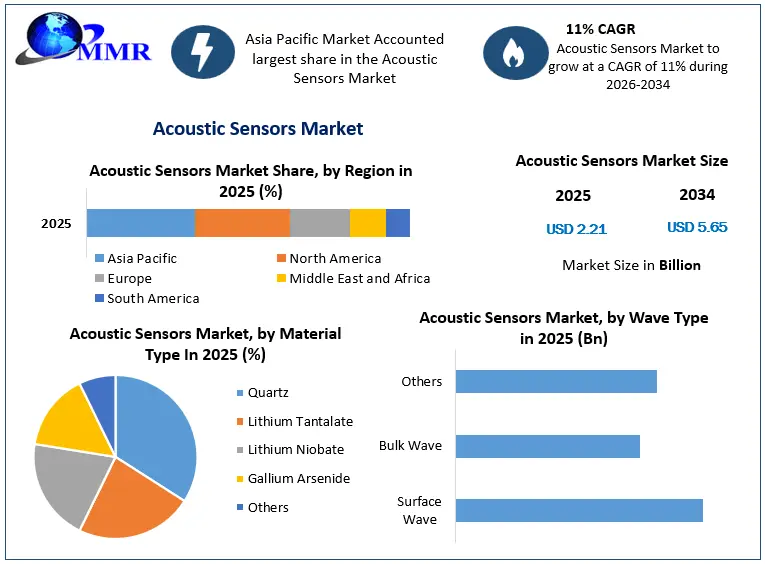
The Acoustic Sensors Market size was valued at USD 2.21 Billion in 2025 and the total Acoustic Sensors revenue is expected to grow at a CAGR of 11% from 2026 to 2034, reaching nearly USD 5.65 Billion.
Acoustic Sensors Market Overview:
Acoustic sensors are used to measure sound and frequency levels. Sound waves are converted into electrical impulses using acoustic sensors, often known as microphones or sound sensors. These sensors are designed to detect variations in air pressure based on sound waves and translate those variations into electrical signals that may be processed, stored, or sent. Acoustic sensors are frequently used by anti-drone systems to identify and track unregistered drones that are operating in forbidden zones. The technique becomes much more advantageous when paired with additional sensor systems, including radar or optical cameras, as this increases tracking and identification precision.
1. Global Acoustic Sensor Buyers & Importers Directory, there are 224 active Acoustic Sensor Importers in World Importing from 217 Suppliers.
2. SIEMENS LTD AUSTRALIA accounted for the maximum import market share with 77 shipments followed by SOCIEDAD MINERA CERRO VERDE SA A with 59 and COMPAL WISE ELECTRONIC VIETNAM COMPANY LIMITED was at the 3rd spot with 53 shipments.
The Acoustic Sensors Market report covers examination of various portions in the business. It examines the drivers, constraints, opportunities, and challenges that hinder the growth of the Acoustic sensors market. The examination in the report dives profoundly into the impacts of mechanical progressions, administrative structures, and industry patterns on the Acoustic sensors industry. In addition, the report provides an in-depth analysis of major players in the Acoustic sensors market, including their strategies and the landscape of competition.
Acoustic Sensors Market Growth Analysis
 To know about the Research Methodology :- Request Free Sample Report
Acoustic Sensors Market Dynamics:
Technological Advances and Market Development Driving Growth in the Global Acoustic Sensors Market
The global acoustic sensor market is witnessing an advancement in technologies and an inflow of investment throughout the world. Thanks to its high sensitivity and capabilities for wireless operations, it has a wide range of applications. The significant rise in the adoption of bulk acoustic wave (BAW) sensors owing to their increased use in consumer electronics, smartphones and laptops is driving the Acoustic Sensors Market growth.

The growth of the global acoustic sensors sector is driven by a rise in user industries like telecommunications and other related devices. MEMS is an innovative technology that transforms both industrial and consumer products through the integration of silicon microelectronics and micromachining technology.
The rising need for LTE, 4G, and 5G products, especially 5G mobile phones, is offering great growth opportunities for businesses offering acoustic sensor technology. RF filters have become common parts in these gadgets, as they separate radio signals in the various spectrum bands that different smartphones use for sending and receiving data. Advanced SAW filters outperform competing BAW filters in the sub-2.7 GHz frequency range, providing greater growth potential with the rise of 5G technology.

Challenges in Developing High-Precision, Energy-Efficient Acoustic Sensors for Critical Applications
Acoustic sensors need to have high sensitivity and accuracy to detect minute changes in sound waves, especially in applications like medical diagnostics and environmental monitoring. Achieving precision is technically demanding and often requires advanced materials and sophisticated manufacturing techniques.
Navigating complex regulatory landscapes, particularly for applications involving health, safety, and environmental monitoring, is challenging. Compliance with different regional regulations adds another layer of complexity. Also, Acoustic sensors, especially those used in portable or remote applications, need to be highly energy-efficient. Balancing performance with low power consumption is a significant challenge.
Acoustic Sensors Market Segment Analysis:
By Application, Consumer Electronics segment held the largest share in 2025 for the Acoustic Sensors Market. Acoustic sensors such as microphones and ultrasonic sensors, play a crucial role in consumer electronic products like smartphones, smart speakers, wearables, and home automation systems. Acoustic sensors are essential in consumer electronics like smartphones, smart speakers, headphones, and hearing helps as they change sound waves into electrical signals. These sensors play a crucial role in functions like voice recognition, noise cancellation, and improving sound quality.
PCB Piezotronics provides Vibration and Acoustic sensors to several of the largest global consumer electronics manufacturers. New and customized sensors for Acoustics and Vibration are continually rolling out with ever smaller sizes and increasing levels of performance. New PCB accelerometers continue to reach higher shock levels and new microphone models are being customized for unique applications requiring low noise floor levels, improved total harmonic distortion, and challenging environmental conditions.
Acoustic Sensors Market Regional Insight:
Asia Pacific held the largest share in 2025 for the Acoustic Sensors Industry. With the rise in smartphone, tablet, and electronic device usage in both developed and developing economies like the United States, China, South Korea, Japan, and India, acoustic sensors are projected to experience growth through the forecast period. Owing to the widespread use of acoustic sensors in consumer electronics, China dominates the acoustic sensors market in the Asia-Pacific region. The automotive, defence, and industrial sectors are also significant end-user segments that widely utilize acoustic sensors and have a strong presence in the area. Most renowned smartphone manufacturers adopt RF filters in their latest 5G smartphones, LG and Samsung are a few of these. The advancement in SAW sensors also enables more power-efficient RF paths in 5G and 4G multimode mobile devices at a lower cost point than competing commercial solutions with similar performance metrics for original equipment manufacturers (OEMs).
1. Acoustic sensor import shipments in the World stood at 886, imported by 262 World Importers from 257 Suppliers.
2. The world imports most of its Acoustic sensors from Japan, the United States and China
3. The top 3 importers of Acoustic sensors are India with 268 shipments followed by Vietnam with 248 and Peru at the 3rd spot with 149 shipments.
TOP 3 PRODUCT CATEGORIES OF ACOUSTIC SENSOR IMPORTS IN THE WORLD
HSN CODE 85423100: 85423100
HSN CODE 90318000: 90318000
HSN CODE 9026101200: 9026101200
Acoustic Sensors Market Recent Industry Developments:
| Date | Company | Development | Impact |
|---|---|---|---|
| 17 March 2025 | MBARI | Researchers deployed Geo-Sense, a portable instrument leveraging distributed acoustic sensing (DAS) technology, for long-term and high-resolution tracking of seafloor geological processes in Monterey Bay. | This development bridges critical geographic gaps in autonomous deep-sea observation, transforming underwater fiber-optic networks into dense seismic monitoring systems. |
| 31 March 2025 | Sintela | The company launched GeoSense, the world’s first specialized subsea distributed acoustic sensing (DAS) system, engineered to track underwater activities along seabed fiber arrays. | The system significantly bolsters subsea infrastructure protection by enabling the real-time detection of maritime threats like anchor drags, unauthorized interventions, and divers. |
| 02 April 2025 | Honeywell International Inc. | The corporation launched its Pro-Acoustic Series smart building sensor platform featuring built-in on-device AI classification for over 35 unique acoustic event categories. | This integration expands the capabilities of BMS architectures, optimizing workplace security compliance, structural safety, and edge-analytics processing. |
| 15 June 2025 | South Eastern Railway | The infrastructure operator completed a successful live trial of an AI-powered Elephant Intrusion Detection System (EIDS) that uses pressure wave acoustic sensors and fiber optics along the Chakradharpur division. | The deployment introduces automated vibration classification to mitigate ecological hazards, serving as a replicable blueprint for wildlife-sensitive mass transportation zones. |
| 05 March 2026 | NKT | The engineering firm unveiled an advanced cable health platform that integrates Distributed Acoustic Sensing (DAS) alongside temperature and depth monitoring systems. | This integrated solution improves power cable grid reliability, providing utilities with a multidimensional view of cable stress and real-time operational diagnostics. |
Acoustic Sensors Market Competitive Landscape:
The fast rate of advancement in sensor technologies requires the constant enhancement and updating of acoustic sensors to remain competitive. Numerous competitors in the market offer a range of acoustic sensors for various purposes, posing challenges for companies to gain a substantial Acoustic Sensors market share.
1. In December 2021, Microchip Technology Inc. announced a significant expansion of its Gallium Nitride (GaN) Radio Frequency (RF) power device portfolio with new MMICs and discrete transistors that cover frequencies of up to 20 gigahertz (GHz). The company's surface acoustic wave (SAW) sensors microelectromechanical systems (MEMS) oscillators, and highly integrated modules combine microcontrollers (MCUs) with RF transceivers (Wi-Fi MCUs) that support major short-range wireless communications protocols, from Bluetooth and Wi-Fi to LoRa.
2. In October 2021, Qualcomm announced a new filter solution, the ultraBAW RF filter. The ultraBAW is intended to differentiate signals from 2.7 GHz up to 7.2 GHz, enabling new 5G and Wi-Fi solutions. Qualcomm's ultraBAW and ultraSAW technology create a filter solution that covers a large portion of the radio spectrum. These filters add to Qualcomm's portfolio of RF solutions, including its modem-to-antenna RF system.
Acoustic Sensors Market Scope : Inquire before buying
| Global Acoustic Sensors Market | |||
|---|---|---|---|
| Report Coverage | Details | ||
| Base Year: | 2025 | Forecast Period: | 2026-2034 |
| Historical Data: | 2020 to 2025 | Market Size in 2025: | USD 2.21 Bn. |
| Forecast Period 2026 to 2034 CAGR: | 11% | Market Size in 2034: | USD 5.65 Bn. |
| Segments Covered: | by Type | Wired Wireless |
|
| by Wave Type | Surface Wave Bulk Wave Others |
||
| by Material Type | Quartz Lithium Tantalate Lithium Niobate Gallium Arsenide Others |
||
| by Application | Automotive Aerospace and Defence Consumer Electronics Healthcare Industrial Others |
||
Acoustic Sensors Market, by Region:
Asia Pacific (China, South Korea, Japan, India, Australia, Indonesia, Malaysia, Vietnam, Taiwan, Bangladesh, Pakistan and Rest of APAC)
Europe (UK, France, Germany, Italy, Spain, Sweden, Austria and Rest of Europe)
North America (United States, Canada and Mexico)
Middle East and Africa (South Africa, GCC, Egypt, Nigeria and Rest of ME&A)
South America (Brazil, Argentina Rest of South America)
Acoustic Sensors Market, Key Players
1. API Technologies Corp.
2. AVX Corp.
3. Burkert
4. Ceramtec.
5. Columbia Research Laboratories, Inc
6. CTS Corp.
7. ECS, Inc. International.
8. Siemens AG
9. Transense Technologies PLC
10. Honeywell Sensing and Productivity Solutions
11. Murata Manufacturing Co.Ltd.
12. Teledyne Microwave Solutions.
13. KYOCERA Corporation
14. Panasonic Corporation
15. EPCOS AG
FAQs:
1] What is the growth rate of the Acoustic Sensors Market?
Ans. The Acoustic Sensors Market is growing at a significant rate of 11% during the forecast period.
2]What was the Global Acoustic Sensors Market size in 2025?
Ans: The Global Acoustic Sensors Market size was USD 2.21 Billion in 2025.
3] What segments are covered in the Market report?
Ans. The segments covered in the market report are Types, Wave Type, Material and Application.
4] What are the factors driving the Acoustic Sensors Market growth?
Ans The global acoustic sensors industry is being propelled by increasing user industries such as telecom and similar devices.