
Abdominal Surgical Robot Market by Product Type, by Application, by End User and Regional Insights 2034
Overview
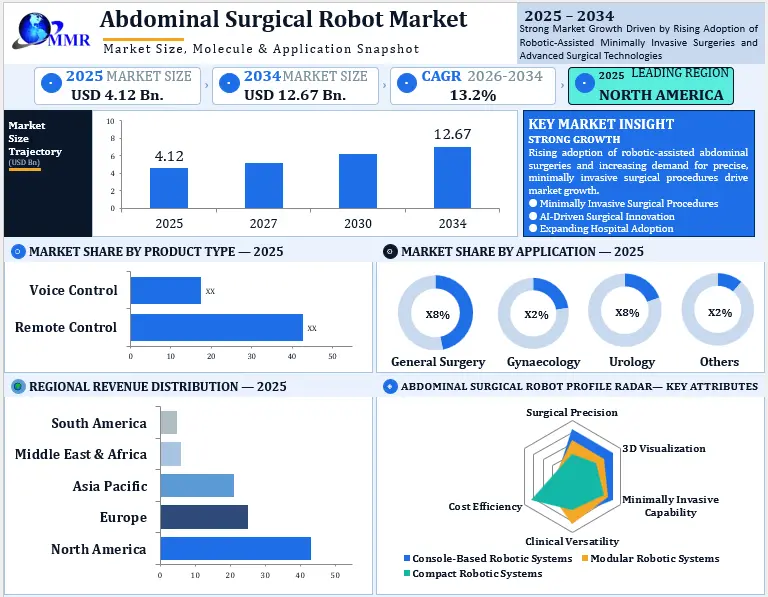
The Abdominal Surgical Robot Market size was valued at USD 4.12 Billion in 2025 and the total Abdominal Surgical Robot revenue is expected to grow at a CAGR of 13.2% from 2026 to 2034, reaching USD 12.67 Billion by 2034.
Global Abdominal Surgical Robot Market Overview
The Global Abdominal Surgical Robot Market comprises robotic-assisted surgical systems, instruments, and related technologies used to perform abdominal procedures with enhanced precision, flexibility, and visualization. These systems support minimally invasive surgeries across gastrointestinal, colorectal, bariatric, and hepatobiliary applications, enabling surgeons to operate through small incisions with improved instrument control and access to complex anatomical structures. Market growth is driven by the rising preference for minimally invasive procedures, increasing prevalence of gastrointestinal disorders and obesity, technological advancements in robotic platforms, and growing investments in advanced hospital infrastructure. Integration of artificial intelligence, 3D imaging, real-time navigation, and improved robotic instrumentation further supports market development. However, high acquisition and maintenance costs, limited availability of trained surgeons, and reimbursement challenges continue to restrict adoption in some healthcare settings.
North America is the leading region in the Global Abdominal Surgical Robot Market in 2025, supported by advanced healthcare infrastructure, high adoption of robotic-assisted surgery, substantial healthcare expenditure, and the presence of established medical technology companies. The United States contributes significantly to regional demand through investments in surgical innovation, surgeon training, clinical research, and the adoption of advanced robotic platforms. Increasing demand for minimally invasive abdominal procedures and continued product development are expected to support the region's market position throughout the forecast period.
Abdominal Surgical Robot is an advanced robotic technology for complex surgical procedures. Surgical robots are controlled by computer programs and help to position surgical instruments during surgery.
Global Abdominal Surgical Robot Market: Key Highlights
• Market Size: The global Abdominal Surgical Robot Market is valued at USD 4.12 billion in 2025 and is projected to reach USD 12.67 billion by 2034.
• Market Growth: The market is expected to grow at a CAGR of 13.2% during 2026–2034, driven by increasing adoption of robotic-assisted minimally invasive surgeries.
• Leading Region: North America holds the leading regional position in 2025, supported by advanced healthcare infrastructure, high robotic surgery adoption, and the presence of established medical technology companies.
• Key Growth Driver: Rising demand for precision, improved surgical visualization, reduced post-operative complications, and faster patient recovery supports market expansion.
• Emerging Opportunities: Expanding healthcare infrastructure in Asia Pacific, alongside growing demand for gastrointestinal, colorectal, bariatric, and hepatobiliary procedures, creates new growth opportunities.
Abdominal Surgical Robot Market Growth and Share Analysis
To know about the Research Methodology :- Request Free Sample Report
Global Abdominal Surgical Robot Market Dynamics:
Abdominal Surgical Robots Market Drivers
Rising Demand for Precision and Safety in Abdominal Surgeries: The growing prevalence of gastrointestinal disorders, obesity, and complex abdominal conditions is increasing demand for robotic-assisted surgical procedures. Advanced robotic systems improve surgical precision, provide enhanced 3D visualization, reduce hand tremors, and support minimally invasive techniques. Increasing hospital investments in advanced surgical infrastructure, rising patient preference for faster recovery, and continuous innovation in robotic instruments and imaging technologies further support market growth.
Abdominal Surgical Robots Market Restraints
High Initial Investment and Operational Costs: The high acquisition costs of robotic surgical systems limit adoption, particularly among small hospitals and healthcare facilities in developing regions. Additional expenses associated with maintenance, specialized instruments, software upgrades, and surgeon training increase the overall cost of ownership. Budget constraints and uncertainties regarding reimbursement for robotic-assisted procedures may also restrict widespread market penetration.
Abdominal Surgical Robots Market Opportunities
Expansion into Emerging Markets and New Surgical Applications: The expansion of healthcare infrastructure in emerging economies creates opportunities for abdominal surgical robot manufacturers. Increasing adoption of robotic-assisted gastrointestinal, colorectal, bariatric, and hepatobiliary surgeries supports demand for advanced surgical platforms. Developments in artificial intelligence, image-guided navigation, compact robotic systems, and cost-effective platforms also create opportunities to improve surgical accessibility and operational efficiency.
Abdominal Surgical Robots Market Challenges
Shortage of Skilled Surgeons and Integration Complexity: The limited availability of trained robotic surgeons and specialized operating-room teams remains a major challenge for market expansion. Surgeons require extensive training and practical experience to achieve proficiency, potentially slowing adoption. Integrating robotic systems with existing hospital infrastructure, surgical workflows, and digital imaging platforms can also create technical and operational difficulties. Manufacturers must address training requirements, system interoperability, and clinical validation to support broader adoption.
Abdominal Surgical Robots Market Trends
Growing Adoption of Minimally Invasive Robotic Surgery: The market is witnessing increasing adoption of robotic-assisted minimally invasive procedures because of improved visualization, enhanced dexterity, and better access to complex anatomical structures. Technological advancements in robotic arms, surgical instruments, real-time imaging, and AI-assisted guidance are expanding applications across gastrointestinal, bariatric, colorectal, and hepatobiliary surgeries. Growing hospital investments, surgeon training programs, and patient preference for less invasive procedures further strengthen this trend.
The report has profiled nineteen key players in the market from different regions. However, the report has considered all market leaders, followers and new entrants with investors while analyzing the market and estimation the size of the same. Increasing R&D activities in each region are different and focus is given on the regional impact on the cost, availability of advanced technology are analyzed and report has come up with recommendations for a future hot spot in APAC region.
Global Abdominal Surgical Robot Market Segment Analysis:
The global Abdominal Surgical Robot market is segmented on the basis of Product Type, Application and End-Users.
By Product Type, The Abdominal Surgical Robots Market is segmented into Remote Control and Voice Control. Remote Control systems represent an important segment as they enable surgeons to operate robotic instruments through specialized control consoles, providing enhanced precision, improved dexterity, and better visualization during complex abdominal procedures. Their adoption increases with the growing demand for minimally invasive surgeries and advanced robotic technologies. Voice Control systems support selected robotic functions through voice commands, improving operating-room workflow and reducing the need for manual interaction with certain controls. Their adoption depends on command accuracy, system compatibility, clinical validation, and operating-room conditions.
By Application, The Abdominal Surgical Robots Market is segmented into General Surgery, Gynaecology, Urology, and Others. General Surgery represents a major application segment due to the increasing use of robotic systems in gastrointestinal procedures, colorectal surgery, hernia repair, and bariatric surgery. Enhanced visualization, instrument flexibility, and precision support their adoption in complex abdominal procedures. Gynaecology benefits from robotic-assisted hysterectomy, myomectomy, and endometriosis treatment, where precise instrument movement improves access to confined anatomical areas. Urology utilizes robotic systems in prostate, kidney, bladder, and urinary tract procedures, supported by improved visualization and instrument control. The Others segment includes additional specialized surgical applications, where technological advancements and expanding clinical indications create opportunities for wider adoption.
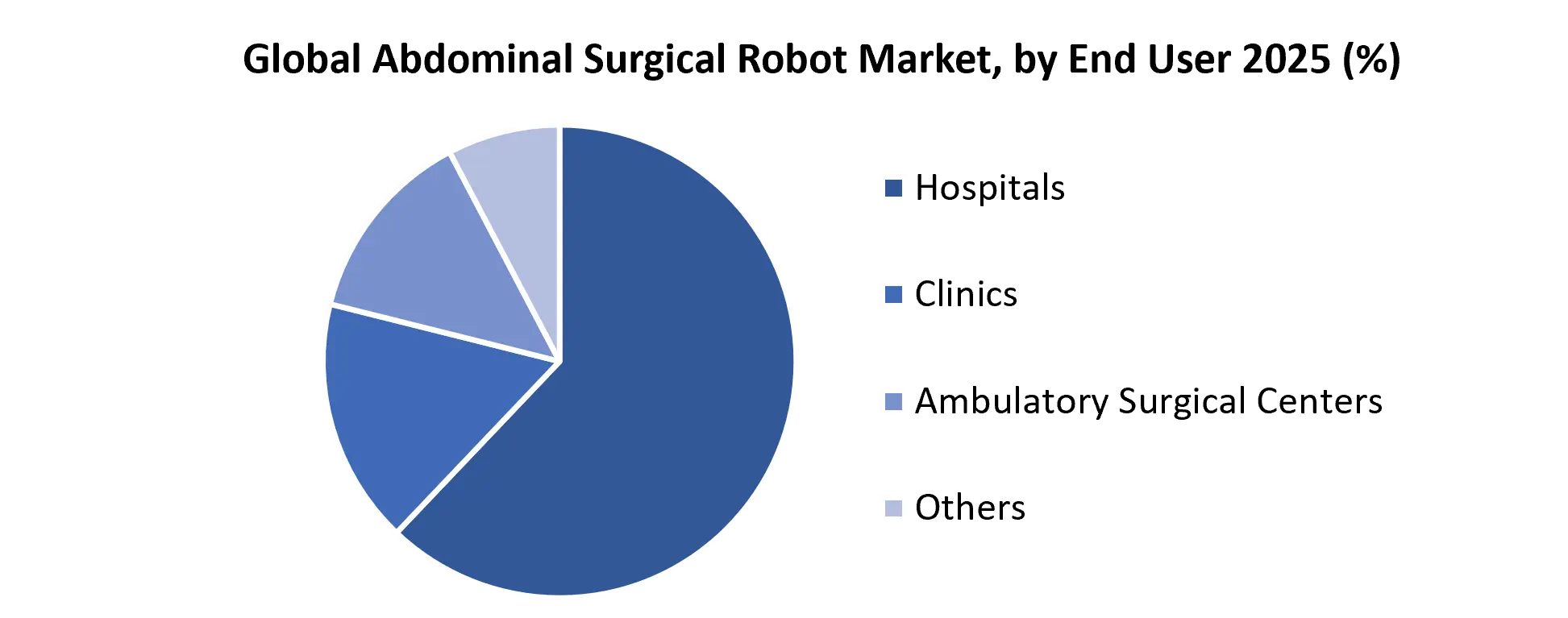
By End User, The Abdominal Surgical Robots Market is segmented into Hospitals, Clinics, Ambulatory Surgical Centers, and Others. Hospitals represent a key end-user segment because they handle complex surgical procedures and generally possess the infrastructure, specialized surgical teams, and financial resources required for robotic-assisted surgery. Increasing investment in advanced surgical technologies and multidisciplinary applications further supports adoption. Clinics contribute to market growth where suitable surgical procedures, trained professionals, and supporting infrastructure are available, although high installation and maintenance costs can limit adoption. Ambulatory Surgical Centers (ASCs) create opportunities for robotic-assisted procedures that support same-day discharge, improve workflow efficiency, and reduce the need for overnight hospitalization in eligible patients. The Others segment includes academic medical centers, research institutions, and specialized healthcare facilities that support robotic surgery through clinical research, surgeon training, and the development of new surgical techniques.
Global Abdominal Surgical Robot Market Regional Insights:
North America dominates the Abdominal Surgical Robots Market in 2025, supported by advanced healthcare infrastructure, high adoption of robotic-assisted minimally invasive surgeries, and substantial investments in surgical technologies. The United States leads the regional market because of its extensive installed base of robotic surgical systems, strong presence of leading manufacturers, established surgeon-training programs, and favorable reimbursement environment. Canada contributes through hospital modernization and growing adoption of advanced surgical procedures, while Mexico offers opportunities through private healthcare investment.
Europe represents a significant market for abdominal surgical robots due to its well-developed healthcare systems, increasing use of minimally invasive procedures, and growing investment in advanced surgical equipment. Countries such as Germany, the United Kingdom, France, Italy, and Spain support regional demand through hospital modernization, clinical research, and specialized surgical training. The presence of established medical technology companies and stringent medical-device standards encourages innovation and clinical validation. However, differences in healthcare budgets, reimbursement policies, and access to robotic systems across countries influence the pace of adoption. Europe is expected to maintain steady growth as hospitals expand robotic-assisted gastrointestinal, colorectal, urological, and gynaecological procedures.
Asia Pacific is expected to be the fastest-growing regional market for abdominal surgical robots, driven by expanding healthcare infrastructure, rising surgical volumes, increasing awareness of minimally invasive procedures, and growing investments in medical technology. China, Japan, and India represent important growth markets because of their expanding hospital networks, increasing demand for advanced surgical care, and growing participation of domestic and international robotic-system manufacturers. Japan benefits from advanced medical technology adoption, while China supports market development through hospital investment and domestic innovation. India presents opportunities as private hospitals and specialty surgical centers increasingly incorporate robotic-assisted procedures. High equipment costs and unequal access to specialized training remain important barriers.
The Middle East & Africa market is gradually expanding as healthcare providers invest in modern hospitals, advanced operating rooms, and robotic-assisted surgical capabilities. Saudi Arabia and the United Arab Emirates are important markets because of their investments in healthcare modernization, specialist medical facilities, and advanced treatment technologies. South Africa also contributes to regional adoption through established private hospitals and specialist surgical services. Increasing medical tourism, partnerships with international healthcare providers, and surgeon-training initiatives create further opportunities. However, high acquisition and maintenance costs, limited access to trained professionals, uneven healthcare infrastructure, and reimbursement constraints restrict widespread adoption. Future market growth depends on continued healthcare investment, improved access to robotic systems, and the development of local clinical expertise.
South America presents emerging opportunities for the Abdominal Surgical Robots Market, particularly in Brazil and Argentina, where major urban hospitals and private healthcare networks are investing in advanced surgical technologies. Growing demand for minimally invasive gastrointestinal, colorectal, and bariatric procedures supports interest in robotic-assisted surgery. Brazil represents an important market because of its comparatively extensive private hospital network and specialist surgical capabilities. Partnerships with international manufacturers, physician-training programs, and healthcare infrastructure improvements can further support adoption. Nevertheless, economic volatility, currency fluctuations, high equipment costs, unequal access to advanced medical services, and reimbursement limitations remain significant challenges. Wider availability of cost-effective robotic platforms and improved access to surgical training are likely to support future regional expansion.
The report also helps in understanding the Global Abdominal Surgical Robot Market dynamics, structure by analyzing the market segments and project the Global Abdominal Surgical Robot Market size. Clear representation of competitive analysis of key players by product, price, financial position, product portfolio, growth strategies, and regional presence in the Global Abdominal Surgical Robot Market make the report investor’s guide.
Global Abdominal Surgical Robot Market Competitive Landscape
Intuitive Surgical maintains a strong competitive position in robotic-assisted soft-tissue surgery through its da Vinci surgical systems, advanced visualization, articulated instruments, and established hospital adoption. The company competes through continuous platform innovation, surgeon training, clinical evidence, and a broad ecosystem of instruments and services. Its established presence in gastrointestinal, colorectal, and other abdominal procedures supports its position in the global abdominal surgical robot market.
Medtronic plc competes through its Hugo™ robotic-assisted surgery system and its broader medical technology portfolio. The company focuses on modular robotic architecture, digital surgical capabilities, and expansion into general surgery and other clinical specialties. Its established hospital relationships and global distribution network support market penetration, while regulatory approvals and clinical adoption remain important factors in its competitive growth.
Johnson & Johnson strengthens competition through its OTTAVA™ robotic surgical system, which targets soft-tissue procedures, including upper-abdominal surgery. The company's surgical technology expertise, hospital relationships, and investment in robotic innovation support its strategy to expand in the robotic-assisted surgery market. Its competitive position depends on clinical validation, regulatory progress, surgeon adoption, and differentiation from established robotic platforms.
CMR Surgical differentiates itself through its Versius robotic surgical system, which features a modular design intended to support flexible operating-room configurations and minimally invasive soft-tissue procedures. The company focuses on improving access to robotic surgery through system flexibility, clinical training, and international commercialization. Its emphasis on general surgery and abdominal procedures positions it as an emerging competitor to established robotic platforms, particularly as hospitals seek alternatives that fit different surgical environments.
Virtual Incision Corporation follows a differentiated strategy with its MIRA surgical robotic system, a compact platform designed to support minimally invasive abdominal procedures. Its smaller footprint offers potential advantages for hospitals and surgical facilities that face space constraints or seek alternatives to large conventional robotic installations. The company's competitive opportunity lies in portability, simplified operating-room integration, and expanding access to robotic-assisted abdominal surgery, although broader adoption depends on clinical evidence, regulatory status, and commercial deployment.
Global Abdominal Surgical Robot Market Recent Developments:
| No. | Company | Exact date | Key development | Market impact |
| 1 | Johnson & Johnson | January 7, 2026 | Submits the OTTAVA™ Robotic Surgical System to the U.S. FDA for authorization in multiple upper-abdominal general surgery procedures. | Advances regulatory progress for a new soft-tissue surgical robotics platform. |
| 2 | Medtronic | February 17, 2026 | Completes the first U.S. commercial surgery using its Hugo™ RAS system at Cleveland Clinic. | Marks the beginning of U.S. commercial use and expands competition in robotic-assisted surgery. |
| 3 | CMR Surgical | March 26, 2026 | Announces that more than 45,000 patients worldwide have been treated using its Versius robotic surgical system. | Demonstrates growing clinical utilization and supports international expansion. |
| 4 | Johnson & Johnson | May 5, 2026 | Announces pivotal clinical study results for OTTAVA, reporting that all 30 patients in the study undergo robotic procedures without conversion to a non-robotic approach. | Adds clinical evidence supporting the system's safety and procedural feasibility. |
| 5 | Medtronic | June 3, 2026 | Submits FDA 510(k) applications to expand Hugo RAS into general and gynaecological surgery. | Supports potential expansion into additional abdominal and pelvic surgical indications. |
| 6 | Johnson & Johnson | July 22, 2026 | Receives FDA De Novo authorization for OTTAVA for multiple upper-abdominal general surgery procedures. | Introduces a new authorized competitor in the soft-tissue robotic surgery market. |
| 7 | CMR Surgical and Stryker | October 12, 2026 | Announce a strategic alliance to advance robotic-assisted surgery. | Supports commercial expansion and intensifies competition among surgical robotics providers. |
Global Abdominal Surgical Robot Market Scope: Inquire before buying
| Global Abdominal Surgical Robot Market | |||
|---|---|---|---|
| Report Coverage | Details | ||
| Base Year: | 2025 | Forecast Period: | 2026-2034 |
| Historical Data: | 2020 to 2025 | Market Size in 2025: | USD 4.12 Bn. |
| Forecast Period 2026 to 2034 CAGR: | 13.2% | Market Size in 2034: | USD 12.67 Bn. |
| Segments Covered: | by Product Type | Remote Control Voice Control |
|
| by Application | General Surgery Gynaecology Urology Others |
||
| by End User | Hospital Clinics Ambulatory Surgical Centers Others |
||
Global Abdominal Surgical Robot Market, by Region
North America (United States, Canada, and Mexico)
Europe (UK, France, Germany, Italy, Spain, Sweden, Austria, and the Rest of Europe)
Asia Pacific (China, South Korea, Japan, India, Australia, ASEAN, Indonesia, Philippines, Malaysia, Vietnam, Thailand, ASEAN, Rest of Asia Pacific)
Middle East & Africa (South Africa, GCC, Nigeria, Rest of ME&A)
South America (Brazil, Argentina, Rest of South America)
Global Abdominal Surgical Robot Market, Key players
1. Auris Surgical Robotics
2. AVRA Surgical Robotics
3. Cambridge Medical Robotics
4. Intuitive Surgical
5. Mazor Robotics
6. Medrobotics
7. Meerecompany
8. OMNI
9. Virtual Incision Corporation
10. Restoration Robotics, Inc.
11. Medtronic plc
12. Smith & Nephew
13. THINK Surgical, Inc.
14. TransEnterix Surgical, Inc.
15. Accuray Incorporated
16. Stryker Corporation
17. Centerline Biomedical
18. Johnson & Johnson
19. Zimmer Biomet
20. Distalmotion SA
21. SS Innovations International, Inc.
22. Shanghai MicroPort MedBot (Group) Co., Ltd.
23. Medicaroid Corporation
24. Ronovo Surgical
25. Cornerstone Robotics
26. Noah Medical
27. Beijing Surgerii Robotics
28. Shenzhen Edge Medical
29. KARL STORZ SE & Co. KG
30. Moon Surgical
31. Asensus Surgical
32. Avatera Medical GmbH
33. Revolve Surgical
34. MicroPort
35. CMR Surgical
36. Johnson & Johnson MedTech
37. Procept BioRobotics Corporation
38. EndoQuest Robotics, Inc.
39. Levita Magnetics
40. Titan Medical Inc.
Frequently Asked Questions:
1. Which region has the largest share in Global Abdominal Surgical Robot Market?
Ans: North America region held the highest share in 2025.
2. What is the growth rate of Global Abdominal Surgical Robot Market?
Ans: The Global Abdominal Surgical Robot Market is growing at a CAGR of 13.2% during forecasting period 2026-2034.
3. What is scope of the Global Abdominal Surgical Robot Market report?
Ans: Global Abdominal Surgical Robot report helps with the PESTEL, PORTER, COVID-19 Impact analysis, Recommendations for Investors & Leaders, and market estimation of the forecast period.
4. Who are the key players in Global Abdominal Surgical Robot Market?
Ans: The important key players in the Global Abdominal Surgical Robot Market are – Intuitive Surgical, Medtronic plc, Johnson & Johnson, CMR Surgical, Virtual Incision Corporation, Medrobotics, Distalmotion SA, SS Innovations International, Shanghai MicroPort MedBot, Medicaroid Corporation, Ronovo Surgical, Cornerstone Robotics, Moon Surgical, and Asensus Surgical.
5. What is the study period of this Market?
Ans: The Global Abdominal Surgical Robot Market is studied from 2020 to 2034.