
Fibre Batteries Market Size by Type, Rechargeability, Capacity, End Use, Region, Industry-Wide Analysis, Competitive Landscape Assessment & Long-Term Forecast to 2032
Overview
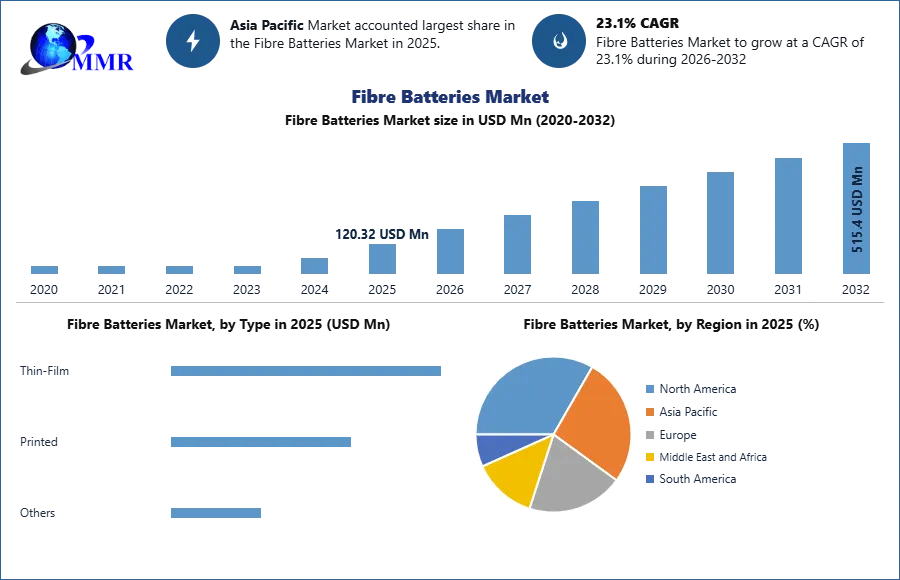
Fibre Batteries Market size was valued at USD 120.32 Mn. in 2025 and the total Fibre Batteries revenue is expected to grow by 23.1 % from 2026 to 2032, reaching nearly USD 515.4 Mn.
Fibre Batteries Market Overview:
Fibre batteries, also known as solid-state batteries or thin-film batteries, are a type of battery that uses fibre or thin-film materials to store and release electrical energy. Unlike traditional batteries, which use liquid or gel electrolytes, fibre batteries use solid electrolytes that enable faster charging, longer lifespan, and higher energy density. The global fibre batteries market is expected to experience significant growth in the forecast years, thanks to increasing demand for reliable and efficient power sources in various industries such as healthcare, automotive, and electronics. The growing adoption of electric vehicles, portable electronic devices, and renewable energy systems is also driving the demand for fibre batteries.
Asia-Pacific dominated the global Fibre Batteries Market thanks to the presence of major manufacturers and the increasing demand for electric vehicles in the region. Some of the key players in the fibre batteries market include PowerOasis Ltd, Infinite Power Solutions, Inc., ProLogium Technology Co., Ltd., and Blue Solutions SA. These companies are focusing on developing new products with higher energy density, longer lifespans, and faster charging capabilities to meet the growing demand from various industries.
To know about the Research Methodology :- Request Free Sample Report
Fibre Batteries Market Trends
Flexible and Stretchable Fibre Batteries Market to boosts as Wearable Technology Adoption Increases
The demand for wearable technology, such as smartwatches, fitness trackers, and health monitoring devices, is growing rapidly. These devices require power sources that are not only efficient and reliable but also flexible and stretchable to conform to the shape and movement of the human body. Flexible and stretchable fibre batteries are a promising solution to this challenge. These batteries use thin and flexible substrates, such as polymer films or textiles, and solid-state electrolytes to enable high energy density, fast charging, and long cycle life. They can be integrated into wearable devices without adding significant weight or bulk and can withstand repeated bending and stretching.
The demand for flexible and stretchable fibre batteries, which are a critical component of these devices. Companies in the fibre batteries market, such as ProLogium Technology Co., Ltd. and Lionrock Batteries, are already developing flexible and stretchable fibre battery technologies to meet this demand. As the adoption of wearable technology continues to grow, the demand for flexible and stretchable fibre batteries is expected to increase, driving further innovation and competition in the market.
Fibre Batteries Market Drivers
Growing Electric Vehicle Adoption to Drive Demand for Fibre Batteries
The adoption of EVs is increasing rapidly, driven by factors such as government incentives, stricter emissions regulations, and improvements in battery technology. However, conventional lithium-ion batteries used in EVs have limitations such as limited energy density, long charging times, and safety concerns. Fibre batteries offer several advantages over conventional batteries, such as higher energy density, faster charging times, and improved safety. They can also be shaped and moulded to fit the specific design requirements of EVs. Additionally, fibre batteries are environmentally friendly, as they can be recycled and do not contain harmful materials such as cobalt and nickel. As a result, fibre batteries are becoming an increasingly attractive option for EV manufacturers. For example, ProLogium Technology Co., Ltd. has partnered with several automotive manufacturers to develop EVs equipped with its solid-state fibre batteries. Prieto Battery, Inc. is also developing fibre battery technology for use in EVs.
Fibre Batteries Market Restraint
High Production Costs Pose a Challenge for Fibre Batteries Market Growth
Fibre batteries are a relatively new technology and require specialized production processes and equipment. The cost of producing fibre batteries is currently higher than that of traditional lithium-ion batteries, which limits their adoption in some applications. The high production costs are thanks to several factors, such as the cost of materials, equipment, and R&D. For example, fibre batteries require specialized materials such as solid-state electrolytes, which are more expensive than liquid electrolytes used in conventional batteries. The production process for fibre batteries is also more complex and requires specialized equipment, which adds to the cost.
As a result, fibre batteries are currently more expensive than traditional lithium-ion batteries, which limits their adoption in some applications. For example, the cost of fibre batteries may be prohibitive for consumer electronics such as smartphones and laptops, where cost is a critical factor. However, as the demand for fibre batteries grows and production volumes increase, it is expected that the cost of production will decrease. Companies in the fibre batteries market, such as ProLogium Technology Co., Ltd. and Prieto Battery, Inc., are already working to reduce the cost of production through process optimization and scaling up production.
Fibre Batteries Market Opportunity
Integration of Fibre Batteries with IoT Devices Creates New Opportunities for the Market
The IoT is a network of interconnected devices that communicate and exchange data with each other. These devices often rely on batteries for power, and there is a growing need for small, lightweight, and long-lasting batteries that can power IoT devices for extended periods. Fibre batteries offer several advantages for IoT devices, such as high energy density, fast charging, and long cycle life. Additionally, fibre batteries can be shaped and moulded to fit the specific design requirements of IoT devices. For example, fibre batteries can be integrated into smart sensors that are embedded in clothing, furniture, or infrastructure. Companies in the fibre batteries market, such as ProLogium Technology Co., Ltd. and Lionrock Batteries, are already working to develop fibre battery technologies that are specifically designed for IoT devices. As the adoption of IoT devices continues to grow, the demand for fibre batteries is expected to increase, creating new opportunities for the market. Moreover, the integration of fibre batteries with IoT devices is a significant opportunity for the fibre batteries market, as manufacturers seek to meet the growing demand for small, lightweight, and long-lasting power sources for their devices.
Fibre Batteries Market Segment Analysis:
Based on Type, the Thin-Film segment of the Fibre Batteries Market is dominating the market with 35% of the market share in the year 2025, the Thin-film batteries are a type of solid-state battery that uses a thin film of material as an electrolyte, which separates the cathode and anode. They are flexible, lightweight, and can be integrated into small devices such as smart cards, medical implants, and wearable devices. In recent years, the demand for thin-film batteries has increased due to their various advantages over traditional batteries, such as high energy density, long cycle life, and the ability to operate in a wide range of temperatures.
Printed batteries are a type of thin-film battery that uses printing technology to deposit materials onto a substrate, allowing for the creation of flexible and custom-shaped batteries. They are lightweight, and thin, and can be integrated into various applications such as smart packaging, wearable devices, and RFID tags. According to industry reports, the printed segment of the fibre batteries market is expected to grow significantly in the forecast period due to increasing demand for portable and wearable electronic devices. Printed batteries offer advantages over traditional batteries, including flexibility, low cost, and the ability to be integrated into a wide range of devices. However, it's important to note that market projections are subject to change based on various factors, such as technological advancements, competition, and changes in consumer demand.
Based on the Rechargeability, the Primary segment of the Fibre Batteries Market is dominating the market with 43% of the market share in the year 2025. Primary batteries, also known as non-rechargeable batteries, are batteries that cannot be recharged once they are fully discharged. They are commonly used in low-power devices such as remote controls, flashlights, and toys. Additionally, the primary batteries are still widely used in various applications due to their low cost, ease of use, and wide availability. They are also preferred for certain applications such as medical devices and safety equipment, where reliability and long shelf life are important factors.
Based on the Capacity, the Below 10 mAh segment of the Fibre Batteries Market is dominating the market with 28% of the market share in the year 2025, The below 10 mAh segment of the fibre batteries market refers to batteries with a capacity of fewer than 10 milliampere-hours (mAh). These batteries are commonly used in small electronic devices such as smart cards, RFID tags, and medical implants. Moreover, the demand for below 10 mAh batteries is expected to increase in the forecast period due to the growing adoption of small and portable electronic devices. These batteries offer advantages over traditional batteries such as high energy density, long cycle life, and the ability to operate in a wide range of temperatures. They also allow for the creation of smaller and more efficient devices.
Based on the End Use, the Below Consumer Electronics segment of the Fibre Batteries Market is dominating the market in the year 2025, The below consumer electronics segment of the fibre batteries market refers to batteries that are used in non-consumer electronic applications such as medical devices, industrial equipment, and automotive applications. However, the demand for fibre batteries in non-consumer electronic applications is expected to increase in the forecast period, thanks to their various advantages such as high energy density, long cycle life, and the ability to operate in a wide range of temperatures. They are also preferred for certain applications such as medical devices, where reliability and long shelf life are important factors. Additionally, fibre batteries offer advantages over traditional batteries in terms of flexibility, durability, and lightweight, making them suitable for various industrial and automotive applications.
Fibre Batteries Market Regional Insights:
Asia Pacific region dominated the market with 44% of the share in the year 2025 and is expected to continue its dominance during the forecast period. The Asia Pacific region has emerged as a dominant player in the fibre batteries market thanks to the presence of several prominent manufacturers and increasing demand for portable and wearable electronic devices. The region comprises countries such as China, Japan, South Korea, India, and Taiwan, which are major contributors to the growth of the fibre batteries market.
However, based on the market trends, it's expected that the region will continue to dominate the market during the forecast period due to factors such as increasing demand for smart devices, growing investments in renewable energy, and favourable government initiatives promoting the adoption of green technologies. Moreover, the region's strong manufacturing base, skilled workforce, and favourable business environment are expected to attract more investments in the fibre batteries market, leading to further growth in the forecast period.
The North America region is also a significant player in the fibre batteries market, with a market share of around 27% in the year 2025. The region's growth is attributed to the increasing demand for portable electronics, the adoption of electric vehicles, and the growing need for renewable energy storage solutions. For example, Tesla, a prominent electric vehicle manufacturer, has developed a fibre battery that is expected to have a longer lifespan than traditional lithium-ion batteries.
Europe is another important player in the fibre batteries market, with a market share of around 20% in the year 2025 The region's growth is driven by factors such as the increasing demand for energy-efficient products, the adoption of electric vehicles, and government initiatives promoting the use of renewable energy sources. For example, Volvo, a Swedish automaker, has introduced a new model of electric vehicles equipped with fibre batteries to increase their driving range and reduce their environmental impact.
The Middle East Africa region has a comparatively smaller market share in the fibre batteries market, accounting for around 6% in the year 2025. However, the region is expected to experience significant growth in the forecast period due to factors such as increasing investments in renewable energy and the growing demand for portable electronic devices. For example, Abu Dhabi Future Energy Company is investing in the development of sustainable technologies, including fibre batteries, to support the country's transition towards renewable energy sources.
South America is also a relatively smaller player in the fibre batteries market, accounting for around 3% of the market share in the year 2025. However, the region is expected to experience growth in the forecast period due to the increasing adoption of renewable energy sources and the growing demand for electric vehicles. For example, the Brazilian government has announced plans to increase the share of renewable energy in the country's energy mix, which is expected to drive the demand for fibre batteries.
Competitive Landscape:
The fibre batteries market is highly competitive, with several established players and new entrants vying for market share. The fibre batteries market is attracting significant investment from various sources, including venture capital firms, government agencies, and strategic investors. Here are some examples of recent investments in the market: These investments are enabling companies in the fibre batteries market to accelerate their R&D efforts, expand their production capacity, and pursue strategic partnerships and acquisitions. As a result, the market is seeing increasing innovation and competition, which is expected to drive further growth in the forecast period.
Fibre Batteries Market Scope: Inquiry Before Buying
| Fibre Batteries Market | |||
|---|---|---|---|
| Report Coverage | Details | ||
| Base Year: | 2025 | Forecast Period: | 2026-2032 |
| Historical Data: | 2020 to 2025 | Market Size in 2025: | 120.32 USD Billion |
| Forecast Period 2026-2032 CAGR: | 23.1% | Market Size in 2032: | 515.4 USD Billion |
| Segments Covered: | by Form Factor | Cylindrical Batteries Pouch Batteries Prismatic Batteries Laminated Batteries Others |
|
| by Type | Thin-Film Printed Others |
||
| by Battery Technology | Lithium-Ion Batteries Solid-State Batteries Polymer Batteries Alkaline Batteries Others |
||
| by Rechargeability | Primary Secondary |
||
| by Capacity | Below 10 mAh 10 mAh -100 mAh Above 100 mAh |
||
| by Application | Consumer Electronics Automotive Energy Storage Systems Medical Devices Others |
||
| by Distribution Channel | Online Channel Offline Channel |
||
Fibre Batteries Market by Region
North America (United States, Canada, and Mexico)
Europe (UK, France, Germany, Italy, Spain, Sweden, Austria, and the Rest of Europe)
Asia Pacific (China, South Korea, Japan, India, Australia, Indonesia, Malaysia, Vietnam, Taiwan, Bangladesh, Pakistan, and the Rest of APAC)
Middle East and Africa (South Africa, GCC, Egypt, Nigeria, and the Rest of ME&A)
South America (Brazil, Argentina Rest of South America)
Key players/Competitors profiles covered in the Fibre Batteries Market report in strategic perspective
1.PowerOasis Ltd
2.Infinite Power Solutions, Inc.
3.ProLogium Technology Co., Ltd.
4.Blue Solutions SA
5.Prieto Battery, Inc.
6. Cymbet Corporation
7.Paper Battery Company, Inc.
8. Ilika plc
9.Cap-XX Limited
10.NEI Corporation
11. Excellatron Solid State, LLC
12.Lionrock Batteries
13.BrightVolt Inc.
14.Nohm Technologies Inc.
15.FlexEl LLC
16. Front Edge Technology, Inc.
17.Faradion Ltd.
18. Jenax Inc.
19.QinetiQ
20. Ultralife Corporation