
Global Fatty Amines Market by Segments, Country, and Region - Global Market Size Estimation, Industry-Wide Analysis, Competitive Landscape Assessment & Long-Term Forecast to 2032
Overview
Fatty Amines Market is expected to grow at a CAGR of 6.75% during the forecast period. Global Fatty Amines Market is expected to reach US$ 7.35 Bn by 2032.
The global Fatty Amines market report is a comprehensive analysis of the industry, market, and key players. The report has covered the market by demand and supply-side by segments. The global Fatty Amines report also provides trends by market segments, technology, and investment with a competitive landscape.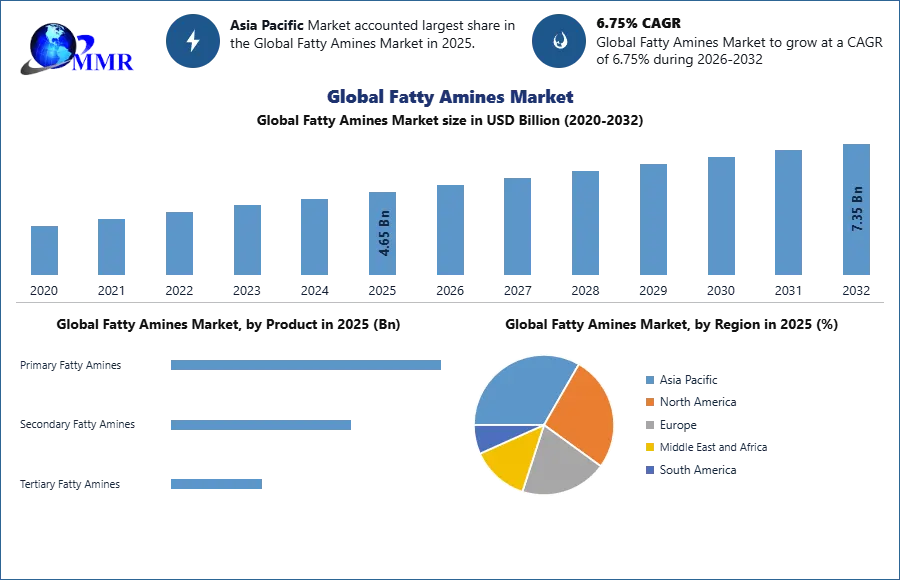 To know about the Research Methodology :- Request Free Sample Report
Fatty Amines Market Overview:
The Fatty amines are the nitrogen derivatives of alcohols, fatty acids, and olefins, manufactured from natural sources, petrochemical raw materials, and fats and oils. Fatty amines are cationic surface-active compounds, which obey surfaces by either chemical or physical bonds. Commercial products are manufactured using fatty amines as reactive intermediates.
Fatty Amines Market Dynamics:
Growing demand for electric vehicle
The alteration towards electric vehicles in the industrialized and emerging nations would help in the growth of present IC engine vehicles and also help the fatty amines market over the forecast timeframe as fatty amines are also used as a lubricant. According to IEA, Norway, the Netherlands and Japan are leaders in the electronic vehicles section.
Norway held the share of 46 % in terms of the global new electric car sales as reported by IEA in 2019. To meet zero-emission targets under the "Paris Climate Accord", in 2017, France government has announced that it will ban diesel and gasoline-powered vehicles completely and switch to electric-powered vehicles by 2040.
Increasing demand for emulsifiers
High levels of demand from agrochemicals application due to the benefits of fatty amines as emulsifiers, is expected to propel the growth of the Fatty Amines market.
An emulsion is a mixture of two or more liquids that are normally immiscible (unmixable or unbendable). Emulsions are part of a more general class of two-phase systems of matter called colloids. Although the terms colloid and emulsion are sometimes used interchangeably, emulsion should be used when both phases, dispersed and continuous, are liquids.
In an emulsion, one liquid (the dispersed phase) is dispersed in the other (the continuous phase). Examples of emulsions include vinaigrettes, homogenized milk, and some cutting fluids for metalworking.
Segment Analysis:
By Product, the segment is divided into Primary, Secondary, and Tertiary. The primary fatty amines are estimated to witness the fastest growth owing to their quality of being used as a basic raw material to produce secondary and tertiary amines, which is anticipated to drive the growth of this product in the forthcoming years.
Additionally, tertiary amines are used as ore floatation, fuel additives, chemical intermediate, and corrosion inhibitors, accelerating the demand for tertiary fatty amines. The primary segment is expected to reach 120.1 kilotons by 2029 owing to the growing demand from developed economies such as North America and Europe. Moreover, tertiary fatty amines have emerged as the largest application segment owing to the significant rise in demand for the product from developed and developing economies due to its wide-ranging abilities.
Furthermore, the U.S. market is anticipated to witness steady growth owing to the high demand for the tertiary product, which is utilized in various end-use products.
By Application, the Segment is categorized as Agrochemicals, Oilfield Chemicals, Chemical Processing, Water Treatment, Asphalt Additives, Personal Care, and Others. The agrochemicals end-use segment is projected to lead the market during the forecast period in terms of both, value and volume.
The growth of this segment can be attributed to the increase in the global demand for nutritious and high-quality food and the limited availability of arable land—this is driving the demand for agrochemicals, thus propelling the demand for the agrochemicals end-use segment of the fatty amines market.
Fatty Amines Market Regional Insights:
Asia Pacific Region is dominating the fatty amines market in terms of both consumption and production. The fatty amines market is anticipated to witness an increase in demand from India, China, and other countries in the Asia Pacific region. Countries like China, Japan, and Thailand's increasing emphasis on wastewater treatment facilities and growing demand for personal care and beauty care products are expected to fuel the fatty acid market in Asia pacific.
North America holds a prominent share as this region has a large presence of detergents and surfactant manufacturers and contributes significantly to production. Europe is seeing strong growth due to household use and personal care goods.
The objective of the report is to present a comprehensive analysis of the global market to the stakeholders in the industry. The past and current status of the industry with the forecasted market size and trends are presented in the report with the analysis of complicated data in simple language. The report covers all the aspects of the industry with a dedicated study of key players that include market leaders, followers, and new entrants.
PORTER, SVOR, PESTEL analysis with the potential impact of micro-economic factors of the market have been presented in the report. External as well as internal factors that are supposed to affect the business positively or negatively have been analyzed, which will give a clear futuristic view of the industry to the decision-makers.
The report also helps in understanding the global market dynamics, structure by analyzing the market segments and project the global market size. Clear representation of competitive analysis of key players by Type, price, financial position, Type portfolio, growth strategies, and regional presence in the global market make the report investor’s guide.
Fatty Amines Market Recent Developments:
| Exact Date | Company | Development | Impact |
|---|---|---|---|
| 25 February 2026 | European Commission | The Commission officially enforced definitive anti-dumping duties on imports of fatty amines originating from China to protect EU manufacturers. | This measure stabilizes the regional pricing landscape and prevents unfair market competition for European producers like Arkema and Nouryon. |
| 31 January 2026 | India Glycols Limited | The company successfully acquired a UK-based chemicals firm to facilitate its global fatty amine production expansion. | The move significantly increases the company's international manufacturing footprint and provides enhanced access to European specialty chemical markets. |
| 15 January 2026 | Evonik Industries | Evonik introduced a new line of low-VOC alkylamines specifically formulated for the coatings and construction sectors in Europe. | This launch addresses stringent environmental regulations and the growing demand for sustainable building materials across the continent. |
| 23 October 2025 | Huntsman Corporation | Huntsman commissioned a new specialty amines plant in Texas, prioritizing the production of oilfield and water treatment chemicals. | The facility enhances domestic supply chain resilience and supports the high demand for corrosion inhibitors in North American shale operations. |
| 08 July 2025 | Dow Inc. | Dow launched a sustainable line of bio-based fatty amines derived from renewable feedstocks for use in surfactant applications. | This development supports the industry's shift toward green chemistry and meets the rising consumer preference for eco-friendly personal care products. |
| 15 May 2025 | Akzo Nobel N.V. | The company acquired a regional fatty amines producer in India to consolidate its presence in the Asian agrochemical and personal care markets. | The strategic acquisition targets the rapidly growing demand for high-purity surfactants and emulsifiers in the Asia-Pacific agricultural sector. |
Fatty Amines market, Key Highlights:
Global Fatty Amines market analysis and forecast, in terms of value.
Comprehensive study and analysis of market drivers, restraints and opportunities influencing the growth of the Global market
The Global market segmentation on the basis of type, source, end-user, and region (country-wise) has been provided.
Global market strategic analysis with respect to individual growth trends, future prospects along with the contribution of various sub-market stakeholders have been considered under the scope of study.
Global market analysis and forecast for five major regions namely North America, Europe, Asia Pacific, the Middle East & Africa (MEA) and Latin America along with country-wise segmentation.
Profiles of key industry players, their strategic perspective, market positioning and analysis of core competencies are further profiled.
Competitive developments, investments, strategic expansion and competitive landscape of the key players operating in the Global market are also profiled.
Fatty Amines Market Scope: Inquire before buying
| Global Fatty Amines Market | |||
|---|---|---|---|
| Report Coverage | Details | ||
| Base Year: | 2025 | Forecast Period: | 2026-2032 |
| Historical Data: | 2020 to 2025 | Market Size in 2025: | 4.65 USD Billion |
| Forecast Period 2026-2032 CAGR: | 6.75% | Market Size in 2032: | 7.35 USD Billion |
| Segments Covered: | by Product | Primary Fatty Amines Secondary Fatty Amines Tertiary Fatty Amines |
|
| by Application | Agrochemicals Oilfield Chemicals Asphalt additives Anti-caking Water Treatment Chemical Synthesis Personal Care Household Others |
||
| by Function | Emulsifiers Floatation Agents Anti-caking Agents Dispersants Corrosion Inhibitors Chemical Intermediates Others |
||
Fatty Amines Market, by Region
Asia Pacific (China, South Korea, Japan, India, Australia, Indonesia, Malaysia, Vietnam, Taiwan, Bangladesh, Pakistan and Rest of APAC)
Europe (UK, France, Germany, Italy, Spain, Sweden, Austria and Rest of Europe)
North America (United States, Canada and Mexico)
Middle East and Africa (South Africa, GCC, Egypt, Nigeria and Rest of ME&A)
South America (Brazil, Argentina Rest of South America)
Key Players
1. Cargill Incorporated
2. Archer Daniels Midland Company
3. Glanbia plc
4. Kerry Group plc
5. Roquette Frères
6. Ingredion Incorporated
7. Fonterra Co-operative Group Limited
8. Arla Foods Ingredients Group P/S
9. Koninklijke DSM-Firmenich N.V.
10. FrieslandCampina Ingredients
11. International Flavors & Fragrances Inc.
12. Abbott Laboratories (Abbott Nutrition)
13. AMCO Proteins
14. Essentia Protein Solutions
15. Kemin Industries Inc.
16. SunOpta Inc.
17. Omega Protein Corporation
18. Merit Functional Foods
19. Plantible Foods Inc.
20. Proti-Farm Holding NV
21. Herbalife Ltd.
22. Nature’s Bounty Co. (Nestlé Health Science)
23. Amway Corporation
24. John Pointon & Sons Ltd.
25. Hilmar Cheese Company Inc
26. Axiom Foods Inc.
27. Burcon NutraScience Corporation
28. Bunge Limited
29. Tate & Lyle PLC
30. Scoular Company
Others