
Europe Embedded Security Market– Industry Structure Evaluation, Demand Drivers Analysis, Growth Analysis and Identification, Competitive Positioning Review & Market Size Forecast to 2032
Overview
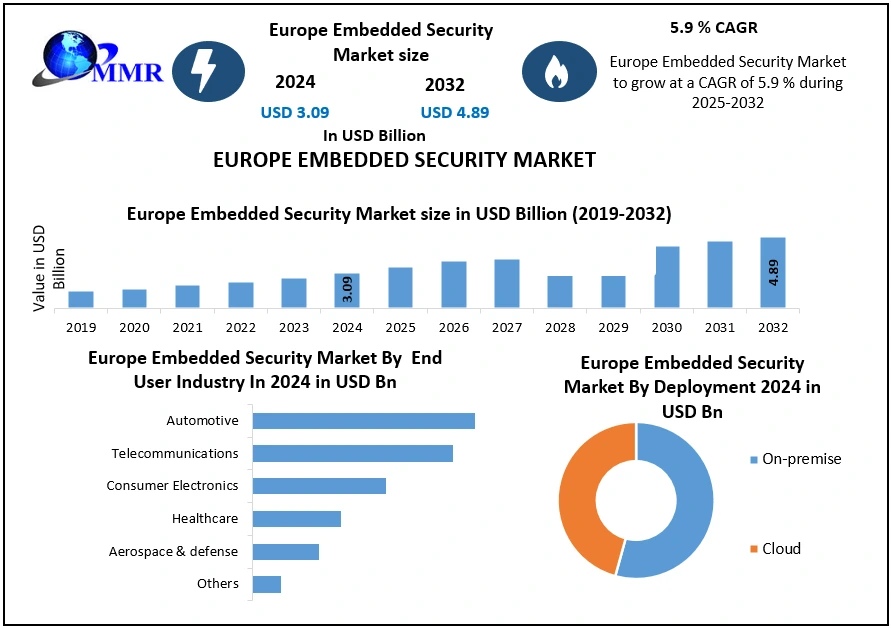
The Europe Embedded Security Market size was valued at USD 3.09 billion in 2024, and the total Revenue is expected to grow at a CAGR of 5.9 % from 2025 to 2032, reaching nearly USD 4.89 billion.
Europe Embedded Security Market Overview:
The MMR report provides an extensive analysis of the Europe Embedded Security Market, covering the regional threat landscape, including IoT/device attacks, data breach trends, ICS attack rates, and emerging vectors such as AI/ML-enabled malware and firmware exploits. It examines protection and resilience frameworks, encompassing EU regulatory initiatives like NIS2 and the Cyber Resilience Act, breach response strategies, proactive monitoring, and employee training programs. The report also analyzes adoption metrics and market penetration by enterprise size and industry, integration with existing IT infrastructure, ROI and cost-benefit considerations, and key adoption barriers. Pricing, licensing, and business models are evaluated, including hardware versus software approaches, tiered pricing, TCO, and the shift toward subscription-based models. the study covers the patent and innovation landscape, technological advancements in secure boot, firmware protection, AI/ML-based intrusion detection, cloud-edge security approaches, and trusted execution environments. The ecosystem and vendor landscape, investment trends, M&A activities, and strategic collaborations are also detailed, alongside the regulatory and compliance framework encompassing GDPR, industry-specific standards, Cyber Resilience Act implications, and AI transparency considerations, providing a 360-degree view for strategic decision-making.
The report includes the analysis of impact of COVID-19 lock-down on the revenue of market leaders, followers, and disrupters. Since lock down was implemented differently in different regions and countries, impact of same is also different by regions and segments. The report has covered the current short term and long term impact on the market, same will help decision makers to prepare the outline for short term and long term strategies for companies by region.
 To know about the Research Methodology :- Request Free Sample Report
Embedded system security is an important process used to reduce the vulnerabilities along with providing protection against different threats in software that are running on embedded devices. It is mostly found in IT fields, and the embedded system security further comprises of a conscientious approach for making hardware design along with coding as well as added security software thereby giving an adherence for best practices with the experts.
The Europe embedded security market is segmented into security type, product, and application. Based on security type, the market is classified into content protection, authentication and access management, and payment. On the basis of product, the market for embedded security includes hardware security module, secure element and embedded sim, hardware tokens, and trusted platform module. Automotive, industrial, wearables, smart identity cards, smartphones and tablets, computers, payment processing and cards are the various application areas for embedded security market in Europe.
Countries in Europe understand the importance of embedded security and each year the embedded world exhibition and conference in Nuremberg offers the embedded companies an opportunity to gather information regarding new products as well as innovations further developing valuable contacts within the industry. Synopsys Software Integrity Group (SIG) for example provides a platform of technologically advanced solutions to improve the quality and security of software. Application of this platform includes automated analysis along with testing of technologies that are integrated seamlessly within the software development process. This further enables organizations to detect as well as remediate defects, vulnerabilities, or any sort of compliance issues throughout the software development lifecycle further boosting the importance of embedded systems and its security.
The benefits of embedded security are huge. These risks are substantial with the catastrophic consequences in today’s world. These security systems are linked through the Internet of Things security that remains a broad issue with multiple dimensions. Protection against reverse engineering, software replication prevented, maximum integrity protection of the application, feature-on-demand activation, and flexible management of access rights are some of the security functions delivered by the embedded security.
Europe has been one of the key region when it comes to technological development and usage of new technologies and security systems for various industry verticals. Optimizing the industrial function and smart connected devices are some of the major factors to drive the Embedded Security application hugely for Embedded Security in Europe.
Europe Embedded Security Market Segment Analysis
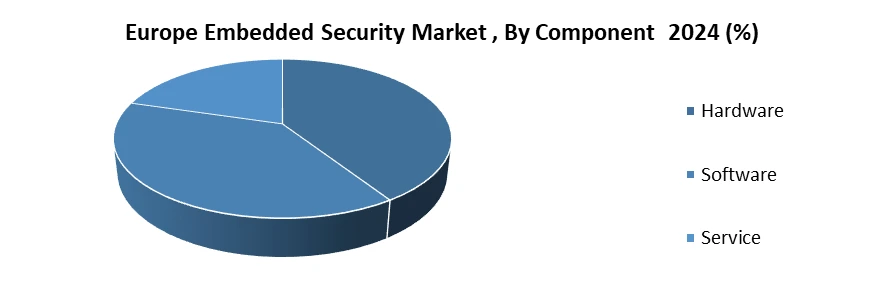
Based on the Component, In 2024, Hardware is expected to dominate the Europe Embedded Security Market, driven by the widespread use of secure elements (SEs), Trusted Platform Modules (TPMs), and Hardware Security Modules (HSMs) across automotive, industrial, and IoT applications. The emphasis on device-level protection, tamper resistance, and cryptographic key storage makes hardware-based solutions essential for compliance with stringent European cybersecurity regulations. Software holds a significant share owing to its critical role in managing firmware protection, authentication protocols, and real-time threat monitoring, enabling flexible integration with existing enterprise security architectures. Meanwhile, the Service segment including consulting, integration, and managed security services is witnessing rapid growth as enterprises seek expert support for implementing and maintaining embedded security frameworks, particularly in cloud-connected and legacy system environments. Overall, Hardware leads in market value due to its foundational role in secure device architecture, while Service is projected to grow the fastest, driven by increasing demand for customization, lifecycle management, and regulatory compliance across Europe.
Based on the Security Type, In 2024, Authentication and Access Management is expected to dominate the Europe Embedded Security Market due to its widespread integration across automotive, industrial, and consumer electronics applications to ensure device identity, secure boot, and user authentication in compliance with GDPR and NIS2 directives. Payment security holds a substantial share, driven by the proliferation of digital payments, contactless transactions, and secure elements in POS terminals, wearables, and mobile devices. Content Protection is gaining importance with the expansion of digital media, OTT platforms, and connected entertainment systems requiring encryption and DRM technologies to safeguard intellectual property. Others, including secure communication protocols, data encryption modules, and firmware protection solutions, contribute to specialized industrial and defense-grade applications. Overall, Authentication and Access Management leads in value and deployment breadth, while Payment and Content Protection segments are poised for faster growth, supported by regulatory compliance, fintech innovation, and rising demand for secure digital ecosystems across Europe.

Europe Embedded Security market Key Highlights:
• Europe Embedded Security market size analysis and forecast
• Comprehensive study and analysis of market drivers, restraints, and opportunities influencing the growth of the Europe Embedded Security market
• Europe Embedded Security Market segmentation on the basis of security type, product, application, and geography
• Europe Embedded Security Market strategic analysis with respect to individual growth trends, future prospects along with the contribution of various sub-market stakeholders have been considered under the scope of the study
• Europe Embedded Security Market analysis and forecast for major countries has been provided.
• Profiling of key industry players, their strategic perspective, and analysis of core competencies
• Competitive landscape of the key players operating in the Europe Embedded Security Market including competitive developments, investments, and strategic expansion
Years that have been considered for the study are as follows:
• Base Year – 2018
• Estimated Year – 2019
• Forecast Period – 2019 to 2026
For company profiles, 2016 has been considered as the base year. In cases, wherein information was unavailable for the base year, the years prior to it have been considered.
Europe Embedded Security market Research Methodology:
The market is estimated by triangulation of data points obtained from various sources and feeding them into a simulation model created individually for each market. The data points are obtained from paid and unpaid sources along with paid primary interviews with key opinion leaders (KOLs) in the market. KOLs from both, demand and supply side were considered while conducting interviews to get the unbiased idea of the market. This exercise was done at the country level to get the fair idea of the market in countries considered for this study. Later this country-specific data was accumulated to come up with regional numbers and then arrive at the market value for Europe Embedded Security Market
Europe Embedded Security market Key Target Audience:
• Embedded security technology platform developers
• Raw material and material testing equipment suppliers
• Embedded security original design manufacturers (ODMs)
• Embedded security original equipment manufacturers (OEMs)
• End-users/enterprise-users
• Research institutes and organizations
• Government bodies, venture capitalists, and private equity firms
• Market research and consulting firms
• Enterprise data center professionals
The Scope of the Europe Embedded Security Market: Inquire before buying
| Europe Embedded Security Market | |||
|---|---|---|---|
| Report Coverage | Details | ||
| Base Year: | 2024 | Forecast Period: | 2025-2032 |
| Historical Data: | 2019 to 2024 | Market Size in 2024: | USD 3.09 Bn. |
| Forecast Period 2025 to 2032 CAGR: | 5.9% | Market Size in 2032: | USD 4.89 Bn. |
| Segments Covered: | by Component | Hardware Secure Element Embedded SIM Trusted Platform Modules Hardware Security Modules Hardware Token Software Service |
|
| by Security Type | Authentication And Access Management Payment Content Protection Others |
||
| by Deployment | On-premise Cloud |
||
| by End-User | Automotive Healthcare Consumer Electronics Telecommunications Aerospace & defense Others |
||
Europe Embedded Security Market, by Region
• Europe
• UK
• Germany
• Italy
• France
• Russia
• Spain
• Others
Europe Embedded Security market Geographic Analysis:
• Breakdown of UK Embedded Security market
• Breakdown of Germany Embedded Security market
• Breakdown of Italy Embedded Security market
• Breakdown of France Embedded Security market
• Breakdown of Russia Embedded Security market
• Breakdown of Spain Embedded Security market
• Breakdown of Others Embedded Security market
Some of the key players of the Europe Embedded Security market include:
1. Infineon Technologies AG
2. STMicroelectronics NV
3. Renesas Electronics Corp.
4. NXP Semiconductors NV
5. Qualcomm Inc.
6. IDEMIA
7. Thales Group
8. emproof B.V.
9. ELSYS Design
10. Hitex
11. Kudelski Group
12. NewTec GmbH
13. Riscure
14. in-tech GmbH
15. Secure-IC
16. IAR
17. AO Kaspersky Lab
18. Exein
19. ProvenRun
20. emlix GmbH
21. PHYTEC Messtechnik GmbH
22. Others
Frequently Asked Questions:
1] What segments are covered in the Europe Embedded Security Market report?
Ans. The segments covered in the Europe Embedded Security Market report are based on Component, Security Type, Deployment, End-Use, and Country.
2] What is the market size of the Europe Embedded Security Market by 2032?
Ans. The market size of the Europe Embedded Security Market by 2032 is USD 4.89 Bn.
3] What is the growth rate of the Europe Embedded Security Market?
Ans. The Europe Embedded Security Market is growing at a CAGR of 5.9 % during the forecasting period 2025-2032.
4] What was the market size of the Europe Embedded Security Market in 2024?
Ans. The market size of the Europe Embedded Security Market in 2024 was USD 3.09 Bn.
5] What major key players are covered in the Market report??
Ans. The major key players in the market are Infineon Technologies AG, STMicroelectronics NV, Renesas Electronics Corp., NXP Semiconductors NV, Qualcomm Inc., IDEMIA, Others