Enterprise AI Market Size by Deployment Type, Industry Vertical, Technology, Region, Industry-Wide Analysis, Competitive Landscape Assessment & Long-Term Forecast to 2034

48.7%
CAGR (2026-2034)
20193.30 USD Mn.
Forecast Market Size
321
Report Pages
125
Market Tables

Overview

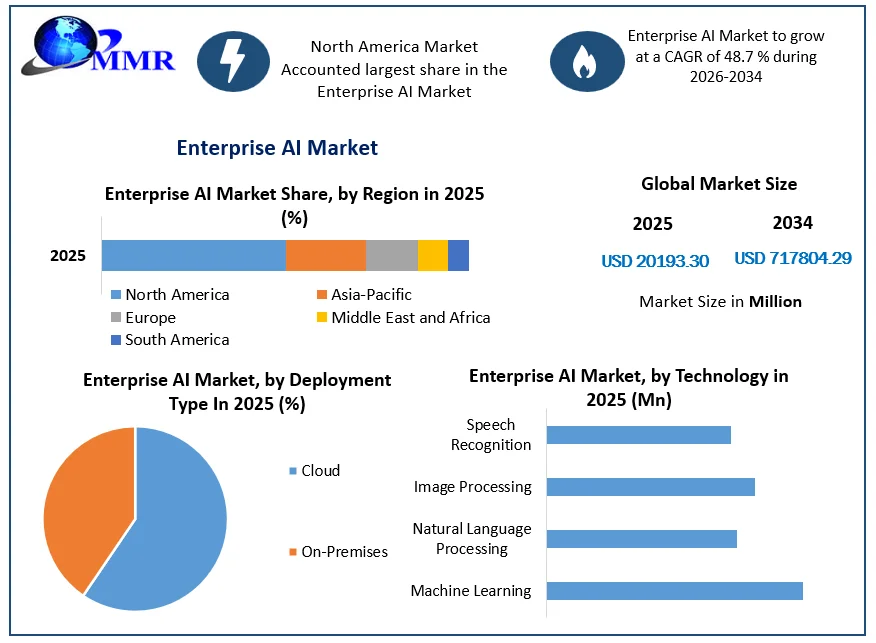
The Enterprise AI Market has valued at US$ 20193.30 Mn in 2025. The Global Enterprise AI Market size is estimated to grow at a CAGR of 48.7% over the forecast period.

Enterprise AI Market Overview:

The Enterprise AI market analyzes and forecasts the market size in terms of value for the market (Million). Further, the Enterprise AI Market is segmented by Deployment Type, Technology, Industry Vertical, and Region. Based on Deployment Type, the market is segmented into Cloud and On-Premises. Because of Services, the market is divided into Machine Learning, Natural Language Processing, Image Processing, and Speech Recognition.

The Industry Vertical, the market is divided into IT and Telecommunication, retail, banking, financial services, and insurance, government and public sector, healthcare, media and entertainment, manufacturing, education, and other sectors. North America is the dominant player in the market. The report thoroughly analyzes market drivers, limitations, and opportunities. The presentation of facts and figures gives key data for the historical period. The report explores the different segments and data that have been provided by market participants and regions.

AI enables computer systems to create and carry out tasks that naturally require human intervention and support, such as speech recognition, decision-making, visual perception, and language translation. Depending upon the individual’s perspective, AI may mean different things to different individuals. For instance, a few years ago, a browser’s recommendation engine would have considered artificial intelligence, but today, the rise of personalized bots, computers that can detect cancer, and self-driving cars, for example, is currently being seen as AI.

Enterprise AI Market Size, Growth & Share Analysis
Enterprise AI Market Growth

To know about the Research Methodology :- Request Free Sample Report

Enterprise AI Market Dynamics:

Thanks to artificial intelligence (AI) enabled computer systems to create and carry out tasks that typically require human intervention and support, such as speech recognition, decision-making, visual perception, and language translation. Manufacturers in the enterprise Artificial Intelligence (AI) sector face significant intellectual obstacles as this technology is developed and improved. The market for AI is driven by increased customer satisfaction, varied application areas, improved productivity, and big data integration. But some market restrictions include a trained labor shortage, risks to human dignity, and other dangers. Still, because of the arrival of new technologies on the market, it is anticipated that the influence of these elements would be very small.

The market’s overall attractiveness is assessed by looking at current and expected corporate Artificial Intelligence (AI) industry trends. The top influencing variables during the forecast period emphasized the opportunities in the corporate AI industry. Investments in artificial intelligence technologies have increased as a result of factors like flourishing inventive start-ups and explosive technological advances. The demand for artificial intelligence business solutions is further increased by the growing need for data analysis and interpretation. The rising AI use in emerging markets like China and India is anticipated to offer important prospects for the growth of the market during the forecast period.

Investing More in AI Technology:

The ability of AI technology to assess the assembled data effectively and forecast choices using essential algorithms aids in product development. For example, Netflix proposes movies based on users’ prior viewing habits. In the contemporary corporate environment, AI has transformed business management through the integration of workflow management tools, brand purchase advertising, trend forecast, and other technologies.

These are the main reasons why money is being invested more and more in AI technologies. Many small startups and IT firms have started spending money on adopting open-source AI platforms to increase the efficiency of their value chains. It is anticipated that the growing availability of high-quality, low-cost AI technologies would support the growth of the enterprise artificial intelligence market.

Rising demand for large-scale data analysis and interpretation.

There are several industries where AI can be applied, such as media & advertising, finance, retail, healthcare, auto & transportation, agriculture, legal, educational institutions, oil & gas, and others. Because of advancements like self-driving cars, space exploration, precise weather forecasting, and others, this has fueled the AI market across the world.

Because of its capacity to evaluate vast volumes of genomic data and assure more precise treatment and prevention of medical disorders, AI is also anticipated to have an impact on healthcare developments. The AI industry is becoming more competitive, owing to many organizations that are discovering the necessity of analyzing and interpreting a vast amount of data.

Artificial intelligence (AI) has great potential to transform every industry, so not only companies but also various government agencies are actively investing in this technology. Although some of these technologies have been around for a while, improvements in computer power and fresh algorithmic innovations are making AI technologies more appealing for new players in the enterprise AI industry.

Businesses are adopting sophisticated analytics solutions for a variety of reasons, including a better understanding of consumer behavior, gaining a competitive edge, and enhancing operational effectiveness. Some businesses use AI technology to analyze consumer behavior and spot fraud and other hazards, other businesses use machine learning to perform preventive maintenance.

The majority of businesses currently use natural language interfaces to create interactive Chatbots and B2B applications. Also, early adopters of AI technology have more expertise and knowledge of best practices than businesses just implementing AI technologies. New entrants can quickly obtain an advantage with the aid of centers of excellence and by hiring analytics experts and data scientists.

The creation and revision of this technology have huge intellectual obstacles, which manufacturers in the enterprise AI industry are observing. The market for AI is driven by bigger data integration, varied application areas, higher efficiency, and increased customer satisfaction. But the scarcity of skilled labor and challenges to human dignity and other dangers are limiting the market growth for corporate artificial intelligence. Because of the arrival of new technologies on the market, it is anticipated to have a minor impact on these aspects.

Enterprise AI Market Segment Analysis

Based on Deployment Type, the cloud segment dominated the market in 2025 and is expected to provide the maximum revenue during the forecast period for the enterprise artificial intelligence market. Enterprises are quickly transitioning to using the cloud for storage. Because of the increasing trend of adoption among businesses, it is expected that the cloud segment would experience great growth. The growth of on-premise Artificial Intelligence (AI) solutions and services in sectors like manufacturing and production is responsible for the growth of the market segment.

Based on technology, the machine learning category led the enterprise AI market and is anticipated to dominate during the forecast period. The image processing segment is expected to increase at the highest rate. During the forecast period, accurate image analysis will be possible because of AI’s image processing technology, which also has the potential to detect dangerous abnormalities and significantly lower false-positive rates. During the forecast period, a greater CAGR is anticipated for the technology segment. Natural Language Processing (NLP) and machine learning applications rely heavily on the enterprise AI market’s services to operate effectively and efficiently.

Services are necessary to successfully combine AI technology with business modules and the current working environment. The NLP sector of the technology market is anticipated to increase at a higher CAGR during the forecast period. The demand for human-to-machine level connection has knowingly increased in businesses as a result of the increasing use of personal gadgets, smartphones, and internet usage. The need for Machine-to-Machine (M2M) translation is growing. Many manufacturers are taking advantage of AI solutions.

Based on Industry Vertical, the IT & telecom sector is expected to contribute the largest enterprise Artificial Intelligence (AI) market share during the forecast period, as numerous startups have been investing in Artificial Intelligence solutions. The demand for AI technologies in developing economies is fueled by growing urbanization, technological development, and an increase in the demand for cloud applications. One of the biggest users of AI technology in the automotive and transportation sector.

Because of the increased consumer demand for connected and smart cars, artificial intelligence has allowed this industry to develop at a very fast rate. For example, smart and linked cars have already been created by companies like Tesla and Morris Garages (MG). The MG Hector, which includes more than 50 connected functions, was just released by MG.

Enterprise AI Market Regional Insights:

North America is dominated the market and is expected to grow at the quickest rate during the forecast period because of the presence of major artificial intelligence businesses in the area and the rising trend of adoption of AI by SMEs and large enterprises.

The Asia Pacific is anticipated to have a higher growth rate, owing to the rise in demand for enterprise AI in developing economies Like China, India, and Japan bringing the market forward. Increased investments in the enterprise AI industry have been seen in the North American region, and several suppliers have developed in response to the growth of the market. Enterprise AI technology is successfully useful in North America for a variety of commercial applications, including process automation, marketing management, customer support and experience, and security and risk management.

The objective of the report is to present a comprehensive analysis of the global Enterprise AI Market to the stakeholders in the industry. The past and current status of the industry with the forecasted market size and trends are presented in the report with the analysis of complicated data in simple language. The report covers all the aspects of the industry with a dedicated study of key players that include market leaders, followers, and new entrants

PORTER, PESTEL analysis with the potential impact of micro-economic factors of the market have been presented in the report. External as well as internal factors that are supposed to affect the business positively or negatively have been analyzed, which will give a clear futuristic view of the industry to the decision-makers.

The reports also help in understanding the Enterprise AI Market dynamic, and structure by analyzing the market segments and projecting the Enterprise AI Market size. Clear representation of competitive analysis of key players by Design, price, financial position, product portfolio, growth strategies, and regional presence in the Enterprise AI Market make the report investor’s guide.

Enterprise AI Market Recent Development

Date Company Development Impact
07 July 2026 Accenture Accenture Edge and Google Cloud launched a joint suite of pre-built agentic AI solutions targeting mid-market enterprises. Accelerated AI production deployment while enhancing operational efficiency and security infrastructure for mid-sized organizations.
03 February 2025 EY The organization expanded its strategic collaboration with Microsoft through the rollout of the AI Skills Passport and enterprise-grade generative AI ecosystems. Bridged critical workforce gaps and accelerated enterprisewide AI transformation across global business units.
02 September 2026 IBM IBM launched IBM Cognos Analytics as a Service on AWS as a fully managed, agentic BI offering. Enabled organizations to modernize trusted enterprise analytics using autonomous BI agents and governed streaming data.

Enterprise AI Market Scope: Inquire before buying

Enterprise AI Market
Report Coverage Details
Base Year: 2025 Forecast Period: 2026-2034
Historical Data: 2020 to 2025 Market Size in 2025: US $ 20193.30 Mn.
Forecast Period 2026 to 2034 CAGR: 48.7% Market Size in 2034: US $ 717804.29 Mn.
Segments Covered: by Deployment Type Cloud
On-Premises
by Industry Vertical IT and Telecommunication
Retail
Banking
Financial Services and Insurance
Government and Public sector
Healthcare
Media and Entertainment
Manufacturing
Education
by Technology Machine Learning
Natural Language Processing
Image Processing
Speech Recognition

Enterprise AI Market by Region

North America (United States, Canada and Mexico)
Europe (UK, France, Germany, Italy, Spain, Sweden, Austria and Rest of Europe)
Asia Pacific (China, South Korea, Japan, India, Australia, Indonesia, Malaysia, Vietnam, Taiwan, Bangladesh, Pakistan and Rest of APAC)
Middle East and Africa (South Africa, GCC, Egypt, Nigeria and Rest of ME&A)
South America (Brazil, Argentina Rest of South America)

Enterprise AI Market Key Players are:

1.IBM (US)
2.AWS (US)
3.Intel (US)
4.Google (US)
5.HPE (US)
6.Oracle (US)
7.Microsoft (US)
8.Sentient Technologies (US)
9.SAP (Germany)
10.Wipro (India)
11.Apple Inc. (US)
12.Alphabet Inc. (US)
13.Verint Systems Inc. (US)
14.MicroStrategy Incorporated (US)

Frequently asked questions:

1. What is the market growth of the Enterprise AI Market?
Ans. The Enterprise AI market was valued at USD 20193.30 Million in 2025 and is expected to reach USD 717804.29  Million by 2034, at a CAGR of 48.7% during the forecast period.

2. Which are the major key players in the Enterprise AI Market?
Ans. The key players in this market include IBM, AWS, Intel, Google, Apple, Microsoft, etc.

3. Which region is anticipated to account for the largest market share?
Ans. North America is anticipated to dominate the Enterprise AI Market.

4. What is the forecast period for the Enterprise AI Market?
Ans. The forecast period for the Enterprise AI Market is from 2026 to 2034.

5. What is the segment in which the Enterprise AI Market is divided?
Ans. The Enterprise AI Market is fragmented based on Deployment Type, Industry Vertical, and Technology. It is also divided on basis of different regions.

Table of Contents

1. Enterprise AI Market Introduction 1.1. Study Assumption and Market Definition 1.2. Scope of the Study 1.3. Executive Summary 2. Global Enterprise AI Market: Competitive Landscape 2.1. MMR Competition Matrix 2.2. Competitive Landscape 2.3. Key Players Benchmarking 2.3.1. Company Name 2.3.2. Business Segment 2.3.3. End-user Segment 2.3.4. Revenue (2025) 2.3.5. Company Locations 2.4. Leading Enterprise AI Market Companies, by market capitalization 2.5. Market Structure 2.5.1. Market Leaders 2.5.2. Market Followers 2.5.3. Emerging Players 2.6. Mergers and Acquisitions Details 3. Enterprise AI Market: Dynamics 3.1. Enterprise AI Market Trends by Region 3.1.1. North America Enterprise AI Market Trends 3.1.2. Europe Enterprise AI Market Trends 3.1.3. Asia Pacific Enterprise AI Market Trends 3.1.4. Middle East and Africa Enterprise AI Market Trends 3.1.5. South America Enterprise AI Market Trends 3.2. Enterprise AI Market Dynamics by Region 3.2.1. North America 3.2.1.1. North America Enterprise AI Market Drivers 3.2.1.2. North America Enterprise AI Market Restraints 3.2.1.3. North America Enterprise AI Market Opportunities 3.2.1.4. North America Enterprise AI Market Challenges 3.2.2. Europe 3.2.2.1. Europe Enterprise AI Market Drivers 3.2.2.2. Europe Enterprise AI Market Restraints 3.2.2.3. Europe Enterprise AI Market Opportunities 3.2.2.4. Europe Enterprise AI Market Challenges 3.2.3. Asia Pacific 3.2.3.1. Asia Pacific Enterprise AI Market Drivers 3.2.3.2. Asia Pacific Enterprise AI Market Restraints 3.2.3.3. Asia Pacific Enterprise AI Market Opportunities 3.2.3.4. Asia Pacific Enterprise AI Market Challenges 3.2.4. Middle East and Africa 3.2.4.1. Middle East and Africa Enterprise AI Market Drivers 3.2.4.2. Middle East and Africa Enterprise AI Market Restraints 3.2.4.3. Middle East and Africa Enterprise AI Market Opportunities 3.2.4.4. Middle East and Africa Enterprise AI Market Challenges 3.2.5. South America 3.2.5.1. South America Enterprise AI Market Drivers 3.2.5.2. South America Enterprise AI Market Restraints 3.2.5.3. South America Enterprise AI Market Opportunities 3.2.5.4. South America Enterprise AI Market Challenges 3.3. PORTER's Five Forces Analysis 3.4. PESTLE Analysis 3.5. Technology Roadmap 3.6. Regulatory Landscape by Region 3.6.1. North America 3.6.2. Europe 3.6.3. Asia Pacific 3.6.4. Middle East and Africa 3.6.5. South America 3.7. Key Opinion Leader Analysis For Enterprise AI Industry 3.8. Analysis of Government Schemes and Initiatives For Enterprise AI Industry 3.9. Enterprise AI Market Trade Analysis 3.10. The Global Pandemic Impact on Enterprise AI Market 4. Enterprise AI Market: Global Market Size and Forecast by Segmentation (in USD Billion) 2025-2034 4.1. Enterprise AI Market Size and Forecast, by Deployment Type (2025-2034) 4.1.1. Cloud 4.1.2. On-Premises 4.2. Enterprise AI Market Size and Forecast, by Industry Vertical (2025-2034) 4.2.1. IT and Telecommunication 4.2.2. Retail 4.2.3. Banking 4.2.4. Financial Services and Insurance 4.2.5. Government and Public sector 4.2.6. Healthcare 4.2.7. Media and Entertainment 4.2.8. Manufacturing 4.2.9. Education 4.3. Enterprise AI Market Size and Forecast, by Technology (2025-2034) 4.3.1. Machine Learning 4.3.2. Natural Language Processing 4.3.3. Image Processing 4.3.4. Speech Recognition 4.4. Enterprise AI Market Size and Forecast, by Region (2025-2034) 4.4.1. North America 4.4.2. Europe 4.4.3. Asia Pacific 4.4.4. Middle East and Africa 4.4.5. South America 5. North America Enterprise AI Market Size and Forecast by Segmentation (in USD Billion) 2025-2034 5.1. North America Enterprise AI Market Size and Forecast, by Deployment Type (2025-2034) 5.1.1. Cloud 5.1.2. On-Premises 5.2. North America Enterprise AI Market Size and Forecast, by Industry Vertical (2025-2034) 5.2.1. IT and Telecommunication 5.2.2. Retail 5.2.3. Banking 5.2.4. Financial Services and Insurance 5.2.5. Government and Public sector 5.2.6. Healthcare 5.2.7. Media and Entertainment 5.2.8. Manufacturing 5.2.9. Education 5.3. North America Enterprise AI Market Size and Forecast, by Technology (2025-2034) 5.3.1. Machine Learning 5.3.2. Natural Language Processing 5.3.3. Image Processing 5.3.4. Speech Recognition 5.4. North America Enterprise AI Market Size and Forecast, by Country (2025-2034) 5.4.1. United States 5.4.1.1. United States Enterprise AI Market Size and Forecast, by Deployment Type (2025-2034) 5.4.1.1.1. Cloud 5.4.1.1.2. On-Premises 5.4.1.2. United States Enterprise AI Market Size and Forecast, by Industry Vertical (2025-2034) 5.4.1.2.1. IT and Telecommunication 5.4.1.2.2. Retail 5.4.1.2.3. Banking 5.4.1.2.4. Financial Services and Insurance 5.4.1.2.5. Government and Public sector 5.4.1.2.6. Healthcare 5.4.1.2.7. Media and Entertainment 5.4.1.2.8. Manufacturing 5.4.1.2.9. Education 5.4.1.3. United States Enterprise AI Market Size and Forecast, by Technology (2025-2034) 5.4.1.3.1. Machine Learning 5.4.1.3.2. Natural Language Processing 5.4.1.3.3. Image Processing 5.4.1.3.4. Speech Recognition 5.4.2. Canada 5.4.2.1. Canada Enterprise AI Market Size and Forecast, by Deployment Type (2025-2034) 5.4.2.1.1. Cloud 5.4.2.1.2. On-Premises 5.4.2.2. Canada Enterprise AI Market Size and Forecast, by Industry Vertical (2025-2034) 5.4.2.2.1. IT and Telecommunication 5.4.2.2.2. Retail 5.4.2.2.3. Banking 5.4.2.2.4. Financial Services and Insurance 5.4.2.2.5. Government and Public sector 5.4.2.2.6. Healthcare 5.4.2.2.7. Media and Entertainment 5.4.2.2.8. Manufacturing 5.4.2.2.9. Education 5.4.2.3. Canada Enterprise AI Market Size and Forecast, by Technology (2025-2034) 5.4.2.3.1. Machine Learning 5.4.2.3.2. Natural Language Processing 5.4.2.3.3. Image Processing 5.4.2.3.4. Speech Recognition 5.4.3. Mexico 5.4.3.1. Mexico Enterprise AI Market Size and Forecast, by Deployment Type (2025-2034) 5.4.3.1.1. Cloud 5.4.3.1.2. On-Premises 5.4.3.2. Mexico Enterprise AI Market Size and Forecast, by Industry Vertical (2025-2034) 5.4.3.2.1. IT and Telecommunication 5.4.3.2.2. Retail 5.4.3.2.3. Banking 5.4.3.2.4. Financial Services and Insurance 5.4.3.2.5. Government and Public sector 5.4.3.2.6. Healthcare 5.4.3.2.7. Media and Entertainment 5.4.3.2.8. Manufacturing 5.4.3.2.9. Education 5.4.3.3. Mexico Enterprise AI Market Size and Forecast, by Technology (2025-2034) 5.4.3.3.1. Machine Learning 5.4.3.3.2. Natural Language Processing 5.4.3.3.3. Image Processing 5.4.3.3.4. Speech Recognition 6. Europe Enterprise AI Market Size and Forecast by Segmentation (in USD Billion) 2025-2034 6.1. Europe Enterprise AI Market Size and Forecast, by Deployment Type (2025-2034) 6.2. Europe Enterprise AI Market Size and Forecast, by Industry Vertical (2025-2034) 6.3. Europe Enterprise AI Market Size and Forecast, by Technology (2025-2034) 6.4. Europe Enterprise AI Market Size and Forecast, by Country (2025-2034) 6.4.1. United Kingdom 6.4.1.1. United Kingdom Enterprise AI Market Size and Forecast, by Deployment Type (2025-2034) 6.4.1.2. United Kingdom Enterprise AI Market Size and Forecast, by Industry Vertical (2025-2034) 6.4.1.3. United Kingdom Enterprise AI Market Size and Forecast, by Technology (2025-2034) 6.4.2. France 6.4.2.1. France Enterprise AI Market Size and Forecast, by Deployment Type (2025-2034) 6.4.2.2. France Enterprise AI Market Size and Forecast, by Industry Vertical (2025-2034) 6.4.2.3. France Enterprise AI Market Size and Forecast, by Technology (2025-2034) 6.4.3. Germany 6.4.3.1. Germany Enterprise AI Market Size and Forecast, by Deployment Type (2025-2034) 6.4.3.2. Germany Enterprise AI Market Size and Forecast, by Industry Vertical (2025-2034) 6.4.3.3. Germany Enterprise AI Market Size and Forecast, by Technology (2025-2034) 6.4.4. Italy 6.4.4.1. Italy Enterprise AI Market Size and Forecast, by Deployment Type (2025-2034) 6.4.4.2. Italy Enterprise AI Market Size and Forecast, by Industry Vertical (2025-2034) 6.4.4.3. Italy Enterprise AI Market Size and Forecast, by Technology (2025-2034) 6.4.5. Spain 6.4.5.1. Spain Enterprise AI Market Size and Forecast, by Deployment Type (2025-2034) 6.4.5.2. Spain Enterprise AI Market Size and Forecast, by Industry Vertical (2025-2034) 6.4.5.3. Spain Enterprise AI Market Size and Forecast, by Technology (2025-2034) 6.4.6. Sweden 6.4.6.1. Sweden Enterprise AI Market Size and Forecast, by Deployment Type (2025-2034) 6.4.6.2. Sweden Enterprise AI Market Size and Forecast, by Industry Vertical (2025-2034) 6.4.6.3. Sweden Enterprise AI Market Size and Forecast, by Technology (2025-2034) 6.4.7. Austria 6.4.7.1. Austria Enterprise AI Market Size and Forecast, by Deployment Type (2025-2034) 6.4.7.2. Austria Enterprise AI Market Size and Forecast, by Industry Vertical (2025-2034) 6.4.7.3. Austria Enterprise AI Market Size and Forecast, by Technology (2025-2034) 6.4.8. Rest of Europe 6.4.8.1. Rest of Europe Enterprise AI Market Size and Forecast, by Deployment Type (2025-2034) 6.4.8.2. Rest of Europe Enterprise AI Market Size and Forecast, by Industry Vertical (2025-2034) 6.4.8.3. Rest of Europe Enterprise AI Market Size and Forecast, by Technology (2025-2034) 7. Asia Pacific Enterprise AI Market Size and Forecast by Segmentation (in USD Billion) 2025-2034 7.1. Asia Pacific Enterprise AI Market Size and Forecast, by Deployment Type (2025-2034) 7.2. Asia Pacific Enterprise AI Market Size and Forecast, by Industry Vertical (2025-2034) 7.3. Asia Pacific Enterprise AI Market Size and Forecast, by Technology (2025-2034) 7.4. Asia Pacific Enterprise AI Market Size and Forecast, by Country (2025-2034) 7.4.1. China 7.4.1.1. China Enterprise AI Market Size and Forecast, by Deployment Type (2025-2034) 7.4.1.2. China Enterprise AI Market Size and Forecast, by Industry Vertical (2025-2034) 7.4.1.3. China Enterprise AI Market Size and Forecast, by Technology (2025-2034) 7.4.2. S Korea 7.4.2.1. S Korea Enterprise AI Market Size and Forecast, by Deployment Type (2025-2034) 7.4.2.2. S Korea Enterprise AI Market Size and Forecast, by Industry Vertical (2025-2034) 7.4.2.3. S Korea Enterprise AI Market Size and Forecast, by Technology (2025-2034) 7.4.3. Japan 7.4.3.1. Japan Enterprise AI Market Size and Forecast, by Deployment Type (2025-2034) 7.4.3.2. Japan Enterprise AI Market Size and Forecast, by Industry Vertical (2025-2034) 7.4.3.3. Japan Enterprise AI Market Size and Forecast, by Technology (2025-2034) 7.4.4. India 7.4.4.1. India Enterprise AI Market Size and Forecast, by Deployment Type (2025-2034) 7.4.4.2. India Enterprise AI Market Size and Forecast, by Industry Vertical (2025-2034) 7.4.4.3. India Enterprise AI Market Size and Forecast, by Technology (2025-2034) 7.4.5. Australia 7.4.5.1. Australia Enterprise AI Market Size and Forecast, by Deployment Type (2025-2034) 7.4.5.2. Australia Enterprise AI Market Size and Forecast, by Industry Vertical (2025-2034) 7.4.5.3. Australia Enterprise AI Market Size and Forecast, by Technology (2025-2034) 7.4.6. Indonesia 7.4.6.1. Indonesia Enterprise AI Market Size and Forecast, by Deployment Type (2025-2034) 7.4.6.2. Indonesia Enterprise AI Market Size and Forecast, by Industry Vertical (2025-2034) 7.4.6.3. Indonesia Enterprise AI Market Size and Forecast, by Technology (2025-2034) 7.4.7. Malaysia 7.4.7.1. Malaysia Enterprise AI Market Size and Forecast, by Deployment Type (2025-2034) 7.4.7.2. Malaysia Enterprise AI Market Size and Forecast, by Industry Vertical (2025-2034) 7.4.7.3. Malaysia Enterprise AI Market Size and Forecast, by Technology (2025-2034) 7.4.8. Vietnam 7.4.8.1. Vietnam Enterprise AI Market Size and Forecast, by Deployment Type (2025-2034) 7.4.8.2. Vietnam Enterprise AI Market Size and Forecast, by Industry Vertical (2025-2034) 7.4.8.3. Vietnam Enterprise AI Market Size and Forecast, by Technology (2025-2034) 7.4.9. Taiwan 7.4.9.1. Taiwan Enterprise AI Market Size and Forecast, by Deployment Type (2025-2034) 7.4.9.2. Taiwan Enterprise AI Market Size and Forecast, by Industry Vertical (2025-2034) 7.4.9.3. Taiwan Enterprise AI Market Size and Forecast, by Technology (2025-2034) 7.4.10. Rest of Asia Pacific 7.4.10.1. Rest of Asia Pacific Enterprise AI Market Size and Forecast, by Deployment Type (2025-2034) 7.4.10.2. Rest of Asia Pacific Enterprise AI Market Size and Forecast, by Industry Vertical (2025-2034) 7.4.10.3. Rest of Asia Pacific Enterprise AI Market Size and Forecast, by Technology (2025-2034) 8. Middle East and Africa Enterprise AI Market Size and Forecast by Segmentation (in USD Billion) 2025-2034 8.1. Middle East and Africa Enterprise AI Market Size and Forecast, by Deployment Type (2025-2034) 8.2. Middle East and Africa Enterprise AI Market Size and Forecast, by Industry Vertical (2025-2034) 8.3. Middle East and Africa Enterprise AI Market Size and Forecast, by Technology (2025-2034) 8.4. Middle East and Africa Enterprise AI Market Size and Forecast, by Country (2025-2034) 8.4.1. South Africa 8.4.1.1. South Africa Enterprise AI Market Size and Forecast, by Deployment Type (2025-2034) 8.4.1.2. South Africa Enterprise AI Market Size and Forecast, by Industry Vertical (2025-2034) 8.4.1.3. South Africa Enterprise AI Market Size and Forecast, by Technology (2025-2034) 8.4.2. GCC 8.4.2.1. GCC Enterprise AI Market Size and Forecast, by Deployment Type (2025-2034) 8.4.2.2. GCC Enterprise AI Market Size and Forecast, by Industry Vertical (2025-2034) 8.4.2.3. GCC Enterprise AI Market Size and Forecast, by Technology (2025-2034) 8.4.3. Nigeria 8.4.3.1. Nigeria Enterprise AI Market Size and Forecast, by Deployment Type (2025-2034) 8.4.3.2. Nigeria Enterprise AI Market Size and Forecast, by Industry Vertical (2025-2034) 8.4.3.3. Nigeria Enterprise AI Market Size and Forecast, by Technology (2025-2034) 8.4.4. Rest of ME&A 8.4.4.1. Rest of ME&A Enterprise AI Market Size and Forecast, by Deployment Type (2025-2034) 8.4.4.2. Rest of ME&A Enterprise AI Market Size and Forecast, by Industry Vertical (2025-2034) 8.4.4.3. Rest of ME&A Enterprise AI Market Size and Forecast, by Technology (2025-2034) 9. South America Enterprise AI Market Size and Forecast by Segmentation (in USD Billion) 2025-2034 9.1. South America Enterprise AI Market Size and Forecast, by Deployment Type (2025-2034) 9.2. South America Enterprise AI Market Size and Forecast, by Industry Vertical (2025-2034) 9.3. South America Enterprise AI Market Size and Forecast, by Technology (2025-2034) 9.4. South America Enterprise AI Market Size and Forecast, by Country (2025-2034) 9.4.1. Brazil 9.4.1.1. Brazil Enterprise AI Market Size and Forecast, by Deployment Type (2025-2034) 9.4.1.2. Brazil Enterprise AI Market Size and Forecast, by Industry Vertical (2025-2034) 9.4.1.3. Brazil Enterprise AI Market Size and Forecast, by Technology (2025-2034) 9.4.2. Argentina 9.4.2.1. Argentina Enterprise AI Market Size and Forecast, by Deployment Type (2025-2034) 9.4.2.2. Argentina Enterprise AI Market Size and Forecast, by Industry Vertical (2025-2034) 9.4.2.3. Argentina Enterprise AI Market Size and Forecast, by Technology (2025-2034) 9.4.3. Rest Of South America 9.4.3.1. Rest Of South America Enterprise AI Market Size and Forecast, by Deployment Type (2025-2034) 9.4.3.2. Rest Of South America Enterprise AI Market Size and Forecast, by Industry Vertical (2025-2034) 9.4.3.3. Rest Of South America Enterprise AI Market Size and Forecast, by Technology (2025-2034) 10. Company Profile: Key Players 10.1. IBM (US) 10.1.1. Company Overview 10.1.2. Business Portfolio 10.1.3. Financial Overview 10.1.4. SWOT Analysis 10.1.5. Strategic Analysis 10.1.6. Scale of Operation (small, medium, and large) 10.1.7. Details on Partnership 10.1.8. Regulatory Accreditations and Certifications Received by Them 10.1.9. Awards Received by the Firm 10.1.10. Recent Developments 10.2. AWS (US) 10.3. Intel (US) 10.4. Google (US) 10.5. HPE (US) 10.6. Oracle (US) 10.7. Microsoft (US) 10.8. Sentient Technologies (US) 10.9. SAP (Germany) 10.10. Wipro (India) 10.11. Apple Inc. (US) 10.12. Alphabet Inc. (US) 10.13. Verint Systems Inc. (US) 10.14. MicroStrategy Incorporated (US) 11. Key Findings 12. Industry Recommendations 13. Enterprise AI Market: Research Methodology 14. Terms and Glossary

Custom Market Research Services

We Will Customise The Research For You, In Case The Report Listed Above Does Not Meet With Your Requirements