
Global Digital Transformation in Manufacturing Market Size by Technology, Solution, Deployment, Enterprise Size, Application and End Use Industry
Overview
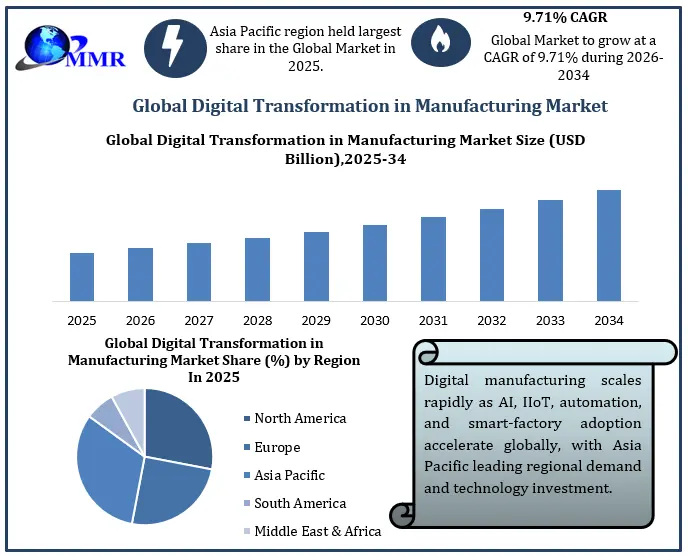
The Digital Transformation in Manufacturing Market was valued at USD 576.22 billion in 2025 and is estimated to grow at a 9.71% CAGR to USD 1,326.80 billion by 2034.
Key Market Highlights
This report covers the Digital Transformation in Manufacturing Market through a comprehensive assessment of technology adoption, solution deployment, manufacturing processes, enterprise size, applications, end-use industries, and regional demand, enabling clients to identify where digital investment concentrates and where the strongest growth opportunities emerge. It provides a clear view of how AI, IIoT, robotics, cloud computing, digital twins, industrial analytics, and IT-OT convergence reshape manufacturing operations, while examining adoption barriers, regulatory influences, competitive positioning, innovation strategies, and regional technology maturity. The report combines market sizing with evidence-based industry analysis to help clients benchmark competitors, evaluate emerging technology opportunities, prioritise high-growth applications and industries, and develop investment, product, and market-entry strategies with greater confidence through 2034.
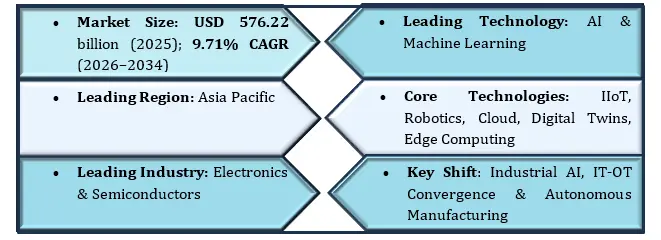
Global Digital Transformation in Manufacturing Market Overview
The Digital Transformation in Manufacturing Market covers the technologies, software, platforms, and services that digitize production and connect machines, operational technology (OT), enterprise systems, and supply-chain processes. The market includes Industrial IoT (IIoT), artificial intelligence (AI), cloud computing, edge computing, advanced analytics, robotics and automation, digital twins, manufacturing execution systems (MES), and industrial cybersecurity. These technologies enable manufacturers to establish connected factories, improve production visibility, optimize asset performance, and support data-driven decision-making.
Digital Transformation in Manufacturing Market penetration increasingly moves beyond basic automation toward integrated and intelligent manufacturing environments. Cloud computing adoption gap indicates substantial room for manufacturers to progress from connectivity and data collection toward advanced analytics and AI-enabled operations.
Manufacturing shows strong relevance for connected technologies because production environments generate continuous machine, process, quality, and asset data. OECD data show that IoT adoption in manufacturing remains above several service industries, reinforcing the sector's suitability for sensor-based monitoring and connected production systems. Large enterprises also adopt advanced digital technologies faster; they are six times more likely than small firms to use AI on average across OECD economies.
The market shifts toward AI-enabled process optimization, predictive maintenance, digital twins, autonomous robotics, industrial edge computing, and integrated IT/OT architectures. NIST's 2026 smart-manufacturing roadmap identifies industrial AI, autonomous systems, digital twins, robotics, industrial analytics, and supply-chain optimization as important application areas, while data integration and interoperability remain key implementation challenges. This transition creates sustained opportunities for manufacturers to move from connected production toward intelligent, adaptive, and increasingly autonomous manufacturing operations.
Global Digital Transformation in Manufacturing Market Growth Analysis
To know about the Research Methodology :- Request Free Sample Report
Global Digital Transformation in Manufacturing Market Dynamics
Manufacturers Accelerate Industrial Automation to Drive Digital Transformation in Manufacturing Market Growth
Manufacturers increasingly deploy automation to improve throughput, production consistency, and labor productivity, making robotics and intelligent automation a major driver of digital transformation investment. The International Federation of Robotics reports that 546,000 industrial robots are installed globally in 2025, with annual installations remaining above 500,000 units for the fourth consecutive year. The operational stock also reaches 4.65 million robots, demonstrating the expanding installed base of digitally enabled production assets. This expanding automation base creates demand for complementary technologies such as IIoT connectivity, machine vision, edge analytics, digital twins, and manufacturing software that integrate robots into broader production workflows.
Emerging Markets Create Opportunities for Smart Factory Adoption
Emerging manufacturing economies create significant opportunities as industrial modernisation programs combine investment in automation with digital manufacturing capabilities. India installs a record 9,100 industrial robots in 2025, representing 7% growth, with the automotive industry accounting for 45% of installations. This expansion creates a broader opportunity for digital transformation providers because new automation deployments increasingly require connected controls, industrial data platforms, predictive analytics, machine vision, and cloud or edge infrastructure. Manufacturers in developing production hubs therefore increasingly bypass some legacy infrastructure and adopt digitally connected production systems as part of new factory investments.
Legacy Equipment and OT Fragmentation Challenge Digital Transformation
Manufacturers face difficulty integrating legacy machinery, industrial control systems, and fragmented OT environments with modern IIoT, cloud, and analytics platforms. Older equipment often lacks standardized interfaces and modern communication capabilities, which increases the need for gateways, sensors, middleware, and system integration. NIST identifies legacy components, interoperability limitations, and difficulties connecting OT with modern IT environments as important barriers to digital transformation. This challenge particularly affects brownfield facilities, where manufacturers need to modernize existing assets without disrupting production, safety, or cybersecurity.
Global Digital Transformation in Manufacturing Market Trends
Industrial AI Expands from Analytics to Autonomous Manufacturing
Industrial AI increasingly moves beyond predictive analytics toward autonomous systems, AI-based process control, machine perception, and adaptive production. NIST’s 2026 smart-manufacturing roadmap identifies autonomous systems, industrial big-data analytics, advanced sensing, robotics, digital twins, and generative AI as key areas shaping smart manufacturing. The Digital Transformation in Manufacturing Market trend supports manufacturing environments where AI increasingly interprets machine and process data and assists with real-time production decisions.
Digital Twins Extend from Simulation to Production Optimization
Digital twins extend beyond product design and virtual simulation into production planning, process optimization, asset management, and lifecycle management. NIST’s 2026 digital-twin research identifies design, production, and lifecycle management as major manufacturing applications, while also prioritizing interoperability and validation. This trend strengthens demand for digital-twin platforms that connect physical production assets with continuously updated digital models.
Connected Robotics Integrates AI and Industrial Data
Industrial robots increasingly operate as connected, data-generating production assets rather than isolated automated machines. The International Federation of Robotics identifies AI-powered robotics, sensor-based perception, digital twins, and connected robot systems as major technology directions. It also reports that the global value of industrial robot installations scales the underlying automation ecosystem. This trend expands demand for IIoT connectivity, machine vision, edge computing, robotics analytics, and AI-enabled automation.
IT-OT Convergence Creates Unified Digital Factory Networks
Manufacturers increasingly connect operational technology (OT) with information technology (IT) to enable enterprise-wide data flows, remote monitoring, industrial analytics, and integrated production management. IT-OT integration is identified as an important mechanism for improving manufacturing productivity and business capabilities, while also highlighting the associated cybersecurity exposure. This trend shifts factory architecture from isolated production systems toward interconnected IT-OT environments that support real-time visibility across production, maintenance, quality, and supply-chain operations.
Global Digital Transformation in Manufacturing Market Segment Analysis
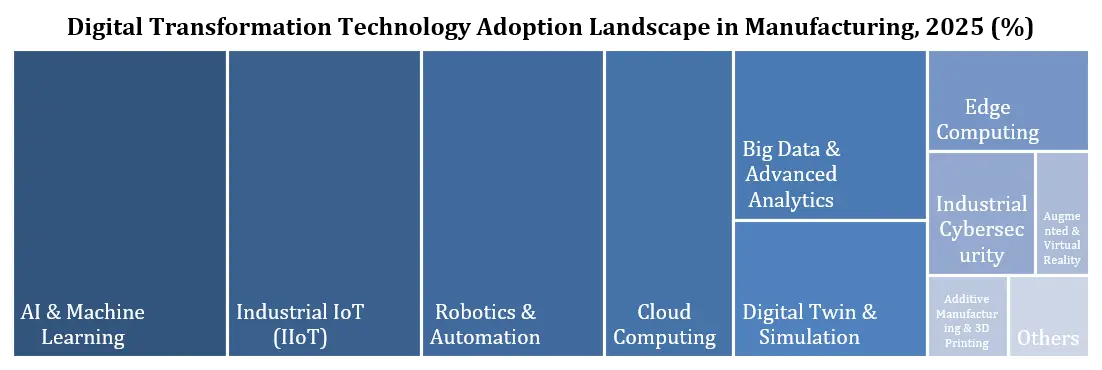
By Technology: Artificial Intelligence & Machine Learning dominated the technology segment for Digital Transformation in Manufacturing Market in 2025, supported by its growing role in predictive maintenance, machine vision, process optimisation, quality inspection, and autonomous decision-making. AI increasingly connects with IIoT and industrial analytics. This allows manufacturers to convert machine and production data into operational decisions. AI adoption differs considerably across manufacturing industries, with 26% of pharmaceutical enterprises and 25% of electronics enterprises reporting AI use, indicating strong penetration in data-intensive and high-value production environments.
AI & ML also show strong growth potential through 2034, as manufacturers move from isolated AI applications toward integrated industrial AI and autonomous production. IIoT, robotics, digital twins, and edge computing support this expansion rather than compete directly with AI, creating a more interconnected technology stack. The increasing intelligence and connectivity of these assets strengthen demand for AI-enabled manufacturing platforms throughout the forecast period.

By End-Use Industry
Electronics & Semiconductors dominated the Digital Transformation in Manufacturing Market in 2025, reflecting its high automation intensity, complex production processes, stringent quality requirements, and strong dependence on precision manufacturing. The industry also leads recent robotics deployment: electronics manufacturers account for 24% of global industrial robot installations in 2025, slightly ahead of automotive at 23%.

Electronics & Semiconductors maintains a strong growth outlook through 2034, as semiconductor fabs and electronics plants increasingly require automated inspection, digital twins, AI-based process control, connected equipment, and real-time analytics. Pharmaceuticals & Medical Devices also represents a high-growth opportunity because 26% of pharmaceutical enterprises in the EU report AI adoption, the highest level among manufacturing industries tracked by OECD. The automotive remains a major digital-transformation adopter because of its extensive automation base and transition toward electric-vehicle production; for example, India installed 9,120 industrial robots in 2025, with automotive accounting for 45% of installations.
Technology leadership centers on AI & ML, while industry demand centers on Electronics & Semiconductors, which boosts Digital Transformation in the Manufacturing Market. The strongest future opportunity comes from the convergence of AI, robotics, IIoT, digital twins, and industrial analytics within increasingly automated production environments.
Global Digital Transformation in Manufacturing Market Regional Analysis
North America dominated Digital Transformation in Manufacturing Market in 2025
North America remains a highly advanced market for manufacturing digital transformation, supported by established automation infrastructure, high cloud and analytics penetration, strong industrial software capabilities, and investment in AI-enabled manufacturing. The U.S. places particular emphasis on interoperability, AI reliability, cybersecurity, and smart-manufacturing standards through NIST initiatives that help manufacturers integrate heterogeneous production systems with advanced communications and data technologies. NIST also develops measurement and validation frameworks for AI-enabled manufacturing, supporting wider industrial adoption. Demand increasingly centers on industrial AI, predictive maintenance, digital twins, robotics, and edge computing, particularly in automotive, aerospace, electronics, and advanced machinery.
Digital Manufacturing Through Regulation and Industry 4.0 in Europe drives Digital Transformation in Manufacturing Market growth
Europe combines strong industrial automation with policy-driven digitalization, although adoption remains uneven across manufacturers. AI adoption in EU manufacturing increases from 7% in 2021 to 11% in 2024, with pharmaceuticals and electronics leading at 26% and 25%, respectively. Regulation increasingly shapes technology deployment: the EU AI Act becomes applicable in August 2026, establishing risk-based requirements for AI developers and deployers, while high-risk provisions for certain products extend into 2027–2028. This regulatory environment increases demand for secure, explainable, compliant, and interoperable AI solutions, while Germany, France, Italy, and other manufacturing-intensive economies continue to support Industry 4.0 adoption.
Smart Manufacturing Through Industrial Modernization boosts the Digital Transformation in Manufacturing Industry Growth
The large manufacturing base, extensive electronics and semiconductor production, expanding automation, and government-led smart-manufacturing programs boost Digital Transformation in Manufacturing Market. China, Japan, South Korea, and India increasingly integrate robotics, IIoT, AI, industrial analytics, and digital production systems into large-scale manufacturing operations. The region's manufacturing depth creates particularly strong demand for connected factory platforms and automation technologies, while semiconductor and electronics production increases requirements for precision monitoring, machine vision, and real-time process optimization. NIST's 2026 roadmap also identifies industrial AI, autonomous systems, digital twins, robotics, and supply-chain optimization as major directions for smart manufacturing, technologies that align closely with Asia Pacific's increasingly automated production base.
South America Advances Digital Manufacturing Through Industrial Modernization
South America shows an emerging digital-transformation opportunity as manufacturers modernize production infrastructure and governments increasingly link industrial competitiveness with technology adoption. Brazil's New Industry Brazil (Nova Indústria Brasil) explicitly prioritizes productivity improvement and digital transformation of the productive sector, alongside advanced technology and sustainable industrial development. Brazil therefore provides an important regional demand center for industrial automation, IIoT, manufacturing analytics, and connected production systems, particularly across automotive, machinery, food processing, and other large manufacturing industries. Adoption remains more uneven than in North America, Europe, or advanced Asia Pacific markets, making brownfield modernization, workforce capabilities, and affordable digital solutions important determinants of future penetration.
Manufacturing Through Government Programs Middle East & Africa to drive Smart
Middle East & Africa shows increasing demand for digital manufacturing as governments use industrial diversification programs to reduce dependence on traditional resource industries and develop higher-value manufacturing. The UAE Industry 4.0 program specifically targets digital transformation, automation, value-chain integration, and industrial productivity, with the government targeting a 30% increase in industrial productivity through 4IR adoption. The UAE operates an Industry 4.0 readiness assessment and provides financial and non-financial incentives for technology adoption. Saudi Arabia and other Gulf economies similarly emphasise smart factories, industrial automation, AI, and digital infrastructure. Consequently, the region increasingly creates opportunities for AI-enabled manufacturing, robotics, industrial IoT, digital twins, and smart-factory platforms, although adoption varies considerably between advanced Gulf manufacturing hubs and less-digitised African markets.
Global Digital Transformation in Manufacturing Market: Recent Developments
| Date | Recent Development | Market Impact |
| Aug 2026 | Anthropic introduces a framework for AI agents to operate physical devices, including robotic arms and industrial instruments. | Advances autonomous manufacturing by connecting AI agents directly with physical industrial equipment. |
| Aug 2026 | Siemens reports record industrial profit, supported by demand for AI-powered factory automation and electronics manufacturing. | Strengthens AI-led automation investment and validates growing demand for intelligent industrial systems. |
| Aug 2026 | U.S. agencies issue a cybersecurity advisory on attacks targeting Siemens PLCs, highlighting vulnerabilities across critical industrial systems. | Increases demand for OT cybersecurity, secure industrial networks, threat monitoring, and resilient digital infrastructure. |
| May 2026 | NIST conducts an AI for Manufacturing workshop focused on industrial AI applications, trust, integration, and manufacturing challenges. | Supports wider industrial AI adoption by addressing reliability, interoperability, and deployment barriers. |
| 2026 | NIST releases its roadmap for AI and ML in smart manufacturing, highlighting AI, autonomy, industrial analytics, digital twins, robotics, and advanced sensing. | Accelerates the shift toward intelligent and autonomous factories, expanding demand for integrated AI, IIoT, robotics, and digital-twin solutions. |
Global Digital Transformation in Manufacturing Market Competitive Analysis
The Digital Transformation in Manufacturing Market shows a highly competitive and increasingly convergent landscape. Competition is not limited to a single technology layer; it spans industrial automation, MES, IIoT, industrial software, cloud platforms, AI, digital twins, cybersecurity, and industrial data infrastructure. Leading vendors increasingly position themselves as end-to-end digital manufacturing partners, combining installed automation bases with software, analytics, AI, and consulting. This creates an advantage for established automation companies because manufacturers generally prefer to modernize existing OT infrastructure rather than replace entire production architectures.
Competition Centers on Integrated Digital Manufacturing Ecosystems
Siemens, Rockwell Automation, Schneider Electric, ABB, and Honeywell represent major global competitors, while technology and cloud companies increasingly participate through AI, cloud, data, and software capabilities. Siemens positions itself around the integration of automation, industrial software, digital twins, and Industrial AI and reports that 33% of machines worldwide run on Siemens controllers. Rockwell emphasizes the convergence of automation, MES, IIoT, analytics, AI, and cybersecurity, positioning its portfolio around incremental modernization rather than isolated technology purchases. Schneider Electric differentiates through the combination of automation, IIoT, energy management, sustainability, and EcoStruxure, targeting manufacturers that want digital transformation alongside energy and operational-efficiency improvements.
Global and Regional Presence Shapes Competitive Positioning
The leading players maintain broad international footprints, but their strengths differ by industrial ecosystem. Siemens has particularly strong positioning across Europe and global discrete manufacturing, while Schneider Electric combines European industrial expertise with substantial international reach in automation and energy management. Rockwell Automation has a strong North American manufacturing presence and increasingly expands its software and connected-enterprise portfolio globally. ABB maintains broad exposure across discrete manufacturing, process industries, robotics, and electrification, while Honeywell has deep positioning in process industries such as refining, petrochemicals, life sciences, and utilities. Honeywell states that its industrial automation portfolio operates across millions of installed assets, giving it a substantial installed-base advantage for digital modernisation.
Technology and Innovation Differentiate Leading Players
Siemens differentiates through digital twins and industrial AI, connecting product lifecycle management, production planning, automation, and factory simulation. Its portfolio combines Teamcenter, Tecnomatix, Opcenter, Insights Hub, connected automation, and industrial AI, creating an integrated digital thread from engineering through production. Rockwell differentiates through OT-IT integration and scalable smart-manufacturing architectures. Its FactoryTalk ecosystem connects MES, analytics, IIoT, machine learning, augmented reality, and cybersecurity, while its newer positioning increasingly emphasizes the transition from automation toward autonomy.
Schneider Electric differentiates through digitalization plus energy and sustainability optimization. Its EcoStruxure architecture combines IIoT connectivity, edge analytics, predictive analytics, automation, and energy management. Schneider reports that its smart-factory implementations reduce energy costs by 10%–30% and maintenance costs by 30%–50%, supporting a value proposition based on measurable operational and sustainability outcomes. Honeywell differentiates through industrial autonomy and installed-base intelligence. Honeywell Forge connects existing industrial assets, contextualizes operational data, and progressively adds intelligence across operations rather than requiring a complete replacement of installed control infrastructure. This positioning is particularly relevant to process-intensive industries where operational continuity and brownfield modernization are critical.
Pricing Strategies Shift Toward Value-Based and Modular Models
Pricing competition remains less transparent than in conventional software markets because digital manufacturing projects combine hardware, software licenses, cloud subscriptions, implementation, integration, cybersecurity, and ongoing services. Leading vendors therefore compete less through simple price reductions and more through total cost of ownership, ROI, modular deployment, and outcome-based value. Rockwell promotes phased implementation through minimum viable products and incremental scaling, helping manufacturers spread transformation expenditure across plants and use cases. Schneider similarly emphasizes business-case development and measurable efficiency, energy, and sustainability outcomes rather than standalone technology pricing.
Competitive Positioning Increasingly Moves Toward Outcome-Based Transformation
Overall, competition increasingly shifts from “selling automation equipment” to “delivering measurable digital manufacturing outcomes.” Siemens emphasizes the digital thread and industrial AI, Rockwell emphasizes connected automation and scalable OT-IT architectures, Schneider emphasizes IIoT, energy efficiency, and sustainability, ABB emphasizes software-defined operational excellence, and Honeywell emphasizes industrial autonomy built on existing assets.
Key Players’ Positioning and Differentiation Strategies
| Player | Core positioning | Key differentiation |
| Siemens | Digital enterprise | Digital twins + industrial AI + automation + industrial software |
| Rockwell Automation | Connected smart manufacturing | OT-IT convergence + MES + IIoT + analytics + cybersecurity |
| Schneider Electric | Sustainable smart factory | IIoT + automation + energy management + sustainability |
| ABB | Operational excellence | Robotics + automation + software-defined manufacturing |
| Honeywell | Industrial autonomy | Installed-base intelligence + process automation + Honeywell Forge |
The competitive advantage increasingly comes from installed industrial assets + proprietary data + software ecosystem + AI capabilities + systems integration expertise. Vendors that successfully combine these layers can capture a larger share of transformation spending because manufacturers increasingly seek one integrated architecture rather than multiple disconnected digital tools.
Digital Transformation in Manufacturing Market Scope: Inquire before buying
| Digital Transformation in Manufacturing Market | |||
|---|---|---|---|
| Report Coverage | Details | ||
| Base Year: | 2025 | Forecast Period: | 2026-2034 |
| Historical Data: | 2020 to 2025 | Market Size in 2025: | USD 576.22 Bn. |
| Forecast Period 2026 to 2034 CAGR: | 9.71% | Market Size in 2034: | USD 1,326.8 Bn. |
| Segments Covered: | by Technology | Industrial IoT (IIoT) Artificial Intelligence & Machine Learning Cloud Computing Big Data & Advanced Analytics Robotics & Automation Digital Twin & Simulation Edge Computing Augmented & Virtual Reality Additive Manufacturing Industrial Cybersecurity Others |
|
| by Solution | Cloud-Based Manufacturing Execution Systems (MES) AI-Enabled Predictive Maintenance Manufacturing Analytics Solutions IIoT Platforms Threat Intelligence & Cybersecurity Platforms Production & Process Optimization Solutions Others |
||
| by Deployment | On-Premises Cloud-Based Hybrid |
||
| by Enterprise Size | Large Enterprises Small & Medium Enterprises |
||
| by Manufacturing Type | Discrete Manufacturing Process Manufacturing |
||
| by Application | Production & Process Optimization Predictive Maintenance Quality Management Asset Management Supply Chain & Inventory Management Product Design & Development Workforce Management Energy Management Remote Monitoring & Operations |
||
| by End-Use Industry | Automotive Aerospace & Defense Electronics & Semiconductors Chemicals & Materials Food & Beverage Pharmaceuticals & Medical Devices Heavy Machinery & Industrial Equipment Consumer Goods Oil & Gas Paper & Pulp Others |
||
Global Digital Transformation in Manufacturing Market, by Region
North America (United States, Canada, and Mexico)
Europe (UK, France, Germany, Italy, Spain, Sweden, Austria, and the Rest of Europe)
Asia Pacific (China, South Korea, Japan, India, Australia, Indonesia, Malaysia, Vietnam, Taiwan, and the Rest of APAC)
Middle East and Africa (South Africa, GCC, Egypt, Nigeria, and the Rest of ME&A)
South America (Brazil, Chile, Argentina, Rest of South America)
Global Digital Transformation in Manufacturing Key Players
North America
1. Rockwell Automation — U.S.
2. Honeywell — U.S.
3. Emerson Electric — U.S.
4. GE Vernova — U.S.
5. PTC — U.S.
6. Microsoft — U.S.
7. IBM — U.S.
8. Oracle — U.S.
9. Cisco Systems — U.S.
10. NVIDIA — U.S.
11. Amazon Web Services (AWS) — U.S.
12. Google Cloud — U.S.
13. Aspen Technology (AspenTech) — U.S.
14. Tulip Interfaces — U.S.
Europe
15. Siemens — Germany
16. Schneider Electric — France
17. ABB — Switzerland
18. Dassault Systèmes — France
19. Bosch — Germany
20. SAP — Germany
21. Hexagon — Sweden
22. KUKA — Germany
23. Krones — Germany
24. Beckhoff Automation — Germany
25. Festo — Germany
26. Endress+Hauser — Switzerland
27. IFS — Sweden
28. Celonis — Germany
29. AVEVA — UK
Asia Pacific — Japan
30. Hitachi — Japan
31. Mitsubishi Electric — Japan
32. FANUC — Japan
33. Omron — Japan
34. Yokogawa Electric — Japan
35. Fuji Electric — Japan
36. Yaskawa Electric — Japan
37. Keyence — Japan
38. Toshiba — Japan
39. NEC — Japan
40. Fujitsu — Japan
Asia Pacific — China
41. Huawei — China
42. Haier — China
43. Midea Group — China
44. Siasun Robot & Automation — China
45. Inovance Technology — China
46. China National Machinery Industry Corporation (Sinomach) — China
47. SUPCON — China
48. Hikvision — China
49. Lenovo — China
50. ZTE — China
Asia Pacific — South Korea
51. Samsung SDS — South Korea
52. LG CNS — South Korea
53. Samsung Electronics — South Korea
54. LG Electronics — South Korea
55. LS Electric — South Korea
56. Hyundai AutoEver — South Korea
57. Doosan Robotics — South Korea
Asia Pacific — India
58. Tata Consultancy Services (TCS) — India
59. Infosys — India
60. Wipro — India
61. Tech Mahindra — India
62. HCLTech — India
63. Larsen & Toubro — India
64. Tata Technologies — India
65. Persistent Systems — India
66. Cyient — India
South America
67. Stefanini — Brazil
68. Embraer — Brazil
69. WEG — Brazil
70. TOTVS — Brazil
71. Senior Sistemas — Brazil
72. TIVIT — Brazil
Middle East & Africa
73. Johnson Controls — U.S./MEA operations
Regional industrial technology and digital manufacturing providers — Middle East & Africa
Frequently Asked Questions
1. What is the Digital Transformation in Manufacturing Market?
Ans: The Digital Transformation in Manufacturing Market covers technologies and solutions that digitize manufacturing operations, including Industrial IoT, AI, robotics and automation, cloud computing, digital twins, advanced analytics, MES, edge computing, and industrial cybersecurity.
2. What drives the Digital Transformation in Manufacturing Market?
Ans: The market is driven by increasing demand for production efficiency, predictive maintenance, real-time operational visibility, automated quality control, lower downtime, and data-driven manufacturing decisions. Growing adoption of AI and connected industrial systems further strengthens digital transformation investments.
3. Which technology dominates the Digital Transformation in Manufacturing Market?
Ans: Artificial Intelligence and Machine Learning represent a leading technology segment as manufacturers increasingly apply AI to predictive maintenance, machine vision, process optimization, quality inspection, and autonomous manufacturing.
4. Which industry leads digital transformation in manufacturing?
Ans: Electronics and semiconductors represent a leading end-use industry because complex production processes, high precision requirements, extensive automation, and stringent quality standards create strong demand for digital manufacturing technologies.
5. What are the major trends in the Digital Transformation in Manufacturing Market?
Ans: Key trends include industrial AI, digital twins, AI-enabled robotics, IT-OT convergence, edge computing, predictive analytics, and increasingly autonomous manufacturing operations.
6. Which region leads the Digital Transformation in Manufacturing Market?
Ans: North America and Europe maintain high digital maturity, while Asia Pacific represents a major manufacturing-driven adoption center because of its extensive electronics, automotive, machinery, and semiconductor production base. South America and Middle East & Africa provide additional growth opportunities as industrial modernization accelerates.
7. Who are the key players in the Digital Transformation in Manufacturing Market?
Ans: Major players include Siemens, Rockwell Automation, Schneider Electric, ABB, Honeywell, Emerson Electric, GE Vernova, Dassault Systèmes, PTC, Hitachi, Mitsubishi Electric, Bosch, SAP, Microsoft, and Yokogawa Electric.