
Cryotherapy Market Size by Type, Product, Application, End-User, Distribution Channel, Region – Revenue Pool Analysis, Margin Structure Assessment, Capital Flow Trends, Competitive Benchmarking & Forecast to 2032
Overview
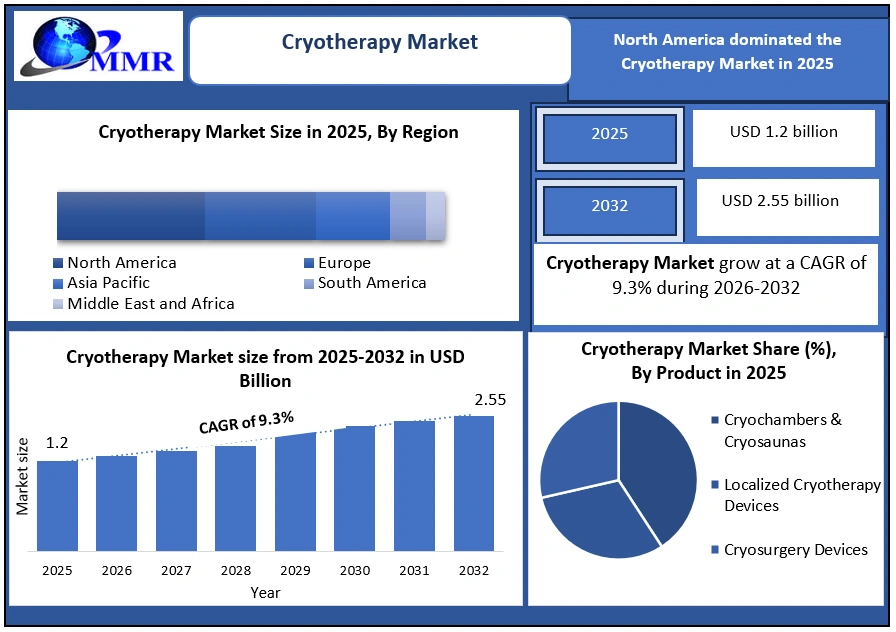
The Cryotherapy Market size was valued at USD 1.2 billion and is projected to reach USD 2.55 billion over the forecast period. This growth reflects a robust CAGR of 9.3%, driven by increasing demand and expanding application areas.
The cryotherapy spans multiple therapy modes whole body cryotherapy market (WBC/PBC chambers), localised cryotherapy market. Industry benchmarking indicates there are slightly above 6,500 whole/partial body cryotherapy installations globally, of which 4,500 are for-profit cryotherapy centres. It shows cryotherapy is an installed-asset business with a large service layer, not only a device market.
To know about the Research Methodology :- Request Free Sample Report
A key structural signal is the use-case mix of installations: around 70% of installations belong to for-profit businesses, medical facilities represent about 5%, and the remaining base is split across private, sports, and corporate settings. This distribution of cryotherapy devices market behaves like a hybrid of medical device wellness equipment, sports recovery infrastructure, with varying standards and buyer criteria.
Key Highlights:
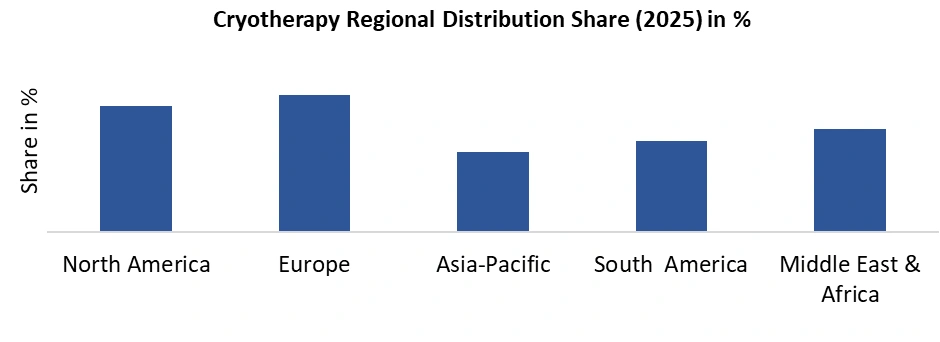
The whole-body cryotherapy markets are Western Europe (including the UK) 30.3% and the United States 28%, representing 60% of installations collectively. These installations are distributed across Asia (12.8%), Eastern Europe (10%), the Middle East (8.6%), Russia (4%), Latin America (3.4%), Scandinavia (1.5%), and Africa (1.4%).
• United States: large installed base and strong franchising/scale dynamics; nitrogen share has dropped to 50%, showing active upgrading to electric systems.
• United Kingdom & Germany: Western Europe’s leading markets; Germany also hosts multi-location franchise activity
• UAE & Saudi Arabia (Middle East): electric systems dominate; nitrogen is ≤40% share there, reflecting premium safety/compliance preference.
• Asia: share of installations (12.8%), but with a higher nitrogen share (70% in Asia & Eastern Europe), typically due to capex sensitivity and legacy supply models.
Cryotherapy Market Dynamics:
Demand and Supply Analysis
• Sports recovery/ fitness (WBC + localized): benchmarking indicates 74.1% of cryotherapy businesses offer whole/partial body cryotherapy (i.e., they own a chamber/sauna), while 81% offer localised cryotherapy (spot devices).
• Aesthetic / dermatology adjacency: large research publishers note cryotherapy’s use in skin-focused wellness settings and rising “consumer-facing” service adoption.
• Package/membership consumption: most businesses depend on bundled purchases; best-selling packages are typically 5–8 sessions (47.5%) and 10–15 sessions (33.7%). This is a demand-shaping commercial model rather than purely clinical pull.
Country-level demand hotspots
• US: high center density + franchise scaling; average single WBC session price around USD 46.9.
• UK: premium pricing; benchmarking reports per session ($80.6) average single session price indicating stronger premium positioning.
• EU average single session around USD 49.9 close to US but generally less price dispersion.
• Australia: premium pricing in benchmarking USD 60.9 average single session.
Industry benchmarking shows electric installations are growing faster than nitrogen/open-top formats, with 20.3% of total electric installations occurring in 2023, vs 14.8% in heat exchange and 4% in open-top nitrogen devices—evidence of a supply-side pivot toward electric platforms.
For the cryotherapy devices market competitive landscape, widely cited market trackers list players such as Zimmer MedizinSysteme GmbH and Boston Scientific among major companies.
Organized vs Unorganized Structure
Organized market
Higher compliance: screening, trained operators, better ventilation standards
More consistent protocols and documentation
Higher capex tolerance → faster adoption of electric systems (especially in Western Europe and Middle East)
Unorganized market
Protocol inconsistency: temperature/time claims vary; weak standardization erodes credibility and outcomes repeatability.
Safety liability exposure in low-compliance setups (especially with nitrogen logistics and ventilation requirements).
Supply reliability risk for nitrogen-driven units; benchmarking highlights real-world operator complaints about nitrogen availability and switching costs.
Service-quality variance → impacts consumer trust, retention, and review-driven acquisition (Google ratings become a demand lever).
Cryotherapy Market Drivers
Installed base expansion and service monetization
With 4,500 for-profit centers globally, the market is pulled by repeat purchase economics (packages/memberships dominate).
Technology shift to electric systems
Nitrogen share differs by market: ~56% nitrogen in Western Europe, ~50% in the US, ~≤40% in the Middle East, while ~70% nitrogen in Asia/Eastern Europe—a clear map of where electric conversion is fastest vs still emerging.
Product portfolio breadth at providers
74.1% offer WBC/PBC and 81% offer localized cryotherapy multi-service menus expand wallet share and improve utilization rates.
Cryotherapy Market Restraints
Contraindications and eligibility constraints
Raynaud’s phenomenon affects 3–5% of the general population and is a known contraindication for cold exposure therapies this reduces addressable eligibility in wellness rollouts.
Operating complexity
Benchmarking highlights nitrogen supply reliability issues and safety scrutiny as structural brakes on nitrogen-driven systems.
Fragmented standards and “unorganised” credibility gap
Inconsistent protocols cause outcome variability; harms review reputation and referral conversion in competitive urban markets.
Cryotherapy Market Opportunities
Electric-driven replacement cycle
Electric installations show higher recent growth, supporting a multi-year replacement/upgrade cycle.
Localization growth and CO₂ device penetration
Localized adoption is high and the technology mix is moving toward easier-operational devices in some markets.
Regional Analysis:
North America dominated the Cryotherapy Market in 2025, accounting for the largest revenue share due to the high adoption of advanced medical and wellness technologies. The region benefited from strong demand across sports medicine, pain management, dermatology, and recovery therapies, particularly in the United States. A well-established healthcare infrastructure, high healthcare spending, and increasing awareness of non-invasive treatment options supported market growth. Additionally, the presence of leading cryotherapy equipment manufacturers, a growing number of wellness centres, and rising use among professional athletes and fitness enthusiasts strengthened North America’s dominance in the global cryotherapy market.
Cryotherapy Market Scope: Inquire before buying
| Global Cryotherapy Market | |||
|---|---|---|---|
| Report Coverage | Details | ||
| Base Year: | 2025 | Forecast Period: | 2026-2032 |
| Historical Data: | 2020 to 2025 | Market Size in 2025: | USD 1.2 Bn. |
| Forecast Period 2026 to 2032 CAGR: | 9.3% | Market Size in 2032: | USD 2.55 Bn. |
| Segments Covered: | by Type | Whole Body Cryotherapy (WBC) Localized Cryotherapy Cryosurgery Icepack / Cold Pack Therapy |
|
| by Product | Cryochambers & Cryosaunas Localised Cryotherapy Devices Cryosurgery Devices Cryoprobes & Cryoguns Accessories & Consumables |
||
| by Application | Oncology Dermatology Pain Management Sports Medicine & Recovery Beauty & Wellness Others |
||
| by End-User | Hospitals Specialty Clinics Ambulatory Surgical Centers Cryotherapy Centers Spas & Fitness Centers Homecare Settings |
||
| by Distribution Channel | Direct Sales Distributors |
||
Cryotherapy Market, by Region
North America (United States, Canada, and Mexico)
Europe (UK, France, Germany, Italy, Spain, Sweden, Austria, and the Rest of Europe)
Asia Pacific (China, South Korea, Japan, India, Australia, ASEAN, Indonesia, Philippines, Malaysia, Vietnam, Thailand, ASEAN, Rest of Asia Pacific)
Middle East & Africa (South Africa, GCC, Nigeria, Rest of ME&A)
South America (Brazil, Argentina, Rest of South America)
Cryotherapy Market, Key Players
1. Zimmer MedizinSysteme GmbH
2. MECOTEC GmbH
3. CryoConcepts LP
4. Impact Cryotherapy
5. Vacuactivus (Cryonick)
6. CryoAction Limited
7. US Cryotherapy
8. CryoBuilt
9. Kriosystem (Kriosystem-Care Sp. z o.o.)
10. Brymill Cryogenic Systems
11. Erbe Elektromedizin GmbH
12. Boston Scientific Corporation
13. Medtronic plc
14. IceCure Medical Ltd.
15. Sanarus Technologies
16. CooperSurgical, Inc.
17. QuidelOrtho Corporation
18. CryoScience Ltd.
19. Cryonic Medical
20. Cryo Innovations
21. CryoUSA
22. CryoLiving
23. Metrum Cryoflex
24. Easycryo
25. Quantum Cryogenics
26. Cortex Technology
27. Shanghai Med-X Scientific Co., Ltd.
28. Guangzhou Wondfo Biotech Co., Ltd.
29. JUKA (Cryotherapy Equipment Division)
30. CryoTreq / BVI Medical
31. Others
FAQ
1. What are the key applications of cryotherapy?
Answer: Cryotherapy is widely used in pain management, sports injury recovery, oncology (cryoablation), dermatology, gynecology, cardiology, and aesthetic treatments. It is also increasingly adopted in wellness and fitness centers for recovery and performance enhancement.
2. What factors are driving the growth of the cryotherapy market?
Answer: Market growth is driven by the rising prevalence of chronic pain and musculoskeletal disorders, increasing sports participation, growing demand for non-invasive treatment options, and expanding adoption of cryotherapy in medical and wellness applications.
3. What types of cryotherapy devices are available in the market?
Answer: The market covers whole-body cryotherapy chambers, localized cryotherapy devices, cryosurgical systems, and portable cryotherapy equipment designed for medical, athletic, and wellness use.
4. Which end users are driving demand for cryotherapy?
Answer: Key end users include hospitals, speciality clinics, dermatology and oncology centres, sports and rehabilitation facilities, wellness centres, and fitness clubs.