
Converting Equipment Market- Industry Structure Evaluation, Demand Drivers Analysis, Regional Growth Analysis and Identification, Competitive Positioning Review & Global Market Size Forecast to 2032
Overview
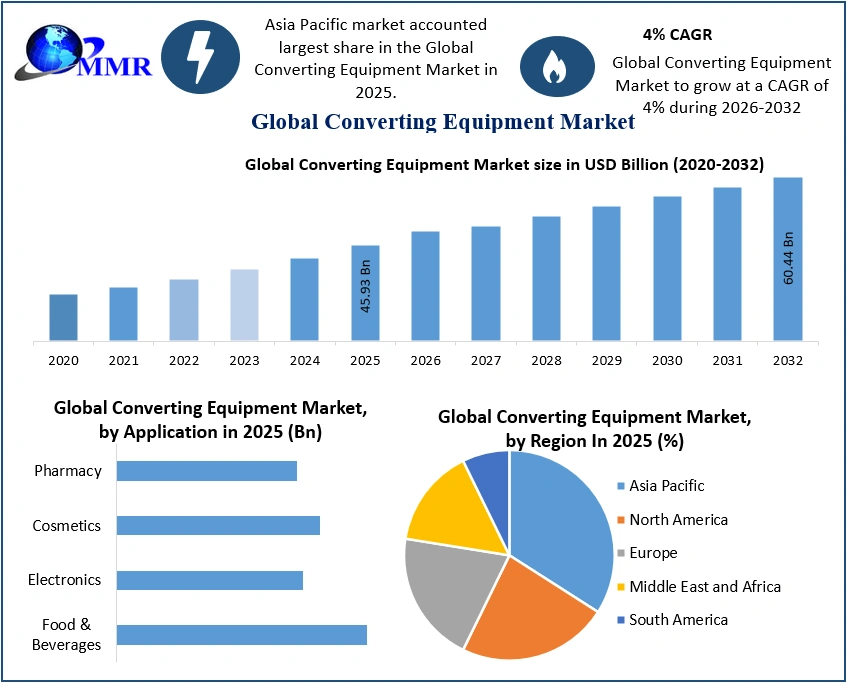
The Converting Equipment Market size was valued at USD 45.93 Billion in 2025 and the total Converting Equipment revenue is expected to grow at a CAGR of 4% from 2026 to 2032, reaching nearly USD 60.44 Billion by 2032.
Converting Equipment Market Overview:
Converting equipment is used to Shift fabrics, plastic sheets, paper, and corrugated materials through the web. A converting machine handles its transformation into final forms or shapes. Converting machinery is capable of slitting, winding, rewinding, weaving, laminating, folding, gluing, seaming, and even sculpting web-based materials.
This category includes manufacturers of machinery that creates packaging and containers from raw materials such as paper, film, and foil, as well as rigid package forming devices such as injection blow molders and can-making equipment. Typical applications for converting machinery include the photographic market, flexible packaging, goods, aluminum fouls, and printed things. Converting equipment is a fantastic solution for virtually any product that is provided in a roll.
To know about the Research Methodology :- Request Free Sample Report
Converting Equipment Market Dynamics:
Market Drivers: The market for printing and converting inline machines is expected to increase significantly in the coming years due to improved production and ink usage. Packaging markets use printing and converting inline machines because they allow manufacturers to choose between automatic and semi-automatic machines. Because of its excellent performance and production capacities, the market for printing and converting inline machines is expected to develop throughout the forecast period. The printing and converting inline machines are equipped with a variety of supporting machines, each of which contributes to the production of a packaging solution.
The market is being driven by the rise of personalization and premium labels. Demand is rapidly shifting toward more personalization and promotion, which means smaller runs, tighter budgets, and, eventually, a completely digital process revolution. According to Big Presence, digital marketing, and sales solutions provider, 82 % of investors want strong brands in the firms they invest in. Small and large brands alike are promoting so-called "targeted campaigns," in which labels alone can improve the apparent quality of a product, hence improving the brand image.
Top influencing Factor: The converting machines market has been pushed by higher productivity gained by converting machines' high working speeds, as well as the combining of several processes into one device. There has been a shift away from plastic films and toward bendy paper packaging solutions due to intolerance toward the use of traditional plastics. The demand for converting equipment for converting paper appears to be growing rapidly.
Furthermore, these machines are well within the budget for materials with widespread low tension. Tissue paper, for example, has seen a significant increase in demand over the last decade and is predicted to generate tremendous opportunities. As a result of the rising demand for products, the total production capacity has increased, presenting a positive opportunity.
Production output & Financing: When it comes to managing the bottom line, it's important to consider how to fund your tissue converting equipment. An outright purchase of machinery that will be used for its full lifespan may allow you to take advantage of lower interest rates and financing terms. Leasing may be a reasonable option if cash flow prevents a purchase or if equipment use is just temporary. Leasing can minimize payments, offer you time to test the equipment's efficacy before buying it, and give you an "out" if you decide you don't want to keep it. However, these advantages come at a price, as leasing is often more expensive than long-term equipment ownership.
Restraints: The expensive cost of label conversion equipment is limiting market Growth. The printing plates are the most important and cost of reprographics to reach the final print stage since this machinery is generally linked with flexographic printing for conversion. There are also considerable operational costs associated with machine utilization. These include items like the cost of electricity utilized to power the machinery, as well as routine maintenance.
Opportunities: The automation method is being adopted by businesses. In 2017, Esko, for example, demonstrated solutions that improved lead times and equipment utilization, reduced errors, and ensured consistent output quality independent of printing technology. WebCenter QuickStart for Labels, a communication bundle for label production with pre-configured process flows aimed at any size label converter, was highlighted by the firm.
Converting Equipment Market Segment Analysis:
Based on Type: The Converting Equipment market types are paper, label, Textile, and Plastic
Paper converting is a term used to describe manufacturing processes that use paper as a raw material. Similar to other converting businesses, this raw material might be in the form of a roll or a sheet. Almost all paper-based items, including magazines, books, newspapers, labels, bags, and general-purpose paper products, require paper converting.
Tray shaping or carton erecting is the process of processing pre-cut cartons or "blanks" and folding them into the required shape to produce final packaging containers. This is an example of a specific form of conversion. Nacho trays, Chinese noodle soup boxes, pizza boxes, French fry trays, hamburger clamshells, and more items can be made with these devices.
Label conversion is mostly a technologically-based market that uses traditional letterpress or flexographic printing. Today, brand owners' demands for adding value to labels are nearly endless, with everything being done in shorter and shorter runs with shorter lead times. While traditional servo drives flexo and offsets presses will continue to dominate the installed base of label presses for many years, digital, particularly inkjet, will likely become the market leader in the long run as quality and performance improvement. Hybrid conventional and inkjet presses will almost probably find a rising market in the future, alongside stand-alone digital presses. Everything will continue to become more automated, which is in line with market trends.

Based on the Application: Food and beverage are expected to dominate the market. With rising food and beverage consumption, demand for label printing is rising, which in turn raises the need for label conversion equipment. A beverage label is much like the beverage consumer in that it is always changing. The products currently on store shelves are being influenced by changing demographics and new print processes. Popular beverages from established brands are undergoing minor adjustments, while up-and-coming firms seek to profit from a burgeoning market. This element makes label conversion equipment more useful. Furthermore, today's brand owners are attempting to achieve a specific style with their beverage labeling. In food & Beverage converting equipment.
While selecting food processing equipment for business, safety should be your top priority. Stock equipment is normally intended to comply with general safety regulations, but these do not account for market-specific risks. Custom-made food processing equipment, on the other hand, is specifically developed to fulfill your company's safety criteria. This ensures optimal cleanliness and hygiene, as well as the safety of your staff. It's unrealistic to expect stock equipment to meet all of your needs and ambitions. Any off-the-shelf machine is likely to lack characteristics that will slow down the manufacturing process.
Blister packers are used to fill blister packs with tablets, capsules, soft gels, injectable solutions, syringes, and other small medical goods. To recover tablets, capsules, or soft gels from blister packs, "deblistering" machines are also available. Bottling and filling lines: For filling liquids into bottles or pills, capsules, or soft gels into containers. Cappers are used to put caps on filled pharmaceutical bottles or containers. Cartons are complex machines that can load small medication boxes with blister packs, fold and insert leaflets, and close, code, and seal the box. Capsules, pills, soft gels, and other small solid objects are counted. Aluminum foil seals to the bottle lip with induction sealers. Land labeling equipment is used to apply or print labels to boxes, bottles, containers, tubes, and another packaging.
Converting Equipment Market Regional Insights:
The Asia Pacific region dominated the market with 42% share in 2025. The demand for packaging in the food, cosmetics, and home industries, as well as the necessity for high-speed and high-quality labeling solutions, is driving market growth in Asia. Southeast Asia has a population of over 646 million people and a label consumption growth rate of over 7%, according to Labels & Labeling, making it one of the world's fastest-growing marketplaces. Also, hundreds of live demonstrations of ground-breaking technologies connected to label machinery and label converting machinery were shown at label expo Asia in December 2022.
The RSI-340 and RSH-340 (horizontal alignment) built for inspection and slitting of printed labels, as well as the RDF-340, a digital label converting system that is adjustable to fulfill design needs, were introduced in September 2022 under the Roto Control Ecoline brand. With the installation in Australia, the market for label conversion machinery will effectively increase in the future. Moreover, several local Asian businesses are investing in cutting-edge machinery to improve their brand image and expand their consumer base.
The objective of the report is to present a comprehensive analysis of the global Converting Equipment Market to the stakeholders in the industry. The past and current status of the industry with the forecasted market size and trends are presented in the report with the analysis of complicated data in simple language. The report covers all the aspects of the industry with a dedicated study of key players that include market leaders, followers, and new entrants.
PORTER, PESTEL analysis with the potential impact of micro-economic factors of the market have been presented in the report. External as well as internal factors that are supposed to affect the business positively or negatively have been analyzed, which will give a clear futuristic view of the industry to the decision-makers.
The reports also help in understanding the Converting Equipment Market dynamic, and structure by analyzing the market segments and projecting the Converting Equipment Market size. Clear representation of competitive analysis of key players by Vehicle type, price, financial position, product portfolio, growth strategies, and regional presence in the Converting Equipment Market make the report investor’s guide.
Converting Equipment Market Scope: Inquire before buying
| Global Converting Equipment Market | |||
|---|---|---|---|
| Report Coverage | Details | ||
| Base Year: | 2025 | Forecast Period: | 2026-2032 |
| Historical Data: | 2020 to 2025 | Market Size in 2025: | USD 45.93 Bn |
| Forecast Period 2026 to 2032 CAGR: | 4% | Market Size in 2032: | USD 60.44 Bn. |
| Segments Covered: | by Type | Paper Label Plastic Textile |
|
| by Application | Food & Beverages Electronics Cosmetics Pharmacy |
||
Converting Equipment Market, by Region
North America (United States, Canada and Mexico)
Europe (UK, France, Germany, Italy, Spain, Sweden, Austria, Turkey, Russia and Rest of Europe)
Asia Pacific (China, India, Japan, South Korea, Australia, ASEAN and Rest of APAC)
Middle East and Africa (South Africa, GCC, Egypt, Nigeria and Rest of ME&A)
South America (Brazil, Argentina, Columbia and Rest of South America)
Converting Equipment Market, Key Players are
1.EIT
2. Smag Graphique
3. Labels and Labeling
4. LabelandNarrow Web
5. ASHE Converting Equipment
6. Daco Solutions
7. Spartanics
8. BOBST
9. Advanced Converting Equipment Ltd
10. ABG International
11. Labelexpo Europe
12. General Motors
13. Universal Converting Equipment
14. Lemorau
15. Sohn Manufacturing Inc.
16. JandJ Converting machinery
Frequently Asked Questions:
1] What segments are covered in the Global Converting Equipment Market report?
Ans. The segments covered in the Global Converting Equipment Market report are based on Product Type and Application.
2] Which region is expected to hold the highest share in the Global Converting Equipment Market?
Ans. The Asia Pacific region is expected to hold the highest share in the Global Converting Equipment Market.
3] What is the market size of the Global Converting Equipment Market by 2032?
Ans. The market size of the Global Converting Equipment Market by 2032 is expected to reach USD 60.44 Bn.
4] What is the forecast period for the Global Converting Equipment Market?
Ans. The forecast period for the Global Converting Equipment Market is 2026-2032.
5] What was the market size of the Global Converting Equipment Market in 2025?
Ans. The market size of the Global Converting Equipment Market in 2025 was valued at USD 45.93 Bn.