Conventional Oil Market Size by Type, Sulfur Content, End-Use Industry, Region – Segment-Level Market Assessment, Growth Opportunity Analysis, Competitive Mapping & Forecast to 2032

3.9%
CAGR (2026-2032)
268 USD Trillion
Market Size
311
Report Pages
148
Market Tables

Overview

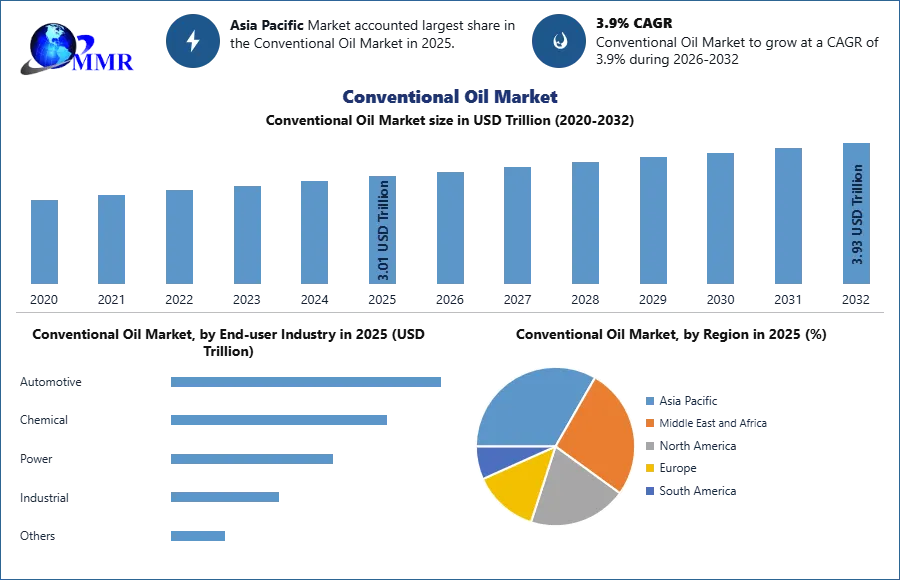
The Conventional Oil Market size was valued at USD 3.01 Trillion in 2025 and the total Conventional Oil revenue is expected to grow at a CAGR of 3.9% from 2026 to 2032, reaching nearly USD 3.93 Trillion.

The conventional oil industry has played a significant role in the global economy for many decades, providing a major source of energy for transportation, industry, and residential and commercial use. The industry has also been a significant source of employment and economic growth, particularly in regions with large oil reserves. However, the conventional oil market has faced a number of challenges in recent years. These include declining oil reserves, increasing costs of oil exploration and extraction, and growing concerns about the environmental impact of oil extraction and use, including greenhouse gas emissions and air and water pollution, resulting in steady market growth.

Conventional oil is a type of oil extracted from underground reservoirs using traditional methods. It is a finite resource subject to depletion over time, and the increasing demand has made it more difficult and expensive to extract. Conventional oil remains a major source of global energy, used in transportation, power generation, and industrial processes.

The depletion of conventional oil reserves has led to concerns about sustainability and the need for transitioning towards cleaner, more sustainable sources of energy. The environmental impact of conventional oil extraction and use, including greenhouse gas emissions, air and water pollution, and habitat destruction, has also raised concerns. Therefore, there is a need to focus on diversifying the global energy mix and reducing dependence on conventional oil while developing alternative energy sources.
To know about the Research Methodology:- Request Free Sample Report

Conventional Oil Market Dynamics:

The growing transportation industry across the world

The transportation industry is a crucial component of modern society. The increasing demand for goods and services, as well as the growing need for mobility, is driving the growth of the transportation industry across all modes of transportation, including road, rail, air, and sea.

In developing countries, in particular, the growth of the transportation industry is seen as a key driver of economic development, as it enables greater access to markets and expands opportunities for trade and commerce. This is leading to increased investment in transportation infrastructure, such as new highways, railways, and airports, to support the growing demand for transportation services.

The growth of the transportation industry is driving the demand for conventional oil products like gasoline and diesel, which are the primary fuels used in the transportation sector, thereby driving the global conventional oil market during the forecast period. Cars and trucks powered by internal combustion engines require gasoline and diesel to operate, and as the number of vehicles on the road increases, boosting the demand for conventional oil.

Increasing technological advancements in the conventional oil industry

Increasing technological advancements in the conventional oil market are expected to offer major growth potential throughout the forecast period. Advancements in technology, such as the development of more efficient extraction methods or the use of enhanced oil recovery techniques, make it easier and cheaper to extract conventional oil. This could lead to an increase in production and extend the lifespan of conventional oil reserves. For instance,

1. Advanced drilling techniques: Innovations in drilling technology have allowed for more precise and efficient drilling, reducing costs and increasing production. For example, directional drilling and horizontal drilling techniques allow for the drilling of multiple wells from a single site, reducing the need for additional drilling sites.

2. Digitalization: The use of digital technologies such as artificial intelligence (AI) and the Internet of Things (IoT) is being increasingly used in the conventional oil industry. These technologies are used to optimize production, detect and prevent equipment failures, and increase safety.

3. Enhanced oil recovery techniques: Advanced techniques such as hydraulic fracturing (fracking) and carbon capture and storage (CCS) are being used to extract more oil from conventional reservoirs. Fracking involves injecting water, sand, and chemicals into the reservoir to release trapped oil, while CCS captures carbon dioxide emissions from industrial processes and stores them underground.

4. Autonomous vehicles: Self-driving vehicles are being used in the conventional oil industry to improve safety and reduce costs. For example, autonomous vehicles can be used to transport personnel and equipment to remote sites, reducing the need for expensive helicopter flights.

As a result, the increasing technological advancements in the conventional oil industry are improving efficiency, reducing costs, and increasing production, while also reducing the environmental impact of oil production and creating lucrative growth opportunities for conventional oil manufacturers.

Growing adoption of renewable energy sources

The growing adoption of renewable energy sources such as wind, solar, and hydroelectric power is one of the major factors that is restraining the demand for conventional oil. Renewable energy sources are becoming increasingly popular due to several factors, including concerns over climate change, environmental sustainability, and the declining cost of renewable energy technologies.

Governments around the world are also providing incentives and subsidies to encourage the adoption of renewable energy sources. For example, many countries have implemented renewable energy targets, tax incentives, and feed-in tariffs to support the growth of renewable energy industries. For instance,

1. Germany has implemented feed-in tariffs that guarantee a fixed price for renewable energy producers for a set period of time, providing stability and certainty for renewable energy investments.

2. China has implemented a variety of policies, including feed-in tariffs, subsidies, and tax incentives, to support the growth of renewable energy industries.

3. The United States has implemented a variety of policies to support renewable energy adoption at the federal, state, and local levels. These policies include tax credits, grants, loan guarantees, and renewable portfolio standards, which require utilities to generate a certain percentage of their electricity from renewable sources.

As the adoption of renewable energy sources continues to increase, the demand for conventional oil is likely to decline and restrain the conventional oil market. This shift towards renewable energy sources is not only important for reducing greenhouse gas emissions and combating climate change but also for promoting energy security and reducing reliance on finite fossil fuel resources.

Conventional Oil Market Segment Analysis:

Based on End-user Industry, the automotive segment held the largest market share in 2025 and dominated the conventional oil market in 2025. The segment is expected to further grow at a significant CAGR during the forecast period. The automotive industry is one of the largest end-users of conventional oil. Conventional oil products like gasoline and diesel are the primary fuels used in cars, trucks, and other vehicles powered by internal combustion engines (ICEs).

As the global population and economy continue to grow, the demand for transportation is also expected to increase, leading to higher demand for conventional oil products in the automotive industry, thereby supporting segment growth. However, the conventional oil market is facing increasing competition from alternative energy sources, particularly electric vehicles (EVs) powered by batteries or fuel cells, thus restraining the segment growth. In recent years, there has been a growing shift towards EVs in the automotive industry, driven by factors like government incentives, technological advancements, and increasing consumer demand for environmentally friendly transportation options. While EVs still represent a small portion of the overall automotive market, their market share is expected to increase over time, potentially leading to lower demand for conventional oil products during the forecast period.

Despite the growth of the EV market, conventional oil products are likely to remain a key fuel source for the automotive industry. Many consumers still prefer ICE-powered vehicles due to factors like range anxiety and the lack of charging infrastructure, and the production and use of conventional oil products are well-established and supported by a well-developed infrastructure, driving conventional oil market growth in the automotive industry. Conventional oil is used in power generation as a fuel for oil-fired power plants. The power generation industry has historically been a significant consumer of conventional oil, particularly in countries with limited access to other sources of energy. The chemical industry is expected to grow at a moderate CAGR during the forecast period.

The chemical industry is also one of the largest end-users of conventional oil, using it as a feedstock for the production of a wide range of chemical products. Conventional oil is processed to produce petrochemicals, which are then used to make plastics, synthetic fibers, rubber, and other chemical products. The demand for petrochemicals and other chemical products is driven by a wide range of industries, including packaging, construction, automotive, and consumer goods. As such, the demand for conventional oil in the chemical industry is closely linked to the overall state of the global economy and the demand for products in these industries.

Conventional Oil Market Regional Insights:

North America dominated the Conventional Oil Market in 2025.  The North American conventional oil market remains a critical segment of the region’s energy landscape, supported by established reserves, advanced extraction technologies, and strong refining infrastructure. The United States dominates production, particularly in Texas, Alaska, and the Gulf of Mexico, while Canada contributes significantly through conventional fields in Alberta and Saskatchewan. Despite growing investment in renewable energy, conventional oil continues to play a vital role in transportation, petrochemicals, and industrial applications. Stable domestic demand, export opportunities, and technological improvements in drilling and reservoir management sustain market growth, although environmental regulations and price volatility remain key challenges.

The Middle East and Africa region is expected to be a significant region for major conventional oil market players. The Middle East region is home to some of the largest conventional oil reserves in the world, with Saudi Arabia, Iran, and Iraq being major producers. The market is highly sensitive to political instability in the region, and tensions with other oil-producing countries lead to supply disruptions.

The oil industry has played a crucial role in the economic development of many Middle Eastern countries, with oil revenues being a major source of income for governments and providing employment opportunities. However, the conventional oil market in the region is also subject to political and security risks, which can lead to supply disruptions and price volatility.

The Organization of the Petroleum Exporting Countries (OPEC), a cartel of 14 oil-producing countries, including several Middle Eastern countries, has a significant influence on the conventional oil market. OPEC members work together to control oil production levels and stabilize prices, making the organization an important player in the conventional oil market. Political disputes and conflicts in the Middle East can also have a significant impact on the oil market. For example,

1. The US sanctions on Iran have led to a decrease in Iranian oil exports, and conflicts in Iraq and Syria have disrupted oil production and transportation.

Despite the region's significant conventional oil reserves, some Middle Eastern countries are also exploring alternative sources of energy, such as solar and wind power. The development of alternative energy sources could have a significant impact on the future of the Middle East's conventional oil industry, as global demand for oil may decrease over time.

United States is the largest producer of conventional oil in North America, followed by Canada and Mexico. The region is characterized by the presence of large oil fields and high levels of investment in oil infrastructure. The conventional oil industry is also influenced by geopolitical factors, such as relations with OPEC countries and the shale oil revolution.

The United States is a significant player in the conventional oil market, with a long history of oil production dating back to the early 1900s. The country is the largest producer of conventional oil in North America and one of the top producers in the world. The majority of conventional oil production in the US comes from onshore fields, such as the Permian Basin in Texas and New Mexico, the Bakken Formation in North Dakota, and the Eagle Ford Formation in Texas.

In recent years, the US has experienced a significant increase in oil production due to the development of shale oil and gas resources. This has led to a shift in the global conventional oil market, with the US becoming less dependent on oil imports and even exporting oil to other countries. The shale revolution has also led to changes in the pricing of oil, with the emergence of shale oil production leading to a lower global oil price.

The US has a well-developed oil infrastructure, including pipelines, refineries, and storage facilities, which supports its significant production and consumption of conventional oil. The country is also home to major oil companies, such as ExxonMobil, Chevron, and ConocoPhillips, which have a significant presence in the conventional oil market. Despite the growth of shale oil production, the US continues to rely on imports of some types of conventional oil, particularly heavier crude oils. The country also faces environmental and regulatory challenges related to conventional oil production, particularly in areas with sensitive ecosystems or concerns about water contamination, resulting in restraining the market growth.

Recent Developments

Saudi Aramco
March 2024: Saudi Aramco advanced its conventional crude production capacity, maintaining an impressive 12 million barrels per day. The company focused on maximizing output from its mature Ghawar and Safaniyah fields while investing in operational efficiency programs and enhanced reservoir management techniques. Alongside upstream expansion, Aramco strengthened its logistics and export infrastructure, ensuring stable supply to global markets. Strategic investments also targeted cost optimization and long-term sustainability, reinforcing its position as the world’s leading conventional oil producer.

ExxonMobil Corporation
April 2024: ExxonMobil accelerated development in the Permian Basin and Guyana’s Stabroek Block to strengthen conventional oil output. The company deployed advanced drilling technologies and optimized production strategies to increase well productivity. Investments focused on reservoir management and enhanced oil recovery methods to ensure sustainable long-term output. Alongside upstream expansion, ExxonMobil emphasized operational efficiency and capital discipline, reinforcing its leadership in high-return conventional oil assets and maintaining a strong position in global crude supply markets.

Conventional Oil Market Scope: Inquiry Before Buying

Conventional Oil Market
Report Coverage Details
Base Year: 2025 Forecast Period: 2026-2032
Historical Data: 2020 to 2025 Market Size in 2025: 3.01 USD Trillion
Forecast Period 2026-2032 CAGR: 3.9% Market Size in 2032: 3.93 USD Trillion
Segments Covered: by Type Light Distillate
Middle Distillates
Heavy Ends
Others
by Sulphur Content Low Sulphur
High Sulphur
by End-user Industry Automotive
Chemical
Power
Industrial
Others

Conventional Oil Market, by Region

North America (United States, Canada and Mexico)
Europe (UK, France, Germany, Italy, Spain, Sweden, Austria, Turkey, Russia and Rest of Europe)
Asia Pacific (China, India, Japan, South Korea, Australia, ASEAN and Rest of APAC)
Middle East and Africa (South Africa, GCC, Egypt, Nigeria and Rest of ME&A)
South America (Brazil, Argentina, Columbia and Rest of South America)

Conventional Oil Market, Key Players are

  1. Saudi Aramco
  2. ExxonMobil Corporation
  3. Royal Dutch Shell plc
  4. BP plc
  5. Chevron Corporation
  6. TotalEnergies SE
  7. China National Petroleum Corporation (CNPC)
  8. Sinopec Group
  9. PetroChina Company Limited
  10. Gazprom
  11. Rosneft Oil Company
  12. Lukoil
  13. Kuwait Petroleum Corporation
  14. Abu Dhabi National Oil Company (ADNOC)
  15. QatarEnergy
  16. Petrobras
  17. Petronas
  18. Equinor ASA
  19. ConocoPhillips
  20. Eni S.p.A.
  21. Occidental Petroleum Corporation
  22. Indian Oil Corporation Limited
  23. ONGC (Oil and Natural Gas Corporation)
  24. Pertamina
  25. Sonatrach
  26. PDVSA (Petróleos de Venezuela, S.A.)
  27. Ecopetrol
  28. CNOOC Limited
  29. Repsol S.A.
  30. Marathon Oil Corporation

Table of Contents

1. Conventional Oil Market Introduction
1.1. Study Assumption and Market Definition
1.2. Scope of the Study
1.3. Executive Summary
2. Global Conventional Oil Market: Competitive Landscape
2.1. MMR Competition Matrix
2.2. Competitive Landscape
2.3. Key Players Benchmarking
2.3.1. Company Name
2.3.2. Business Segment
2.3.3. End-user Segment
2.3.4. Revenue (2025)
2.3.5. Company Locations
2.4. Leading Conventional Oil Market Companies, by market capitalization
2.5. Market Structure
2.5.1. Market Leaders
2.5.2. Market Followers
2.5.3. Emerging Players
2.6. Mergers and Acquisitions Details
3. Conventional Oil Market: Dynamics
3.1. Conventional Oil Market Trends by Region
3.1.1. North America Conventional Oil Market Trends
3.1.2. Europe Conventional Oil Market Trends
3.1.3. Asia Pacific Conventional Oil Market Trends
3.1.4. Middle East and Africa Conventional Oil Market Trends
3.1.5. South America Conventional Oil Market Trends
3.2. Conventional Oil Market Dynamics by Region
3.2.1. North America
3.2.1.1. North America Conventional Oil Market Drivers
3.2.1.2. North America Conventional Oil Market Restraints
3.2.1.3. North America Conventional Oil Market Opportunities
3.2.1.4. North America Conventional Oil Market Challenges
3.2.2. Europe
3.2.2.1. Europe Conventional Oil Market Drivers
3.2.2.2. Europe Conventional Oil Market Restraints
3.2.2.3. Europe Conventional Oil Market Opportunities
3.2.2.4. Europe Conventional Oil Market Challenges
3.2.3. Asia Pacific
3.2.3.1. Asia Pacific Conventional Oil Market Drivers
3.2.3.2. Asia Pacific Conventional Oil Market Restraints
3.2.3.3. Asia Pacific Conventional Oil Market Opportunities
3.2.3.4. Asia Pacific Conventional Oil Market Challenges
3.2.4. Middle East and Africa
3.2.4.1. Middle East and Africa Conventional Oil Market Drivers
3.2.4.2. Middle East and Africa Conventional Oil Market Restraints
3.2.4.3. Middle East and Africa Conventional Oil Market Opportunities
3.2.4.4. Middle East and Africa Conventional Oil Market Challenges
3.2.5. South America
3.2.5.1. South America Conventional Oil Market Drivers
3.2.5.2. South America Conventional Oil Market Restraints
3.2.5.3. South America Conventional Oil Market Opportunities
3.2.5.4. South America Conventional Oil Market Challenges
3.3. PORTER's Five Forces Analysis
3.4. PESTLE Analysis
3.5. Technology Roadmap
3.6. Regulatory Landscape by Region
3.6.1. North America
3.6.2. Europe
3.6.3. Asia Pacific
3.6.4. Middle East and Africa
3.6.5. South America
3.7. Key Opinion Leader Analysis For Conventional Oil Industry
3.8. Analysis of Government Schemes and Initiatives For Conventional Oil Industry
3.9. Conventional Oil Market Trade Analysis
3.10. The Global Pandemic Impact on Conventional Oil Market
4. Conventional Oil Market: Global Market Size and Forecast by Segmentation (in USD Trillion) 2025-2032
4.1. Conventional Oil Market Size and Forecast, by Type (2025-2032)
4.1.1. Light Distillate
4.1.2. Middle Distillates
4.1.3. Heavy Ends
4.1.4. Others
4.2. Conventional Oil Market Size and Forecast, by Sulphur Content (2025-2032)
4.2.1. Low Sulphur
4.2.2. High Sulphur
4.3. Conventional Oil Market Size and Forecast, by End-user Industry (2025-2032)
4.3.1. Automotive
4.3.2. Chemical
4.3.3. Power
4.3.4. Industrial
4.3.5. Others
4.4. Conventional Oil Market Size and Forecast, by Region (2025-2032)
4.4.1. North America
4.4.2. Europe
4.4.3. Asia Pacific
4.4.4. Middle East and Africa
4.4.5. South America
5. North America Conventional Oil Market Size and Forecast by Segmentation (in USD Trillion) 2025-2032
5.1. North America Conventional Oil Market Size and Forecast, by Type (2025-2032)
5.1.1. Light Distillate
5.1.2. Middle Distillates
5.1.3. Heavy Ends
5.1.4. Others
5.2. North America Conventional Oil Market Size and Forecast, by Sulphur Content (2025-2032)
5.2.1. Low Sulphur
5.2.2. High Sulphur
5.3. North America Conventional Oil Market Size and Forecast, by End-user Industry (2025-2032)
5.3.1. Automotive
5.3.2. Chemical
5.3.3. Power
5.3.4. Industrial
5.3.5. Others
5.4. North America Conventional Oil Market Size and Forecast, by Country (2025-2032)
5.4.1. United States
5.4.1.1. United States Conventional Oil Market Size and Forecast, by Type (2025-2032)
5.4.1.1.1. Light Distillate
5.4.1.1.2. Middle Distillates
5.4.1.1.3. Heavy Ends
5.4.1.1.4. Others
5.4.1.2. United States Conventional Oil Market Size and Forecast, by Sulphur Content (2025-2032)
5.4.1.2.1. Low Sulphur
5.4.1.2.2. High Sulphur
5.4.1.3. United States Conventional Oil Market Size and Forecast, by End-user Industry (2025-2032)
5.4.1.3.1. Automotive
5.4.1.3.2. Chemical
5.4.1.3.3. Power
5.4.1.3.4. Industrial
5.4.1.3.5. Others
5.4.2. Canada
5.4.2.1. Canada Conventional Oil Market Size and Forecast, by Type (2025-2032)
5.4.2.1.1. Light Distillate
5.4.2.1.2. Middle Distillates
5.4.2.1.3. Heavy Ends
5.4.2.1.4. Others
5.4.2.2. Canada Conventional Oil Market Size and Forecast, by Sulphur Content (2025-2032)
5.4.2.2.1. Low Sulphur
5.4.2.2.2. High Sulphur
5.4.2.3. Canada Conventional Oil Market Size and Forecast, by End-user Industry (2025-2032)
5.4.2.3.1. Automotive
5.4.2.3.2. Chemical
5.4.2.3.3. Power
5.4.2.3.4. Industrial
5.4.2.3.5. Others
5.4.3. Mexico
5.4.3.1. Mexico Conventional Oil Market Size and Forecast, by Type (2025-2032)
5.4.3.1.1. Light Distillate
5.4.3.1.2. Middle Distillates
5.4.3.1.3. Heavy Ends
5.4.3.1.4. Others
5.4.3.2. Mexico Conventional Oil Market Size and Forecast, by Sulphur Content (2025-2032)
5.4.3.2.1. Low Sulphur
5.4.3.2.2. High Sulphur
5.4.3.3. Mexico Conventional Oil Market Size and Forecast, by End-user Industry (2025-2032)
5.4.3.3.1. Automotive
5.4.3.3.2. Chemical
5.4.3.3.3. Power
5.4.3.3.4. Industrial
5.4.3.3.5. Others
6. Europe Conventional Oil Market Size and Forecast by Segmentation (in USD Trillion) 2025-2032
6.1. Europe Conventional Oil Market Size and Forecast, by Type (2025-2032)
6.2. Europe Conventional Oil Market Size and Forecast, by Sulphur Content (2025-2032)
6.3. Europe Conventional Oil Market Size and Forecast, by End-user Industry (2025-2032)
6.4. Europe Conventional Oil Market Size and Forecast, by Country (2025-2032)
6.4.1. United Kingdom
6.4.1.1. United Kingdom Conventional Oil Market Size and Forecast, by Type (2025-2032)
6.4.1.2. United Kingdom Conventional Oil Market Size and Forecast, by Sulphur Content (2025-2032)
6.4.1.3. United Kingdom Conventional Oil Market Size and Forecast, by End-user Industry (2025-2032)
6.4.2. France
6.4.2.1. France Conventional Oil Market Size and Forecast, by Type (2025-2032)
6.4.2.2. France Conventional Oil Market Size and Forecast, by Sulphur Content (2025-2032)
6.4.2.3. France Conventional Oil Market Size and Forecast, by End-user Industry (2025-2032)
6.4.3. Germany
6.4.3.1. Germany Conventional Oil Market Size and Forecast, by Type (2025-2032)
6.4.3.2. Germany Conventional Oil Market Size and Forecast, by Sulphur Content (2025-2032)
6.4.3.3. Germany Conventional Oil Market Size and Forecast, by End-user Industry (2025-2032)
6.4.4. Italy
6.4.4.1. Italy Conventional Oil Market Size and Forecast, by Type (2025-2032)
6.4.4.2. Italy Conventional Oil Market Size and Forecast, by Sulphur Content (2025-2032)
6.4.4.3. Italy Conventional Oil Market Size and Forecast, by End-user Industry (2025-2032)
6.4.5. Spain
6.4.5.1. Spain Conventional Oil Market Size and Forecast, by Type (2025-2032)
6.4.5.2. Spain Conventional Oil Market Size and Forecast, by Sulphur Content (2025-2032)
6.4.5.3. Spain Conventional Oil Market Size and Forecast, by End-user Industry (2025-2032)
6.4.6. Sweden
6.4.6.1. Sweden Conventional Oil Market Size and Forecast, by Type (2025-2032)
6.4.6.2. Sweden Conventional Oil Market Size and Forecast, by Sulphur Content (2025-2032)
6.4.6.3. Sweden Conventional Oil Market Size and Forecast, by End-user Industry (2025-2032)
6.4.7. Austria
6.4.7.1. Austria Conventional Oil Market Size and Forecast, by Type (2025-2032)
6.4.7.2. Austria Conventional Oil Market Size and Forecast, by Sulphur Content (2025-2032)
6.4.7.3. Austria Conventional Oil Market Size and Forecast, by End-user Industry (2025-2032)
6.4.8. Rest of Europe
6.4.8.1. Rest of Europe Conventional Oil Market Size and Forecast, by Type (2025-2032)
6.4.8.2. Rest of Europe Conventional Oil Market Size and Forecast, by Sulphur Content (2025-2032)
6.4.8.3. Rest of Europe Conventional Oil Market Size and Forecast, by End-user Industry (2025-2032)
7. Asia Pacific Conventional Oil Market Size and Forecast by Segmentation (in USD Trillion) 2025-2032
7.1. Asia Pacific Conventional Oil Market Size and Forecast, by Type (2025-2032)
7.2. Asia Pacific Conventional Oil Market Size and Forecast, by Sulphur Content (2025-2032)
7.3. Asia Pacific Conventional Oil Market Size and Forecast, by End-user Industry (2025-2032)
7.4. Asia Pacific Conventional Oil Market Size and Forecast, by Country (2025-2032)
7.4.1. China
7.4.1.1. China Conventional Oil Market Size and Forecast, by Type (2025-2032)
7.4.1.2. China Conventional Oil Market Size and Forecast, by Sulphur Content (2025-2032)
7.4.1.3. China Conventional Oil Market Size and Forecast, by End-user Industry (2025-2032)
7.4.2. S Korea
7.4.2.1. S Korea Conventional Oil Market Size and Forecast, by Type (2025-2032)
7.4.2.2. S Korea Conventional Oil Market Size and Forecast, by Sulphur Content (2025-2032)
7.4.2.3. S Korea Conventional Oil Market Size and Forecast, by End-user Industry (2025-2032)
7.4.3. Japan
7.4.3.1. Japan Conventional Oil Market Size and Forecast, by Type (2025-2032)
7.4.3.2. Japan Conventional Oil Market Size and Forecast, by Sulphur Content (2025-2032)
7.4.3.3. Japan Conventional Oil Market Size and Forecast, by End-user Industry (2025-2032)
7.4.4. India
7.4.4.1. India Conventional Oil Market Size and Forecast, by Type (2025-2032)
7.4.4.2. India Conventional Oil Market Size and Forecast, by Sulphur Content (2025-2032)
7.4.4.3. India Conventional Oil Market Size and Forecast, by End-user Industry (2025-2032)
7.4.5. Australia
7.4.5.1. Australia Conventional Oil Market Size and Forecast, by Type (2025-2032)
7.4.5.2. Australia Conventional Oil Market Size and Forecast, by Sulphur Content (2025-2032)
7.4.5.3. Australia Conventional Oil Market Size and Forecast, by End-user Industry (2025-2032)
7.4.6. Indonesia
7.4.6.1. Indonesia Conventional Oil Market Size and Forecast, by Type (2025-2032)
7.4.6.2. Indonesia Conventional Oil Market Size and Forecast, by Sulphur Content (2025-2032)
7.4.6.3. Indonesia Conventional Oil Market Size and Forecast, by End-user Industry (2025-2032)
7.4.7. Malaysia
7.4.7.1. Malaysia Conventional Oil Market Size and Forecast, by Type (2025-2032)
7.4.7.2. Malaysia Conventional Oil Market Size and Forecast, by Sulphur Content (2025-2032)
7.4.7.3. Malaysia Conventional Oil Market Size and Forecast, by End-user Industry (2025-2032)
7.4.8. Vietnam
7.4.8.1. Vietnam Conventional Oil Market Size and Forecast, by Type (2025-2032)
7.4.8.2. Vietnam Conventional Oil Market Size and Forecast, by Sulphur Content (2025-2032)
7.4.8.3. Vietnam Conventional Oil Market Size and Forecast, by End-user Industry (2025-2032)
7.4.9. Taiwan
7.4.9.1. Taiwan Conventional Oil Market Size and Forecast, by Type (2025-2032)
7.4.9.2. Taiwan Conventional Oil Market Size and Forecast, by Sulphur Content (2025-2032)
7.4.9.3. Taiwan Conventional Oil Market Size and Forecast, by End-user Industry (2025-2032)
7.4.10. Rest of Asia Pacific
7.4.10.1. Rest of Asia Pacific Conventional Oil Market Size and Forecast, by Type (2025-2032)
7.4.10.2. Rest of Asia Pacific Conventional Oil Market Size and Forecast, by Sulphur Content (2025-2032)
7.4.10.3. Rest of Asia Pacific Conventional Oil Market Size and Forecast, by End-user Industry (2025-2032)
8. Middle East and Africa Conventional Oil Market Size and Forecast by Segmentation (in USD Trillion) 2025-2032
8.1. Middle East and Africa Conventional Oil Market Size and Forecast, by Type (2025-2032)
8.2. Middle East and Africa Conventional Oil Market Size and Forecast, by Sulphur Content (2025-2032)
8.3. Middle East and Africa Conventional Oil Market Size and Forecast, by End-user Industry (2025-2032)
8.4. Middle East and Africa Conventional Oil Market Size and Forecast, by Country (2025-2032)
8.4.1. South Africa
8.4.1.1. South Africa Conventional Oil Market Size and Forecast, by Type (2025-2032)
8.4.1.2. South Africa Conventional Oil Market Size and Forecast, by Sulphur Content (2025-2032)
8.4.1.3. South Africa Conventional Oil Market Size and Forecast, by End-user Industry (2025-2032)
8.4.2. GCC
8.4.2.1. GCC Conventional Oil Market Size and Forecast, by Type (2025-2032)
8.4.2.2. GCC Conventional Oil Market Size and Forecast, by Sulphur Content (2025-2032)
8.4.2.3. GCC Conventional Oil Market Size and Forecast, by End-user Industry (2025-2032)
8.4.3. Nigeria
8.4.3.1. Nigeria Conventional Oil Market Size and Forecast, by Type (2025-2032)
8.4.3.2. Nigeria Conventional Oil Market Size and Forecast, by Sulphur Content (2025-2032)
8.4.3.3. Nigeria Conventional Oil Market Size and Forecast, by End-user Industry (2025-2032)
8.4.4. Rest of ME&A
8.4.4.1. Rest of ME&A Conventional Oil Market Size and Forecast, by Type (2025-2032)
8.4.4.2. Rest of ME&A Conventional Oil Market Size and Forecast, by Sulphur Content (2025-2032)
8.4.4.3. Rest of ME&A Conventional Oil Market Size and Forecast, by End-user Industry (2025-2032)
9. South America Conventional Oil Market Size and Forecast by Segmentation (in USD Trillion) 2025-2032
9.1. South America Conventional Oil Market Size and Forecast, by Type (2025-2032)
9.2. South America Conventional Oil Market Size and Forecast, by Sulphur Content (2025-2032)
9.3. South America Conventional Oil Market Size and Forecast, by End-user Industry (2025-2032)
9.4. South America Conventional Oil Market Size and Forecast, by Country (2025-2032)
9.4.1. Brazil
9.4.1.1. Brazil Conventional Oil Market Size and Forecast, by Type (2025-2032)
9.4.1.2. Brazil Conventional Oil Market Size and Forecast, by Sulphur Content (2025-2032)
9.4.1.3. Brazil Conventional Oil Market Size and Forecast, by End-user Industry (2025-2032)
9.4.2. Argentina
9.4.2.1. Argentina Conventional Oil Market Size and Forecast, by Type (2025-2032)
9.4.2.2. Argentina Conventional Oil Market Size and Forecast, by Sulphur Content (2025-2032)
9.4.2.3. Argentina Conventional Oil Market Size and Forecast, by End-user Industry (2025-2032)
9.4.3. Rest Of South America
9.4.3.1. Rest Of South America Conventional Oil Market Size and Forecast, by Type (2025-2032)
9.4.3.2. Rest Of South America Conventional Oil Market Size and Forecast, by Sulphur Content (2025-2032)
9.4.3.3. Rest Of South America Conventional Oil Market Size and Forecast, by End-user Industry (2025-2032)
10. Company Profile: Key Players
10.1. Saudi Aramco
10.1.1. Company Overview
10.1.2. Business Portfolio
10.1.3. Financial Overview
10.1.4. SWOT Analysis
10.1.5. Strategic Analysis
10.1.6. Scale of Operation (small, medium, and large)
10.1.7. Details on Partnership
10.1.8. Regulatory Accreditations and Certifications Received by Them
10.1.9. Awards Received by the Firm
10.1.10. Recent Developments
10.2. ExxonMobil Corporation
10.3. Royal Dutch Shell plc
10.4. BP plc
10.5. Chevron Corporation
10.6. TotalEnergies SE
10.7. China National Petroleum Corporation (CNPC)
10.8. Sinopec Group
10.9. PetroChina Company Limited
10.10. Gazprom
10.11. Rosneft Oil Company
10.12. Lukoil
10.13. Kuwait Petroleum Corporation
10.14. Abu Dhabi National Oil Company (ADNOC)
10.15. QatarEnergy
10.16. Petrobras
10.17. Petronas
10.18. Equinor ASA
10.19. ConocoPhillips
10.20. Eni S.p.A.
10.21. Occidental Petroleum Corporation
10.22. Indian Oil Corporation Limited
10.23. ONGC (Oil and Natural Gas Corporation)
10.24. Pertamina
10.25. Sonatrach
10.26. PDVSA (Petróleos de Venezuela
10.27. Ecopetrol
10.28. CNOOC Limited
10.39. Repsol S.A.
10.30. Marathon Oil Corporation
11. Key Findings
12. Industry Recommendations
13. Conventional Oil Market: Research Methodology

Custom Market Research Services

We Will Customise The Research For You, In Case The Report Listed Above Does Not Meet With Your Requirements