
Controlled Environment Agriculture Market Size by Crop, Growing Methods, Components, Region – Segment-Level Market Assessment, Growth Opportunity Analysis, Competitive Mapping & Forecast to 2032
Overview
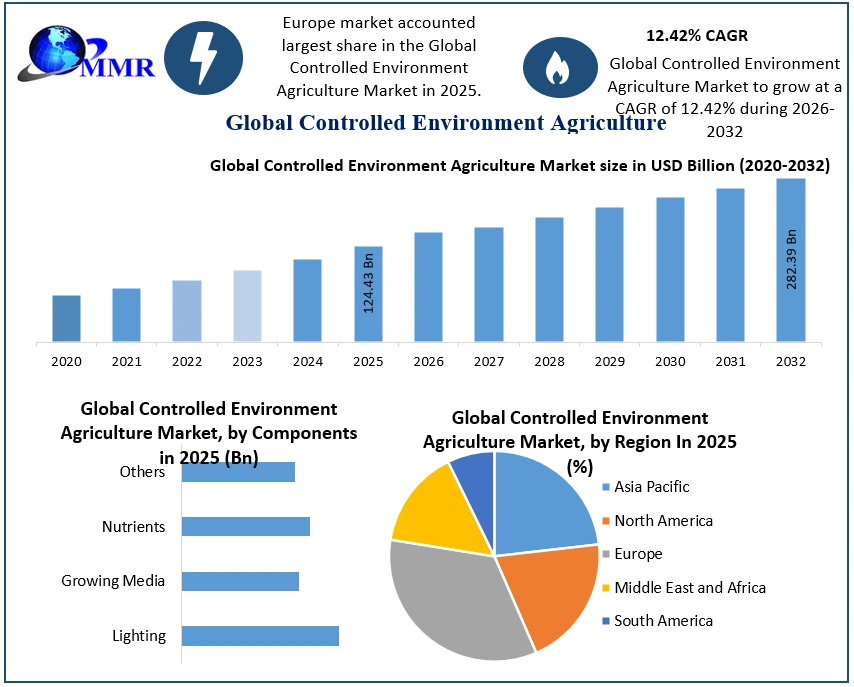
The Controlled Environment Agriculture Market size was valued at USD 124.43 Billion in 2025 and the total Controlled Environment Agriculture revenue is expected to grow at a CAGR of 12.42% from 2025 to 2032, reaching nearly USD 282.39 Billion by 2032.
Controlled Environment Agriculture Market Overview:
By 2050, the worldwide population is projected to reach 9 billion, requiring new technologies to ensure food security, with potential cultivation in outer space. Climate change further exacerbates the challenge of food scarcity. Controlled Environment Agriculture (CEA) utilizes advanced technology to manipulate and optimize crop environments. Greenhouses, hydroponics, and aquaculture are prime examples of CEA techniques. The Controlled Environment Agriculture Center (CEAC) within the BE department holds promise in expanding its capabilities with the support of CALES and UA initiatives to meet these growing demands.

Global Controlled Environment Agriculture Market Insights & Analysis:
The controlled environment agriculture market is expected to grow at a compound annual growth rate of approximately 12.42% during 2026-2032. This growth is primarily driven by rising food demands and the continuous decline in arable land worldwide, demanding the development of controlled environments for agriculture. Technological advancements and their growing adoption in the agricultural sector have spurred the creation of innovative farming solutions and equipment, resulting in healthier crops and higher yields.
The reduction in arable and fertile land globally, owing to rapid urbanization and soil erosion, shows a significant challenge for the agricultural sector. This has made it increasingly difficult for farmers to maintain sufficient yields. Controlled Environment Agriculture (CEA) methods have emerged as a global solution, enabling farmers to produce abundant food year-round, more efficiently, and with limited resources.
 To know about the Research Methodology :- Request Free Sample Report
Controlled Environment Agriculture: A Booming Market Fuelled by Innovation
The Controlled Environment Agriculture market has recently seen transformative improvements that highlight its strategic evolution and increasing influence. Saffron Tech's cutting-edge facility, integrating Controlled Environment Agriculture methods and an autonomous cultivation system, underscores a considerable advancement in this sector. By leveraging AI technology, In May 2024, Saffron Tech established a cutting-edge facility including Controlled Environment Agriculture methods and an autonomous cultivation system for efficient saffron farming. This invention allows the integration of AI logic to enhance productivity and quality. The innovation is ideal for expanding saffron-related products in beauty, wellness, and nutraceutical industries owing to the growing demand for high-quality saffron.
Global Controlled Environment Agriculture Market Dynamics:
The worldwide population is projected to reach nearly 10 billion by 2050, posing a considerable challenge in meeting escalating food demand sustainably globally. In response, governments and farmers are progressively adopting advanced farming techniques like Hydroponics, Aeroponics, Aquaponics, soil-based methods, and hybrids. These methods are used to cultivate a diverse array of crops with tomatoes, leafy greens, cannabis, microgreens, flowers, strawberries, cucumbers, peppers, herbs, mushrooms, onions, leeks, hops, figs, sweet corn, fish, eggplant, insects, carrots, and shrimp. The global controlled environment agriculture market is experiencing rapid growth as a result, with a production of indoor farms—both small and large—emerging globally. This trend is also driving demand for associated supplies like nutrients and growing media.
| KEY CHALLENGES AND DYNAMICS OF THE AGRICULTURE ECOSYSTEM | |||
|---|---|---|---|
| Growing population ~10 bn by 2050 | Lack of available labor | ||
| Climate change | Immigration restrictions | ||
| Contribution to global GHG ~30% | Increasing regulation (e.g., overtime, heat breaks) | ||
| Food requirements ~ +60% by 2050 | Wage inflation ~ +50%, Aging Farmers ~ 60 yrs | ||
The loss of agricultural land to urban and industrial advancement, exacerbated by climate change impacts, has reduced arable land availability and crop yields. This has enhanced the appeal of CEA, which allows efficient food production without reliance on traditional farmland or being constrained by external climate conditions. Furthermore, urbanization trends have spurred strong consumer preferences for nearby grown foods. With 55% of the world's population already belong to in urban areas, a figure estimated to rise to 68% by 2050, there is growing demand for fresh, locally sourced produce. The controlled environment agriculture market is poised to capitalize on this trend, specifically with facilities strategically located near urban centers. These facilities offer benefits like reduced transportation costs and improved product quality owing to shorter supply chains.
Controlled Environment Agriculture also delivers substantial environmental benefits, specifically in water and nutrient conservation compared to conventional farming. Techniques like hydroponics and aquaponics optimize resource use, minimize water wastage, and enhance crop health and growth rates. This decreases the need for pesticides and supplements, resulting in healthier plants and higher-quality produce. These factors together contribute to the rapid growth and promising future of the controlled environment agriculture market globally, driven by its ability to sustainably increase food production in an increasingly urbanized and resource-constrained globe.
Barriers in Controlled Environment Agriculture Market:
Controlled Environment Agriculture (CEA) allows accelerated plant growth and higher yields year-round, yet it remains a high-risk, low-margin endeavor, akin to traditional agriculture. Establishing a CEA hydroponic vegetable operation demands substantial capital investment, often reaching tens of millions of dollars depending on scale and technology. These upfront costs, coupled with ongoing operational expenses and inherent risks, present significant challenges for growers and the broader controlled environment agriculture market. Furthermore, limited awareness and low adoption rates of controlled environmental farming methods in underdeveloped countries hinder global CEA market growth. Traditional farming methods persist in low-income nations like India, slowing the uptake of CEA technologies.
| Exact Date | Company | Development | Impact |
|---|---|---|---|
| 16 February 2026 | DeLaval | Launched the DelPro 10.11 farm management platform, integrating AI-enhanced performance indicators for real-time livestock data analysis. | The update allows for precise milk distribution tracking and identifies animal-specific health issues, significantly increasing operational efficiency in dairy farming. |
| 14 January 2026 | The Business Research Company | Confirmed the Global Agriculture Analytics Market reached a valuation of USD 2.05 billion, maintaining a robust 10.4% CAGR. | The growth is primarily driven by the rapid adoption of precision agriculture and rising global demand for traceability and data transparency. |
| 01 December 2025 | John Deere (Deere & Company) | Announced its 2026 fiscal outlook, prioritizing software-as-a-service (SaaS) and predictive maintenance analytics to navigate the bottom of the large equipment cycle. | This strategic shift focuses on generating recurring digital revenue and providing data-driven insights that help farmers manage input costs during economic volatility. |
| 17 November 2025 | Trimble (PTx Trimble) | Debuted the AI-powered next-generation Trimble TMS at the 2025 Insight Tech Conference, featuring automated critical transportation workflows for ag-logistics. | By automating real-time fleet analytics and freight auditing, the solution reduces logistical latency and improves supply chain transparency for large-scale agribusinesses. |
| 30 April 2025 | DeLaval | Unveiled the BioSensors Milk Cell Analysis (MCA) sensor, utilizing advanced optical technology for automated somatic cell counting. | This sensor enables early detection of subclinical mastitis, allowing for data-driven dry-off decisions and a reduction in unnecessary antibiotic treatments. |
| 14 January 2025 | Bayer (Climate FieldView) | Introduced FieldView Drive 2.0 hardware at the 2025 Crop Production Show, featuring enhanced processing power and Bluetooth connectivity for cross-brand equipment. | The upgraded hardware facilitates seamless wireless transfer of prescription maps and real-time yield data, optimizing nitrogen and seed placement for 2025-2026 planting cycles. |
Controlled Environment Agriculture Market Segmentation Analysis:
Based on Crop Segment, controlled environment agriculture market is segmented by Leafy Greens, Tomato, Strawberries, Cucumber, Cannabis Others. With a substantial 45.2% share in 2025, the tomato segment was dominated controlled environment agriculture market. The factors which are propelling to the growth are because it is suitable for both outdoor and indoor and helps fetch more values with a higher yield. Tomato is widely used mostly in food processing across the globe also it has larger exports.
Strawberries also leading in this segment because their demand is high in the western countries as well as their export demands are always high, their consumption levels in all the seasons are considered as same and thus, it will sustain the market and estimate growth in the forecasted period. The other segments like cucumber, pepper, and leafy greens are also captured the global market and their revenues are also increasing by 20-55% in a year in Controlled Environment Agriculture Market, because of their demand in the global market, especially in North America and Asia-Pacific regions.
By Growing Method, the controlled environment agriculture market is segmented into Hydroponics, Aquaponics, Aeroponics, and Others. The hydroponics segment market is expected to grow at a CAGR of 13.5% in the forecasted period. The rising factor in these segments is the popularity of the technique of cultivation. Each seeding is inserted into a growing network that is suspended within a reservoir of formulated nutrient solution. According to the set schedule, water is circulated and delivered nutrient solution. It requires significantly less labor for operation, which is the boosting factor of this segment.

Aquaponics is the second market holder of these segment markets. It is estimated by the OEC that the revenue generated by this segment is US$ 25921.76 million in 2025. It is because the features like the ability to control the environment indoors have given rise to these techniques to cultivate plants without restriction to the growth of any plants, it represents the symbolic relationship between two enteritis’s: growing plants and breeding fish with the same water flowing between the two tanks. Fish produces natural fertilizers that are absorbed and carried by water.
Controlled Environment Agriculture Market Regional Analysis:
In 2025, The European region is poised to dominate the controlled environment agriculture market share of 35% with substantial revenue growth driven by several factors. Rapid technological advancements, increasing urbanization, and high demand for vegetables and fruits have positioned Europe as a key player in the agricultural sector. Notably, the commercial greenhouse segment in Europe stands out as the most energy-intensive within agriculture. Countries such as Spain, Italy, and the Netherlands lead in adopting advanced greenhouse practices, covering extensive areas under cultivation. Government initiatives aimed at promoting greenhouse farming further bolster growth in this sector.
In Europe, Spain leads with approximately 46,000 hectares of greenhouse cultivation, followed by Italy with 25,000 hectares, France with 9,500 hectares, and Greece with 3,800 hectares, according to recent studies. Furthermore, governments across Europe are increasingly focusing on initiatives to support organic produce production. For instance, in May , the European Commission introduced the Farm to Fork strategy, which aims to reduce chemical pesticide use by 50%, nutrient loss by 50%, and fertilizer usage by 20%. These initiatives underscore Europe's commitment to sustainable agriculture practices and further propel the growth of the agricultural industry in the region.
Controlled Environment Agriculture Market Competitive Analysis:
The adoption of advanced packaging technologies in the controlled environment agriculture market is driving innovation and enabling the development of more efficient, high-performance memory solutions to meet the growing demands of various applications, including mobile devices, automotive electronics, and data centers. Companies are implementing various strategies, kike strategic alliances, partnerships, mergers and acquisitions, geographical growth, and product/service launches, to enhance their presence in the controlled environment agriculture market. For Example:
1. In March 2024, Meister Media Worldwide, producer of Greenhouse Grower, launched CEAg World, a new worldwide brand dedicated to advancing food grown in controlled environments. This involves various industry segments like vertical farms, greenhouses, high tunnels, hoop houses, etc. CEAg World's initial focus is on greenhouse-grown produce in the U.S. & Canada, under the brand CEAg World Greenhouse Produce.
2. In February 2023, AeroFarms & Public Investment Fund (PIF) joined forces to build & operate the largest indoor vertical farm in Saudi Arabia by using the latest technologies with an annual production capacity of up to 1.1 million kgs of crops, which would increase regional food supply over increased production of sustainable & locally produced high-quality crops.
Controlled Environment Agriculture Market Scope: Inquire before buying
| Controlled Environment Agriculture Market | |||
|---|---|---|---|
| Report Coverage | Details | ||
| Base Year: | 2025 | Forecast Period: | 2026-2032 |
| Historical Data: | 2020 to 2025 | Market Size in 2025: | USD 124.43 Bn. |
| Forecast Period 2026 to 2032 CAGR: | 12.42% | Market Size in 2032: | USD 282.39 Bn. |
| Segments Covered: | by Crop | Leafy Greens Tomato Strawberries Cucumber Cannabis Others |
|
| by Growing Methods | Hydroponics Aquaponics Aeroponics Others |
||
| by Components | Lighting Growing Media Nutrients Others |
||
Controlled Environment Agriculture Market by Region:
North America (United States, Canada and Mexico)
Europe (UK, France, Germany, Italy, Spain, Sweden, Austria and Rest of Europe)
Asia Pacific (China, South Korea, Japan, India, Australia, Indonesia, Malaysia, Vietnam, Taiwan, Bangladesh, Pakistan and Rest of APAC)
Middle East and Africa (South Africa, GCC, Egypt, Nigeria and Rest of ME&A)
South America (Brazil, Argentina Rest of South America)
Leading Controlled Environment Agriculture Key Players include:
1. AeroFarms - USA
2. Gotham Greens - USA
3. Plenty (BrightFarms) - USA
4. Lufa Farms - Canada
5. IDEA Protected Horticulture - Netherlands
6. Green Sense Farms - USA
7. Metro Farms - USA
8. Mirai - Japan
9. Sky Greens - Singapore
10. Greenland - China
11. Scafil - Japan
12. Jingpeng - China
13. Metropolis Farms - USA
14. Garden Fresh Farms - USA
15. Infinite Harvest - USA
16. Spread - Japan
17. Agricool - France
18. Kalera - USA
19. Infarm - Germany
20. Oishii - USA
Frequently asked Questions:
1. What is Controlled Environment Agriculture?
Ans: Controlled Environment Agriculture (CEA) refers to the practice of cultivating plants within an environment that is precisely controlled for temperature, humidity, light, and nutrients, often using technologies like greenhouses, hydroponics, and aeroponics.
2. How are technological advancements driving innovation in Controlled Environment Agriculture?
Ans: Technological advancements in Controlled Environment Agriculture (CEA) are driving innovation by enabling precise control over environmental factors such as temperature, humidity, light spectrum, and nutrient delivery, thereby optimizing plant growth and productivity in settings like greenhouses, hydroponic systems, and vertical farms.
3. Why is the Nutrients segment dominating the Controlled Environment Agriculture market?
Ans: The Nutrients segment dominates the Controlled Environment Agriculture market owing to its essential role in optimizing plant growth and productivity through precise management and tailored formulations in soilless growing systems like hydroponics and aeroponics.
4. What is the restraining factor?
Ans. Establishing a CEA hydroponics vegetation operation requires high investment, it can run into 10 million dollars. This high required risk, investment, and operation cost is a huge challenge for growers and the controlled environment agriculture.
5. What was the Global Controlled Environment Agriculture Market size in 2025?
Ans: The Global Controlled Environment Agriculture Market size was USD 124.43 Billion in 2025.