
Contract Manufacturing Market Size by Service Type, Manufacturing Type, Production Volume and End Use Industry
Overview
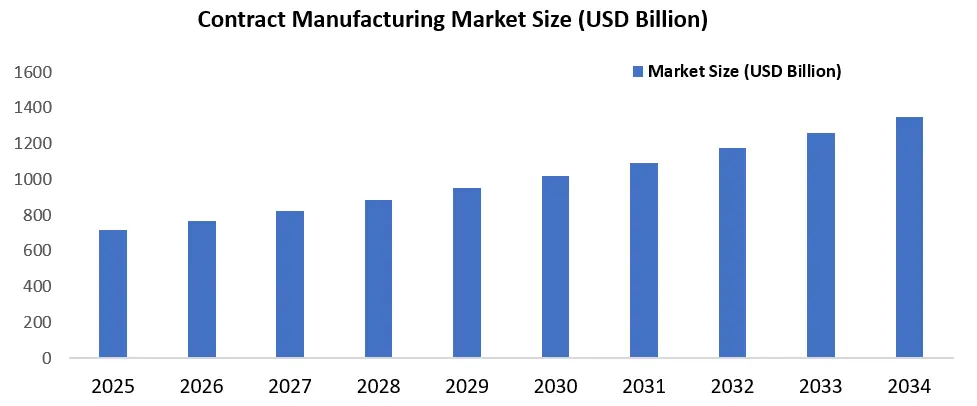
The Global Contract Manufacturing Market was valued at USD 717.0 billion in 2025 and is projected to reach USD 1,350.2 billion by 2034, registering a CAGR of 7.3% during 2025–2034.
| Contract Manufacturing Market — Key Takeaways |
| ➢ Asia Pacific remains the leading contract manufacturing hub, supported by large-scale production capacity, established supplier networks, cost advantages, and strong electronics and industrial manufacturing ecosystems. |
| ➢ China continues to be a core manufacturing destination, particularly for electronics, components, consumer products, and high-volume production, despite increasing efforts by OEMs to diversify sourcing. |
| ➢ India is emerging as a high-potential outsourcing destination, particularly across pharmaceuticals, electronics, automotive components, and other specialized manufacturing activities. |
| ➢ Vietnam and Southeast Asia are gaining traction under China+1 strategies, as manufacturers seek to diversify production locations and reduce dependence on a single manufacturing base. |
| “The Contract Manufacturing Market is undergoing a structural transformation, moving beyond traditional cost-driven outsourcing toward technology-enabled, flexible, and strategically integrated manufacturing. Our analysis highlights how supply-chain diversification, specialized capabilities, regional manufacturing networks, and smart production are reshaping competitive positioning across the market. The outlook remains positive as OEMs increasingly view contract manufacturers not merely as production partners, but as strategic contributors to scalability, resilience, and long-term growth.”
-Krishna Ghorpade |
Contract Manufacturing Market Overview:
Contract manufacturing involves the outsourcing of production, assembly, processing, packaging, testing, and related manufacturing activities to specialized third-party manufacturers. It serves industries such as electronics, automotive, pharmaceuticals, healthcare, consumer goods, industrial products, aerospace and defense, and food & beverage. Asia Pacific remains a major manufacturing hub, supported by competitive production costs, skilled labor, established supplier ecosystems, and expanding manufacturing investments.
The Contract Manufacturing Market Report provides analysis of market size, growth trends, market dynamics, regional opportunities, segmentation, supply-chain developments, technology adoption, and the competitive landscape. It evaluates key market segments, major players, manufacturing processes, end-use industries, and emerging trends to help stakeholders identify growth opportunities and understand the evolving global outsourcing landscape.
Contract Manufacturing Market Growth Outlook
To know about the Research Methodology :- Request Free Sample Report
Global Contract Manufacturing Outsourcing & Manufacturing Hub Landscape
The global contract manufacturing landscape is increasingly shaped by the geographic rebalancing of production, with established manufacturing economies outsourcing selected production activities to specialized partners across cost-competitive and capability-rich markets. Asia Pacific remains the dominant manufacturing hub, supported by extensive supplier networks, production scale, skilled labor, and established electronics and industrial ecosystems, while China continues to anchor regional manufacturing capacity. At the same time, India, Vietnam, and other Southeast Asian economies are gaining importance as alternative production bases, supported by China+1 strategies, supply-chain diversification, and investments in electronics, pharmaceuticals, automotive components, and advanced manufacturing. North America and Europe continue to retain strong positions in high-value, regulated, and technology-intensive manufacturing, while Mexico is benefiting from nearshoring demand linked to the North American supply chain.
Key Outsourcing Origin Markets and Manufacturing Destinations
| Outsourcing Origin Market | Typical Outsourcing Requirement | Major Destination / Partner Markets |
| United States | Electronics, healthcare, automotive, industrial products | Mexico, China, India, Southeast Asia |
| Western Europe | Automotive, pharmaceuticals, aerospace, industrial goods | Eastern Europe, China, India, Southeast Asia |
| Japan | Electronics, automotive, precision manufacturing | China, Vietnam, Thailand, Southeast Asia |
| South Korea | Electronics, automotive, chemicals | Vietnam, China, Southeast Asia |
| Other Developed Markets | Consumer goods, industrial & specialized manufacturing | Asia Pacific, Eastern Europe, Latin America |
Contract Manufacturing Market Dynamics :
Increasing Outsourcing of Non-Core Manufacturing Activities is Driving Market Expansion
OEMs and brand owners are increasingly shifting production activities to specialized contract manufacturers to reduce capital requirements, improve cost efficiency, and concentrate internal resources on product development, branding, and market expansion. This is particularly attractive for companies that require flexible capacity without maintaining large in-house manufacturing infrastructure.
Growing Intellectual Property and Confidentiality Risks are Restraining Market Growth
Contract manufacturers may receive access to product designs, formulations, engineering specifications, production processes, and proprietary data. This creates concerns around IP protection, data security, and unauthorized technology transfer.
Rapid Adoption of Smart and Digital Manufacturing is Creating New Growth Opportunities
Investment in robotics, AI, IoT, connected quality systems, predictive maintenance, and digital production monitoring is creating opportunities for contract manufacturers to differentiate themselves through productivity, traceability, quality, and faster production.
Difficulty in Maintaining Consistent Quality Across Multiple Facilities is Challenging Market Expansion
As production becomes geographically distributed, maintaining consistent quality standards, process controls, and delivery performance across different manufacturing facilities becomes increasingly challenging, particularly for highly regulated and technically complex products.
Relative Impact of Key Trends on the Contract Manufacturing Market, 2025–2034

Contract-Manufacturing Market Segment Analysis
By Service Type: Manufacturing and production services are expected to represent the core of the market, as OEMs primarily outsource actual production capacity. However, the market is gradually expanding toward higher-value services such as engineering support, testing, packaging, and integrated supply-chain services. This evolution is also visible in electronics contract manufacturing, where manufacturing, testing, and design services are increasingly analyzed as distinct offerings.
By Manufacturing Type: Discrete manufacturing is likely to maintain strong demand because of extensive outsourcing across electronics, automotive, aerospace, industrial equipment, and consumer products. Process manufacturing remains particularly important in pharmaceuticals, food, chemicals, and personal care, while hybrid manufacturing is gaining relevance as products increasingly combine mechanical, electronic, and software components.

Geographic Analysis and Regional Market Outlook:
Asia Pacific — The Global Manufacturing Powerhouse
Asia Pacific is expected to remain the dominant regional ecosystem for contract manufacturing, supported by manufacturing scale, extensive supplier networks, competitive production economics, and strong electronics, automotive, consumer, pharmaceutical, and industrial manufacturing bases. China continues to provide exceptional manufacturing depth, while India and Southeast Asia are increasingly complementing Chinese capacity as OEMs diversify production footprints. This makes the region less a story of “China replacement” and more a story of multi-country Asian manufacturing networks. Pharmaceutical-focused research also consistently identifies India and China as major outsourcing destinations, while Asia Pacific is frequently identified as the fastest-growing regional market.
North America — High-Value and Resilience-Driven Manufacturing
North America is increasingly positioned around high-value, technologically advanced, and regulated manufacturing, rather than competing primarily on production cost. The region benefits from established pharmaceutical, medical-device, aerospace, electronics, automotive, and industrial ecosystems. In pharmaceutical contract manufacturing specifically, North America accounts for roughly 38% of the 2025 market, demonstrating how strongly the region performs in specialized and high-value outsourcing even though the broader contract-manufacturing market has a different regional structure.
Europe — Specialized Manufacturing and Quality Leadership
Europe retains a strong position in precision, regulated, and technically complex contract manufacturing. Germany, Switzerland, Ireland, the UK, France, and other European manufacturing centers are particularly relevant across pharmaceuticals, automotive, aerospace, industrial equipment, and specialty products. Rather than competing directly with Asia on basic production costs, European contract manufacturers increasingly differentiate through engineering expertise, quality systems, regulatory capabilities, automation, and specialized production. Pharmaceutical market research also continues to identify Europe as a major contract-manufacturing region.
South America — The Nearshoring Opportunity
South America represents an emerging contract-manufacturing opportunity, with Mexico standing out because of its proximity to the U.S., established automotive and electronics manufacturing base, and integration with North American supply chains. The region's competitive proposition is therefore different from Asia Pacific: shorter lead times, geographic proximity, trade integration, and supply-chain resilience are becoming more important than simply achieving the lowest manufacturing cost.
Middle East & Africa — Localization-Led Expansion
The Middle East & Africa currently represent a smaller portion of the global contract-manufacturing ecosystem, but the region offers long-term potential through industrial diversification, localization initiatives, infrastructure development, and efforts to build domestic production capabilities. Growth is likely to remain selective rather than broad-based, with opportunities concentrated in pharmaceuticals, food, consumer products, industrial goods, and selected advanced manufacturing activities.
Source: MMR Analysis and Estimates, based on triangulation of secondary research, industry-level manufacturing indicators, regional outsourcing patterns, and published market benchmarks.
Recent Strategic Developments Reshaping Contract Manufacturing
Contract manufacturing is rapidly evolving as manufacturers respond to AI-driven demand, capacity constraints, supply-chain diversification, and the need for more localized production. Recent investments increasingly reflect a shift toward smarter, more flexible, and geographically diversified manufacturing ecosystems.
Competitive Landscape & Market Positioning
1. Competitive Landscape Overview
The global contract manufacturing market remains highly competitive and relatively fragmented outside the largest global players. Competition is increasingly shifting away from basic production cost toward manufacturing scale, geographic flexibility, engineering capabilities, automation, quality systems, and end-to-end services. Large players are expanding their role from production providers to integrated manufacturing and supply-chain partners, while specialized companies continue to compete through sector expertise and regulatory capabilities.
The competitive structure is also becoming more technology- and capability-driven. AI infrastructure, advanced electronics, healthcare, aerospace, and industrial applications are encouraging manufacturers to invest in higher-value production capabilities. For example, Foxconn reported 2025 revenue of USD 259 billion, while its current strategy increasingly emphasizes AI, smart manufacturing, robotics, semiconductors, and EV-related capabilities.
Our assessment: The market is best characterized as scale-led at the top, specialized in the middle, and increasingly technology-driven across both segments.
2. Company Benchmarking
| Company | Core Strength | Major Focus | Strategic Position |
| Foxconn | Scale + vertical integration | Electronics, AI infrastructure | Global scale leader |
| Jabil | Diversified manufacturing | Electronics, healthcare, industrial | Integrated global partner |
| Flex | Supply-chain integration | Electronics, industrial, healthcare | Global diversified player |
| Sanmina | Complex manufacturing | Industrial, medical, aerospace | High-complexity specialist |
| Celestica | Advanced technology manufacturing | Cloud, communications, aerospace | Technology-focused player |
| Benchmark | Engineering-led manufacturing | Semiconductor, medical, aerospace | Specialized high-value player |
| Plexus | Product realization | Healthcare, industrial, aerospace | Niche/high-complexity player |
| Lonza | Biopharma manufacturing | Pharmaceuticals & biotechnology | Regulated-sector specialist |
| Samsung Biologics | Large-scale biomanufacturing | Biopharmaceuticals | High-scale CDMO player |
| Magna | Automotive engineering + production | Automotive | Industry-focused manufacturer |
3. Recent Strategic Developments
The competitive environment is currently being shaped by four major strategic moves:
AI & Smart Manufacturing → Manufacturers are investing in automation, AI-enabled production, digital quality systems and intelligent factories.
Geographic Diversification → Companies are building multi-region manufacturing networks rather than depending on one production base.
Vertical Integration → Leading players are expanding into engineering, sourcing, testing, logistics and product-development support.
Capacity Expansion & Partnerships → Companies are adding specialized capacity and forming strategic partnerships to capture higher-value outsourcing opportunities.
Contract Manufacturing Market Future Outlook
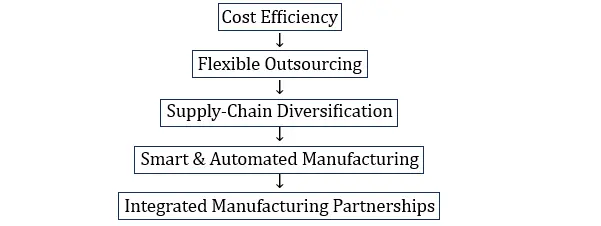
The Contract Manufacturing Market is expected to move toward a more distributed, technology-enabled, and value-added manufacturing model through 2034. Outsourcing is likely to expand beyond cost reduction as OEMs increasingly seek flexible capacity, specialized expertise, faster commercialization, and reduced supply-chain exposure. Industry forecasts broadly support continued market expansion, while manufacturing research points toward increasing adoption of AI, automation, digital supply-chain tools, and smart operations.
The next phase of competition will be shaped by regional manufacturing diversification, AI-enabled production, advanced automation, vertical integration, and strategic OEM–manufacturer partnerships. Rather than completely replacing established hubs, emerging locations are likely to complement existing networks, creating multi-country manufacturing footprints designed around cost, capability, resilience, and proximity to end markets.
Future Market Direction
Contract Manufacturing Market Scope: Inquire before buying
| Contract Manufacturing Market | |||
|---|---|---|---|
| Report Coverage | Details | ||
| Base Year: | 2025 | Forecast Period: | 2026-2034 |
| Historical Data: | 2020 to 2025 | Market Size in 2025: | USD 717 Bn. |
| Forecast Period 2026 to 2034 CAGR: | 7.3% | Market Size in 2034: | USD 1.35 Tn. |
| Segments Covered: | by Service Type | Manufacturing & Production Assembly & Integration Testing & Quality Control Packaging & Labeling Design & Engineering Support Supply Chain & Logistics Services |
|
| by Manufacturing Type | Discrete Manufacturing Process Manufacturing Hybrid Manufacturing |
||
| by Production Volume | High-Volume Manufacturing Medium-Volume Manufacturing Low-Volume / High-Mix Manufacturing |
||
| by End-Use Industry | Electronics & Semiconductors Pharmaceuticals & Healthcare Automotive & Transportation Consumer Goods Aerospace & Defense Industrial Machinery & Equipment Food & Beverages Personal Care & Cosmetics Textiles & Apparel Others |
||
| by Company Size | Small & Medium Enterprises Large Enterprises |
||
| by Geography | North America Europe Asia Pacific Latin America Middle East & Africa |
||
Frequently Asked Questions:
1] What segments are covered in the Contract Manufacturing Market report?
Ans. The segments covered in the Contract Manufacturing Market report are based on Service Type, Manufacturing Type, Product Type, Manufacturing Process, and End-Use Industry.
2] Which region is expected to hold the highest share in the Contract Manufacturing Market?
Ans. Asia Pacific region is expected to hold the highest share in the Contract Manufacturing Market.
3] What is the market size of the Contract Manufacturing Market by 2034?
Ans. The market size of the Contract Manufacturing Market by 2034 is US$ 1.35 Trillion.
4] What is the forecast period for the Contract Manufacturing Market?
Ans. The forecast period for the Contract Manufacturing Market is 2026–2034.
5] What was the market size of the Contract Manufacturing Market in 2025?
Ans. The market size of the Contract Manufacturing Market in 2025 was US$ 717.0 Billion.