
Color Detection Sensor Market Size by Type, Application, Region – Segment-Level Market Assessment, Growth Opportunity Analysis, Competitive Mapping & Forecast to 2029
Overview
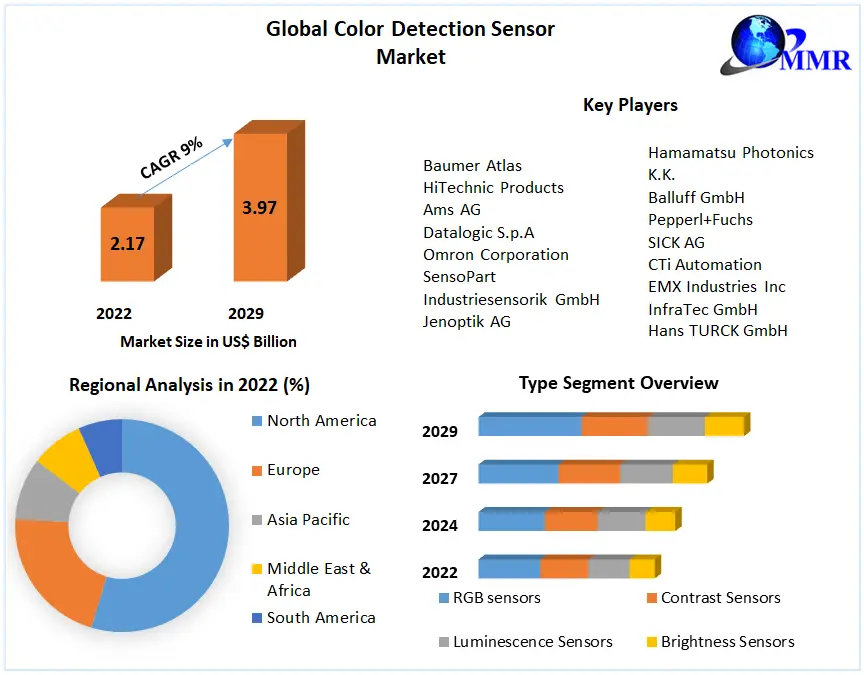
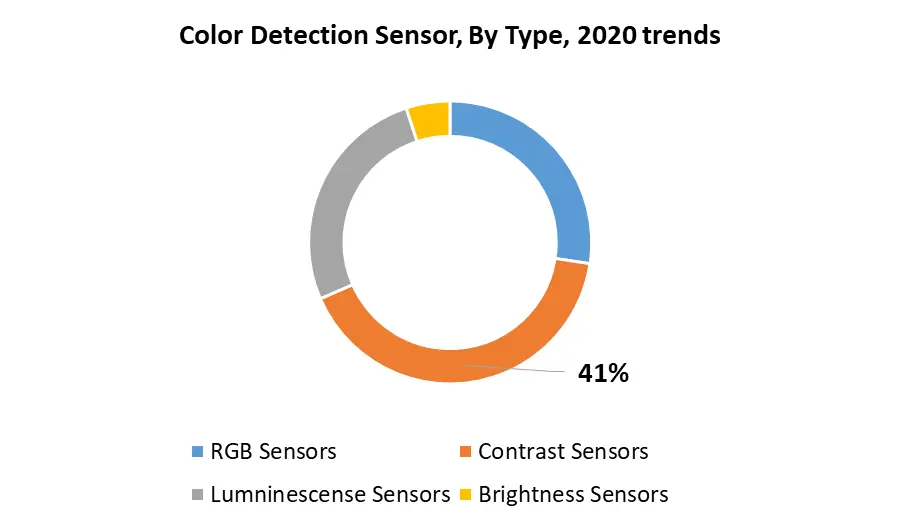
Color Detection Sensor Market was valued at 2.17 Bn. USD in 2022. Contrast Sensor, one of the segments reviewed in our report is dominating the Global Color Detection Sensor Market.
Color Detection Sensor Market Overview:
The color of a surface is detected using color sensors. The sensors shine red, green, and blue LEDs on the objects to be examined, then calculate the chromaticity coordinates from the reflected light and compare them to previously saved reference colors. A switching output is engaged if the color values are within the set tolerance range. Color sensors can illuminate an item with a broad wavelength, calculate the light ratio, and identify the primary color light intensity (red, blue, green, and white). The amount of light reflected and absorbed by the item is determined by the intensity light ratio. Global color detection sensor market is expected to register CAGR of 9% during the forecast period.
 To know about the Research Methodology :- Request Free Sample Report.
Color Detection Sensor Market Dynamics:
The color detection system's concept is that many industries are focused on products that have color as a distinguishing attribute. Industries that make multicolored light bulbs, glass bottles, and food goods, among other things. Aside from these, shading plays an important role in determining product quality in practically every industrial business. Color detection provides the foundation for subsequent processing such as product sorting and quality assessment. To determine the degree of brightness required by the display, smartphones now employ an RGB or red, green, blue ambient light sensor instead of a conventional white ambient light sensor. Similarly, the ambient RGB detection sensor is utilized with handsets and tablets' built-in cameras to ensure appropriate skin tones and color constancy in photos taken by the user. Color sensors are increasingly being used by businesses to present novel products to customers.

Moreover, increasing automation in food and processing technology, automotive, packaging and smartphone industries is considered to drive the demand for color detection sensors. Quality control in the production and demand for identifying the color tone of fabrics in textile industry are the factors attributing growth in the color detection sensor market.
In the field of computer vision, it's common to come across problems that require the use of color information to perform reference point detection, which allows for the tracking and definition of the behavior of objects with specific characteristics that are observed through sequences of images taken in a controlled environment. In other fields, such as agriculture and biology, the need for color-based image processing techniques has arisen in order to apply them to problems such as weed detection in crops, the classification and study of various types of fruits that exhibit significant color changes during various stages of ripening, or due to the presence of defects or associated pests, and the counting of organisms, among others.
Increasing demand for high color intensity components and RGB sensor applications across end user segments is considered as key factor driving the market growth. Moreover, smartphones and other technologies associated with the sensor augmentation is expected to bolster the product demand.
In order to improve their market share and brand presence in the worldwide market, color detection sensor firms are expected to focus on supplying innovative products. Omron Corporation, for example, has created E2E Next Generation Proximity Sensors, which will improve the vehicle industry's operation rates.
Color Detection Sensor Market Segmentation:
Contrast Sensors segment is dominating the Color Detection Sensor market in terms of Applicability:
Both contrast and luminescence sensors are projected to present market players with lucrative future prospects, trailing colour sensors closely. Contrast sensors are commonly used in packaging/printing machines and are used to identify printed or control marks. For example, Tired's KT line of contrast sensors detects even the tiniest variations at the highest speeds, such as print defects on foils or packaging. On matte, glossy, or plain surfaces, these sensors detect minute grayscale differences between the check and the foundation. The popularity of contrast segregation is likely to increase as the packaging market grows around the world. According to Semiconductors Manufacturers Association (SMA), color detection sensors have registered YOY growth of 12.8% in year 2019. In 2020, market has oppressed by 5.7% lowering the production of sensors to only 1.2 million units in USA.
Moreover, effective responsiveness of the Color detection sensors in materials including grease, paints, adhesives, inks and others have adhered the demand for the sensors in the sector of chemicals and beverage on larger scale.
Packaging sector is driving the demands for color sensors with highest CAGR:
The growth of the packaging market in numerous regions, including Europe, North America, and Asia Pacific, is creating attractive prospects for colour detecting sensor manufacturers. Color detection sensors are widely employed in the packaging sector to guarantee that the packaging material is correctly positioned before closing or filling processes. Furthermore, colour mark sensors are used to identify marks reliably even in changing situations during machine operating procedures. The packaging industry's need for colour sensors for synchronised quality inspection and position detection is driving the demand for colour detection sensors around the world.
Color Detection Sensor Market Trends:
1. Increasing use of discrete color sensors in smartphones:
The measuring of IR light is possible using a discrete colour sensor in conjunction with an image sensor. Because this section of the light spectrum is not visible, it is blocked by most smartphone image sensors, and it can have negative impacts on image capture quality. As a result, image sensors in smartphone cameras often include an IR blocking filter to ensure that the camera does not detect IR. In some cases, IR light can penetrate through these blocking filters, resulting in false hue and other image quality issues. If the camera's image processing algorithms have a measure of the ratio of IR light to v, they can eliminate these IR-induced effects.
2. Cyber Physical Systems:
As a computer process and a physical process of unity, cyber physical systems (CPS) are integrated computing, communication, and control in one of the next generation of intelligent systems. It employs the network space to manage a physical entity in a remote, dependable, real-time, secure, and cooperative manner, interacting with the physical process through the human-computer interaction interface.
Future ubiquitous environment awareness, embedded computing, network communication, and network control system engineering are all part of the CPS, which allows physical systems to have computing, communication, precise control, remote collaboration, and autonomous capabilities. It is mostly concerned with computing resources. It focuses on the close integration and coordination of computing and physical resources, primarily for some intelligent systems such as robotics and intelligent navigation. The information physics system is still a relatively new research subject at the moment.
3. Video Image Segmentation: new computer vision system is drawing the attention of key players in the market:
In the realm of computer vision, video image segmentation is a critical subject as well as a classic puzzle. Its research has been used in face recognition, fingerprint recognition, fire detection and identification, machine vision, and medical imaging, among other things. CT (computed tomography) is commonly utilised in hospitals, and the results of image segmentation are used to assist diagnose patients effectively and quickly in real time. Many key players are currently especially concerned about face recognition systems and machine vision.
4. Automatic adjustment sensing:
Color sensing also enables automated adjustment of the display's white point to match the CCT of the lighting environment. The display white point, also known as reference white, is a fixed setting where the displayed 'white colour' appears to our eyes to be 'white.' According to vision science study, the optimal viewing experience is achieved when the display white point is adjusted based on the lighting environment's CCT. As a result, for cell phones that are used in a variety of lighting settings, a fixed setting is not optimal. The ability to modify the display white point dynamically depending on the lighting environment makes visuals more appealing and pleasant.
APAC is dominating the Market with highest CAGR:
Asia Pacific is a major market for semiconductor manufacturing equipment businesses, as well as one of the top regions for semiconductor device and equipment research and development. The governments of different nations, including India, Japan, and China, have begun to adopt measures for the development of applications based on novel semiconductor technologies and devices, as part of a current research and development trend. Because of the growing IoT applications in these countries, demand for sensors and other IC-related goods is likely to rise in the near future.
Because of its proficiency in technology-driven areas, the United States dominates the North Aemrican market. The United States is a major global producer of industrial automation equipment, which is roughly defined as the hardware and components used to automate systems in manufacturing or industrial settings, according to the International Trade Administration. Furthermore, increased capital expenditures in industries like automotive, oil & gas, and power are driving demand for industrial automation and boosting related automation markets, such as colour detecting sensors. With this backing, the United States leads the market in the automation of numerous industrial processes, resulting in increased productivity.
The objective of the report is to present a comprehensive analysis of the Color Detection Sensor Market to the stakeholders in the industry. The past and current status of the industry with the forecasted Market size and trends are presented in the report with the analysis of complicated data in simple language. The report covers all the aspects of the industry with a dedicated study of key players that include Market leaders, followers, and new entrants.
PORTER, PESTEL analysis with the potential impact of micro-economic factors of the Market have been presented in the report. External as well as internal factors that are supposed to affect the business positively or negatively have been analyzed, which will give a clear futuristic view of the industry to the decision-makers.
The report also helps in understanding the Color Detection Sensor Market dynamics, structure by analyzing the Market segments and project the Color Detection Sensor Market size. Clear representation of competitive analysis of key players by Type, price, financial position, Type portfolio, growth strategies, and regional presence in the Color Detection Sensor Market make the report investor’s guide.
Color Detection Sensor Market Scope: Inquire before buying
| Global Color Detection Sensor Market | |||
|---|---|---|---|
| Report Coverage | Details | ||
| Base Year: | 2022 | Forecast Period: | 2023-2029 |
| Historical Data: | 2018 to 2022 | Market Size in 2022: | US $ 2.17 Bn. |
| Forecast Period 2023 to 2029 CAGR: | 9% | Market Size in 2029: | US $ 3.97 Bn. |
| Segments Covered: | by Type | RGB sensors Contrast Sensors Luminescence Sensors Brightness Sensors |
|
| by Application | Food & Beverage Medical Chemical Textile Automotive Factory Automation |
||
Color Detection Sensor Market, by region
North America (United States, Canada and Mexico)
Europe (UK, France, Germany, Italy, Spain, Sweden, Austria, Turkey, Russia and Rest of Europe)
Asia Pacific (China, India, Japan, South Korea, Australia, ASEAN and Rest of APAC)
Middle East and Africa (South Africa, GCC, Egypt, Nigeria and Rest of ME&A)
South America (Brazil, Argentina, Columbia and Rest of South America)
Color Detection Sensor Market, Key Players are
1.Baumer Atlas
2. HiTechnic Products
3. Ams AG
4. Datalogic S.p.A
5. Omron Corporation
6. SensoPart Industriesensorik GmbH
7. Jenoptik AG
8. Hamamatsu Photonics K.K.
9. Balluff GmbH
10. Pepperl+Fuchs
11. SICK AG
12. CTi Automation
13. EMX Industries Inc
14. InfraTec GmbH
15. Hans TURCK GmbH
FAQ’S:
1) What is the share of the Color Detection Sensor Market in 2022?
Answer: The Color Detection Sensor Market was accounted for 2.17 Bn. Units in the year 2022.
2) Which Application segment is dominating the Color Detection Sensor Market?
Answer: Textiles segment is dominating the market owing to increasing penetration of color sensors in color management of clothes and increasing use of IR vision in the industry vertical.
3) What are the key players in the Color Detection Sensor Market?
Answer: Baumer Atlas, HiTechnic Products, Ams AG, Datalogic S.p.A, Omron Corporation, SensoPart Industriesensorik GmbH, Jenoptik AG, Hamamatsu Photonics K.K., Balluff GmbH, Pepperl+Fuchs, SICK AG, CTi Automation, EMX Industries Inc, InfraTec GmbH, Hans TURCK GmbH
4) Which factor acts as the driving factor for the growth of the Color Detection Sensor Market?
Answer: Moreover, increasing automation in food and processing technology, automotive, packaging and smartphone industries is considered to drive the demand for color detection sensors. Quality control in the production and demand for identifying the color tone of fabrics in textile industry are the factors attributing growth in the color detection sensor market.
5) What factors are restraining the growth of the Color Detection Sensor Market?
Answer: detection and sensing problems occurred in the color sensors and light weight design of color sensors posing threats to the environment are the key factors driving the market growth.