
China Makeup Market Industry Analysis, Demand Drivers, Segment Performance, Competitive Landscape & China Market Size Forecast to 2032
Overview
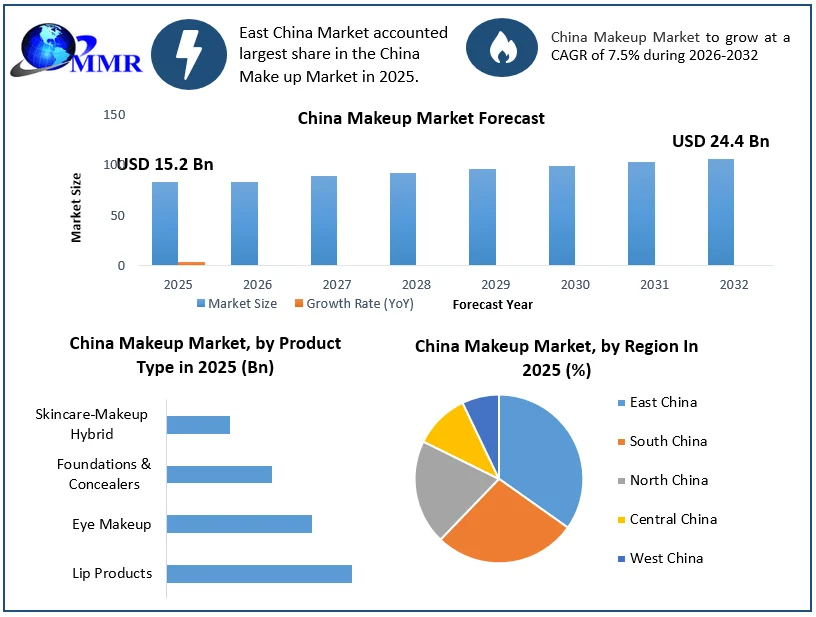
The China makeup market was valued at USD 15.2 Billion in 2025 and is projected to reach USD 24.4 Billion by 2032, growing at a CAGR of 7.5% during the forecast period (2026–2032). Growth is driven by premium beauty consumption, rapid digital commerce penetration, increasing Gen Z purchasing power, rising demand for domestic brands, and expanding personalized beauty solutions.
China Makeup Market Definition
The China Makeup Market refers to the market for decorative cosmetic products used to enhance facial appearance and create different beauty looks. It includes face makeup, eye makeup, lip makeup, and nail products, such as foundation, concealer, powder, blush, eyeliner, eyeshadow, mascara, lipstick, lip gloss, and nail polish.
Market growth is supported by rising beauty awareness, changing consumer preferences, product innovation, and increasing demand for premium and personalized makeup products. Online retail, social commerce, and digital beauty trends are also expanding access to makeup products across China.
| Parameter | Value |
| Market Size (2025) | USD 15.2 Billion |
| Forecast Market Size (2032) | USD 24.4 Billion |
| CAGR (2026–2032) | 7.5% |
| Base Year | 2025 |
| Forecast Period | 2026–2032 |
| Historical Period | 2020–2025 |
| Key Growth Opportunity | Digital Beauty Commerce & Personalized Cosmetics |
China Makeup Market Overview
China has emerged as one of the leading makeup markets in the Asia-Pacific region, supported by expanding beauty expenditure, increasing consumer sophistication, rapid e-commerce penetration, and strong digital engagement. The market includes face makeup, lip makeup, eye makeup, nail makeup, and other color cosmetics, distributed through e-commerce platforms, specialty beauty stores, department stores, supermarkets, and brand-owned channels. Consumer demand is increasingly influenced by social media, livestream commerce, beauty influencers, premiumization, skincare-makeup convergence, and interest in clean and multifunctional formulations. The competitive landscape includes leading domestic and international companies, with Proya Cosmetics representing a prominent Chinese beauty player that has strengthened its market presence through product innovation and digital consumer engagement. The combination of domestic brand development, expanding online retail, premium beauty consumption, and evolving consumer preferences continues to create new growth opportunities within China's makeup market.
China Makeup Market Size, Growth and Share Analysis
To know about the Research Methodology :- Request Free Sample Report
The China Makeup Market Report provides detailed insights into market size, growth patterns, forecasts, competitive developments, and major market drivers. The analysis covers product type, category, ingredient type, and distribution channel, along with consumer behavior, pricing strategies, brand positioning, and regional demand. The report also examines opportunities arising from premium and mass-market cosmetics, domestic beauty brands, sustainable and clean beauty, digital commerce, livestream retail, and technology-driven beauty experiences. Furthermore, it evaluates competitive intensity, regulatory developments, supply-chain trends, market challenges, and strategic initiatives, helping manufacturers, investors, retailers, distributors, and new entrants identify attractive opportunities and formulate effective market expansion strategies
China Makeup Historical Market Size (2020–2025)
| Year | Market Size | Growth Rate (YoY) |
| 2020 | USD 10.29 Bn | 7.5% |
| 2021 | USD 11.12 Bn | 7.5% |
| 2022 | USD 12.03 Bn | 7.5% |
| 2023 | USD 13 Bn | 7.5% |
| 2024 | USD 14.06 Bn | 7.5% |
| 2025 | USD 15.2 Bn | 7.5% |
China Makeup Market Size Forecast (2026–2032)
| Year | Market Size | Growth Rate (YoY) |
| 2026 | USD 16.34 Bn | 7.5% |
| 2027 | USD 17.56 Bn | 7.5% |
| 2028 | USD 18.88 Bn | 7.5% |
| 2029 | USD 20.29 Bn | 7.5% |
| 2030 | USD 21.82 Bn | 7.5% |
| 2031 | USD 23.45 Bn | 7.5% |
| 2032 | USD 24.4 Bn | 7.5% |
China Makeup Market Key Highlights
| Market Parameter | Value / Insight | Trend |
| China Makeup Market Size (2025) | USD 15.2 Billion | ↑ Strong Growth |
| Projected Market Size (2032) | USD 24.4 Billion | ↑ Accelerating Expansion |
| Forecast CAGR (2026–2032) | 7.5% | ↑ Sustained Growth |
| Dominant Product Segment | Face Makeup | ↑ 37.2% Share |
| Fastest-Growing Segment | Premium Clean Beauty | ↑ Rapid Adoption |
| Leading Distribution Channel | E-commerce | ↑ 58.6% Share |
China Makeup Market Consumer Insights & Demand Analysis
Consumer behavior in the China makeup market reflects the convergence of health awareness, digital lifestyle evolution, and growing beauty consciousness among younger demographics. Consumers are increasingly seeking premium products with proven efficacy, clean-label credentials, and multifunctional benefits that address multiple beauty priorities simultaneously.
| Consumer Dimension | Key Insights | Market Implication |
| Premiumization | Increasing preference for luxury and premium cosmetics among Gen Z and Millennials | Supports premium product positioning and higher ASPs |
| Digital Behavior | Livestream commerce and social media dominate product discovery and purchase | Influencer marketing and KOL strategy critical |
| Sustainability | Rising interest in clean beauty, vegan, and cruelty-free cosmetics | ESG investments and clean-label variants gaining share |
| Gen Z Influence | Gen Z represents the fastest-growing consumer demographic with strong spending power | Fast trend cycles and demand for personalized formats |
| Male Grooming | Growing acceptance and adoption of cosmetics among male consumers | New revenue streams and product category expansion |
China Makeup Market Dynamics
China Makeup Market Drivers
• Expansion of China's livestream commerce ecosystem through Douyin, Taobao Live, Xiaohong Shu, and Kuaishou accelerating beauty product discovery and purchasing
• Rising premiumization among Gen Z and Millennial consumers driving demand for luxury domestic and international cosmetic brands
• Growth of domestic beauty brands including Florasis, Perfect Diary, and Proya challenging multinational firms through localization and digital marketing
• Rapid adoption of AI beauty technology including virtual try-on tools, AI shade matching, and personalized product recommendations
• Expansion of beauty market into Tier-2 and Tier-3 cities as disposable income rises across lower-tier urban demographics
China Makeup Market Restraints
• Highly fragmented market with intense price competition reducing margins across mass-market cosmetics segments
• Counterfeit cosmetics prevalent in lower-tier distribution channels reducing consumer trust in product authenticity
• Complex NMPA regulatory requirements increasing compliance costs for both domestic and international brands
• Economic uncertainty and consumer confidence fluctuations affecting discretionary beauty spending patterns
China Makeup Market Opportunities
• Clean beauty expansion driven by growing demand for vegan, cruelty-free, and sustainably packaged cosmetics across premium demographics
• Male grooming segment remains significantly underpenetrated relative to its long-term growth potential
• Tier-3 and Tier-4 city expansion creating substantial addressable market as disposable income and digital commerce access increase
• AI-powered personalization enabling next-generation beauty discovery and recommendation experiences with strong conversion uplift
China Makeup Market Challenges
• Rapid product obsolescence driven by fast beauty trend cycles requiring continuous product development investment
• Consumer loyalty instability as digital platforms make brand switching increasingly frictionless
• Intense competition between domestic players and global multinationals compressing pricing and margin structures
• Short trend cycles increasing inventory management complexity and markdown risk across retail channels
China Makeup Market Segment Analysis
China Makeup Market, by Product Type
The China makeup market is segmented by face makeup, lip products, eye makeup, foundations and concealers, skincare-makeup hybrids, and other products. Face makeup holds the dominant position with a 37.2% market share, supported by strong demand for foundation and base products. Lip products account for 21.4%, benefiting from premium and luxury product demand, while eye makeup represents 18.8%, supported by stable consumer demand and ongoing premiumization. Foundations and concealers hold 13.1%, driven by increasing demand for personalized complexion products. Skincare-makeup hybrids account for 6.4% and represent the fastest-growing segment, supported by clean beauty and multifunctional product trends. Other makeup products hold the remaining 3.1%, representing niche, specialty, and emerging formats.
China Makeup Market, by Consumer Group
Consumer preferences across different demographic groups are shaping the growth of the China makeup market, which is segmented into women, men, and gender-neutral cosmetics. Women remain the dominant consumer group, accounting for 84.7% of the market, supported by widespread makeup adoption and demand for diverse beauty products. The men's segment holds 10.1% and is expanding rapidly as acceptance of male grooming, skincare, and makeup continues to increase. Gender-neutral cosmetics account for 5.2%, representing an emerging segment driven by inclusive beauty trends, changing consumer attitudes, and growing demand for versatile products suitable for a wider range of consumers.

China Makeup Market, by Distribution Channel
The China makeup market is segmented into e-commerce, offline retail, and livestream commerce channels. E-commerce is the dominant distribution channel, accounting for 58.6% of the market, supported by platforms such as Tmall, JD.com, and brand-owned DTC platforms that offer extensive product choices and convenient purchasing. Offline retail holds a 30.8% share, with beauty stores, department stores, and supermarkets remaining important for product discovery and physical testing. Livestream commerce accounts for 10.6% and is the fastest-growing channel, driven by platforms such as Douyin, Taobao Live, and Kuaishou, where influencer recommendations, demonstrations, and promotional offers encourage consumer purchases.
China Makeup Market Regional Analysis
Makeup demand within China is not uniformly distributed, with significant variation by region driven by differences in population density, income levels, digital penetration, beauty culture maturity, and retail infrastructure development.
| Region | Market Share | Key Demand Drivers & Trends |
| East China (Shanghai/Hangzhou/Nanjing) | 34.8% | Largest market, premium beauty consumer base, luxury demand |
| South China (Guangzhou/Shenzhen) | 27.4% | Strong luxury beauty, high digital penetration, high income |
| North China (Beijing/Tianjin) | 20.1% | Mature market, professional demographic, premium brands |
| Central China | 10.6% | Emerging – Growing middle class and beauty awareness |
| West China | 7.1% | Growth potential – Lower penetration, rising disposable income |
China Makeup Market Competitive Landscape
The China makeup market is characterized by a dynamic mix of global multinational corporations and rapidly expanding domestic beauty brands. Competition is driven by brand equity, digital marketing capability, distribution reach, product innovation, and pricing strategy.
Key Players & Benchmarking
| Company | Headquarters | Segment | Market Position | Revenue (Est.) |
| L'Oréal China | Shanghai | Full Range | Market Leader | Part of L'Oréal Group |
| Florasis (Huaxizi) | Hangzhou | Premium Domestic | Fast Growing | Private |
| Perfect Diary | Guangzhou | Mass Premium | Growing Player | Listed |
| Proya Cosmetics | Hangzhou | Skin + Makeup | Major Domestic | Public |
| Estée Lauder China | Shanghai | Luxury | Premium Leader | Part of EL Group |
| Shiseido China | Shanghai | Premium | Major Player | Part of Shiseido |
| Judy doll | Shanghai | Mass Premium | Growing Player | Private |
| Maybelline (L'Oréal) | Shanghai | Mass Market | Major Brand | Part of L'Oréal Group |
China Makeup Market Technology & Innovation Trends
China's beauty industry demonstrates extremely high innovation intensity, supported by significant investment from domestic technology giants, beauty start-ups, and multinational R&D centers in AI-powered personalization, augmented reality tools, and advanced cosmetic formulation. Platforms such as Alibaba, ByteDance, and Tencent continue to integrate beauty technology across their ecosystems
| Innovation Area | Current Trend | Market Impact |
| AI Beauty Personalization | AI-driven shade matching, skin analysis, and personalized product recommendation | Higher conversion rates, stronger customer retention |
| AR Virtual Try-On | Augmented reality tools enabling virtual cosmetic testing on e-commerce platforms | Reduced return rates, improved consumer confidence |
| Skin Diagnostics Technology | AI-powered skin analysis integrated into beauty apps and retail experiences | Premiumization and personalized upselling |
| Livestream Commerce Innovation | Integrated KOL-driven beauty livestreaming with embedded purchasing | Accelerated product discovery and sales conversion |
| Smart Packaging | Digital interaction, NFC-enabled product authentication and consumer engagement | Consumer retention and anti-counterfeiting |
China Makeup Market Regulatory Framework
China's cosmetics industry is regulated primarily by the National Medical Products Administration (NMPA), formerly the China Food and Drug Administration (CFDA). The NMPA administers product registration, ingredient compliance, safety testing standards, and labelling requirements under the Cosmetics Supervision and Administration Regulation (CSAR) enacted in 2021.
China has progressively reduced mandatory animal testing requirements for imported ordinary cosmetics (non-special use) sold through cross-border e-commerce channels, enabling premium international brands greater market access. Special-use cosmetics, including hair dyes, sunscreens, and anti-hair loss products, continue to require full NMPA registration prior to market entry.
China Makeup Market Strategic Insights
Why does this market deserve investor attention?
China's makeup market sits at the intersection of several powerful secular trends — rising disposable income, increasing beauty consciousness, digital commerce dominance, and the emergence of globally competitive domestic brands. The market combines the scale of the world's largest consumer population with the sophistication of one of the most digitally advanced beauty ecosystems globally.
What are the key growth drivers and momentum?
Growth is driven by expanding premium and luxury cosmetics segments, rapid livestream and e-commerce commerce penetration, rising Gen Z purchasing power, and accelerating domestic brand innovation. The post-pandemic beauty rebound and increasing social media influence continue to provide strong commercial momentum across key product categories.
What regional factors shape demand?
Within China, demand is highest in East and South China's major metropolitan centers with established beauty retail infrastructure and high-income demographics. Central and Western regions represent longer-term growth opportunities as disposable income, digital commerce access, and beauty awareness continue to improve.
How strong is innovation and competition?
Innovation intensity is exceptionally high, with both domestic and multinational brands investing heavily in AI personalization, AR try-on technology, and clean beauty formulation. Competition is intensifying as domestic brands such as Florasis and Proya demonstrate the capability to challenge global multinationals in premium segments.
Where are the biggest future opportunities?
The largest future opportunities lie in premium and luxury cosmetics (highest margin), male grooming (most underpenetrated), AI-powered beauty personalization, and lower-tier city market expansion. Clean beauty and sustainable cosmetics represent high-growth niches aligned with consumer trend evolution.
China Makeup Market Investor Takeaway
China's makeup market offers a compelling dual investment thesis: a large and growing domestic market expanding at a 3.75% CAGR through 2032, and a strategically important digital beauty ecosystem that is increasingly influencing global beauty trends and brand innovation strategies. China's world-class digital commerce infrastructure, premium country-of-origin domestic brands, and rapidly evolving consumer sophistication create a uniquely attractive investment environment. Investment in China's beauty sector whether through domestic brand exposure, digital commerce infrastructure, or AI beauty technology represents both domestic market capture and participation in the global beauty industry's most dynamic innovation center.
China Makeup Market Scope: Inquire before buying
| China Makeup Market | |
| Base Year | 2025 |
| Forecast Period | 2026–2032 |
| Historical Period | 2020–2025 |
| Market Size (Base Year) | USD 15.2 Billion |
| Forecast Market Size (2032) | USD 24.4 Billion |
| CAGR | 7.5% |
| Segment: By Product Type | Face Makeup │ Lip Products │ Eye Makeup │ Foundations & Concealers │ Skincare-Makeup Hybrid │ Others |
| Segment: By Consumer Group | Women │ Men │ Gender-neutral Cosmetics |
| Segment: By Distribution | E-commerce │ Offline Retail │ Livestream Commerce| Supermarket| Speciality Stores |
| Regional Analysis | East China │ South China │ North China │ Central China │ West China |
| Key Companies | L'Oréal China │ Florasis │ Perfect Diary │ Proya │ Estée Lauder China │ Shiseido China │ Others |
Frequently Asked Questions:
1. What is the size of China's makeup market?
The China makeup market was valued at USD 15.2 Billion in 2025 and is projected to reach USD 24.4 Billion by 2032, growing at a CAGR of 7.5%.
2. What drives growth in China's makeup market?
Growth is primarily driven by expanding livestream commerce, premiumization among younger consumers, the rise of domestic beauty brands, and increasing adoption of AI-powered beauty technology across digital platforms.
3. How does China's NMPA regulate the cosmetics market?
The National Medical Products Administration (NMPA) regulates cosmetics in China under the Cosmetics Supervision and Administration Regulation (CSAR). Products are categorized as ordinary or special-use cosmetics, with different registration requirements. China has progressively reduced animal testing requirements for imported ordinary cosmetics in cross-border e-commerce channels.
4. Which product type dominates China's makeup market?
Face makeup leads with a 37.2% market share, reflecting strong demand for foundations, BB creams, and base products. The Skincare-Makeup Hybrid segment is the fastest growing, driven by clean beauty and multifunctional product trends.
5. Who are the key companies in China's makeup market?
Major players include L'Oréal China, Florasis (Huaxizi), Perfect Diary, Proya Cosmetics, Estée Lauder China, and Shiseido China. Domestic brands continue gaining share against multinationals through localized marketing, social commerce, and culturally relevant product positioning.