
Cell Therapy Market – Industry Structure Evaluation, Demand Drivers Analysis, Regional Growth Analysis and Identification, Competitive Positioning Review & Global Market Size Forecast to 2032
Overview
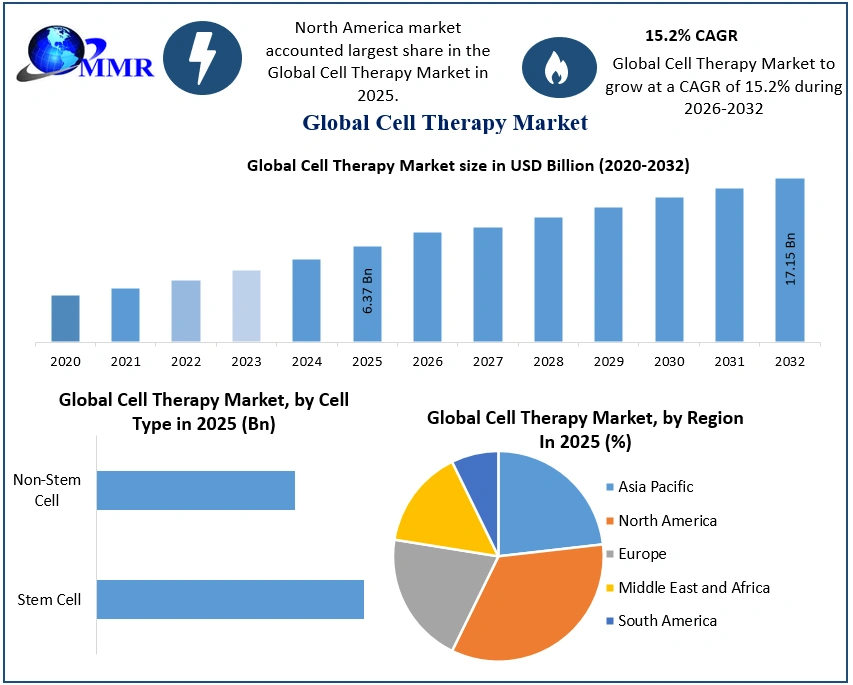
The Cell Therapy Market size was valued at USD 6.37 Billion in 2025 and the total Cell Therapy revenue is expected to grow at a CAGR of 15.2% from 2026 to 2032, reaching nearly USD 17.15 Billion by 2032.
Cell Therapy Market
The healthcare sector has shown significant interest in cell therapy, a therapeutic approach that involves introducing healthy cells into the body to replace dysfunctional ones and regulate specific functions. Continuous advancements in regenerative medicine, especially within the area of cell therapy, have unlocked novel possibilities for treating several medical conditions. The capacity to regenerate damaged tissues and organs through cell-based therapies has emerged as a driving force boosting research and investment, ultimately contributing to the strong growth of the Cell Therapy Market. Cell therapies have risen as an innovative solution for severe diseases such as cancer and rare genetic disorders. LUXTURNA, a significant example, stands as a treatment for an inherited retinal disease leading to blindness. This represents the transformative impact of cell therapies, solidifying their position as a groundbreaking solution in the evolving landscape of healthcare and the Cell Therapy Market
Many other Cell therapies are now in development. According to MMR Study report more than 750 trials of CGTs in almost 30,000 patients were underway as of June 2020, and Cell and Gene Therapy products account for some 12 percent of the pharmaceutical industry’s clinical pipeline and at least 16 percent of its preclinical pipeline. All that activity reflects the hope that CGTs increase the still-limited treatment options available to many patients and transform the clinical paradigm. But the COVID-19 crisis has severely disrupted the sector.
To know about the Research Methodology :- Request Free Sample Report
Cell Therapy Market Dynamics:
Driver
Increased Prevalence Of Chronic Diseases Drives Market Growth
The growth of the cell therapy market is being driven by the increasing prevalence of chronic diseases. As the population ages and lifestyles change, there has been a significant rise in the incidence of chronic conditions such as cancer, cardiovascular diseases, and autoimmune disorders. The conventional treatments for these ailments often have limitations, which has led to a shift toward innovative therapeutic approaches such as cell therapy. Cell therapies have the potential to address the root causes of diseases at a cellular level, offering promising avenues for effective and personalized treatment. The rising burden of chronic diseases across the globe highlights the urgent need for advanced medical solutions, making cell therapy a leading option in the evolving healthcare landscape. The market's response to this demand demonstrates a commitment to transformative solutions and the continuous pursuit of breakthroughs in medical science.
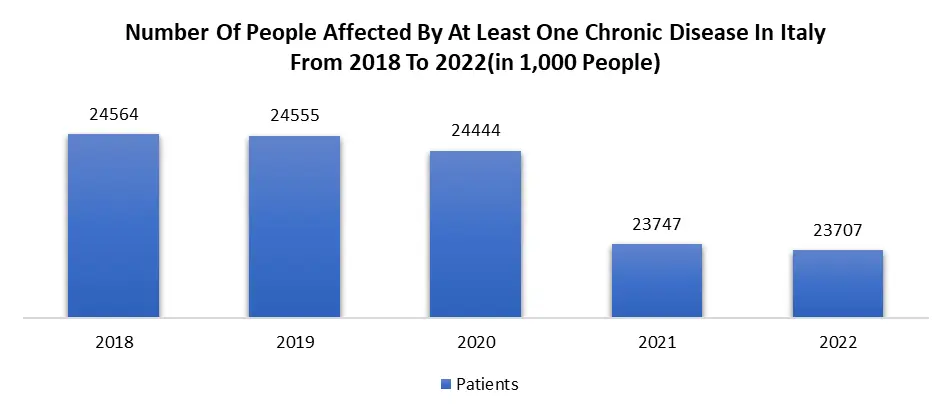
For Instance, according to the MMR Study Report in Italy, 23.7 million individuals suffered from at least one chronic disease. A considerable number of people were even affected by two or more chronic conditions. Among them, hypertension, arthritis, and allergies were the most widespread.
Restrain
High Treatment Costs and Affordability Concerns limit the Cell Therapy Market
The high costs associated with cell therapy treatments, encompassing research, development, and manufacturing expenses, pose a considerable challenge to affordability for patients and healthcare systems alike. This financial obstacle is particularly pronounced due to the intricate and personalized nature of cell therapies, contributing to elevated production costs. Consequently, a broader patient population finds it difficult to access these advanced treatments, hindering the widespread adoption of cell therapies.
This affordability challenge is especially impactful in regions with limited resources where reimbursement policies are insufficient. To ensure the equitable distribution and adoption of cell therapies in healthcare systems globally, it is imperative to address these cost-related challenges. Efforts aimed at optimizing production processes and establishing sustainable pricing models are crucial in overcoming this hindrance and fostering the growth of the Cell Therapy Market. Recognizing the importance of cost considerations contributes to making cell therapies more accessible and inclusive in diverse healthcare settings.
Opportunity
Increasing therapeutic applications and the development of innovative treatments create lucrative growth opportunities for the market growth
There is a growing and dynamic opportunity to explore new indications beyond the current focus areas of the cell therapy market, particularly in oncology. Cell therapies demonstrate the potential to address a diverse range of medical conditions, including neurological disorders, genetic diseases, and degenerative conditions. The emergence of gene-editing technologies, notably CRISPR-Cas9, brings an exciting prospect to enhance the precision and effectiveness of cell therapies. This breakthrough opens avenues for the development of next-generation, genetically modified cell therapies specifically targeting disease mechanisms.
Collaborations between academic institutions, biotechnology companies, and pharmaceutical firms present another promising opportunity for advancing cell therapy research and development. By pooling expertise and resources, these collaborations accelerate the translation of scientific discoveries into clinically viable cell-based treatments, contributing to the overall growth of the cell therapy market. The establishment of regulatory frameworks that facilitate a streamlined approval process for cell therapies represents a crucial opportunity. Clear regulatory pathways expedite market entry, fostering innovation and encouraging investment in the development of novel cell therapies. These regulatory advancements play a pivotal role in shaping the future landscape of the cell therapy market by creating an environment conducive to the efficient approval and commercialization of Innovative treatments.
Cell Therapy Market Segment Analysis:
Based on Therapy Type, the autologous treatment segment dominated the cell therapy market in the year 2025. The segment is expected to maintain its dominance over the forecast period. This can be due to several benefits associated with autologous transplantation, such as B. Easy to obtain, no need to identify HLA-matched donors, low risk of life-threatening complications, no risk of GvHD, and no need for immunosuppressive therapy. In addition, autologous therapies are more affordable compared to allogeneic therapies, which is further due to segment growth. Due to the high cost and relatively low recurrence rate associated with allogeneic transplantation, the growth of cell banking and the relocation of companies to the development of allogeneic therapeutic products are driving the Cell Therapy Market.

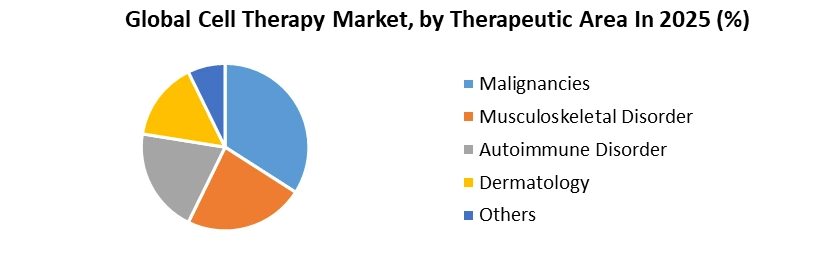
Based on the Therapeutic Area, Autoimmune Disorders dominate the Global Cell Therapy Market in the year 2025. Currently, cell therapy is a potential treatment for cancer, autoimmune disorders disease, and other infectious diseases with more than 40% of the application in given treatments. Hematopoietic stem cell transplant is the most frequent cell therapy opted in many Asians as well as in North America. Potential applications of cell therapies include treating cancers, autoimmune diseases, urinary problems, and infectious diseases, rebuilding damaged cartilage in joints, repairing spinal cord injuries, improving a weakened immune system, and helping patients with neurological disorders. This application in such treatment boosted the growth in the Global Cell Therapy Market.
Regional Analysis: Cell Therapy Market
North America dominated the cell therapy market in the year 2025. This commanding presence is primarily attributed to collaborative research endeavors involving research institutes and pharmaceutical giants in the region. The collaborative landscape saw significant advancements, exemplified by the partnership between Immatics and Bristol Myers Squibb in June 2022. The collaboration aimed to develop Gamma Delta Allogeneic Cell Therapy Programs, with Bristol Myers Squibb holding two initial programs and both entities having the option to develop up to four additional programs each.
Asia Pacific is expected to witness the fastest growth in the Cell therapy market. The region's accelerated growth is boosted by rising demand for cell therapy, bolstered by factors such as heightened awareness of novel therapies, increased investments, and anticipated favorable government policies. A case in point is Tessa Therapeutics Ltd., which, in June 2022, secured USD 126 million in series funding to expedite the development of next-generation cancer therapy. This dynamic regional landscape underscores the global trajectory of cell therapy, with North America leading in 2022 and Asia Pacific poised for significant growth in the forecast period.
According to MMR Study Report, The FDA anticipates that each year they receive more than 200 investigational new drug applications for CGTs and expects to approve 10 to 20 new cell and gene therapies per year. In 2024 alone, up to 21 cell therapy launches and as many as 31 gene therapy launches are expected. Because of this expected increase in workload, the FDA has elevated and reorganized its Office of Tissues and Advanced Therapies (OTAT) to a ‘Super Office’ within the Center of Biologics Research and Evaluation (CBER) to meet its growing cell and gene therapy workload. Proposed structural changes improve functional alignment, increase review capabilities, and enhance expertise on new cell and gene therapies
Cell and Gene Therapy Landscape
| North America | Europe | Asia Pacific | Other Region | |
| Developers | 686 | 244 | 492 | 35 |
| Clinical Trials | 964 | 403 | 848 | 139 |
| Investment | $10.8 B | $3.2 B | $2.2 B | $3.6 B |
Cell Therapy Market: Competitive Landscape
Cell Therapy Market, key players are strategically positioning themselves for growth and innovation. Leading companies are actively growing their customer base by targeting surgeons for transplantation procedures. Significantly initiatives include 2seventy Bio and Regeneron's collaborative efforts to develop new cell therapy-based combinations for solid tumors, announced in January 2023. Adaptimmune Therapeutics plc's collaboration with Genentech in September 2021 focuses on the development and marketing of allogeneic therapies for multiple oncology indications.
These market players are focusing on collaborations and employing various strategies such as new product launches, partnerships, mergers, and acquisitions to reinforce their market presence. As the cell therapy landscape continues to advance, these initiatives reflect a commitment to innovation and a proactive approach to addressing the diverse needs of the healthcare industry. Noteworthy companies in this competitive space include 2seventy Bio, Regeneron, and Adaptimmune Therapeutics plc.
Cell Therapy Market Scope: Inquire before buying
| Global Cell Therapy Market | |||
|---|---|---|---|
| Report Coverage | Details | ||
| Base Year: | 2025 | Forecast Period: | 2026-2032 |
| Historical Data: | 2020 to 2025 | Market Size in 2025: | USD 6.37 Bn. |
| Forecast Period 2026 to 2032 CAGR: | 15.2% | Market Size in 2032: | USD 17.15 Bn. |
| Segments Covered: | by Cell Type | Stem Cell Non-Stem Cell |
|
| by Therapy Type | Autologous Allogeneic |
||
| by Therapeutic Area | Malignancies Musculoskeletal Disorder Autoimmune Disorder Dermatology Others |
||
Cell Therapy Market, by Region
North America (United States, Canada, and Mexico)
Europe (UK, France, Germany, Italy, Spain, Sweden, Austria, and the Rest of Europe)
Asia Pacific (China, South Korea, Japan, India, Australia, Indonesia, Malaysia, Vietnam, Taiwan, Bangladesh, Pakistan, and the Rest of APAC)
Middle East and Africa (South Africa, GCC, Egypt, Nigeria, and the Rest of ME&A)
South America (Brazil, Argentina Rest of South America)
Cell Therapy Market, Key Players
North America
1. Gilead Sciences, Inc. (United States)
2. Kite Pharma (a Gilead Company) (United States)
3. Johnson & Johnson (United States)
4. Bluebird bio (United States)
5. Celgene Corporation (a Bristol Myers Squibb Company) (United States)
6. Regeneron Pharmaceuticals, Inc. (United States)
7. Fate Therapeutics (United States)
8. Vericel Corporation (United States)
9. Rubius Therapeutics (United States)
10. Magenta Therapeutics (United States)
11. Precision BioSciences (United States)
12. Allogene Therapeutics (United States)
Europe
1.Novartis AG (Switzerland)
2.Adaptimmune Therapeutics plc (United Kingdom)
3.Celyad –(Belgium)
4.Orchard Therapeutics (United Kingdom)
Asia Pacific
1.Gamida Cell Ltd. (Israel)
2.Celltrion Healthcare (South Korea)
3.Cynata Therapeutics (Australia)
Frequently Asked Questions:
1] What segments are covered in the Global Cell Therapy Market report?
Ans. The segments covered in the Cell Therapy Market report are based on Cell Type, Therapy Type, Therapeutic Area, and Regions.
2] Which region is expected to hold the highest share in the Global Cell Therapy Market?
Ans. The North America region is expected to hold the largest share of the Cell Therapy Market.
3] What is the market size of the Global Cell Therapy Market by 2032?
Ans. The market size of the Cell Therapy Market by 2032 is expected to reach USD 17.15 Bn.
4] What is the forecast period for the Global Cell Therapy Market?
Ans. The forecast period for the Cell Therapy Market is 2026-2032.
5] What was the market size of the Global Cell Therapy Market in 2025?
Ans. The market size of the Cell Therapy Market in 2025 was valued at USD 6.37 Bn.